Since the start of writing myLife in the English Cotswolds blog, now over fifteen years ago, overseas readers have repeatedly commented on our network of public footpaths. Mostly it is one of surprise that we can seemingly wander at will over privately owned land and clear any obstruction that may be blocking our way. In this post I hope to clarify what this civil right, now enshrined in law, is all about.
A footpath crossing privately-owned land in the Cotswolds
Many of our footpaths are ancient in origin dating back 5000 years or more. Of course, in those days, these paths were the main highways across a wild and untamed land. Even in the relatively recent past much of the road system was a dusty, uncomfortable route to take in summer and not any better later in the year when winter rain turned them into a muddy quagmire. Over many centuries the network of paths was created, usually by local people on foot or horseback taking the most direct and dry route to work or market. This is one of the reasons why paths often pass through farmsteads and gardens.
This public footpath passes close to Lower Dornford Farmhouse
Today, the public footpaths of England and Wales (Scotland has a different system) are much loved and well-used, mostly for recreational purposes. There are several organisations and charities (see list below) that help to protect the paths and walker’s rights to use them for there are several threats, such as land development for roads and houses, as well as the occasional, unscrupulous landowner. Landowners seem to fall into two categories: those that maintain the paths to allow ease of access and those that allow the paths to fall into disrepair for it is the landowner that is responsible for the path’s maintenance. A well-maintained path is clearly defined across the landscape, its gates and stiles giving ease of access whilst remaining stockproof. By statute, where a path crosses a road, the local council must signpost it.
This farmer has mown a strip through his crop to define the footpathWhere a path meets a road it must be clearly marked
After many years of campaigning, England created its first long-distance path, the Pennine Way, in 1965. It is 268 miles in length and runs down the spine of northern England passing through spectacular countryside. Today, there are many of these long-distance paths as well as shorter, circular paths. However, with a good Ordnance Survey map (paper or app) it is possible to create your own route whether it be for an hour’s stroll or for much longer. In 2010 the Slow Ways network linking various paths and lanes, villages and towns, across the whole country was created, one of the few benefits to have arisen from the Covid-19 lockdown when walking alone was one of the few permitted activities. The routes listed are all tried and tested by local people who walk them regularly.
The rugged landscape at Jacob’s Ladder, part of the Pennine Way long-distance pathOrdnance Survey map shows the public rights of way (the solid red line is a main road, the solid yellow line, a country lane [Copyright Ordnance Survey]
In the Ordnance Survey map illustrated above the footpaths are clearly defined using red dashes. The short dashes show footpaths (walkers only) whereas bridlepaths (walkers, horses and bicycles) have long dashes. The broken short-long dashes mark those tracks that can be used by horse-drawn vehicles (“restricted byway”). Some paths have signs along their routes showing not just the route but also the path’s category.
As mentioned, paths frequently cross farmland or other enclosed land. A way through a fenced or walled area must be maintained at all times. Below are illustrations of some of the different types of barriers you may come across although none must prevent you from continuing along your route. If it’s a route for horses the rider must be able to open the gate without dismounting.
Wooden gate to pass through easily or wooden stile to scramble overNot all stone wall are so tricky to get over!
Visitors to England often spend far too much time in the major cities or tourist hot-spots (the Cotswolds have lots of those!) returning home not realising that they have missed the opportunity to see parts of the country that never feature in the travel magazines – the homes and villages, the woodlands and old drover’s tracks that can be found all over the country. You may choose to walk alone but when you do meet someone, they are often local and happy to exchange greetings and share a few minutes in dialogue.
Bibury – one of the most visited villages in the Cotswolds. To see it like this you need to arrive soon after dawn!Get away from the crowds by exploring the peace and quiet of the English countryside
Not everyone, of course, feels comfortable walking by themselves, especially in an area unknown to them. Fortunately, there are a lot of local groups or larger organisations such as the Ramblers Association that will welcome you on a regular or one-off basis. Occasionally you may even find an individual who’ll be happy to share with a visitor a favourite walk or place – I’ve done it myself and made some good friends along the way. That is one of the best things about walking, the walks can be short or long, easy or arduous, solitary or in company but it is the interesting conversations you have, the beautiful scenery you pass through, and the wildlife you encounter that make such a memorable experience. Why not give it a try?
Walk quietly and you’ll be surprised who accompanies you!
Useful Links click on the organisations below to visit their webpage
‘We’re off to the heath!” Such excitement whenever my father made this announcement. It happened perhaps just three or four times a year and when it did it was always a special day. Almost seventy years of summer sun – for we only ever went there when the sun was shining – have passed and the memory of those innocent days still bring joy. Much later the heath became my place of refuge when sadness threatened to overwhelm me; under the great tree that had witnessed my journey into adulthood, its shade restored and healed me.
Many summers have passed since I last sought the shade of the great tree
Going to the heath involved ritual. The ritual included packing the picnic that my mother had been busy making; the ‘paste’ and cheese sandwiches, rock cakes that required the currants to be removed before being eaten (“no, mummy, they look like eyes”) and the steel Thermos flasks of scalding hot water for tea. No tea bags in those days so teapot, loose tea and strainer were all added to the basket along with the rug for sitting on. The rug fascinated me for it was of coarse wool and a faded khaki in colour but, most of all, it had my father’s name written on it in capitals: SHORTLAND H A 174445, the numbers being those from his army days. The blanket, he would tell us, had seen the Holy Land, Tripoli, the Pyramids of Egypt and the ancient ruins of Rome. Being spared the horrors he’d witnessed during World War 2, it seemed to us as if the rug had magical qualities, perhaps it was the carpet that would one day take us to these far-off places as well. Of equal importance to the outing was the cricket bat, ball and stumps, all to be placed in the boot of the cream Consul car – but only after I’d been lifted out of it for my jumping into the boot was all part of the ritual too.
Being packed into the car boot was all part of the ritual in 1955!These days, picnics are taken in a lot more comfort…
Driving along the narrow country lanes my sister and I, noses pressed hard against the car window, would comment on every house made of flint, or with a thatched roof, that we passed for we knew the journey so well. “Oooh, I so wished we lived there…” After a few miles the car would begin to slow and we eagerly awaited the moment it would stop and we could all clamber out. Hoisting me onto his shoulders so that I could see over the high hedge, we would look down onto the ‘model farm’. How I loved it for it looked so much like my toy farm at home with its cows, sheep and horses enclosed by beautifully painted white wooden rails. Of course, it wasn’t really the miniature farm that my father claimed it to be but set in a deep and steep-sided valley gave it the illusion of being on a much-reduced scale. One day, I’m not sure how or why, we visited the old farmhouse with its ancient, beamed ceilings. In one room the main beam was much split with age into which coins had been hammered. It only added to my sense of awe as the farmer showed me the oldest coins, some of which dated back three hundred years or more. He also showed me the one he’d placed with the ‘new’ queen’s head on it, the first he’d seen, for Elizabeth the Second had only come to the throne in the year of my birth.
Everything about the farm seemed to be in miniature….
Our next stop would be for a stroll around the village of Fingest. The church fascinated me for it had beautiful, honey-colour rendered walls quite unlike the other churches in the area. Its other unique feature was its bifurcated tower which to childish eyes looked as if it was splitting in half. Best of all, inside the church, was a ladder, so tall that I was sure it must be Jacob’s ladder that I’d learnt about in Sunday School. I never saw any angels climbing it but I was convinced that if I was allowed to do so I would reach Heaven. In adulthood, I would live in the village for a short while although by then, it was the excellent inn where they served great ale and delicious suppers that I eagerly sought after a long day at work.
The church at FingestJacob’s Ladder – was heaven just beyond the top rung?
Fingest’s neighbouring village of Turville would only be visited on our way back from the heath, my parents stopping off at The Bull & Butcher. In those days, children were not allowed in pubs and so we were left outside to explore its two streets and to clamber up the steep hill to the windmill. How carefree those far-off days now seem when small children could be left to freely wander without fear. The village now is famed for it being the village of the film ‘Goodnight, Mr Tom’, the windmill featured in Chitty Chitty Bang Bang and the church in the Vicar of Dibley. After I moved from Fingest, I had the pleasure of living within a couple of miles of the windmill (and so close to the heath) for eighteen years.
Time stands still in the ancient village of TurvilleThe windmill stands high above Turville village
The lanes beyond Fingest become narrower and more enclosed by hedgerow and woodland as you approach the heath, all of which adds to the excitement of finally arriving at its wide-open expanse. The car parked, out we would spill while mother busied herself with the picnic and my father set up the cricket. We only had one wicket and so the match didn’t consist of ‘runs’ – our reward was in actually managing to hit the ball at all and the praise we would receive for our skill. Perhaps this is why the heath holds such affectionate memories for, back in the fifties, fathers didn’t interact hugely with their children – mine was too busy working or tending the garden to make trips out a regular occurrence and my mother, like most women, was unable to drive. Finally, we would hear mother calling us for tea and after devouring everything in sight we would lie back on the short turf replete and happy. On one occasion my mother had packed roasted chicken legs, a rare treat for chicken was, in those days, a luxury meat. Before we had the chance to try them, our little mongrel dog Tammy had snatched them away and into the bracken to eat out-of-sight. Chicken never again appeared on picnics.
My father in 1963 – a tie was required even for casual dress in those days…
Soon we would be up and eager to explore. The heath was beautifully unkempt; the rabbits cropped short the wide grass rides allowing the bracken and scrub to grow elsewhere, untouched so it seemed by man. Along the western edge of the heath an ancient avenue of lime trees grew, their limbs now left to grow in a haphazard, twisted way. From time to time one of these great boughs would fall to the ground there to gently lie and rot and return to the soil. By summer, the bracken would have grown tall enough to obscure them from view. We knew where to find them and would crawl alongside beneath a green tunnel of fern fronds. Tiny, pale toadstools grew from moist fissures in the bark, beetle scurried away from our disturbance and here we learned about nature., much of which seemed magical to young eyes Later, as I learned patience, I would sit quietly to watch for wildlife: a wren chattering away as it searched for insects, the occasional slow-worm hunting for slugs and not as slow as its name suggests. Once I was rewarded by a family of stoats moving like a sinuous string of sausages as they followed one another each holding the tail of the one in front in its mouth. Such excitement!
Casual wear for ladies in 1963: my mother out for a picnic in the country
Magic played an important part in our young lives for everything we didn’t understand surely had to be caused by magic? We saw regular proof of this in our painting books for they had the word ‘magic’ written across the front cover. A blank page of paper would be transformed into a colourful picture by just brushing with water from the empty paste jars. The paste jars held the exact amount of water required for ‘art’ without too much risk of spills. In those days of necessity, although the word recycling hadn’t been invented, everything – paper, string, milk and other bottles – were all carefully saved or returned for re-use. Plastic wrapping and the throw-away society was still to come.
Evidence of magic could be easily found within these pages!
Further proof of the magical world around us came one day when exploring a new part of the heath. We’d always thought that one dark, wooded corner looked rather forbidding but like all small boys, I knew better. Venturing deep inside it, with every twig snapping under my feet making me jump, I came across a small, black pond besides which stood an old hollowed oak. I squeezed inside the trunk to look up expecting to see sky. Instead, there was darkness followed by much scrabbling and hissing as dust and twigs dropped onto my head. Running as fast as I could I found my sister to tell her all about it. Unbelieving, she and I returned and this time it was she who was hissed at. Scared witless, we ran back to our parents. Just an old barn owl we’d disturbed my father had said. But we knew better, we’d found the door to the magic kingdom of elves and goblins. How lucky were we that the door hadn’t snapped shut with us inside, never to return, as described in the numerous books that we had read. Utter nonsense we were told. That, we realised, was the trouble with grown-ups: they didn’t believe and that was why the magic was hidden from them. *
I have to admit that it probably was a Barn owl that scared us
From time to time, I still return to the heath although I now live many miles from there. Whenever I do, I am struck at how small this ‘giant’ area to children’s eyes actually is. The difficult stage of my life, where the old tree supported me through despair, have long passed and the memory of it does not overshadow the pleasure that revisiting brings. Despite being a grown-up, I can still feel its magic. I’m not alone in this for recently I read Hugh Thomson’s book, The Green Road Into The Trees, in which he crosses southern England on foot. He too, feels the need to return to this very same heath in search of healing and finds it. He believes that the mysteries of the Ancient World are not as far away from us as we tend to think for our mixed Celtic, Saxon and Viking heritage shapes not just the British landscape but also our souls. Perhaps that’s where the magic comes from?
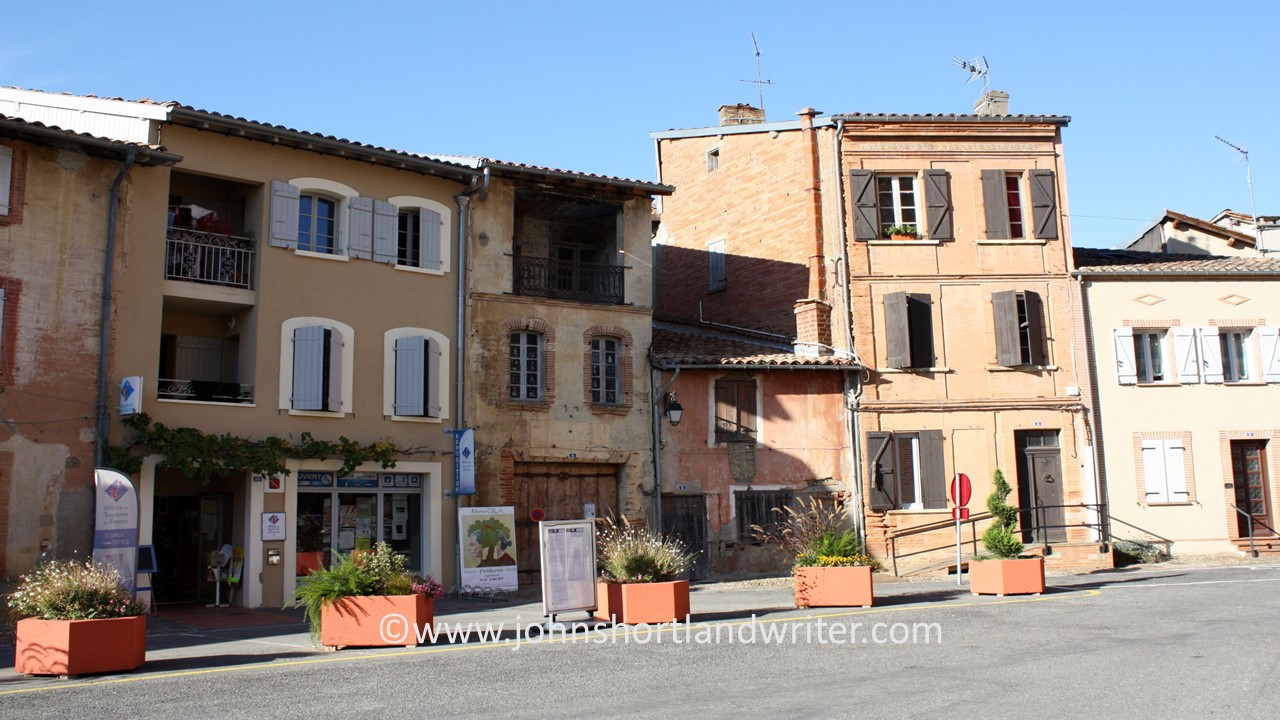
Everything about the compact town of Lombez oozes history and Gallic charm; its narrow streets are lined with ancient buildings. Discovering it as we did by chance confirms the principle of always taking the slow route – drive along motorways and you miss so much.
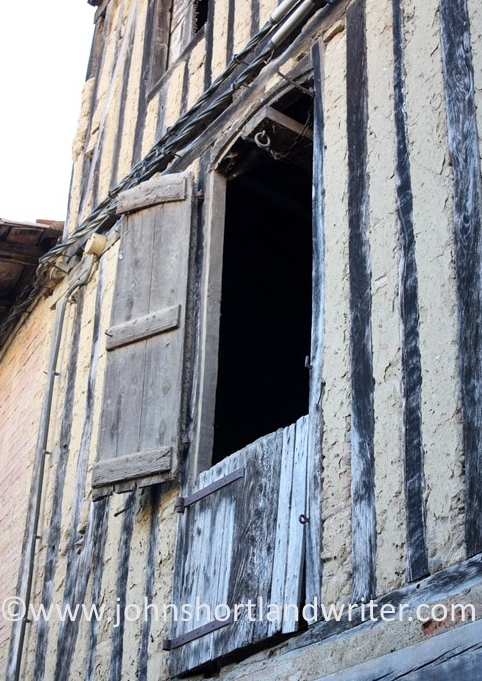
Walking through Lombez takes you back to a time when life too was slower; amongst its buildings are images that conjure up the France portrayed by the great artists – rich colours, faded paintwork, closed shutters keeping out hot sunshine.
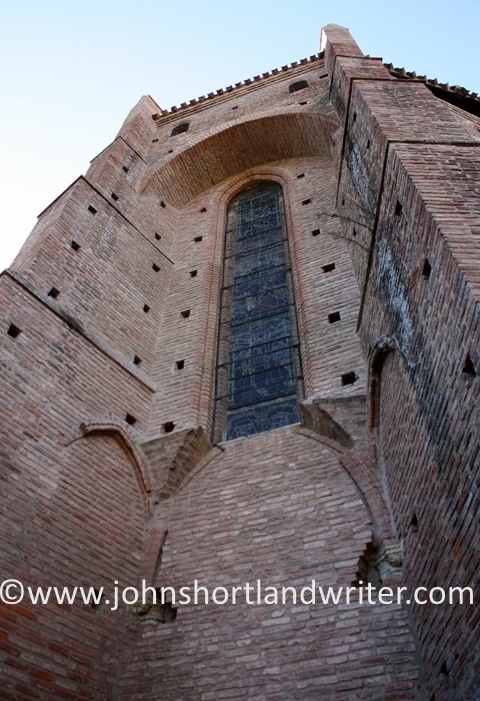
Dominating the town, the pink and white octagonal bell tower of the fourteenth century cathedral is in ornate contrast to the austere façade of the brick built body of the church. The severity of the style accentuates its height and gives no hint of its splendid interior.
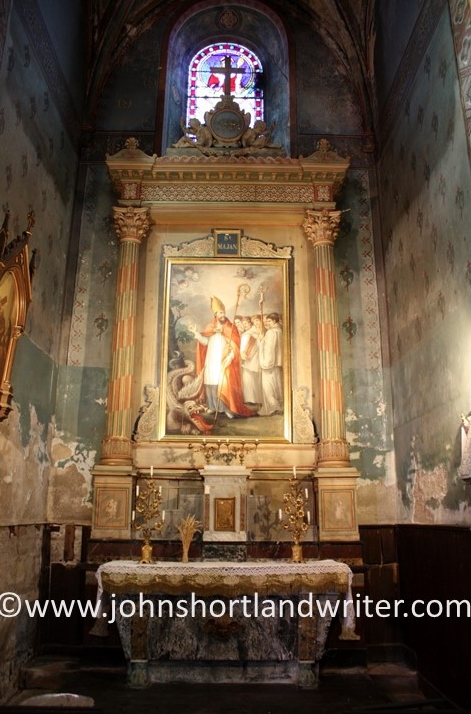
Fine stained glass, some dating back to the 1400s, marble altars, decorative carvings and statues all demand careful exploration and give good reason to linger inside away from the summer heat.
The cathedral is a listed monument historique and preservation work of the exterior was being carried out during our visit. With such an ancient building, work is on-going and there are areas of the interior that still have to be restored, although they do have a special charm and serenity about them that may be lost when renovated.
Stepping back outside, the sun appears to be even brighter than before and gives an excuse to find a bistro for a cold beer. Unlike the UK, where bars and coffee shops crowd the pavements to draw in the visitors, outside the cathedral there are few signs of life and very little traffic. This part of France remains true to its laid-back style and does not woo the tourist: when in Lombez behave like a native – stay calm, slow down, relax.
Lombez is in the Gers region of southwest France, 55km west of Toulouse and within sight of the Pyrenees Mountains.






 Life in the English Cotswolds