
Buckinghamshire, one of the so-named Shire counties, lies to the north-west of London. A long, narrow county; the southern part is renowned for its beech woodlands. Although greatly diminished in size over the centuries, many of them are still there, remnants of the ancient woodlands that once covered much of Britain, although the industries that they supported are long gone.

In the Chilterns the beechwoods can almost engulf the lanes
Straddling the Buckinghamshire/Oxfordshire borders the Chiltern Hills extend diagonally northwards into neighbouring Bedfordshire where they change character from dense woodlands to more open downland. It is within the shadow of the southern woodlands where I was born and where I lived for the greater part of my life before moving to the secret valley in the Cotswolds. Inspired by Enid Blyton’s The Children of Cherry Tree Farm, my childhood was spent crawling around the fields, woods and hedgerows learning as much as I could about the wild birds and animals that lived within them.
Although nowadays the woods appear mostly deserted, they are still made use of. The old tracks and paths that were once used by the men and women that worked and lived there are trodden by walkers, and by the wildlife that remains elusive for only those that move quietly have the pleasure of seeing anything other than a glimpse of a fleeing animal.
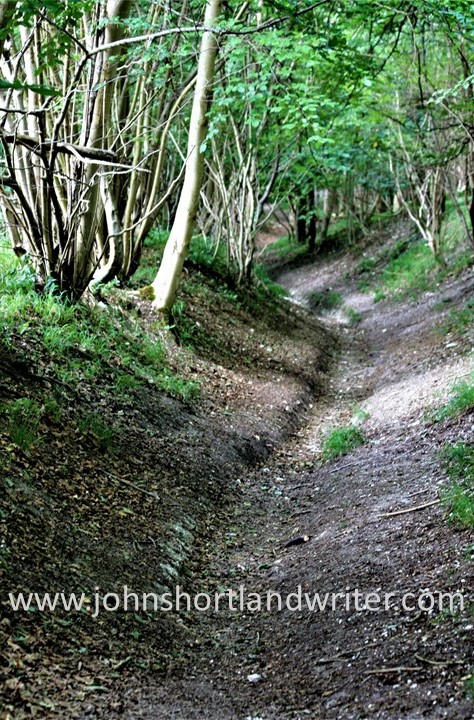
This centuries old track leads down into a deep valley
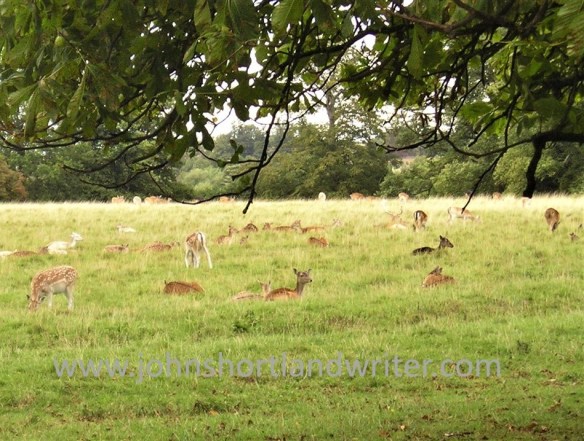
Fallow deer can often be seen at rest in clearings if you walk quietly
The making of chair legs to keep the flourishing furniture industry of High Wycombe, the local market town, was carried out within the woodland by men who would set up shelters there. Known as chair-bodgers, a local dialect word originally confined to this immediate area, they were highly skilled craftsmen who could earn relatively high wages for their work. The Second World War virtually ended the centuries old tradition, the last being Samuel Rockall who died in the early 1960s. I had been unaware of Rockall’s life until I researched for this blog post and it seems as if we may have been related for I have Rockalls in my family tree. In the 1851 census return one of my ancestral cousins is described as a chair turner living in the village where I spent much of my adult life. More research required!

Jonathan Rockall, chair turner and ancestral cousin in the 1851 census return. His wife, Ann, a lace maker,- another local craft

Some of my cousins?! Photo from an old book ‘English Country Life & Work’
It is, perhaps, springtime when the beech woods are most visited for the forest floor is carpeted with bluebells. The intensity of their colour plus the iridescent green of the tree’s unfurling leaves almost hurt the eyes. With early morning sunshine the scent is unique and difficult to describe – gentle is the best I can come up with. As the day progresses the scent is quickly lost.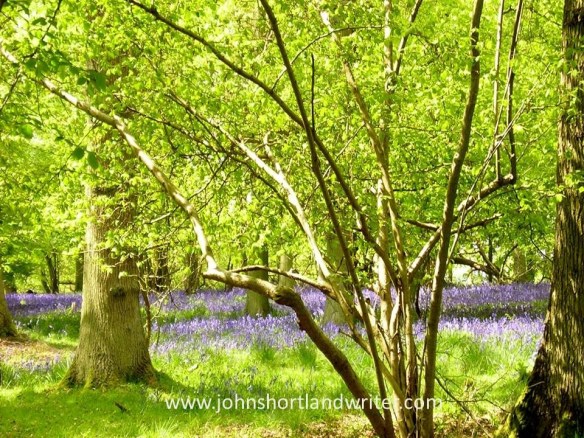
During midsummer, the woods become visually silent: the leaves have turned a dark, leathery green and the bluebells gone to lie dormant for the rest of the year. With autumn, the trees become alive once more with colour, this time as their leaves turn into every shade of copper, gold and brown before they drop to the ground for winter. It is then that the smooth bark of the trees come to the fore with a silvery sheen that catches the low light of a winter’s day. Although it may seem as if the woodlands are sleeping, in places the first bluebells are starting to poke their noses through the leaf litter. Spring is on its way.

 Life in the English Cotswolds
I grew up on the outskirts of Reading. The Chiltern beech woods were always a favourite visit. Fine walking country. Your photos bring back happy memories. I do like the meanders in your own Cotswold stream. I hope the willows soon regrow.
Hello Richard and thanks for stopping by my blog and taking time to comment. I’m glad you enjoyed the post. As you say, the Chiltern woodlands are fine walking although you won’t be spoilt for choice for walks in Sussex. I have childhood memories of long walks around Midhurst and Rudgwick and listening to nightingales singing. The meanders in ‘our’ river are rather splendid, aren’t they? You will be pleased to hear that the willow pollards have regrown to their former glory. It will soon be time to harvest them again. I see that you are a Cobbett and Richard Jefferies fan. Did you know that there is a RJ Society? There is also a Facebook page of which I am an administrator if you wish to join (you don’t have to be a member of the society). There is also a Facebook page for my blog.
Thanks for the info. My interest is in rural writers and poets generally, linked with our beautiful English countryside. I hope to visit your ‘neck of the woods’ next. We are indeed spoilt for choice scenery in these islands.
Very interested to read your blog . I am the grandaughter of Samuel Rockall and the proud owner of some of his work .I lived next door to his cottage and workshop as a child . I live in Yorkshire now but always miss the countryside of the chilterns .
Thank you, Christina for contacting. How splendid to have seen first hand the craftsmanship of this now almost forgotten craft, I can well imagine the pride you feel with your family connection and must treasure the pieces of Samuel’s work in your possession. I still haven’t pursued my Rockall connection. I wonder of we are distantly related. I really must check it out!
Yorkshire is a lovely county too and the Cotswolds are beautiful but nothing beats a walk in a Chilterns beechwood 🙂
My Great Grandfather was a Jonathan Rockall
You must have lived up at Turville Heath then. I used to play family cricket on the heath as a child! Later I lived in Ibstone for the eighteen years before I moved to the Cotswolds. You may be interested in a blog post I wrote last year about the heath. Write Turville into the search box at the top of the page and it should show it – called, unsurprisingly, The Heath. Thanks again for your comments – I’m enjoying our dialogue about a place that we both hold dear.
I am so moved by your description of The Heath.
I went to school in Turville and was in the Turville church choir. We alternated every other sunday with Fingest church .So, I know Fingest church very well .
I was at Turville primary school during the filming of chitty chitty bang bang and met the film stars( but have sadly since lost my autograph book with their signatures!)
I spent all my childhood and teen years on That Heath. I had so many adventures, and first kisses ! I particularly enjoyed going out on The Heath by myself in thunder storms . It felt so spiritual .I loved that pond , and I remember watching families play cricket on a Sunday!
Thank you so much for bringing that all alive again for me with your wonderful style of writing . I am sure I will return again and again to your description whenever I feel the need .
That is such a lovely comment – thank you. Receiving messages like yours (especially praise!!) makes the effort of writing so worthwhile. Thank you once again.