
We are sociable animals here in the secret valley and nothing pleases us more than when friends call in unexpectedly as they pass by. It doesn’t matter whether there is just one or twentyone, we can always find enough in the store cupboards to water, and feed them too if needbe. More often than not, they are on their way somewhere so a cup of tea, or something a little stronger, is all that is required.

Not the secret valley but still in the Cotswolds. If you click on the photo to enlarge it you can see that the river Windrush has as many twists and turns in it as our little river
Most of the time visitors arrive by car or on foot for the lane that brings you into the valley is as inviting and sinuous as the little winding river itself: it takes you across cornfields, through trees which create, at this time of year, a leafy tunnel before entering a fold in the hills lined with an avenue of cherry and lime trees. It is here that you get your first glimpse of the river and beyond the meanders the lane turns sharply over the bridge taking you a few more yards to the door of our home.

The villages of Lower and Upper Oddington – you can clearly see the lines of the old ‘ridge and furrow’ field plough marks that can date back a thousand years or more
The secret valley, as I have mentioned before, is a landscape in miniature. Everything is small – the road, the hills, the views, the river, even the stone built bridge you can pass over without noticing it. If it all sounds very idyllic that is because it is.
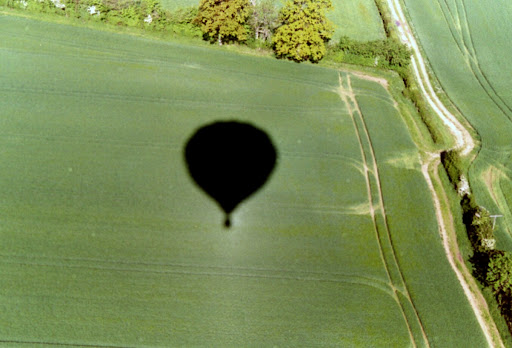
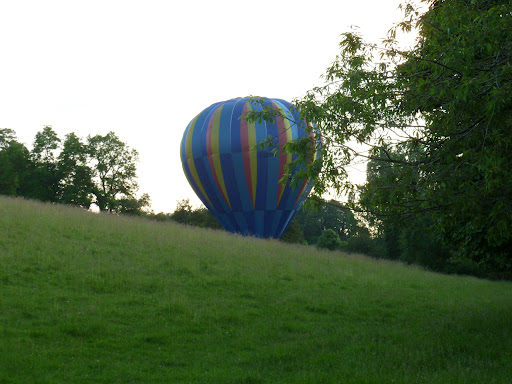
A couple of weeks ago we had some very unexpected guests although we could hear them arriving for quite a while before they finally did so. It was the unmistakeable sound of a hot air balloon losing height. Hidden by trees we could not see who was landing but went off to investigate – She-dog leading the way – and to assist if required. The multicoloured stripes told us it belonged to Charles Teall who lives some miles away and who had once taken me for a flight, although on that occasion we had not landed on our doorstep – for details of that flight click here.

Charles’ wife, Liz, incidentally, is a very talented potter and we have some very nice pieces of her work. She, like myself, is interested in traditional folk music but, unlike me, she can sing and play the whistle and tabor; she also belonged until recently to a local Morris dancers side. Have a look at her work by clicking here.
By the time we reached it, the balloon had already landed. It never fails to surprise me just how large it is and just how small the basket is.

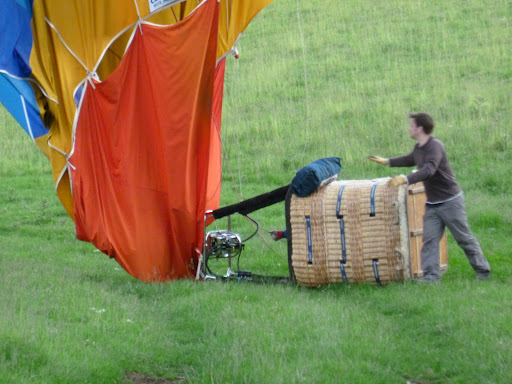
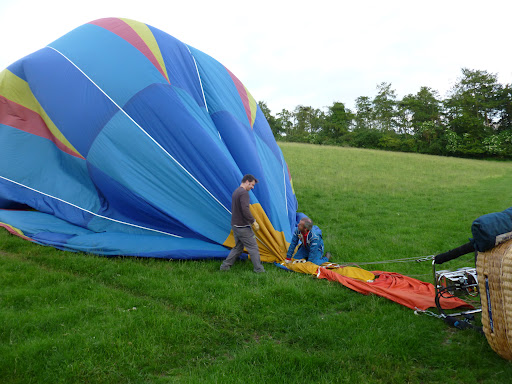
She-dog is normally fairly cautious and we thought that she would be nervous of the balloon. As always, she proved us wrong and felt it important to inspect every part of the balloon: below, the folding meets her approval. Talking of approval, those of you that follow She-dog’s exploits may have been wondering what is the latest on puppy news: there isn’t any. On the last two occasions she has refused to co-operate. She obviously felt that once was quite enough!
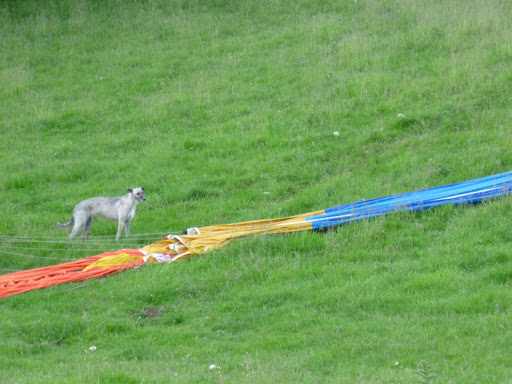
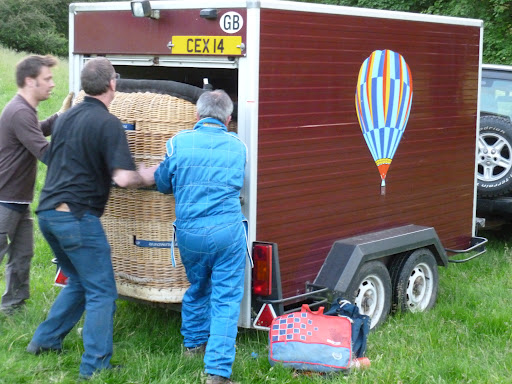
I am always surprised how neatly everything folds away and into such a small space. There is always a mobile support team to assist where necessary so our help wasn’t required. Once packed we were able to catch up with the latest news over a drink and reminisce about our trip flying over the Cotswolds. The aerial shots were all taken on that day.


The counties of Oxfordshire and Gloucestershire, which form the greater part of the region known as the Cotswolds, have some of the best surviving examples of ridge and furrow. To find out how these were created, click here.

 There is something rather special about Burghley that is quite difficult to define. The atmosphere is electric yet relaxed, a great team of people organise it, the visitors all thoroughly enjoy it and, of course, there is the splendour of the magnificent Burghley House that dominates the grounds.






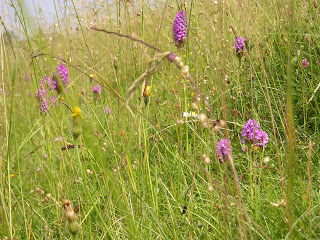
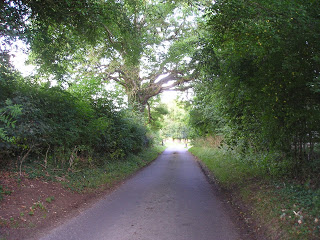 To call it an avenue would be rather pretentious, but the roadside plantings of beech and cherry create the first thought that you may be going somewhere rather special. And as you begin to pass beneath their canopy, the hills start to rise on either side. These are rarely, if ever, treated with any chemicals and wild flowers, including orchids, abound.
 But there is still no hint of our little, winding river. Then, as the avenue ends and on a sharp bend there it is! The first glimpse is of the old sheepwash, where the river was widened and deepened although still almost jumpable, for everything about the secret valley is miniature: the hills, the river, the road. Beyond the sheepwash come the meanders – the photo of these snake like bends are in the blog’s header title.
  Our little stone cottage lies further along the road – and this is now the original old drove road, for the one that we have travelled so far has probably only been in place since about the late 1700’s. More of the drover’s in another post. Below is the view from the house looking back towards the meanders – we may only have just one other house nearby but there are dozens of sheep for neighbours!
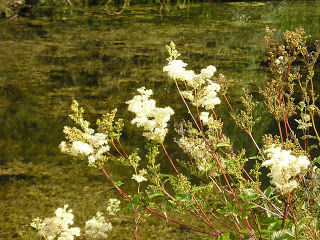
 Just below the cottage, the river passes beneath the lane and snakes its way around us, travelling through lush meadows. Watercress and meadowsweet grow along the water’s edge and little rickety, make-do bridges made from old telegraph poles criss-cross from one bank to another. Ancient, gnarled willow trees line the banks, more about these can be found in an earlier post:
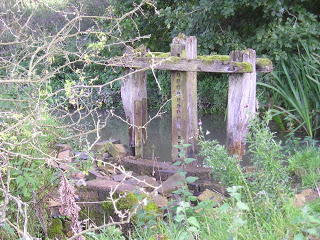
 And tucked away beyond the bridges are the remains of the old mill workings. The culvert is barely noticeable until the river levels rise and the water diverts towards the mill. We’ll travel there another day.
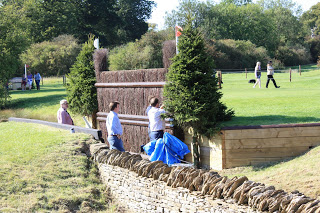
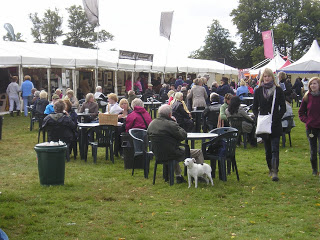 A walk around the cross country course is always exciting: working out how you would approach the jumps, most of which are huge and difficult, talking with the competitors and admiring the thought and work that goes into creating the course. I should say that my riding skills are nowhere good enough (nor my courage level high enough) to compete but my partner has in the past and jumped into the dreaded “leaf pit”. The photograph of it below hardly does justice to the 4ft drop into the pit – the horse takes off just to the right of the guy, then immediately tackles either one of the two smaller jumps and then gallops off down the course. It is quite nerve wracking to watch, especially if it’s your partner doing it! If I was on my horse, Barney, I would be another 7ft higher still – it makes me feel quite ill just thinking about it!
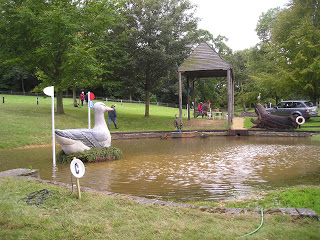
 The water jumps are always a popular place so I visit them before the competition starts. People congregate here, not to see the jump carved to look like a duck, but in the hope of seeing the riders fall and get a good ducking!
 A crowd of over 140,000 watch the eighty or so horses compete over four days – the guy with the best view is certainly the television cameraman – I always watch most of it on the giant screens that are strategically placed around the grounds.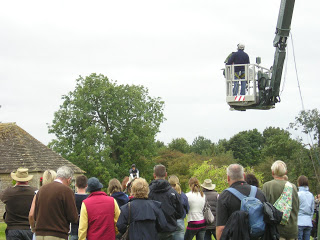
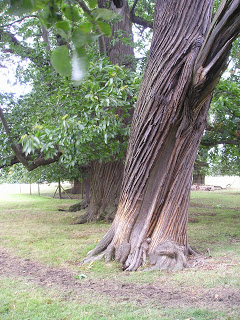
 There is always a place, ‘though, where you can get a clear view of the jumps and, if the crowds get too much, a quiet place under the magnificent sweet chesnut avenues.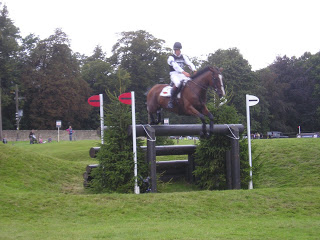
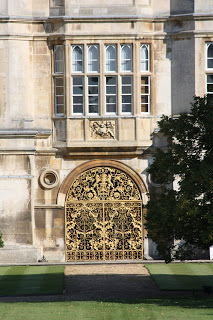
 Burghley House is a magnificent Elizabethan building built – and virtually unaltered – in the sixteenth century and set in hundreds of acres of parkland. With over 80 major rooms, gardens and the park, it is well worth a visit. Although still privately owned (by the same family since being built) it is open to the public throughout the summer months.
 Great excitement! She-Dog has met her husband! The potentially lucky lad may ‘marry’ her around Christmas and, with luck, we will become proud parents in the spring of 2010. Burghley is a good place for romance too – watch this space!
 Life in the English Cotswolds