
I suppose it is because of the long winter weeks of relative stillness in the garden that we eagerly await the first signs of new life: the first grey green tip of the daffodil’s leaves pushing through the soil, the lengthening of the flower stalk, the swelling of the bud and the first hint of colour and, then, the pleasure of seeing the open trumpet in all its glory. And how apt that daffodils are one of the few flowers that have trumpets, for the sight of them, whether just a few or en masse, herald the start of the floral year with a fanfare of pleasure as great as any orchestral masterpiece.
 Narcissus ‘Carlton’
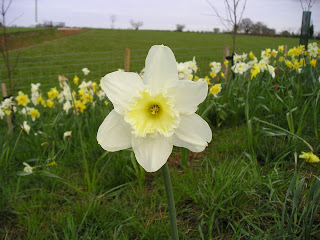
Narcissus ‘Ice Follies’
I can be incredibly opinionated, as many of you will know, where plants are concerned. I tend to prefer simple, unimproved varieties – fancy colours and doubles, or those described as having the largest flowers ever seen, can be left for others to grow. I can see no reason why, for example, a bloom “as big as your face” (as I saw one begonia described) is considered desirable. I am not keen on double daffodils as they nearly always seem to be top heavy. The slightest puff of wind or shower of snow and the heads sit face down on the ground where they remain to be eaten by slugs. Ice King is a variety I plant – although hardly to be described as a favourite – as it stands fairly well. In the photo one bloom has collapsed which rather proves a point.
 Narcissus ‘Ice King’
Salome, is a bi coloured variety, the trumpet changing from a rich yellow to a peachy shade as it fades. I can never decide if I really like it or not. Here, in the photo below, it gives a warm glow to the border. However, what can be more charming the pure simplicity of Segovia? Its delicate yellow cup and pure white, evenly spaced petals (or perianth, if we want to be horticulturally correct) give it the look of a plant that has quiet superiority.
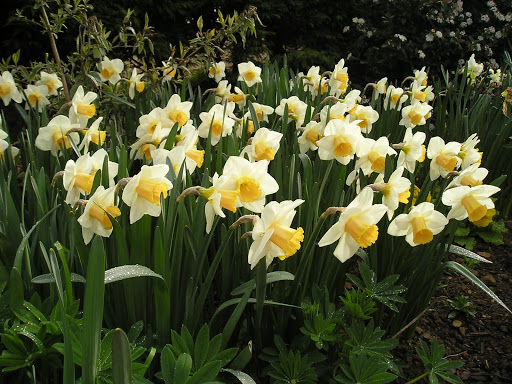 Narcissus ‘Salome’

Whatever your personal preference, daffodils are a joy and amazing value for money. With individual bulbs just costing pence each and increasing year by year if left to naturalise, it is always remarkable that after a few short weeks, we cannot wait to see them gone, being tired of their gently decaying leaves which interfere with our border work or mowing regimes.
 Narcissus ‘Burma’

 Daffodils, or Narcissus if we want to be technical, are one of the first of the bulbs to be planted for they start to send out their roots early in the season as we discover when we dig them up by mistake when weeding. Like all bulbs, they need to be planted in generous quantities to look their best. The photo above shows several hundred lining the old lime avenue of the house I described in an earlier blog ( 21st August 2009:
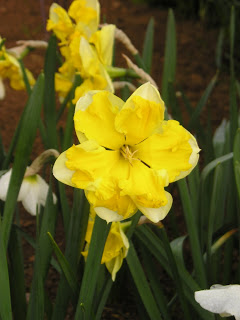
  I am not keen on double varieties – they tend to be top heavy and spend most of their time prostrate. However, I find the Orchid flowering types don’t do this and are quite fascinating to look at. The one above is Dolly Mollinger, the one below Chanterelle.
  Bicolours can also be tricky to my biased eye. I don’t like Scarlet O’Hara (below top), so vulgar in the border! But Jetfire, which is a similar colour combination works well in this wilder setting and is beautifully enhanced by the white bark of the Jacqmontii birch tree (below bottom).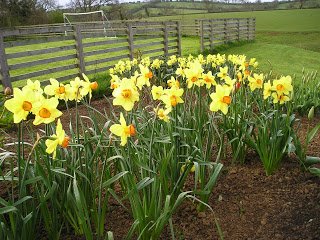
 Scent is all important in any flower and in narcissus it is especially welcome after the bleak winter months. Few scented winter flowers have the freshness of the smell of a vase full of Cheerfulness – a stonger coloured version is Laurens Koster.
 But perhaps the best daffodils of all are the ‘bog standard’ yellow ones. That’s what spring is all about. (Although to be honest, I don’t totally agree with that statement – my favourites are the miniatures but I don’t have any photographs! I will have to take some next March and persuade you all then……)
 Life in the English Cotswolds