Sunshine and Laughter

I always feel better when the sun is shining. I have more energy and achieve far more, whether working in the garden or even doing indoor chores. And sitting outside feeling the warmth on bare bits of body (not much on show these days after a bout of skin cancer), preferably with a glass of a good, chilled, white wine, makes me feel that all is right with the world.

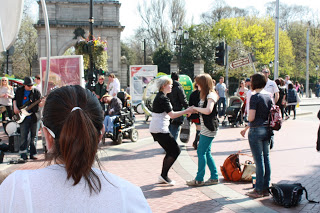
And when I was in Grafton Street, the main ‘drag’ in Dublin, Ireland on a glorious spring day, I found that it wasn’t only me revelling in the long awaited heat. The road filled with people all intent on rushing at speed but instead ending up relaxing and enjoying themselves. It was good to see.

Magicians and entertainers did what they said: not only did they entertain but they worked their magic on the crowds and the street came to a standstill. All around people stood and laughed and clapped and cheered. A picture, so the saying goes, is worth a thousand words. These photos speak for themselves.
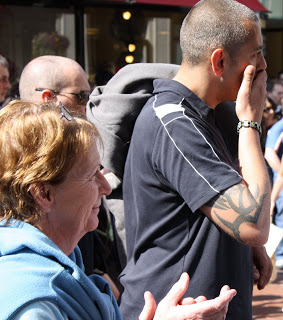
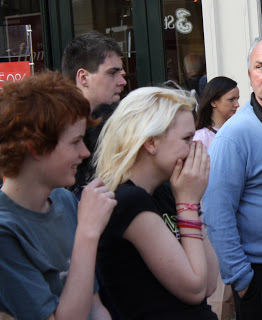
Musicians played and, quite spontaneously, there was dancing.

And if the heat became too much, continue laughing in Bewley’s cafe…..

…..or just bask in the sun down a side street….
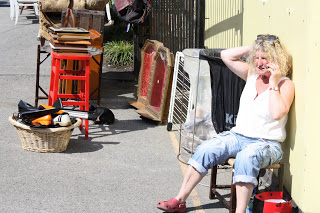

I love these photographs for the warmth that radiates from them – and I don’t mean sunshine. Having just been fortunate enough to hear Archbishop Desmond Tutu speak in Oxford, for me, these are confirmation of his viewpoint that, if you look for it, you will find that the natural goodness in people shines out.

Let’s hope we all have a warm, happy and laughter filled summer.

Add to Technorati Favorites

Archbishop Tutu comes to Oxford

One of the best aspects of living in the secret valley, (apart from being unknown, of course), and living on a relatively small island, is that we aren’t too far from anywhere. We can travel north, south, east and west with comparative ease and one of the nearest cities is Oxford.

Oxford is so steeped in the history and daily life of the Universities that it is generally forgotten that it has another side to its personality – but that will have to wait for another post. It was to Oxford, thanks to Kellogg College, that I found myself in the Sheldonian Theatre last Monday afternoon. If the word theatre conjures up a vision of red velvet curtains and plush velour seats, think again: The Sheldonian was designed by Sir Christopher Wren, perhaps our greatest architect, around 1664 to provide a suitable venue for ceremonies associated with the University. It is still used for this purpose and for lectures and the seats – benches – are hard and unforgiving. However, it is a masterpiece of design and, also by being circular, it is possible to see the platform uninterrupted by the heads of other people or by pillars.

When a friend asked if I would like to attend a lecture given by Archbishop Desmond Tutu I thought it must be joke as surely all places would be allocated. They were and we were amongst those that were priviledged to attend. Archbishop Tutu is a person I have admired for many years – for how can someone (or a people) that have suffered so much indignity and hardship be so forgiving? This was the subject of the lecture: Lessons From the Truth and Reconciliation Process for 21st Century Challenges. The transcript and video is not yet available but a similar lecture given in the States can be seen here.

Call me an old softy, but my initial reaction when the Archbishop walked into the centre of the building was to want to burst into tears, such was the emotion in seeing him in person. And when I looked around at the audience, many were wiping their eyes, both men and women, young and old.
.

Archbishop Tutu talked about the hardship that his people had suffered through the dreadful years of apartheid (I’m ashamed to say, that the British government didn’t give much assistance). In his characteristic tone of voice – sometimes high, sometimes low – he pointed out many of the everyday insults that arpartheid brought: the designation of race (black or coloured) by having a comb run through your hair. Of being denied medical treatment, so many things. He told harrowing stories of both blacks and whites being murdered during the armed struggle.
And also, after a long pause, as the horrors were absorbed, his high pitched laugh would bring the story to a close with a quip or a gesture. And he made us laught at ourselves too, which always has to be a good thing!

But the lecture wasn’t all about horror – in fact, horror (although plenty of it) was not the overwhelming feeling. That feeling was of joy and of love and of hope and that has to be great, in the biggest sense of the word, for we all need to be reminded that much in the world is good – don’t we?
.
.
.
.
.
.
Add to Technorati Favorites

Cotswold Cowslips

I never did get to see the fritillary fields of Oxford and the Upper Thames. Perhaps next year. If fritillaries are the flowers of the lowlands (albeit rare) then it has to be the cowslip that can lay claim to the title for the hills of the Cotswolds. These little, short stemmed wild primulas (Primula veris) have a simple beauty – they look good growing in the garden but even better in the fields and hedgerows where they belong.


Cowlsips grow in plenty in the secret valley and I have noticed this year that they abound along the old drovers road, as do bluebells – don’t they look good growing in combination? Is this because these green lanes are never sprayed with chemicals and the thick hedgerows that line them prevent any spray drift from reaching? The field below is at the top of the secret valley and is a haven for wild flowers – soon there will be orchids showing. The farmer likes to see them so has never tried to ‘improve’ the ground in the agricultural sense and, as a consequence, the field is also full of birds and bees and butterflies.


However, to see the truly stunning cowslip meadows, you have to travel out of the secret valley. Just a few miles up the road is this field where the cowslips grow in the tens of thousands, so dense that it is impossible to walk without trampling several plants at once. Few people see them as they are ‘off the beaten track’ which is a pity in some respects, for they should be enjoyed and marvelled over.

The scent of cowslips is subtle but, when growing in these huge numbers, it wafts over in waves on gentle, warm breezes, a heady mix of hay and honey. This gives cowslip wine, a traditional drink, its characteristic taste and potency. Made from many hundreds of flower heads it is now rarely made as, fortunately, most people now understand the importance of preserving our native flora and fauna. This has benefitted the cowslips, which were once quite an uncommon sight, as they are left to multiply with these spectacular results.

Add to Technorati Favorites