
English people constantly talk about weather. It’s in our makeup, our genes – we can’t possibly walk past someone, even a total stranger, without saying something about it. We can’t help it, no matter how much we realise that the person isn’t that interested (or even doesn’t speak English). We rattle on about too much rain, too little rain, too much sun, no sun, cold for the time of year, how warm it is. And to prove the point, this post is about weather and, no, I’m not going to apologise about it. By the way, we had a fantastic sunset in the secret valley a couple of days ago.
 I think the reason we may behave like this is because English weather is nearly always gentle. The landscape that makes up England is beautiful and can be dramatic but not in the way of so many other countries. Take the USA, for example. Where’s our Grand Canyon, our towering redwoods, our Rocky Mountains, our Great Plains and our Niagara Falls? We have them in miniature and, perhaps, that is just as well as we are such a small country. And likewise, our weather: we have heatwaves, we have floods, we have blizzards. But they are rarely anything truly spectacular (except to those poor people affected by them, of course). And so when we were told by the weather men in 1987 that reports of a hurricane were completely exaggerated, we believed them totally. And despite the fact that much of the country was hit hard by it when it arrived, my part of the Chiltern Hills where I lived at the time was not much affected, even though it is one of the most wooded parts of the country.
 The night in January 1990 was different. This time we had winds, whilst not as severe as three years earlier, which created total havoc with the already weakened root systems of the trees. Great swathes of the magnificent beech woods that are the very heart and soul of the Chilterns were flattened in a couple of hours. (I am reminded by my partner, that as the rest of the world cowered in their beds as the trees came crashing down all around, I woke up to say “a bit windy out there” before falling asleep again). As dawn broke the true damage could be seen.

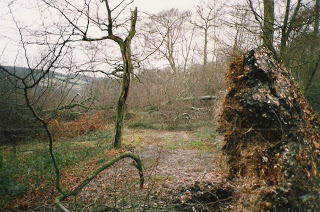 Fast forward twenty years to 2010 and the woodands are transformed. Those of us that remember the 200 year old beech know that the majority are gone and, in their place, are new trees of mixed species. It will be many years before the magnificence of the woods return but they are healing. This photo below is taken from the same spot as the one above. Some of the biggest old stumps have been left, too difficult to move – time has hardly changed their appearance apart from their ‘roof’ of mosses.
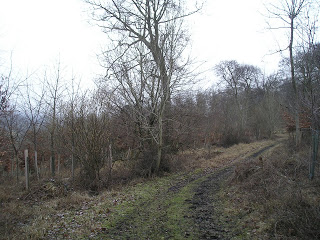
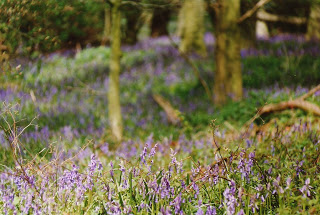
 One of the unforeseen benefits of the hurricane is the increased amount of light reaching the woodland floor, for beech trees cast a dense shade where little can grow, other than where the canopy is lightest. Apart from the view to the valley below, which was unseen before, many wild flowers are better now than ever. Roll on April when we can see the blue carpet of tens of thousands of bluebells disappearing into the distance.

 Oh! And I nearly forgot to say, the weather today is a mix of sunshine, cold winds, rain and sleet. Don’t forget to tell the next person you meet!

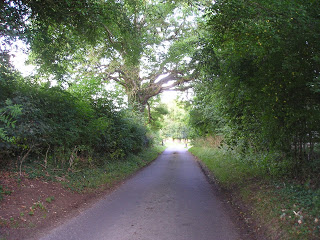 To call it an avenue would be rather pretentious, but the roadside plantings of beech and cherry create the first thought that you may be going somewhere rather special. And as you begin to pass beneath their canopy, the hills start to rise on either side. These are rarely, if ever, treated with any chemicals and wild flowers, including orchids, abound.
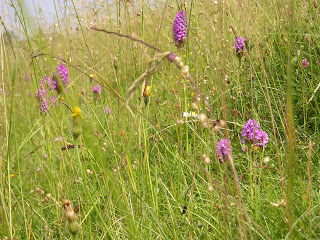 But there is still no hint of our little, winding river. Then, as the avenue ends and on a sharp bend there it is! The first glimpse is of the old sheepwash, where the river was widened and deepened although still almost jumpable, for everything about the secret valley is miniature: the hills, the river, the road. Beyond the sheepwash come the meanders – the photo of these snake like bends are in the blog’s header title.
  Our little stone cottage lies further along the road – and this is now the original old drove road, for the one that we have travelled so far has probably only been in place since about the late 1700’s. More of the drover’s in another post. Below is the view from the house looking back towards the meanders – we may only have just one other house nearby but there are dozens of sheep for neighbours!
 Just below the cottage, the river passes beneath the lane and snakes its way around us, travelling through lush meadows. Watercress and meadowsweet grow along the water’s edge and little rickety, make-do bridges made from old telegraph poles criss-cross from one bank to another. Ancient, gnarled willow trees line the banks, more about these can be found in an earlier post:
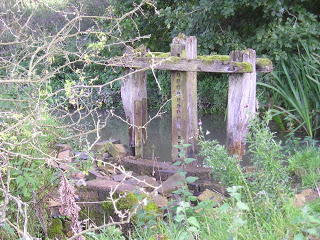
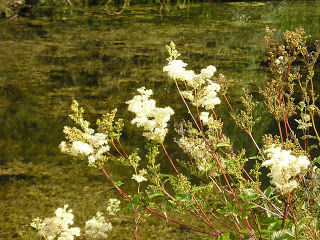 And tucked away beyond the bridges are the remains of the old mill workings. The culvert is barely noticeable until the river levels rise and the water diverts towards the mill. We’ll travel there another day.
 Wild flower meadows are quite easy to create whether on the big scale or in the garden. Of course, the species rich meadows of the Chilterns and Cotswolds have evolved over centuries and have a wealth of insect and plant life to show for it. In the garden you just have to be a little more realistic and be grateful for every bug and butterfly that comes along and colonises it. Hopefully wild orchids, like the Pyramidal orchids below, will arrive too.
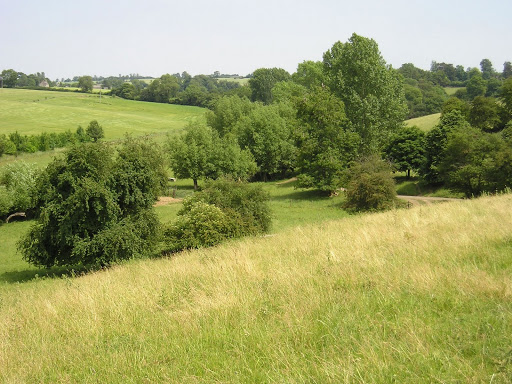
 The golden rule of all meadows is to reduce fertility. As soon as fertility rises, usually through feeding, the grass sward thickens and out competes the flowers. The photo below is of ‘our’ bank and shows, as a golden haze, the unimproved grassland – thin, tall and sparse and too steep for the tractors to get onto and spray. The brighter green grass above and below is where the tractors can reach, the grass has been fed and, consequently, there are few wild flowers.
 Late summer wild flower meadows require a different maintenance regime to those which have an abundance of spring flowers and, as it is that time of year, I shall concentrate on the former. Now is the time to cut the ‘hay’ whether on the bigger scale such as in this orchard or, by hand, in the garden. It is important to get the timing right – you need to leave it late enough for the seeds to fall from their heads to increase more. Leave it too late and bad weather knocks the grass and plants flat to the ground when it becomes a devil of a job to cut. The difference is a task that is a joy to do or one that is totally hateful!
 Hardheads, the local name I learnt for Knapweed in my Chiltern Hills childhood, is a favourite flower of mine. Although normally purply-mauve (above), I found this bi-coloured one and some pure white flowered ones growing in an old meadow – rarities, indeed. I live in hope that they might appear one day in the secret valley!
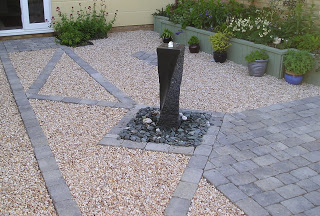
 Neglect does not create a meadow. If you don’t work at it all you will end up with is a sheet of docks, nettles and thistles as has happened in this garden here – not a pretty sight!


 Life in the English Cotswolds