Many thanks to all of you that have read and followed my blog during 2011. Despite the dire weather predictions, the secret valley is having the mildest Christmas for years. Instead of extreme cold and deep snow as forecast some weeks ago, the sun has been shining and the temperature has risen to +13C. I’ve had to rely on a snowy photograph from last winter!
Flowers at Christmas
Forsythia: Another spring bloomer and again just the odd flower rather than branches being smothered in flower. Perhaps not so surprising, as flower arrangers would know – the tight buds that cluster along the bare stems will burst into flower early when brought into the warmth of a house in a similar way to the ‘sticky buds’ of the horse chestnut bursting into leaf indoors. Here, forsythia has been trained as a tightly clipped shrub to screen an ugly garage wall, the warmth and protection of which also makes the flowers open a week or two before normal.
Ferns: Some of the shabbier looking ferns had been cut dowm to ground level as part of the autumn tidy. I hadn’t expected them to burst back into growth …..
Daisy: There have even been odd wild daisies flowering in the lawn (we have mowed twice this month too). The Erigeron daisy that you see growing in profusion amongst the ruins of ancient Rome has been flowering in our garden as if it was still midsummer; it is smothered in blooms.
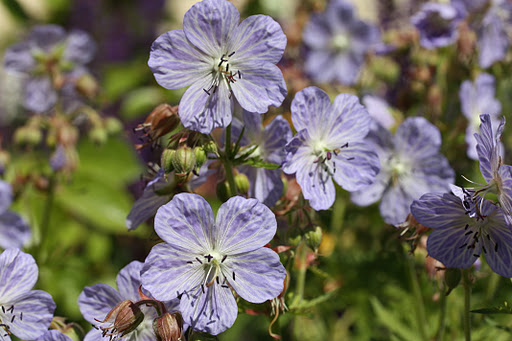
Geraniums: The hardy herbaceous sort. Like the ferns, they had been given the chop some time ago but are coming back into leaf and flower. Some of the hardy salvias are doing the same thing.
Mallows: I have seen hollyhocks still in flower on my travels around the Cotswolds. They are majestic when they are grown well but my favourite of all is the musk-mallow, Malva moschata, which is a wild flower that is often brought into gardensl. I grow both the pink and the white versions and they self sow happily in the borders without ever becoming a nuisance. It wouldn’t matter, you couldn’t have too many!
Roses: There are nearly always roses out on Christmas Day and we always exclaim how extraordinary a sight it is. They are poor, wet, bedraggled specimens carefully left in place by even the hardest pruners as a reminder of warm summer days. For the most part that is the case this year too. What we don’t expect to find are bushes smothered in beautiful blooms still wafting scent but this is the case in one rose garden I attend. I am uncertain as to the variety but there are three of these amongst forty other bushes – all shrub roses. They really are a joy to see.
Now on Facebook
What A Difference A Year Makes
The British are always going on about the weather and I’m no exception. My very first words upon waking are “What is the weather doing?” and my final words before sleeping are “What will the weather be doing?”. I make no apologies for this: it’s part of our make-up as a nation. It’s because, I was once told, that whereas other countries have seasons, Britain just has weather. It’s not quite that simple, we do have seasons – Spring, Summer, Autumn and Winter – just like any other temperate country, it’s just that in the UK they get a bit muddled up.
I write this, snug in front of the woodburner – not that much heat is getting past She-dog who thinks this has been lit solely for her pleasure and comfort – listening to a gale rattling the window panes and whistling around the eaves. The rain is lashing down and there is absolutely no need for me to ask what the weather is doing this evening. However, I have been told that I have said “Listen to the weather” several times. I could have said how remarkable it is that only yesterday I had my lunch sitting in the garden. Yes, really.
I should admit that I am a hardy sole as I work outdoors all year and so am less affected by cold than most and I also should admit that I was wearing a coat and gloves and sitting in a sheltered, sunny spot. Regardless of those finer details, yesterday I commented how last year to the day we were up to our necks in snow in the worst wintry weather the Secret Valley had had for years. And, even more remarkably, the snow came when you would expect it – in midwinter but (and there’s always a ‘but’ where British weather is concerned) in the Cotswolds we rarely get snow before January ….. But it was still rather remarkable to be sitting there, surely and remark worthy?
What is even more remarkable is that all of this week I have been planting out herbaceous plants and laying turf; late even by our odd climate standards. We have had frosts: there were three quite hard ones in October, then none until the last week of November and then a couple more last week and none since. In between, we had two weeks of warmish air and thick fog which was enough to make even me depressed.
The spirits, even on those damp, grey days, were uplifted by the huge array of flowers that have reappeared. There are always a few late roses hanging on determinedly until Christmas Day, looking bedraggled and ragged but not this time. Some of them have given up but others have almost as many blooms as midsummer. There are pots of herbaceous Salvia nemerosa ‘Mainacht’ that have regrown after their end-of-season haircut and are in full bloom once again. Primroses and cowslips are showing colour. Today I counted over twenty different summer flowering plants still going strong. That’s a bit of an exaggeration, I really mean showing the odd flower or two. All the plants have become muddled so we have Winter Jasmine as you would expect but not alongside spring flowering Forsythia. And we have evergreen, flowering shrubs such as Viburnum and Sarcococca as we should have at this time of year – but not alongside the newly unfurling purple leaves of Cotinus cogyggria. Where, or more to the point, when will it all end? Possibly quite soon.
It isn’t just the garden that is confused. On the farm the cattle are still out grazing the fields. They should be inside by now but with plenty of grass still available in the fields they can be out for a little longer.
While I am here writing about a bit of wind and rain, the north of England and Scotland, in particular, are bearing the brunt of 100mph gales and heavy snow. Perhaps we are quite fortunate, after all. The rain here is only supposed to last a few hours and tomorrow is forecast unbroken sunshine once more. Which reminds me, I really must start talking about the lack of rain we have had in recent months. The little winding river is running lower than it ever has and can be easily walked across in places in just walking boots where the water flows over gravel . It should look, at this time of year, like the photograph I use on the header to this blog. Instead it looks like midsummer again with the water, where it flows deeper, still choked with watercress. Oh well! I suppose I should be grateful that I am still able to go out and pick it in December – I can make a store of some delicious hot soup to drink when the weather realises it is winter.
All the photographs, except for She-dog in the snow, were taken over the past week or two. When the frost has been hard the Secret Valley has looked at its best.
A Royal Invitation
Like most people, I wait with eager anticipation for the postman to deliver the mail each day and, each day, I find that, if it isn’t bills he’s put through the letter box, it’s circulars that go straight into the recycling bin. So when a card sized envelope arrived with a nicer quality about it than most – and especially as it wasn’t my birthday – I was intrigued. Why do we always feel envelopes and squint at postmarks to try and work out what is inside when all we have to do is open them and take a look?
My first reaction upon finding I’d received an invitation from the Duke of Edinburgh to attend Windsor Castle was to think that a friend was playing a practical joke. But the more I read it the more real it looked:
How extraordinary! Why me? Why should I be drinking and eating one evening soon with Royalty? The answer was, of course, it wasn’t me at all, it was my partner who has spent a lifetime working with and competing horses.
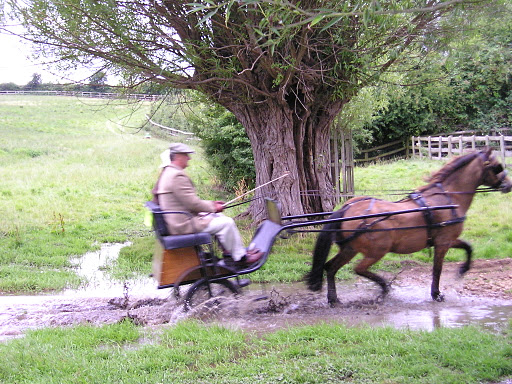
Horses have always been close to the Royal Family and both the Queen and the Duke of Edinburgh are knowledgable and skilled horsemen. Carriage driving at top competition level had, until recently, been a regular part of the Duke’s regime and we had often been to watch him race at Windsor Great Park. We too, have also participated in driving although my competition level is still at the most basic. My partner is much more skilled and fearless and I always marvel when a neurotic and potentially lethal animal becomes calm and pliable under his control. The photo below is of us just out for a quiet afternoons drive – although the pony did have his moment a little later when we careered out of control amongst the trees. Thomas could become quite exciteable at times!
I realised with dismay that the date on the invitation was the day that we would be on Exmoor for a couple of weeks holiday, 150 miles away. Working on the theory that we’d never likely receive another invitation we postponed the trip by a day. And so, that early evening we drove up to the closed gates of Windsor Castle, showed our credentials and passed through to be further security checked. Once this had taken place we were driven by an offical to the Quadrangle and the State Entrance. Thie entrance, as it’s name implies, is used on State occcasions and the Quadrangle is used for military parades, including the regular Changing of the Guard. From here is a panoramic view of the castle buildings, the oldest of which date from the 11th century (making Windsor the world’s oldest inhabited castle), and the Long Walk: a tree lined vista that cuts across the Great Park for a distance of over two and a half miles.
We entered the building by the Grand Staircase, with it’s fine displays of armour and firearms. Here we were able to see the musket ball that killed Lord Nelson which had been presented to Queen Victoria. Queen Charlotte’s sedan chairs were also here, remarkably small, I thought.
The reception was held in St George’s Hall, which was at the centre of the fire in the 1990’s and completely destroyed. As a consequence, the restoration work has made the green oak, hammer beam roof the largest to be constructed in that century. The craftsmanship and colours are extraordinary: set into the roof are the shields of every Knight of the Garter with some shields being blank. These, I discovered, were not reserved for future knights but were of those that had fallen from Royal favour.
Nothing prepares you for the sheer magnificence and size of this room as you enter – it measures 185 x 30 feet. Here we met other guests – there were only about two hundred – and, finally, the Duke who arrived with little pomp or ceremony. The Duke made a short speech before joining us informally to champagne and canapes. I was impressed not just by his energy (he is now over 90) but also by his wit. He really is very funny, indeed. I wondered how many other people of his age could carry out all these duties day in, day out and still make you feel as if you were of interest to them. Both he and the Queen – who works equally hard – may live in splendour with aides and courtiers but I wouldn’t exchange places with them: I will be more than content just to still be able to hear, see, think and garden!
Access was also granted to The Grand Reception Room and The Waterloo Chamber, where the immense and seamless, two ton carpet took fifty soldiers to lift to a place of safety during the fire. What I found surprising was that we were given free access to wander around these rooms at will, although I’m certain that if we had attempted to go elsewhere we would have found our way blocked! Sadly, because we were attending a royal event, we were not allowed to take photgraphs, so I am unable to show you the splendours of these rooms. You will find them, however, if you look in a search engine.
The evening came to a close after two and a half hours and, as we stepped back out into the autumn air in the Quadrangle, I was struck by the realisation why it is traditional to say, upon the death of a monarch, “The King is dead, long live the King”: for all the affection that the current Queen has in the hearts of many of her subjects, the Office is greater than the individual. The institution of monarchy has worked well for this country, long may it remain so.
A Walk in the Doone Valley
Exmoor is one of England’s smaller National Parks and it is also has one of the most varied landscapes: heather moorland, grass moorland, wooded combes, rushing streams and waterfalls, the lush farmland of the Porlock Vale, high cliffs and sea views.
The moor is especially beautiful at this time of year now the heather flowers, which in midsummer had turned hundreds of acres purple, have changed to a golden bronze. The bracken, also yellowing as the autumn progresses, helps to make the landscape a combination of coppers, oranges, golds, browns and greens.
For an English holiday at this time of year, I couldn’t have been luckier with the weather either: day after day pleasantly mild and with only a couple of days rain. Perfect conditions for walking and, because it is now ‘out of season’ with the summer visitors long departed, the moor was even more empty of people than usual.


Summer, Autumn, Summer, Autumn
It is said that the English, compared to those from other countries, always talk of the weather and, I have to admit that it is true. I have also heard it said that, whereas other countries have ‘climate’, we just have ‘weather’. And it is weather that has shaped the nation’s psyche, especially those of us that earn our living standing outside in it.
It has been an odd year. The hardest and earliest winter for years gave way to a lovely spring, March and April being mild and sunny. We were then hit by the hardest May frost that anyone could remember and here, in the secret valley, many of the trees had their newly formed leaves and flower buds blackened. The horse chestnuts and oaks seemed hardest hit, although oddly enough, not all of them and not even all of the leaves or flowers on the same tree. Those damaged leaves fell and bare braches remained until July when, suddenly, they sprouted fresh leaves with the same verdent intensity as you would find two or three months earlier.
One moment bright green growth, the next ……..
But what has happened now? Three days ago, we returned to chill, and with a drop of nearly twenty degrees it suddenly feels more like November. Some leaves have begun to turn colour but others have fallen, too exhausted to give us their fleeting pleasure of golds and yellows. Snow is forecast up north in Scotland and every day the news is full of gloomy stories of an even harsher winter than the last one.
So, we Brits have suddenly become wrapped up and stand huddled together talking about being too hot and too cold and will there be snow. Who knows? One thing, however, is certain: if there is snow down here in the south, it will be the chalk cut on the M40 that will get it first and it will also be the first motorway to be blocked by traffic trying to climb to the top of the ridge.
At the 2011 Burghley Horse Trials – part 2
To compete at the Burghley horse trials you have to be brave, for the size of the fences are not for the faint-hearted. However, to have reached the standard that is required, riders and their horses have had to overcome fear in plenty and have the necessary skill, stamina and strength to compete at this level – not just on the cross-country course but also in dressage and showjumping disciplines. It certainly draws the crowds with over 140,000 people attending.
In part 1 of these posts on the Trials – click here for link – the photograph below was also the first photograph shown, but before the trials began. It looked a huge, solid jump (and was) but the horses cleared it with ease. It is often the smaller jumps where a tired rider or horse come unstuck. Fortunately, this year, there were no major casualties although, sadly, these do occur from time to time.


Burghley, because of its status as one of the top eventing locations, not just in Britain but worldwide, attracts the superstars of the equestrian world, from both the UK and overseas. Ollie Townend won Burghley in 2009 and was a favourite to win this year. It wasn’t to be, with one of his horses being eliminated on the cross country, the other having to retire.
Mary King, is always enthusiastically applauded whenever she appears and is supposed to be the person most young ‘horsey’ girls want to be when they grow up! Not surprising really, for she gets results and is a charming person as well. She came third on her own homebred Kings Temptress.
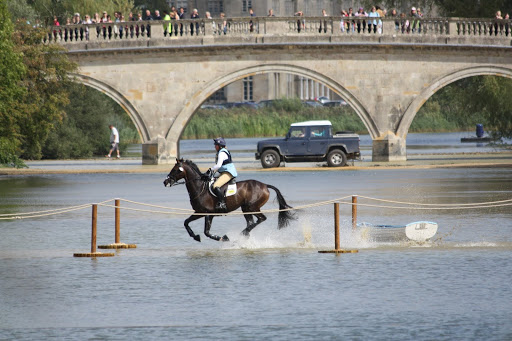
The water jumps always attract the crowds and there is nothing more they like to see than a rider get a good ducking! This year their were few such moments. Apart from small ponds to jump in and out of, the Capability Brown lake also featured as an obstacle. There can be few more magnificent views than this with Burghley House, one of the greatest Elizabethan buildings in England, in the distance.

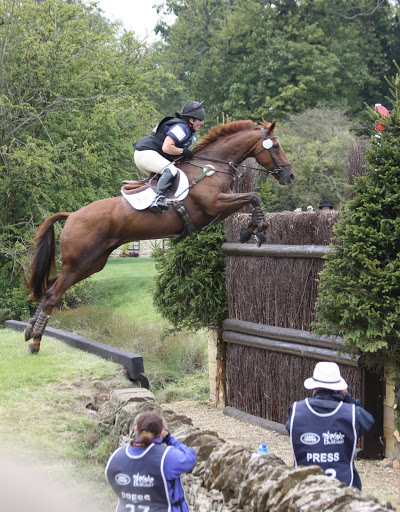
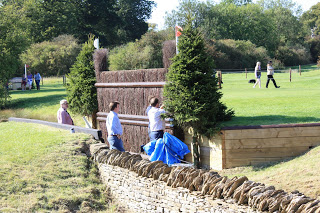
Another photograph that appeared in the first post was the one below. This image has a horse clearing what is the biggest jump on the course. To guage the height look at the press photographers being dwarfed by it ….. This jump was another that the horses took with ease – it is more of a frightener for the rider. The press and the television crews all help to create the atmosphere at Burghley which is , to my mind anyaway, the greatest horse show of them all.
Zara Phillips, daughter of the Princess Royal and grand-daughter of the Queen was another competitor here. She came in tenth place on High Kingdom.
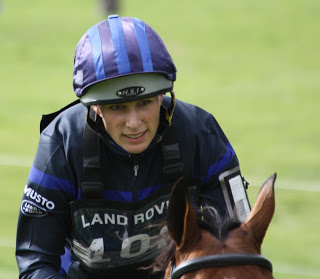
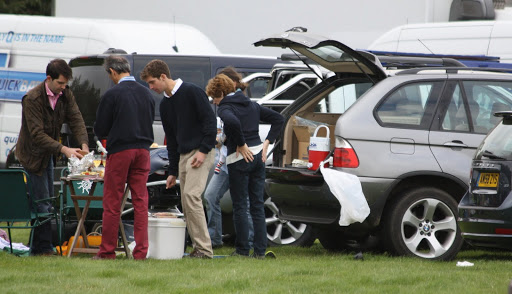
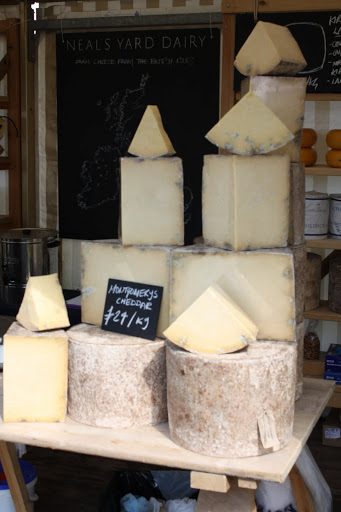
But Burghley isn’t just about horses! For many of us, Burghley and events like it, are places where we can meet up with old friends and aquaintances, a place to relax in late summer sunshine, a place to bring all the family including our dogs. It’s a place where we can shop, where we can picnic and where we can dream of one day riding a horse well enough to compete here.At the 2011 Burghley Horse Trials – part 1
One of the highlights of my social calendar is the annual trip to Burghley for the horse trials. Although I ride and, probably immodest of me to say it, ride rather well, neither my horse, nor my skill, nor my nerve would take me to this level. As it happens, we have just got an additional new horse that has competed at Burghley in the past – as has my partner – but just the sight of some of the fences fill me with such fear we won’t be attempting it!
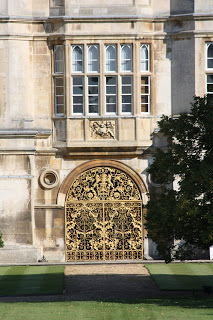
There is something rather special about Burghley that is quite difficult to define. The atmosphere is electric yet relaxed, a great team of people organise it, the visitors all thoroughly enjoy it and, of course, there is the splendour of the magnificent Burghley House that dominates the grounds.


Gardening With Weeds
Much has been written about creating wild flower meadows in recent years. Many gardening magazines infer that somehow you must be lacking in something if you don’t rush out there and then and rip up your precious lawn to create the daisy and orchid studded turf depicted in medieval tapestries. There is much to be said for doing this (and I’ve done a few in my time too). However, the reason why most of us don’t do it is purely down to lack of space and time, and also most of us still like to see a reasonably weed free patch of green grass at the centre of our gardens. Now don’t get me wrong, anything that reduces the amount of chemicals used and encourages wildlife has got to be a good thing and our gardens, collectively, could – and should – make one vast nature reserve.
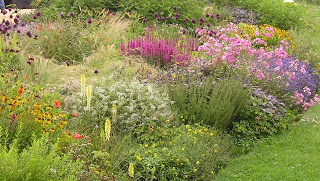
But why restrict yourself to wild flowers in grass? Very few articles suggest using them in herbaceous borders, or amongst shrubs, but I have been planting them like this for some years now and the results can be terrific. This flower border in the photo was taken 14 months after planting and looks very much like a traditional, English flower border. But there are some differences and those are the wild flowers intermingling with the more usual garden plants.

Purple Loosetrife, Lythrum salicifolium, grows wild in boggy places and by stream edges so seems an unlikely candidate for the border. I have found it to be a great choice which copes well with ordinary soil conditions. In the hot, dry summer we have had this year they have only grown to about half their normal height of 3-4ft but their cerise colour and longevity have still made them a worthy addition. In the photograph above they are the bright pink ‘blob’ in the centre, growing separately to the surrounding plants.

Here they are being grown as a companion to a bright pink ground cover rose, a combination that I’m not so keen on (even though I did plant them myself). They are a bit too strident and close in colour for my taste but others have stopped and admired them so there they remain.

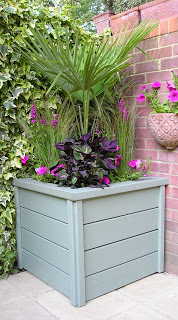
I have also experimented growing them in containers where, of course, you can easily give them the moister conditions they would naturally prefer. Here, their colour makes them quite an exotic addition to the matching colour petunias, the purple leafed coleus and tropical looking (but hardy) palm.

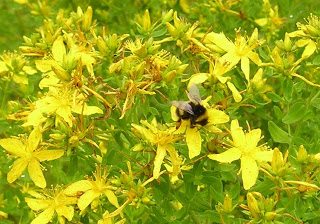
Another reason for growing wild flowers is that, of course, they are great attractants of the local insects. A clump of the herbaceous St John’s Wort, this one is Perfoliate St John’s Wort, Hypericum perfoliatum, always are covered, when in flower, with bees and other beneficial, pollinating insects. The flowers are miniature versions of the shrubby Hypericum ‘Hidcote’ and all the better for being small. In the wild, they grow (as many wild flowers do) quite happily amongst grass and other plants. In the garden, I find they combine well with Wormwood, the tall, shrubby Artemisia.
.
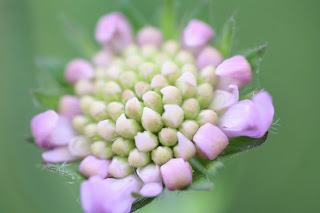
The pale blue flowers of the Field Scabious, Knautia arvensis, continue for months on end and combine well with most other colours. Growing them in the garden gives you the opportunity to notice them in detail. In the wild, it is less likely that you would see how the outer petals of the flower uncurl before the inner ones. Grow them with exotic looking Icelandic poppies or, like here, with tall, purple, Salvia.


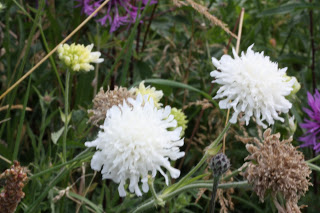
Wild flowers often are generous with their flowering, not only in the quantity of blooms and their exuberance. Sometimes, they offer a ‘sport’. The most common variant from the norm is white and this pure white version of scabious was a delightful bonus. I like the way the buds start off a creamy colour.

Recently, I have tried growing Lady’d Bedstraw, Galium verum. It is working quite well and the rather acid yellow looks good with lavender. In fact, this flower is all the better for propping itself up against its neighbours as it is a bit inclined (in an unlady-like way) to sprawl, otherwise.

One word of caution about introducing wild flowers into the garden: sometimes, they like garden conditions just too much. If in doubt, plant a small number of plants in an area where you can control them should they take off. I didn’t do this with one of my childhood favourites, Toadflax. It took me three years of painful weeding to extract the final pieces from more delicate plants. I have gone back to admiring it where it belongs – along roadside verges and on waste ground.