I am not certain as to why I should be so honoured but Kilbournegrove, has awarded me with the Best Blog Award. I may not know why I have been honoured, but honoured I feel. Thank you very much. The next paragraph I have lifted from her own Canadian blog Green Theatre. I am certain that this is acceptable behaviour on my part – however, if it is not, then I grovel and beg for forgiveness….
Post the award on your blog along with the name of the person who passed it on to you and link to their blog. Chose 15 blogs which you have recently discovered and you think are great and pass it on to them. Don’t forget to leave a comment on their blog to let them know that they have been chosen for this award.
So, now we know what to do, here are my 15 blogs that I think deserve special mention:
The Gaudy Garden Jim is one of my favourite American bloggers, writing in a sharp and witty way, mostly about roses. He calls a spade a spade. I like him!
Wood Ridge Lynne is another American blogger, aiming for self sufficiency in Virginia. Lynne writes on anything from gardening to recipes to needlework and much else besides. Full of energy, even her thoughts on the American Constitution were interesting – even to an Englishman like me.
The Patient Gardener Written not so very many miles from the secret valley, this is all about plants and plantmanship.
Great Stems This Texan blog – I seem to like American bloggers – has the most amazing photographs. I like following this blog as it inspires me to attempt to improve my photograhy. I live in hope.
Bay Area Tendrils Alice’s blog from California is another great photgraphy blog. And it deserves special mention for the fabulous rill in the title photo.
Helen’s Blog Helen’ s frequency of writing is somewhat erratic (I’m sure she will agree) but is always interesting. And those of us in the UK can follow her readily in her columns in the Telegraph, a national newspaper.
A Chef in the Garden The title says it all – Tim (yes, American again!) gave up chef-ing to become a full time Estate gardener but food is never too far from the blogs.
A Gardener in Progress Another blog with wonderful photos.
Down to Earth An Australian blog this time.
Elizabeth Rhiannon An American desperate to live in England – and who can blame her even with our taxes?
High Altitude Gardening This is the blog that started me off on my blog adventures! Kate gardens at over 7000ft (I would have thought she would be gasping for breath not digging). My favourite of favourites.
My Little Vegetable Garden This is a Malaysian blog, again with beautiful photos. Fascinating to read about gardening in a climate I have no experience of.
Notes From a Somerset Garden Pictures of Exmoor means that I have to include this one!
Plant Tips & Guidelines for the Desert Garden Noelle’s blog is another great favourite of mine, partly for the photographs and for introducing me to plants that I am never likely to experience. I do have cousins that live in the New Mexican desert, so there is just the slightest chance…
Welsh Hills Again A very recently found blog and how glad I am that I did find it.
And for those of you that haven’t been mentioned, I promise I will on another occasion.

 The pieces with circles carved into them appealed greatly, especially those with water running through. Their smooth interior face contrasted beautifully with the rough, natural surface of the outer faces.
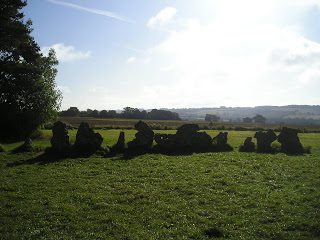
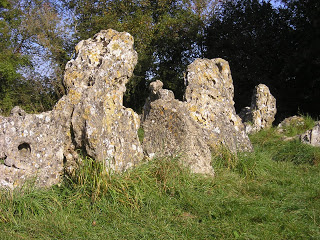
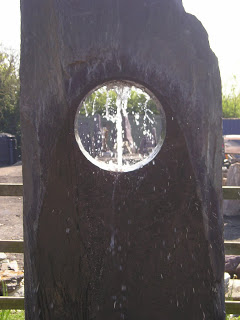 But then I liked this group of large standing stones – they reminded me of the prehistoric ones that litter our English landscape. The Cotswolds have a good number of these, so it made good sense to continue the tradition. I have written about some of these local stones in the past and we hold them in great affection:
  Time for a reality check. How could we lift these giants into place when there was no easy access? And so we went for this one – as large a piece as two of us could manhandle (and it nearly killed us in the process, as did digging the hole for the reservoir in root infested ground) – but we were happy with the end result.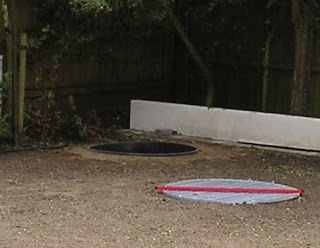

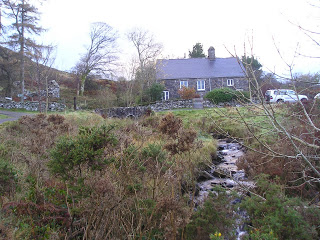 The weather started out unseasonably mild with beautiful blue skies from dawn to dusk giving clear views of the tops of the mountains. Of course, compared to the mountain ranges of the world, the mountains of Snowdonia are not high, Mt. Snowden being the highest at 3560ft. The photo below shows the Cadair Idris range at 2831ft, one of the most popular areas for hill walking. Often mistaken for an extinct volcano because of its crater like top, it was actually formed by glaciation during the last Ice Age.
 The Pecipice Walk is less well known and being close to ‘our’ house is a favourite walk. The path clings to the side of the mountain with a sharp drop to the valley and river below. Further along the path the view opens out to give wonderful views to the sea in the far distance.
 The return route, on the other side of the mountain, gives the totally unexpected view of this small lake. The water is quite clear and tranquil and with its reflections of forest and sky, a pleasant place to rest and ponder.


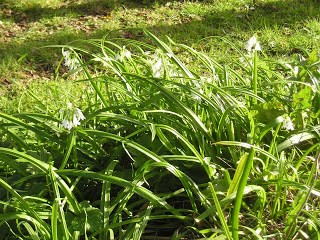


 Sometimes it seems as if flowers have inspired the sunsets! Here is the rose Rosa x odorata ‘Mutabilis’ trying to outdo another mountain sunset. This rose starts with the most intense pink bud and, as the flower fades, turns to the softest apricot, ending up with this wonderful colour combination.
 This old mossy wall was the starting point for a mini parterre – the ‘moss’ is made from the box (boxwood) framework, the ‘stones’ from variegated Iris and Cotton Lavender. The wall reminds me of our garden wall in the secret valley (Sunday 20th September 2009) but this one is in north Wales and is a hard, cool grey and silver granite unlike our soft, mellow Cotswold stone. This planting is tiny compared to the usual grand parterre designs and has been used to link two levels of a small garden.


 So let your imagination take you where it will. Sometimes the combinations don’t work but, more often than not, there will be some exciting discoveries to be made and a lot of fun will be had along the way. And make sure you tell me all about them……

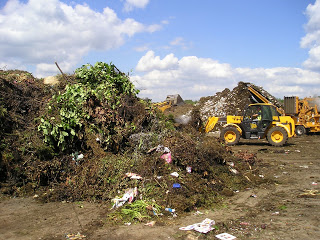 Green waste from the garden, as well as other material that will rot down, is brought by lorry to the site and piled up in long lines – windrows -stretching into the distance. The size of these heaps dwarf the heavy machinery used to move it.
  Unlike the compost heaps of our gardens, the temperatures that are built up destroy all harmful bacteria, noxious weed roots and seeds, resulting in a clean, fertile and very marketable resource. The compost shown here is destined to be spread on fields and has made a significant reduction to the amount of synthetic chemicals and fertilisers being used on the farm, so there is a double positive effect to the environment.
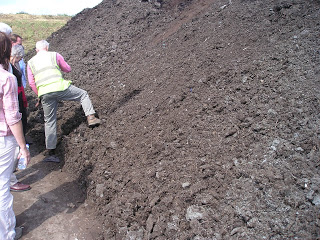 This method of composting can be recreated on a smaller scale. The compost heap below belongs to a large garden which produces a lot of garden waste, whether from flowers and vegetables, from leaves or from the sheep which help to keep the grass low.
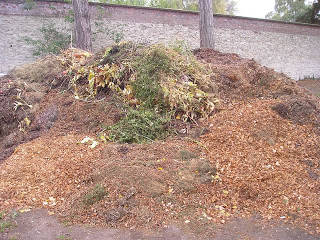 The result is the same: although the temperature does not reach the same height as with the industrial scale, the compost quality is excellent.
  These timber compost bins, with removeable fronts, I make for my own garden as well as those of clients. Ideal for the smaller plot, they last for years, and keep the heaps tidy and easily managed. For smaller gardens still, there are numerous plastic compost containers….
 …..so, there is no excuse! Get composting and help the environment as well as saving money on all those expensive bags of fertiliser…..
 October on Exmoor saw weather changes from day to day: one moment mists, another driving rain and cold winds but, more often than not, warm sunshine. How many times do walkers get fooled into wandering on the moor only to find the mists creeping up the deep coombes (as the valleys are called here) before spreading out across the wider, open spaces where landmarks are few and bogs many? To my knowledge, deaths in the bogs only happen in fiction but a cold plunge to chest height in sticky, peaty water and a twisted ankle miles from anywhere has the potential to be fatal.
 The wild ponies of Exmoor are one of Britain’s oldest native breeds and survive all year finding their feed on the moor. During this month they are gathered up by the local landowners and checked over, branded and the foals weaned. These are normally sold at the annual, local pony sales although this year, for various reasons, the sales have been cancelled leaving a gap in the social calendar, for the sales are one of the great meeting places of the widely scattered population.
 Another meeting point is the local hunt. On Exmoor, there are packs of staghounds as well as fox, for the moors are one of the few places where the Red Deer still run wild in England. With the change of law, only two hounds now hunt the deer, the unfortunate creature having been selected by the Harbourer – a local person who knows both the deer and the moor inside out. Once the correct deer has been found and separated from the rest of the herd, the beast is shot. This is a necessary culling as the population is continually increasing to the detriment of both the moor and the deer themselves.
  Hunting is becoming ever more pouplar as the crowds and cars, pictured, prove. As soon as the hunt moves off across the moor the crowds get left behind and, with the hunt hidden deep in the coombe, the moor seems deserted once again.
 More on Exmoor to follow…..