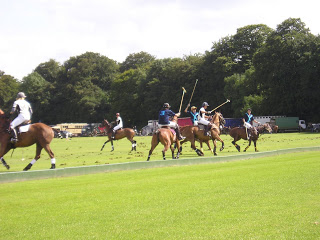
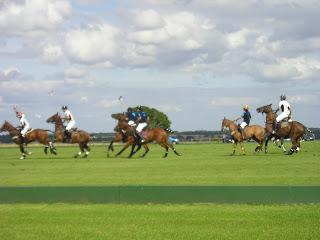
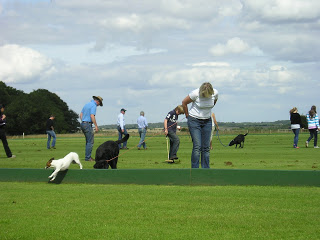
Cirencester, which is just outside the Cotswold country, is famous for being one of the most important English Roman towns, then known as Corinium. Now it is well known for Polo.

Cirencester, which is just outside the Cotswold country, is famous for being one of the most important English Roman towns, then known as Corinium. Now it is well known for Polo.

Can there be a lovelier flower than the poppy? What other can look so frail yet be so resilient to wind and rain? And how can such a paper thin petal hold such an intensity of colour whether it is the scarlet of the wild, the pale pink of the domesticated or the dazzling purity of the white?
< Poppy seed needs light to germinate and this is why they appear in their thousands in disturbed soil whether it is the ploughed cornfield, the scarred battlefield or just our humble vegetable plots, newly dug. They can survive buried for centuries and have even been known to germinate from seed found in archaelogical excavations.
< In the garden I use them all the time – sometimes the wild and sometimes the cultivated varieties, either mix with all types of plants and in all situations. < 
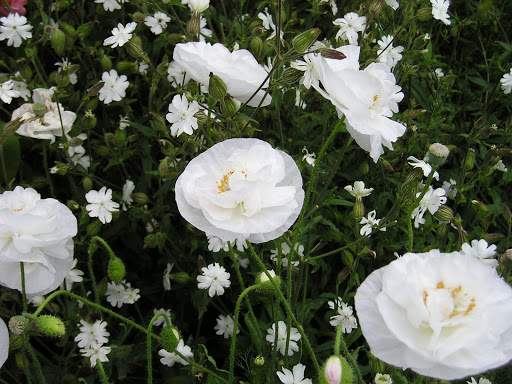
These double white Icelandic poppies weren’t carefully sown in trays and planted out – just a packet of seed thrown onto the ground where I noticed some of our native White Campion (Silene alba) growing in a border. Both flowered for months and when fading pulled up and put onto the compost heap: there will be enough fallen seed of both to germinate again next year.
<
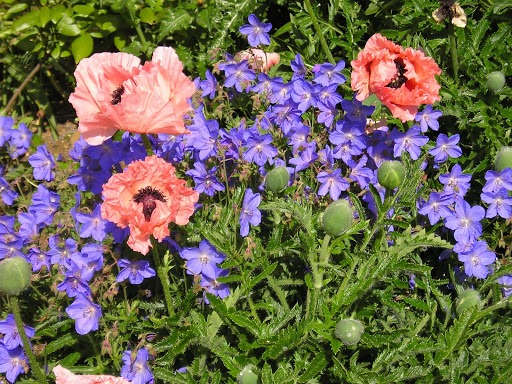
The pink Oriental poppy shown here is the variety ‘Turkish Delight’ growing amongst Geranium ‘Johnson’s Blue’ (not named, unfortunately, after me!). Unlike most of the poppies which are annuals, the Orientals grow year after year from the same rootstock and require some staking to keep upright unless you cheat like me – the Geranium disguises the partially collapsed, sprawling stems.
< A sea of catmint, ox-eye daisies and bright red Oriental poppies I planted below creates a dramatic walk through an old walled kitchen garden. The poppy is ‘Beauty of Livermere’ and has an extravagance that our smaller native poppy could not achieve. Extravagance in space too for this border will only look good for about two months. Once the flowers fade, which they do together, they are all cut off – leaves and all – to ground level. Within two weeks new growth will appear but there will be no more drama until next year.

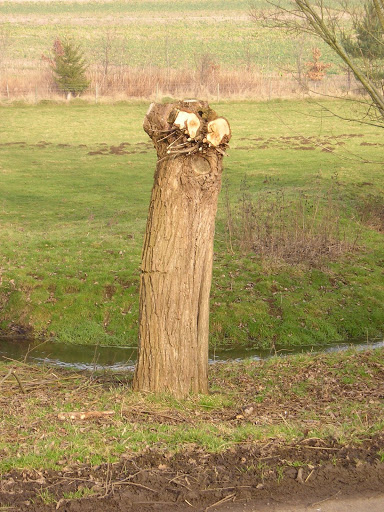
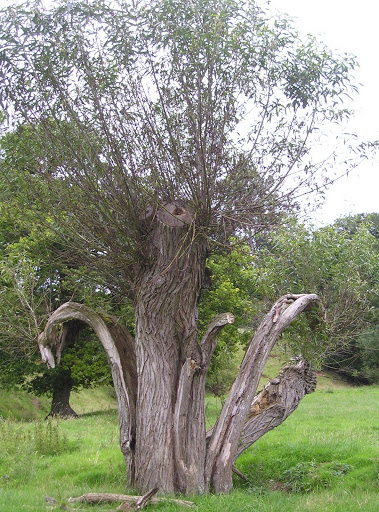
The pollarded willows that line the banks of our river are ancient. Pollarding is the removal of all the top growth of the tree, the timber in the past being used in many ways but, most famously in the manufacture of cricket bats, but now used mainly for firewood. Severe as this pruning is, it prolongs the life of the trees.
In the garden, pollarding (and coppicing, which is the same type of pruning but at ground level) can be used to advantage. The new growth of the coloured bark willows (Salix) and dogwoods (Cornus) are considerably brighter than the older wood and make a good backdrop to the winter garden. A little, winding river flows through the heart of our secret valley. As far as rivers go it isn’t still, it isn’t deep and it certainly isn’t wide – you can jump across it in places. But it is important: in its very short journey of 15 miles from start to finish it passes through several historic country estates where it has been broadened to form ornamental lakes for fishing and pleasure. The photograph on the header of this page shows the river just above our home.
and just downstream, the river has formed ‘our’ lake (really only a little larger than a pond, but that description doesn’t seem to give it enough dignity) where, today, I watched a kingfisher perched on a low bough of a willow. A flash of iridescent blue and orange and it was gone, its shrill call giving warning to all around.
Pretty as they are, the lakes were built for a purpose. In winters past, their frozen water would be carried to specially built ice houses: pits made from brick or stone, deep underground. When full they would be sealed making ice available throughout the summer months. Of course, this was only available for the wealthiest few and it was in the kitchens of the gentry that ice cream recipes were devised – a luxury unimagineable to the poor cottagers. They often struggled to feed themselves the most basic diet.
I stopped off in Enstone today, a small village just a few miles north of Blenheim Palace. I wanted to meet the Old Soldier, the name locals give to the largest of the Neolithic stones that were placed here 4000-6000 thousand years ago.
Old Mont lived just a mile from the stones in Fulwell, a tiny hamlet of no more than a dozen houses. The very end cottage, made out of our local, mellow stone was his house, now marked by a ‘blue’ plaque . The local shepherd has become quite a celebrity since his death some years ago: a story teller persuaded to put his tale into a book [Lifting the Latch] and his few possessions into the Woodstock museum. He would find his own fame far more surprising than meeting the Old Soldier down the pub and the hollyhocks flowering by his garden wall far more impressive!
The lane outside our cottage is narrow and winding as it climbs out of the secret valley. To the right the river follows its meandering course below us and, on the left, the lane is bound by an ancient hedgerow, full of wild flowers.
Crane’s-bill is in full bloom there now and has been for a few weeks. This is the Geranium pratense of gardens and flowers so profusely in this part of the Cotswolds it could be our county flower. In places the banks and verges are dominated by this plant creating a sea of colour – and when the wind moves it, it has the appearance of rippling water.
In the garden I like growing it amongst shrub roses where it can hook onto the thorns and peep out amongst the more exotic rose flowers. Once the first flush of crane’s-bill flowers are over, I cut the whole plant down to ground level and within days new leaves and flowers start to appear again. And when the contractor’s cut the roadside verges it is always the crane’s bill that shows through first.
After all the scorching weather we had a little while ago, now it won’t stop raining. Suddenly temperatures dropped from the upper 80’sF (scorching for England!) by 20 degrees and, day after day, we have woken to grey skies and rain lashing the windows. There have been times when the sun breaks through to remind us that it is still mid summer and we can get on with our outdoor work in comfort.
The garden has been overdue for a tidy as working with other people’s gardens takes up most of our hours at this time of year. This weekend we were able to cut the tall hedges and they look a lot better for it – not a job I especially enjoy but a sense of satisfaction once done.
Hand clipping box hedges is a joy however, providing you have plenty of time for accuracy. There is nothing worse than a ragged, uneven finish to a formal hedge. Powered hedge trimmers rarely do a good enough job and the slow, rythmic sound of hedging shears is mesmeric.
I have heard that the dreaded box blight is in the area. Let’s hope that it doesn’t find any of ours!
Over the coming weeks and months I hope to share with you life in one of the most beautiful and unspoilt areas of southern Britain. You will see from my profile that I have many interests, mostly connected with gardening and the countryside and these will be included. I do hope that you will find the time to visit regularly and to offer your feedback so that I may improve the blog further. So, please, get emailing!
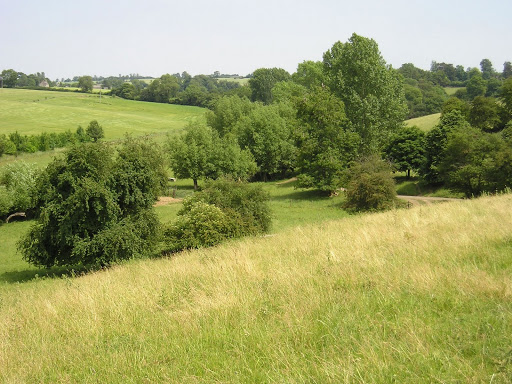
This is the top of ‘our’ secret valley , taken in high summer – a place full of wild flowers and birds and, nowadays, the occasional otter. More of that to come……