
I suppose it is because of the long winter weeks of relative stillness in the garden that we eagerly await the first signs of new life: the first grey green tip of the daffodil’s leaves pushing through the soil, the lengthening of the flower stalk, the swelling of the bud and the first hint of colour and, then, the pleasure of seeing the open trumpet in all its glory. And how apt that daffodils are one of the few flowers that have trumpets, for the sight of them, whether just a few or en masse, herald the start of the floral year with a fanfare of pleasure as great as any orchestral masterpiece.
 Narcissus ‘Carlton’
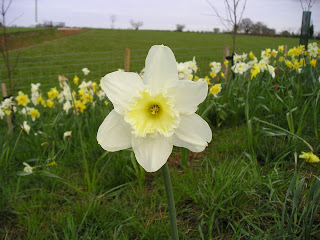
Narcissus ‘Ice Follies’
I can be incredibly opinionated, as many of you will know, where plants are concerned. I tend to prefer simple, unimproved varieties – fancy colours and doubles, or those described as having the largest flowers ever seen, can be left for others to grow. I can see no reason why, for example, a bloom “as big as your face” (as I saw one begonia described) is considered desirable. I am not keen on double daffodils as they nearly always seem to be top heavy. The slightest puff of wind or shower of snow and the heads sit face down on the ground where they remain to be eaten by slugs. Ice King is a variety I plant – although hardly to be described as a favourite – as it stands fairly well. In the photo one bloom has collapsed which rather proves a point.
 Narcissus ‘Ice King’
Salome, is a bi coloured variety, the trumpet changing from a rich yellow to a peachy shade as it fades. I can never decide if I really like it or not. Here, in the photo below, it gives a warm glow to the border. However, what can be more charming the pure simplicity of Segovia? Its delicate yellow cup and pure white, evenly spaced petals (or perianth, if we want to be horticulturally correct) give it the look of a plant that has quiet superiority.
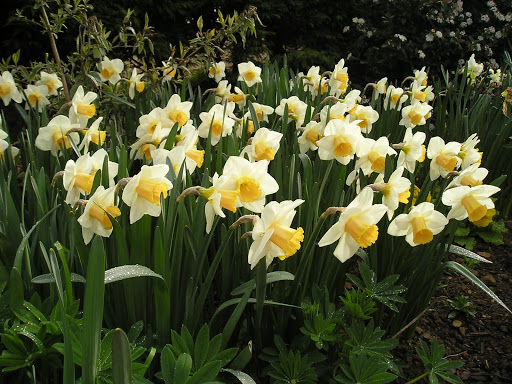 Narcissus ‘Salome’

Whatever your personal preference, daffodils are a joy and amazing value for money. With individual bulbs just costing pence each and increasing year by year if left to naturalise, it is always remarkable that after a few short weeks, we cannot wait to see them gone, being tired of their gently decaying leaves which interfere with our border work or mowing regimes.
 Narcissus ‘Burma’






 So what is cheese rolling? A 7lb Double Gloucester cheese is set in motion from the top of the steep hill – and it can reach speeds up to 70 miles per hour – and us ‘locals’ then chase it. The first person to reach the bottom and cross the line is the winner. Yes, you are right -it is another barmy English tradition.
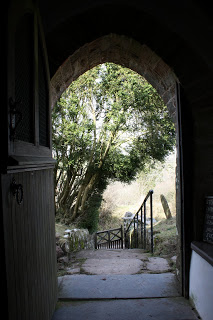
 When you arrive at Stoke Pero, there is no cosy village green scene to greet you, for the church serves a widely scattered community. The wind cuts across the open land with an icy blast and even the church seems to be hunkered down against it, squatting in a dip in the land. As you enter the porch an old sign reminds you why.

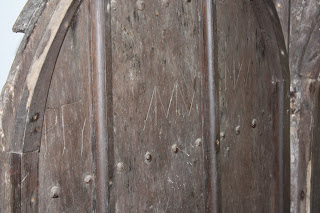
 The doorway to the belltower is tiny – so narrow that only the slimmest can enter. Despite its size it has a degree of solidity about it. The main door to the church is the opposite – a massive piece of oak with letters and symbols scratched into its surface. To date, the meaning of these remain unknown. Any ideas, anyone?
 The tiny clifftop hamlet of Countisbury – the far distant horizon is the south coast of Wales


 Getting too close for their comfort, they were soon up on their feet and ambling away. In a matter of moments their camouflage made the moorland look empty once again.


 Life in the English Cotswolds