Unknown's avatar

About johnshortlandwriter

John the Writer: It is as natural for me to write as it is for me to eat or drink (sometimes I forget to do both when the ink is flowing). For years I would write – then shuffle the words until satisfied - then shred it. The act of writing was enough. One day I thought that seemed just a tiny bit silly so saved them on the computer and Life in the English Cotswolds was born. That was in 2009 and to my surprise people like you came along and liked what you saw. Since then, over 180,000 of you have visited, commented and become ‘friends’. Thank you! 2012 saw the very first Chipping Norton Literary Festival take place with which I was closely involved for several years. It was there that I was approached to write my book, Why Can’t my Garden Look Like That?, published a year later by How To Books, an imprint of Constable & Robinson and now part of Little, Brown. Over the years, my blog has expanded to cover many topics ranging from travel to family history and much else. This has brought a new audience with it for which I am both delighted and grateful. John the Gardener: The earliest image of me gardening is one of me as a child of about four using – well that’s too strong a word for it – a rake. Gardening is in my blood for every member of my family have been keen amateur gardeners (I am the only one doing it for a living). Whether it was aunts, grandparents or my father, everywhere I went they were in the garden tending flowers and vegetables or in the greenhouse potting up seedlings. Indoors, around the table, the talk was all about plants. Despite that, I started off my working life (apart from a short stint on a remote Exmoor farm) in the rag trade – selling men’s and women’s fashions. All the time, the great outdoors beckoned so it was off to horticultural college as a mature student before becoming Head Gardener to several large, country estates. That was twenty years ago now and every day I realise that not only did I make a great career move but just how lucky I am. Another sideways step brought me to where I am now – designing gardens, showing others how to garden and looking after gardens. And, of course, writing about it. John the Countryman: I have lived in the country all my life. As a child I spent my time exploring the lanes, woodlands and orchards of the Chilterns, that range of glorious, chalk hills cloaked with beech trees. Each spring they become carpeted with tens of thousands of bluebells. It was here, as a small boy, that I learnt about the wild plants and animals that share our world, a magical place. In more recent times I moved to the Cotswolds – only 50 miles away yet a completely different range of hills both geologically and in character. Here, there are wide open views and skyscapes, dry stone walls and rushing streams and some of the prettiest towns and villages in Britain. I now live in a tiny stone cottage beside the winding river in the photo above, all tucked way in a secret valley. Bliss. Horses and dogs play an important part in my life too. More bliss. John the Explorer: The description is a tad exaggerated but I have had my moments. I guess that spending a night in a hostel for down and outs in the Rocky Mountains (how did I mistake it for a hotel and why didn’t I leave, I often ask myself), being stuck in a blizzard in an Indian reservation at 3 am in the morning in the far north of Canada or getting caught up in an attempted coup in Sudan probably allows me some claim to the title. Recent years have seen my exploring closer to home, in considerably more comfort and a lot less scary. Well, in principle, it is. I spend a lot of time on Exmoor, my spiritual home of over 45 years, and Ireland is another place that I visit frequently. Strangely, things still don’t always seem to go quite to plan …

Finally, We Have Daffodils!

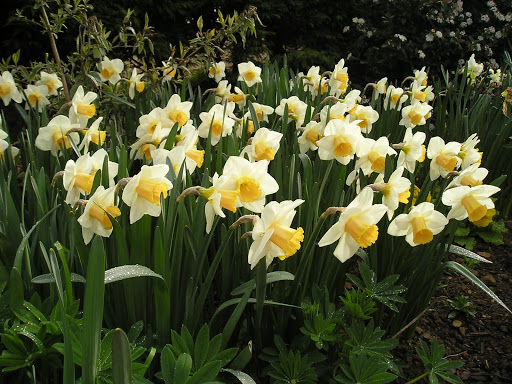
Despite a return to cold, blustery weather and barely a decent spring day so far this year, the daffodils (narcissus) have at last started to bloom.

I suppose it is because of the long winter weeks of relative stillness in the garden that we eagerly await the first signs of new life: the first grey green tip of the daffodil’s leaves pushing through the soil, the lengthening of the flower stalk, the swelling of the bud and the first hint of colour and, then, the pleasure of seeing the open trumpet in all its glory. And how apt that daffodils are one of the few flowers that have trumpets, for the sight of them, whether just a few or en masse, herald the start of the floral year with a fanfare of pleasure as great as any orchestral masterpiece.

Narcissus ‘Carlton’
Last autumn saw the planting of 8000 daffodils along the edge of a field that led to one of our client’s houses. The hard labour was well worthwhile both in physical effort and the time we have had to wait to see the result. When I plant like this, I mix the varieties to extend the flowering period – generally Carlton, St Keverne, Counsellor and, if I want a few white included, Ice Follies.

Combination of varieties to extend the flowering period
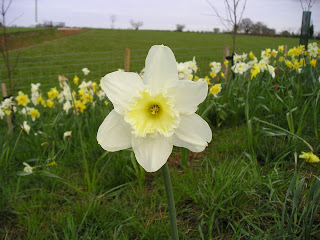
Narcissus ‘Ice Follies’

I can be incredibly opinionated, as many of you will know, where plants are concerned. I tend to prefer simple, unimproved varieties – fancy colours and doubles, or those described as having the largest flowers ever seen, can be left for others to grow. I can see no reason why, for example, a bloom “as big as your face” (as I saw one begonia described) is considered desirable. I am not keen on double daffodils as they nearly always seem to be top heavy. The slightest puff of wind or shower of snow and the heads sit face down on the ground where they remain to be eaten by slugs. Ice King is a variety I plant – although hardly to be described as a favourite – as it stands fairly well. In the photo one bloom has collapsed which rather proves a point.

Narcissus ‘Ice King’

Salome, is a bi coloured variety, the trumpet changing from a rich yellow to a peachy shade as it fades. I can never decide if I really like it or not. Here, in the photo below, it gives a warm glow to the border. However, what can be more charming the pure simplicity of Segovia? Its delicate yellow cup and pure white, evenly spaced petals (or perianth, if we want to be horticulturally correct) give it the look of a plant that has quiet superiority.
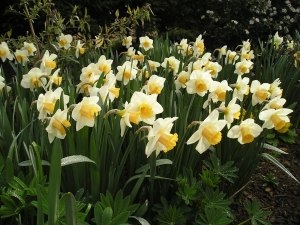
Narcissus ‘Salome’

Narcissus ‘Segovia’


Whatever your personal preference, daffodils are a joy and amazing value for money. With individual bulbs just costing pence each and increasing year by year if left to naturalise, it is always remarkable that after a few short weeks, we cannot wait to see them gone, being tired of their gently decaying leaves which interfere with our border work or mowing regimes.
.
When grown in grass, we mow the top growth off six weeks after flowering for, by then, nourishment has returned to the bulb and next years flowering is assured. Just to be doubly certain, we feed the grass grown bulbs with Autumn lawn food (minus the weedkiller, of course) immediately after flowering. And being the fickle species man is, six months later we will be back eagerly scouring the ground for the first signs of the daffodils and the forthcoming warmer weather once more.
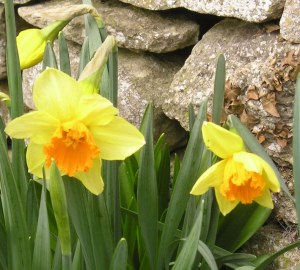
Narcissus ‘Burma’

Add to Technorati Favorites

Coronation Chicken, Anyone?

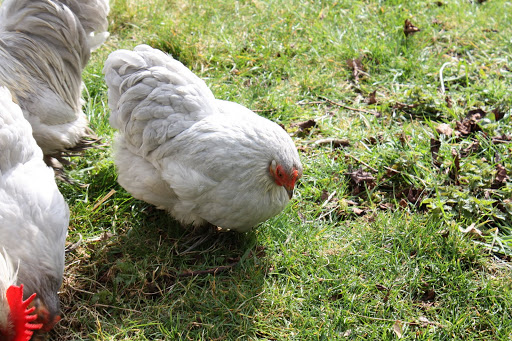
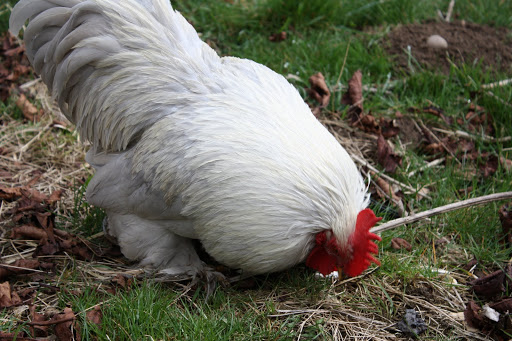
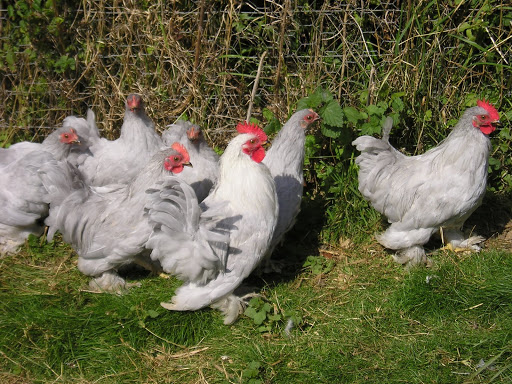
According to one tradition, the first Pekins were smuggled out of China and presented to Queen Victoria in 1837, the year of her coronation. Whether this is true or not is immaterial – it just makes for a nice story. The first Pekins (I have read that in the States and Canada the breed is known as Cochins) presented to me were a gift from a friend several years ago and we have been breeding them ever since, concentrating on the more unusual lavender coloured variety.

Pekins are a breed that is only found as bantams – which is fairly unusual in itself – the majority of bantam breeds have a ‘full size’ chicken version as well. Recognised most easily by their feathered feet they are friendly, almost cuddly, as the hens especially are rounded and dumpy, another recognisable feature.

The cockerels, too, are reasonably lacking aggression (some bantam breeds I have kept in the past would attack at every opportunity). They do, however, have their moments, especially at this time of year. I have found that the way to deal with this is to arm yourself with thick gloves and ‘teach’ the cockerel that you are not intimidated. As he attacks, I catch and pin him to the ground, holding him there for a few seconds: he soon learns that he is second in the pecking order to me and the only thing to be hurt is the cockerel’s pride. We have a number of cockerels (too many) and, surprisingly, they show no aggression to each other.

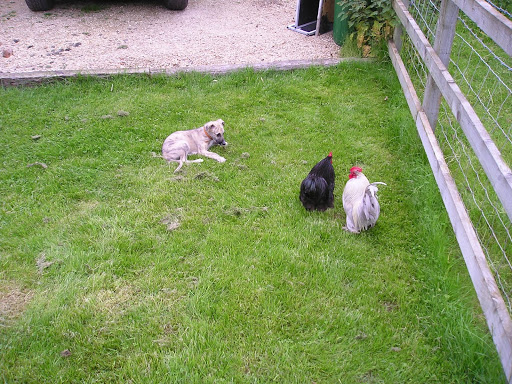
Penned away safely at night, during the daytime we release them when they have the freedom to roam the fields of the secret valley. It is extraordinary the distance they travel in the course of the day as they cross back and forth. With the odd handful of corn to entice them back, I try to keep them reasonably close to the house for safety but, even then, the fox takes them from time to time.

Ramblers dogs are also a threat – it is amazing the number of people that seem to think it is acceptable for their animals to chase livestock when they are in the country. She-dog, our lurcher, a type of dog specifically bred for hunting, had to be taught that chasing certain animals was unacceptable if she wished to remain living on a farm. From the earliest age she was made to sit amongst sheep and also the bantams, which made useful training aids, with the consequence that now she totally ignores them. It didn’t stop her stalking them when a puppy if she thought we wouldn’t notice!

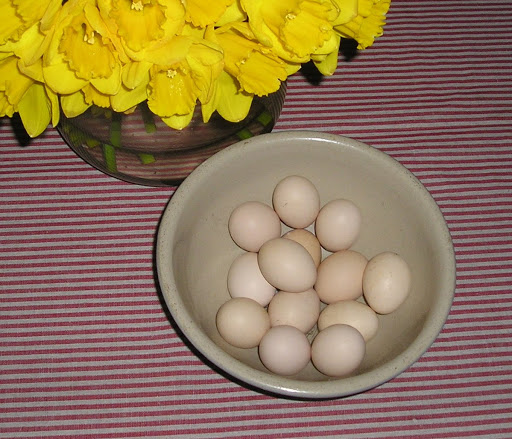
Would I recommend Pekins? Only with reservations. If it’s egg production you want, they are fairly useless although they lay enough for our requirements and the eggs are full of flavour with rich yolks. If it’s meat, then there isn’t much food on a bantam! If it’s just the lovely sight of a group wandering about the open fields, scratching in the hedgerows and dust bathing in the sunshine then yes, they win hands – or even feathered feet – down every time.

Coronation chicken? We don’t eat our bantams but I bet they would taste good and coronation chicken has to be one of my favourite dishes. If you want the recipe you will have to ask……

Add to Technorati Favorites

Frog March

As night falls we have started hearing the sound of tapping at our garden door. It happens every year as the weather begins to warm up and the days draw out. At first we were uncertain as to what it was for there was no-one there when we looked outside. Yet, as soon as the door was closed, the gentle knocking sound would start again.

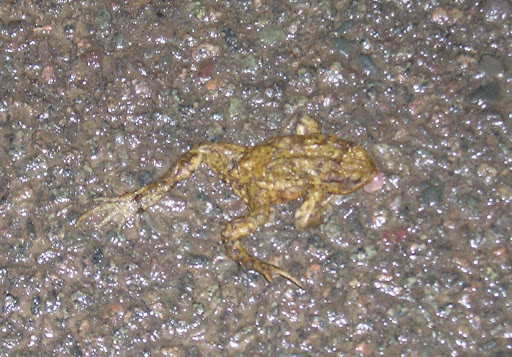
No, this is not the start of a scary story for on one occasion, leaving the door open a little longer than usual, into the house jumped a large frog, followed by several more. Now when we hear the sound we know that the frogs (and some toads) are on their march to their spawning grounds. Unfortunately this involves them crossing the little country lane just below our house and, although traffic is few and far between in the secret valley, each morning there are the squashed bodies of those that didn’t make it to the other side. The photo below may look as if it’s squashed but this one survived!

Quite why the frogs cross here is a bit of a mystery. The river is below and to one side of us as it meanders through the valley and around the house. The frogs are coming from the field up on the hillside and this isn’t a nice, moist and lush grass field that might be a bit of froggy heaven. The field they come from is plough – stony, brashy and rough. Or have they been hibernating in the old hedgerow and, if so why, when there are plenty of, what would appear to be, more attractive and comfortable places to sleep? Whatever the reason, they are off back to the river and pond and our house is in their way. If the doors are open, a constant flow of ‘hoppers’ pass through the sitting room and kitchen – or around it as we tend to keep them out. When our little cottage was built 150 years ago, was it built on an ancient pathway created by thousands of generations of frogs?

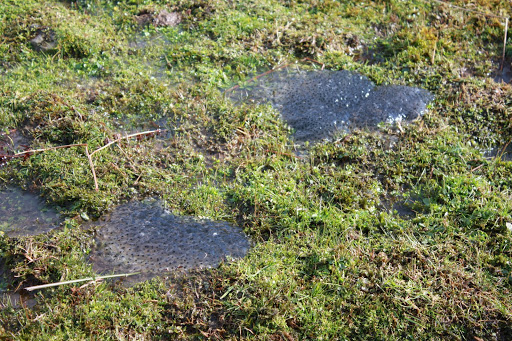
Oddly enough, on Exmoor, despite its harsh climate, the frogs spawn earlier than here in the secret valley. On a walk recently, we found this perfectly formed circular pond (perhaps an old sheep wash) on the moor and the frogs had already filled it with spawn. And in every boggy patch of the moor we found even more spawn. It rose above the water level in great mounds: perhaps it is the higher rainfall that prevents the spawn from drying out. However many frogs must there be and how many tadpoles will survive to return to breed in the future? The answer is mind boggling!

An update 27th March:

The frog march has ended as they have reached their destination. When I walk past the large pond that has been formed by a breach of the river banks, the noise of croaking is amazing. Everywhere you look there are frogs and toads amongst the submerged vegetation. In the last 36 hours spawning has commenced – we have snow showers forecast over the next few days but, hopefully, it won’t affect the spawn too much.
Add to Technorati Favorites

No More Cheese Rolling…..

Another great Cotswold tradition has come to an end thanks to Health & Safety issues. Cheese Rolling, which has taken place at Cooper’s Hill for centuries, has been banned.

As a protest and in support of the cheese makers, I went out today and bought some of the same local type they use. Not a 7lb wheel, more a slither but it was the gesture that was important. And it tastes very good too. My photo below does not do justice to the texture, the smell and oh, the taste: ecstasy on a biscuit!

So what is cheese rolling? A 7lb Double Gloucester cheese is set in motion from the top of the steep hill – and it can reach speeds up to 70 miles per hour – and us ‘locals’ then chase it. The first person to reach the bottom and cross the line is the winner. Yes, you are right -it is another barmy English tradition.

Cheese rolling is not for the faint hearted as competitors are catapulted through the air such is the force and momentum generated by the hill’s steepness. Injuries are common but not as serious as you might think – a few broken bones but that is of little consequence to those that want to take part. What is more odd, is that the Health and Safety concerns are not about the competitors but the spectators, for the event has become so popular that over 15000 people attended the last one, which is usually held in May. With our little country lanes totally jammed and the hill only able to cope with 5000 people, the numbers are quite obviously a problem.

But there is some good news: a revised version of cheese rolling may take place next year. If it involves eating the cheese rather than risking life and limb running after it, I may just enter the competition…….

[Acknowledgement to the Daily Mail for some of this information]

Exmoor: Stoke Pero Church

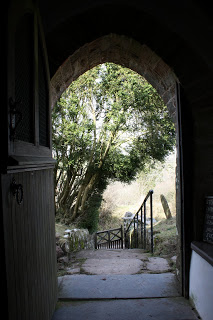
“Culbone, Oare and Stoke Pero, three churches where no priest will go”, goes the local Exmoor rhyme. Three parishes so remote that, before the days of motor transport, it took for ever to reach them, over some of the roughest and open terrain England has to offer. And of all the remote parishes, Stoke Pero has to win hands down, for even by car it is a difficult place to find. The narrow lanes cross wide expanses of moorland, close to Dunkery Beacon, the highest place on Exmoor. When you arrive at Stoke Pero, there is no cosy village green scene to greet you, for the church serves a widely scattered community. The wind cuts across the open land with an icy blast and even the church seems to be hunkered down against it, squatting in a dip in the land. As you enter the porch an old sign reminds you why.


Once inside the church, the simplicity of its decoration is the first thing that strikes you. Whitewashed walls with little in the way of decoration are the backdrop for ancient, worn pews and the most beautiful barrel vaulted roof. The red of the altar cloth at the far end almost seems an intrusion of colour, a scarlet splash of paint on a plain canvas.

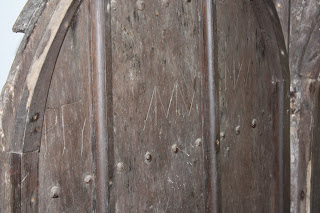
The doorway to the belltower is tiny – so narrow that only the slimmest can enter. Despite its size it has a degree of solidity about it. The main door to the church is the opposite – a massive piece of oak with letters and symbols scratched into its surface. To date, the meaning of these remain unknown. Any ideas, anyone?

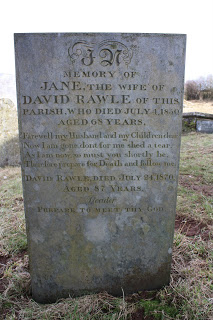
Leaving the church, the sun is shining again and the wind has eased. Many of the Exmoor tombstones from the 19th century have verses on them. Was this the fashion of the time or a peculiarity of Exmoor custom? This particular one seemed to me to be slightly malicious – saying “I might be dead but you’ll be next” – not a great comfort to the bereaved!

Add to Technorati Favorites

An Ancient Breed – The Exmoor Pony

Exmoor beckons at this time of year despite the harsh moorland climate. The landscape may be drab – the bracken and heather has lost most of its colour and the predominant colours are greys and fawns with just the occasional rusts and greens. However we were lucky – the sun shone for much of the time giving us additional blues from the sky and also from the sea, for the rolling moorland tumbles steeply into the sea on its northern edge.

The tiny clifftop hamlet of Countisbury – the far distant horizon is the south coast of Wales

The origins of the Exmoor pony date back into pre-history, for they are the oldest surviving breed in Britain and have remained virtually unchanged from the earliest days. They are perfectly adapted to surviving on the moor all year and, as can be seen from the photographs, look fit and well having come through the snow and bitter weather of the coldest winter for very many years. The ponies that live in the Valley of the Rocks (photo below) are used to seeing people for it is a much visited area with easy access despite its rugged terrain. The ponies of the high moor are far more wary.

On a walk across Brendon Common there would appear to be no ponies or wildlife of any kind at all. However, ponies and red deer are common and buzzards and ravens soar and call overhead. Despite appearing to be a rolling plateau, the moor is divided by deep valleys, locally known as coombes. The little stream at its foot is Farley Water, a remote and a beautiful place. If you look carefully at the lower photo you will see the ponies – totally camouflaged. Their coats are the colours of the winter bracken, their mealy coloured muzzles (which is one of the breeds identifying features) the colour of the bleached winter grasses.

There are fewer than 500 Exmoors left and the breed is recognised as being endangered. Many of these are kept as pets and riding ponies in other parts of the country and there are probably no more than 150 of these free roaming ones left on the moor. It took quite a while to approach this group but patience was rewarded by finding the herd at rest with two lying flat out in the first sunshine of the year.


Getting too close for their comfort, they were soon up on their feet and ambling away. In a matter of moments their camouflage made the moorland look empty once again.


Add to Technorati Favorites

The Real Vicar of Dibley

When a new comedy television series called The Vicar of Dibley hit British television screens in 1994, Dawn French, the actress who played the part of the vicar, was already a familiar and much loved face. Less well known, was the situation of the village of Dibley. Was it even a real place for surely nowhere could be that idyllic and unspoilt? Well, yes, it is real.

Turville, is a tiny village, hidden deep in a valley in the Chiltern Hills and is close to where I was born and spent the greatest part of my life (I only came to the secret valley nine years ago). The Chilterns is a place of steep hills, thick with beechwoods that seem to hang onto their very sides – many use the word in their names: Old Hanging Wood near Hughenden, for example. The villages, as a consequence, seem tucked away and forgotten, yet they lie only some 30 miles west of London.
Chalk and flint are the geological features that make the Chiltern Hills what they are and you are never far from them for the topsoil is thin, as all Chiltern children soon learn. Childhood games need chalk for drawing hopscotch and the flint cuts deep into knees when falling over. Flint also is, or was, the favoured building material for houses and Turville has plenty of fine examples, even the church is made from it.


No English village is complete without its pub and Turville is no exception. The Bull and Butcher stands almost in the road. Less common are windmills and Turville lays claim to Cobstone Mill (which really ‘belongs’ to the neighbouring village of Ibstone), standing high above on a steep hilltop. The windmill, like the village has been used in many films such as Chitty, Chitty, Bang Bang and the 101 Dalmatians. In the latter, when the road outside became covered in machine made ‘snow’ I drove past confused – for there were still traces of the snow and it was midsummer. We also had no water for several hours as the filming had used up the village supply in the making of it.

Turville is popular both with the film crews and visitors because it is so ancient and unspoilt. To get photos like these you have to visit on a grey, winter’s weekday as weekends, especially fine, summer ones, find the narrow lanes choked with cars. The village is so unchanged that even the warning roadsigns, like this old schoolchildren one are decades out-of-date!

Add to Technorati Favorites

Snowdrops and Aconites

The winter may have been one of the snowiest and coldest for a long time but it hasn’t made the slightest difference to the displays of snowdrops and aconites which are now at their best.

There has been a great upsurge of interest in the different varieties of snowdrops in recent times. To those of you who just thought there were singles or doubles, it may come as a surprise to learn that there are more than 500 named cultivars derived from the 19 or so species found in the wild. All are variations on a theme, basically white petals with green (or occasionally yellow) markings. The Royal Horticultural Society Plant Finder lists 251 as being available in the UK and prices for the more unusual ones start from a few pounds per bulb to large sums of money for the very rare. Personally I am quite happy with the simple purity of the common single type and am also aware of the difference, namely the ‘frilly petticoat’, of the common double one.
.

Now people get very excited by upturning the flowerhead so they can see a slightly larger speck of green on the bloom or scrabbling about on their knees in search of the single rarity that lurks amongst the ordinary – and good luck to them. Call me boring or unimaginative if you want but just give me bog standard Galanthus nivalis any day – preferably in their thousands. This really is a case where more is best as the carpets of snowdrops that flower in the garden of the house that was built for me two hundred years ago proves. (Readers of this blog may remember the post describing this house, along with the possibility that I have been reborn and finally reunited with it – most of the time I say this tongue-in-cheek, occasionally I half believe it). According to tradition the nuns that took over the property upon ‘my’ death planted them and now they have spread to cover many acres. Is there any better way for ‘me’ to be remembered?


Well, yes, there could be. My death next time round should be marked with the Winter Aconite, Eranthis hyemalis. There is something very cheering and positive about their bright yellow, perhaps it is because we crave some strong colour after a long winter. It is the same shade as the yellow daffodils and also of forsythia. By the time these have finished, weeks later, we are fed up with it and find it all rather garish. But in January we start to notice the little ruffs of green leaves pushing through the ground and, quite suddenly, the flower is opening its blooms. I hadn’t noticed before just how similar the individual flowers are to a buttercup when fully open. Not surprising really, as they all belong to the same family, Ranunculaceae. The aconite, I assume, is so-named beacause of the similarity of the leaf with the tall herbaceous aconites, Aconitum.

Neither snowdrops or aconites are native to the British Isles although both naturalise well and, given time, will occupy large areas. Conditions in this country must favour the snowdrop for snowdrop woods, whilst not common, are found with relative ease and are nearly always associated with a large country house. A much greater rarity is the aconite wood and I know of only one and heard of only one other. To visit it is an extraordinary experience for it is difficult to walk through the tens of thousands of plants that carpet the ground. This wood is also attached to a country estate but rarely visited and away from public paths. Perhaps that is why it has survived.

.

Sold as ‘in the green’, both snowdrops and aconites establish in the garden best when transplanted now, that is with their leaves and flowers still lush. A grower recently told me that snowdrops naturalise more quickly when aconites are grown amongst them, perhaps because the yellow flowers attract more pollinators. However, snowdrops in grass benefit from an annual feed whilst aconites detest it. A case of ‘you pays your money and you takes your choice’, perhaps?

Add to Technorati Favorites

The Ugly Thing in Life is Set Up….

It is strange how curiosity sets you down a path that you do not expect. From childhood I have been fascinated by a set of six embossed postcards that my father brought home from Germany after the Second World War. Like many of his generation, he did not like to speak of those times and the postcards were kept in an envelope inside his desk, only to be taken out and looked at on rare occasions. Consequently, the colours are as rich today as when they were first printed. I found them again recently, tucked away and near forgotten, for my father died 30 years ago and my mother more recently. And these days, what do we do when we are curious – we Google. First searches threw up nothing until I entered the text Das is im Leben hässlich eingerichtet which, translating to The ugly thing in life is set up, whilst sounding not very promising, turned out to reveal part of an epic poem by Joseph Victor von Scheffel, written in 1853. Don’t worry, I hadn’t heard of him either! The poem was The Trumpeter of Säckingen.

The town of Bad Säckingen (the Bad was added to the name in 1978) is in southern Germany on the banks of the Rhine, between the Black Forest and the Swiss border. In 1854 von Scheffel published his epic but it was not until some years later that it became popular. By 1884 it had been turned into an opera with music by Nessler and in 1918 a silent movie had been filmed using over 200 local people as extras. The opera is still performed today at the open air festival (Festspielgemeinde) in the town. There is also a museum devoted to Scheffel and the Trumpeter.
So who was the Trumpeter? Franz Werner Kirchofer was born in 1633, of common birth, who fell in love with Maria (Margarethe), the daughter of a noble family that resided in the town’s castle. Against all the family’s wishes the couple were finally married in 1657, raising five children. Their gravestone beside the cathedral tells the story of their love – a truly romantic tale and one with a happy ending. The castle still stands, now owned by the town, and is surrounded by public park and gardens, it also houses the Trumpeter museum.
A trip to Germany now seems probable at some time in the future so that I can see the castle that I first came across fifty years ago but only very recently knew existed. The power of the internet, as we all often mention in our blogs, never fails to throw up surprises. And it led me to the town’s interesting website where much of this information has been found. The postcards, by the way, which aren’t shown in any particular order, date back to 1910.

I leave the last words to von Scheffel: it seems appropriate to print it in its native tongue. If you want the English version or more verses, Google it!

Das ist im Leben häßlich eingerichtet ♦ Daß bei den Rosen gleich die Dornen steh´n ♦ Und was das arme Herz auch sehnt und dichtet ♦ Zum Schluße kommt das Voneinandergehn ♦ In deinen Augen hab ich einst gelesen ♦ Es blitzte drin von Lieb und Glück ein Schein: ♦ Behüt dich Gott, es wär so schön gewesen ♦ Behüt dich Gott, es hat nicht sollen sein

Add to Technorati Favorites

The English Hurricane: 20 years on

English people constantly talk about weather. It’s in our makeup, our genes – we can’t possibly walk past someone, even a total stranger, without saying something about it. We can’t help it, no matter how much we realise that the person isn’t that interested (or even doesn’t speak English). We rattle on about too much rain, too little rain, too much sun, no sun, cold for the time of year, how warm it is. And to prove the point, this post is about weather and, no, I’m not going to apologise about it. By the way, we had a fantastic sunset in the secret valley a couple of days ago.

I think the reason we may behave like this is because English weather is nearly always gentle. The landscape that makes up England is beautiful and can be dramatic but not in the way of so many other countries. Take the USA, for example. Where’s our Grand Canyon, our towering redwoods, our Rocky Mountains, our Great Plains and our Niagara Falls? We have them in miniature and, perhaps, that is just as well as we are such a small country. And likewise, our weather: we have heatwaves, we have floods, we have blizzards. But they are rarely anything truly spectacular (except to those poor people affected by them, of course). And so when we were told by the weather men in 1987 that reports of a hurricane were completely exaggerated, we believed them totally. And despite the fact that much of the country was hit hard by it when it arrived, my part of the Chiltern Hills where I lived at the time was not much affected, even though it is one of the most wooded parts of the country.

The night in January 1990 was different. This time we had winds, whilst not as severe as three years earlier, which created total havoc with the already weakened root systems of the trees. Great swathes of the magnificent beech woods that are the very heart and soul of the Chilterns were flattened in a couple of hours. (I am reminded by my partner, that as the rest of the world cowered in their beds as the trees came crashing down all around, I woke up to say “a bit windy out there” before falling asleep again). As dawn broke the true damage could be seen.

Fast forward twenty years to 2010 and the woodands are transformed. Those of us that remember the 200 year old beech know that the majority are gone and, in their place, are new trees of mixed species. It will be many years before the magnificence of the woods return but they are healing. This photo below is taken from the same spot as the one above. Some of the biggest old stumps have been left, too difficult to move – time has hardly changed their appearance apart from their ‘roof’ of mosses.


One of the unforeseen benefits of the hurricane is the increased amount of light reaching the woodland floor, for beech trees cast a dense shade where little can grow, other than where the canopy is lightest. Apart from the view to the valley below, which was unseen before, many wild flowers are better now than ever. Roll on April when we can see the blue carpet of tens of thousands of bluebells disappearing into the distance.

Oh! And I nearly forgot to say, the weather today is a mix of sunshine, cold winds, rain and sleet. Don’t forget to tell the next person you meet!

Add to Technorati Favorites