One of the joys of going away is the pleasure of returning home. The main road that cuts across our bit of the Cotswolds follows the ridge of the hill, which gives the appearance of being plateau like. There are few hints that just a little way off to the side is the secret valley and the little lane leading to it gives few hints either.
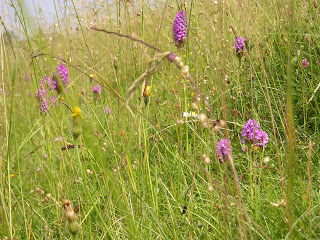
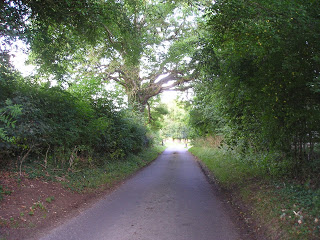 To call it an avenue would be rather pretentious, but the roadside plantings of beech and cherry create the first thought that you may be going somewhere rather special. And as you begin to pass beneath their canopy, the hills start to rise on either side. These are rarely, if ever, treated with any chemicals and wild flowers, including orchids, abound.
 But there is still no hint of our little, winding river. Then, as the avenue ends and on a sharp bend there it is! The first glimpse is of the old sheepwash, where the river was widened and deepened although still almost jumpable, for everything about the secret valley is miniature: the hills, the river, the road. Beyond the sheepwash come the meanders – the photo of these snake like bends are in the blog’s header title.
 Our little stone cottage lies further along the road – and this is now the original old drove road, for the one that we have travelled so far has probably only been in place since about the late 1700’s. More of the drover’s in another post. Below is the view from the house looking back towards the meanders – we may only have just one other house nearby but there are dozens of sheep for neighbours!
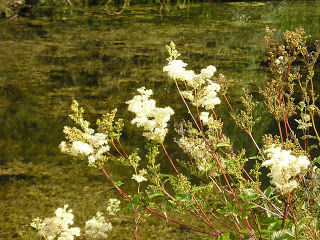
 Just below the cottage, the river passes beneath the lane and snakes its way around us, travelling through lush meadows. Watercress and meadowsweet grow along the water’s edge and little rickety, make-do bridges made from old telegraph poles criss-cross from one bank to another. Ancient, gnarled willow trees line the banks, more about these can be found in an earlier post: Willows
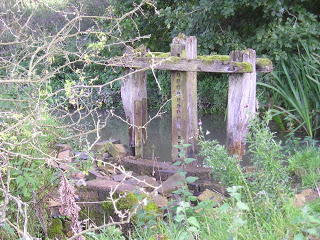
 And tucked away beyond the bridges are the remains of the old mill workings. The culvert is barely noticeable until the river levels rise and the water diverts towards the mill. We’ll travel there another day.



 The pieces with circles carved into them appealed greatly, especially those with water running through. Their smooth interior face contrasted beautifully with the rough, natural surface of the outer faces.
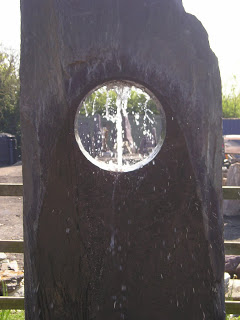 But then I liked this group of large standing stones – they reminded me of the prehistoric ones that litter our English landscape. The Cotswolds have a good number of these, so it made good sense to continue the tradition. I have written about some of these local stones in the past and we hold them in great affection:
  Time for a reality check. How could we lift these giants into place when there was no easy access? And so we went for this one – as large a piece as two of us could manhandle (and it nearly killed us in the process, as did digging the hole for the reservoir in root infested ground) – but we were happy with the end result.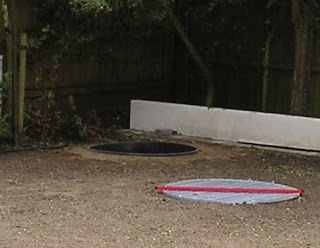

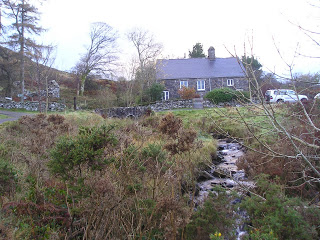 The weather started out unseasonably mild with beautiful blue skies from dawn to dusk giving clear views of the tops of the mountains. Of course, compared to the mountain ranges of the world, the mountains of Snowdonia are not high, Mt. Snowden being the highest at 3560ft. The photo below shows the Cadair Idris range at 2831ft, one of the most popular areas for hill walking. Often mistaken for an extinct volcano because of its crater like top, it was actually formed by glaciation during the last Ice Age.
 The Pecipice Walk is less well known and being close to ‘our’ house is a favourite walk. The path clings to the side of the mountain with a sharp drop to the valley and river below. Further along the path the view opens out to give wonderful views to the sea in the far distance.
 The return route, on the other side of the mountain, gives the totally unexpected view of this small lake. The water is quite clear and tranquil and with its reflections of forest and sky, a pleasant place to rest and ponder.




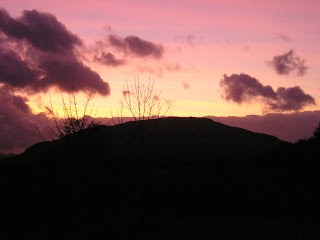
 Sometimes it seems as if flowers have inspired the sunsets! Here is the rose Rosa x odorata ‘Mutabilis’ trying to outdo another mountain sunset. This rose starts with the most intense pink bud and, as the flower fades, turns to the softest apricot, ending up with this wonderful colour combination.
 This old mossy wall was the starting point for a mini parterre – the ‘moss’ is made from the box (boxwood) framework, the ‘stones’ from variegated Iris and Cotton Lavender. The wall reminds me of our garden wall in the secret valley (Sunday 20th September 2009) but this one is in north Wales and is a hard, cool grey and silver granite unlike our soft, mellow Cotswold stone. This planting is tiny compared to the usual grand parterre designs and has been used to link two levels of a small garden.


 So let your imagination take you where it will. Sometimes the combinations don’t work but, more often than not, there will be some exciting discoveries to be made and a lot of fun will be had along the way. And make sure you tell me all about them……

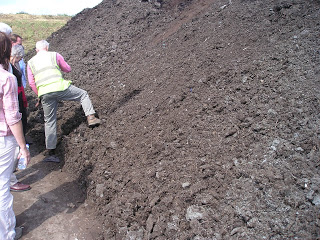
 Green waste from the garden, as well as other material that will rot down, is brought by lorry to the site and piled up in long lines – windrows -stretching into the distance. The size of these heaps dwarf the heavy machinery used to move it.
  Unlike the compost heaps of our gardens, the temperatures that are built up destroy all harmful bacteria, noxious weed roots and seeds, resulting in a clean, fertile and very marketable resource. The compost shown here is destined to be spread on fields and has made a significant reduction to the amount of synthetic chemicals and fertilisers being used on the farm, so there is a double positive effect to the environment.
 This method of composting can be recreated on a smaller scale. The compost heap below belongs to a large garden which produces a lot of garden waste, whether from flowers and vegetables, from leaves or from the sheep which help to keep the grass low.
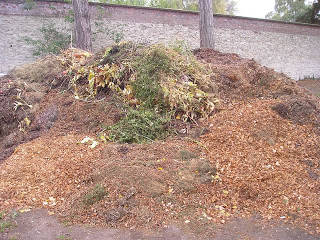 The result is the same: although the temperature does not reach the same height as with the industrial scale, the compost quality is excellent.
  These timber compost bins, with removeable fronts, I make for my own garden as well as those of clients. Ideal for the smaller plot, they last for years, and keep the heaps tidy and easily managed. For smaller gardens still, there are numerous plastic compost containers….
 …..so, there is no excuse! Get composting and help the environment as well as saving money on all those expensive bags of fertiliser…..
 October on Exmoor saw weather changes from day to day: one moment mists, another driving rain and cold winds but, more often than not, warm sunshine. How many times do walkers get fooled into wandering on the moor only to find the mists creeping up the deep coombes (as the valleys are called here) before spreading out across the wider, open spaces where landmarks are few and bogs many? To my knowledge, deaths in the bogs only happen in fiction but a cold plunge to chest height in sticky, peaty water and a twisted ankle miles from anywhere has the potential to be fatal.
 The wild ponies of Exmoor are one of Britain’s oldest native breeds and survive all year finding their feed on the moor. During this month they are gathered up by the local landowners and checked over, branded and the foals weaned. These are normally sold at the annual, local pony sales although this year, for various reasons, the sales have been cancelled leaving a gap in the social calendar, for the sales are one of the great meeting places of the widely scattered population.
 Another meeting point is the local hunt. On Exmoor, there are packs of staghounds as well as fox, for the moors are one of the few places where the Red Deer still run wild in England. With the change of law, only two hounds now hunt the deer, the unfortunate creature having been selected by the Harbourer – a local person who knows both the deer and the moor inside out. Once the correct deer has been found and separated from the rest of the herd, the beast is shot. This is a necessary culling as the population is continually increasing to the detriment of both the moor and the deer themselves.
  Hunting is becoming ever more pouplar as the crowds and cars, pictured, prove. As soon as the hunt moves off across the moor the crowds get left behind and, with the hunt hidden deep in the coombe, the moor seems deserted once again.
 More on Exmoor to follow…..