If you could only choose three things to demonstrate why you love a place, what would they be? This is the tricky question that is being asked by The Guardian in conjunction with enjoyEngland, the English tourist authority ( http://www.guardian.co.uk/enjoy-england ). Well, here are mine:
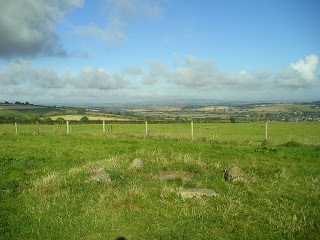
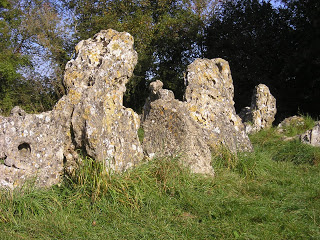
The King’s Men stone circle forms part of the Rollright Stones and have been a meeting place since they were set here 4,500 years ago. In early morning light they appear mysterious and brooding but when the sun strikes them their colours and markings are awe inspiring. Rest here a while, at a time when you can be alone, for the feeling of peace is palpable.
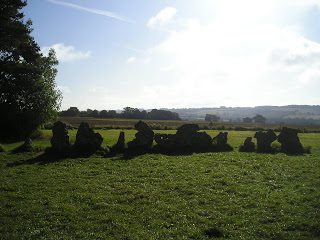
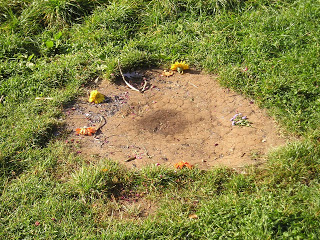
And give back to the soil an offering, (when we have taken so much away), as others have done from the beginnings of time and continue to do so. Single flowers placed at the centre of the circle have a calm simplicity…
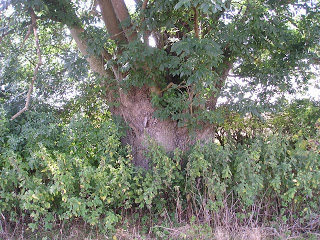
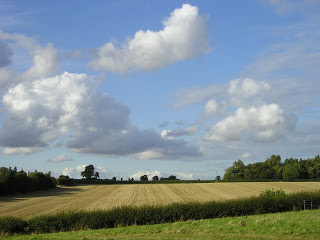
2. Nature. It is impossible not to be aware of nature in the Cotswolds, whether it is the magnificence of old trees, the deer crossing roads in front of you or the cloud formations of our large skyscapes. This ancient ash tree has watched centuries of agricultural change take place and, despite modern farming practice, still stands proud in a hedgerow dividing wheatfields.



So, come and visit the Cotswolds and decide for yourself. And, in the meantime, select three things that make your special place, special.

 But it is the walls dividing fields and gardens that are perhaps the most iconic of all the Cotswold scenes. Probably nothing more than heaps of stone thrown to one side when the fields were first cleared, centuries ago, it was the obvious choice for building and permanent too – a good stone wall lasts for decades with virtually no maintenance. However, neglect took its toll.
 A dying art, the old stone walls fell into disrepair until recently when, with an upsurge of interest, building of new walls and repair of the old, has seen the work revived. New, younger blood learning the skills from the dwindling number of ‘wallers’ and with classes available to anyone, means that for the time being at least, the craft seems safeguarded for the future. Here a new walled garden – the classic feature of the English country house – is being created.
 The use of a timber frame as a guide creates the ‘batter’ – the name given to the sloping sides that gives the wall stability. The photos below shows the frame and a new wall being built. Modern techniques tend to use a bit of mortar at the base and also cementing in of the ‘header’ stones along the top. The latter is partially to make the wall more weatherproof (how the old timers would shake their heads at that!) and also to prevent theft of the stone, which is expensive and does disappear at times. Sometimes, the headers are left off altogether and a concrete cap is placed instead which soon weathers down to give an acceptable appearance.
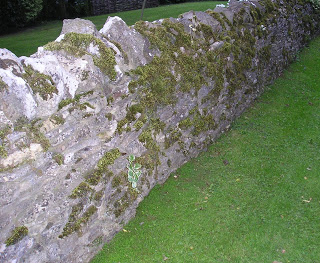
 Our garden in the secret valley has a wall that has stood for over 150 years, below. It will be many years before new walls have the depth of colour and the mosses and lichens of this one.
 Daffodils, or Narcissus if we want to be technical, are one of the first of the bulbs to be planted for they start to send out their roots early in the season as we discover when we dig them up by mistake when weeding. Like all bulbs, they need to be planted in generous quantities to look their best. The photo above shows several hundred lining the old lime avenue of the house I described in an earlier blog ( 21st August 2009:
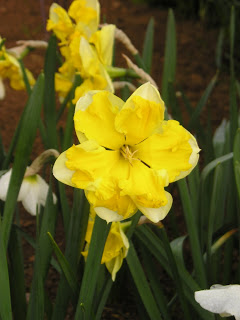
  I am not keen on double varieties – they tend to be top heavy and spend most of their time prostrate. However, I find the Orchid flowering types don’t do this and are quite fascinating to look at. The one above is Dolly Mollinger, the one below Chanterelle.
  Bicolours can also be tricky to my biased eye. I don’t like Scarlet O’Hara (below top), so vulgar in the border! But Jetfire, which is a similar colour combination works well in this wilder setting and is beautifully enhanced by the white bark of the Jacqmontii birch tree (below bottom).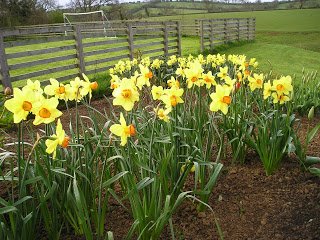
 Scent is all important in any flower and in narcissus it is especially welcome after the bleak winter months. Few scented winter flowers have the freshness of the smell of a vase full of Cheerfulness – a stonger coloured version is Laurens Koster.
 But perhaps the best daffodils of all are the ‘bog standard’ yellow ones. That’s what spring is all about. (Although to be honest, I don’t totally agree with that statement – my favourites are the miniatures but I don’t have any photographs! I will have to take some next March and persuade you all then……)

 A thin, worm ridden, timid creature, when we got Daisy May. We realised she would be too light for us to ride but we took delight in building up her trust and her body. She was sold some time later to be a brood mare.
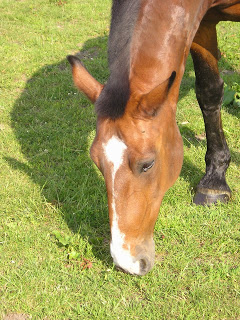
 Barney is the wonder horse and still going strong after many years. A 17 hands 3″ Irish Draught he is a great companion. His main picture is to the right but he also appears on the one below with Squirrel and Polly, the 30 year old pony that we ‘inherited’ along with the paddock. Barney is another great jumper and will tackle the biggest fences with ease – but in a kind and considerate sort of way.
 Squirrel was another danger horse who would try his utmost to throw you off when you first mounted him. Providing you stayed on he would settle down and be a good lad for the rest of the day. However, in the end he proved too hot to handle and, just when we were wondering what to do with him, he had to be put down. A good thing probably – I think he might have killed us in the end.
  Now white with age, Henry our grey Irish Draught and Rambo, our young Shire horse, along with Barney make up our stables at the moment. Rambo is ridden occasionally and has all the makings of a good horse as he gets older. Enormous, towering over Barney, but a gentle giant.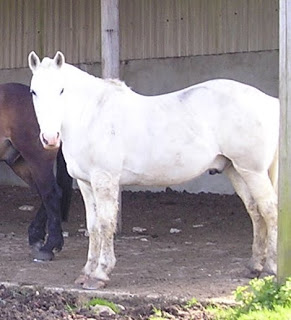
 Carriage driving is not for the faint hearted either! This belongs to a friend and it is great fun when travelling off road and at speed….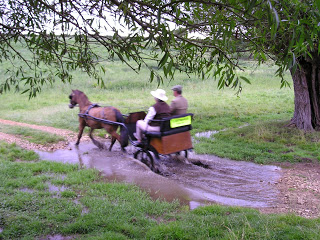

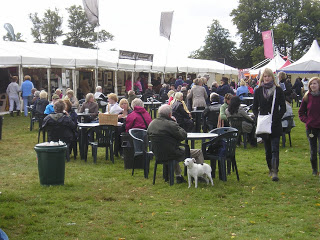 A walk around the cross country course is always exciting: working out how you would approach the jumps, most of which are huge and difficult, talking with the competitors and admiring the thought and work that goes into creating the course. I should say that my riding skills are nowhere good enough (nor my courage level high enough) to compete but my partner has in the past and jumped into the dreaded “leaf pit”. The photograph of it below hardly does justice to the 4ft drop into the pit – the horse takes off just to the right of the guy, then immediately tackles either one of the two smaller jumps and then gallops off down the course. It is quite nerve wracking to watch, especially if it’s your partner doing it! If I was on my horse, Barney, I would be another 7ft higher still – it makes me feel quite ill just thinking about it!
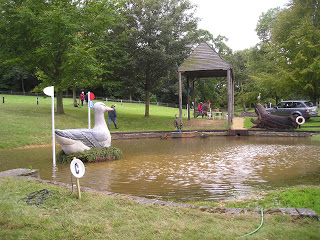
 The water jumps are always a popular place so I visit them before the competition starts. People congregate here, not to see the jump carved to look like a duck, but in the hope of seeing the riders fall and get a good ducking!
 A crowd of over 140,000 watch the eighty or so horses compete over four days – the guy with the best view is certainly the television cameraman – I always watch most of it on the giant screens that are strategically placed around the grounds.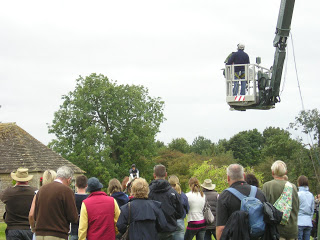
 There is always a place, ‘though, where you can get a clear view of the jumps and, if the crowds get too much, a quiet place under the magnificent sweet chesnut avenues.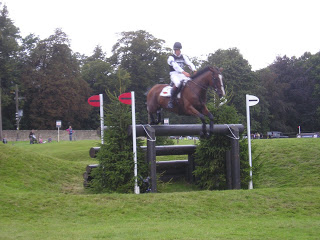
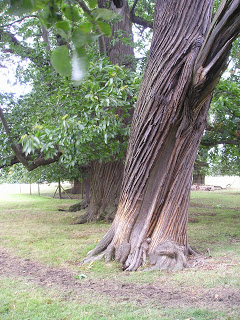 Burghley House is a magnificent Elizabethan building built – and virtually unaltered – in the sixteenth century and set in hundreds of acres of parkland. With over 80 major rooms, gardens and the park, it is well worth a visit. Although still privately owned (by the same family since being built) it is open to the public throughout the summer months.
 Great excitement! She-Dog has met her husband! The potentially lucky lad may ‘marry’ her around Christmas and, with luck, we will become proud parents in the spring of 2010. Burghley is a good place for romance too – watch this space!


 Wild flower meadows are quite easy to create whether on the big scale or in the garden. Of course, the species rich meadows of the Chilterns and Cotswolds have evolved over centuries and have a wealth of insect and plant life to show for it. In the garden you just have to be a little more realistic and be grateful for every bug and butterfly that comes along and colonises it. Hopefully wild orchids, like the Pyramidal orchids below, will arrive too.
 The golden rule of all meadows is to reduce fertility. As soon as fertility rises, usually through feeding, the grass sward thickens and out competes the flowers. The photo below is of ‘our’ bank and shows, as a golden haze, the unimproved grassland – thin, tall and sparse and too steep for the tractors to get onto and spray. The brighter green grass above and below is where the tractors can reach, the grass has been fed and, consequently, there are few wild flowers.
 Late summer wild flower meadows require a different maintenance regime to those which have an abundance of spring flowers and, as it is that time of year, I shall concentrate on the former. Now is the time to cut the ‘hay’ whether on the bigger scale such as in this orchard or, by hand, in the garden. It is important to get the timing right – you need to leave it late enough for the seeds to fall from their heads to increase more. Leave it too late and bad weather knocks the grass and plants flat to the ground when it becomes a devil of a job to cut. The difference is a task that is a joy to do or one that is totally hateful!
 Hardheads, the local name I learnt for Knapweed in my Chiltern Hills childhood, is a favourite flower of mine. Although normally purply-mauve (above), I found this bi-coloured one and some pure white flowered ones growing in an old meadow – rarities, indeed. I live in hope that they might appear one day in the secret valley!
 Neglect does not create a meadow. If you don’t work at it all you will end up with is a sheet of docks, nettles and thistles as has happened in this garden here – not a pretty sight!
 So sit back, enjoy the summer warmth while you can and relax……
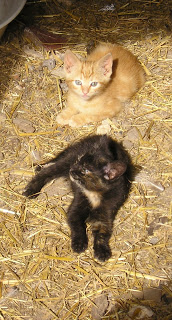

 Or lie amongst the corn and gaze at the sky…..



 The house won’t let go. Several weeks later I am asked to return on a regular basis as an adviser and I have been travelling there ever since – the last time to supervise the planting of lavender hedges and, when I return, I still get that warm, contented and happy feeling. Do I believe in reincarnation? I’m far too much a sceptic to say ‘yes’ but there are too many coincidences to give an emphatic ‘no’…..

 The layout of this garden near the village of Oddington is beautifully illustrated from the air – I wonder if the owners were ever so fortunate to see it from above?
 The walled, organic gardens at Daylesford, too, are shown to be quite an unusual shape: the intricate design of the parterre giving way to a less formal area uses this to its advantage – a study in good design.
 Saxon ridge and furrow field systems are also shown in sharp relief. There are a lot of these around the Cotswolds and they can originate from as far back as a thousand years although many were worked up until a couple of hundred years ago. Now preserved and retained as pasture, often the drier, warmer ridges have quite different wild flowers growing compared with the damper furrows.
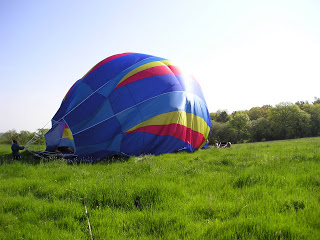
 We ‘touched down’ in a field not far from the small town of Stow-on-the-Wold, shown in the photo below. Stow is famed for its twice annual Gypsy Horse Fair where travellers gather from all over the UK to buy and sell ponies and catch up with news. It is also well known for its exposed climate as in the local saying “Stow-on-the-Wold where the wind blows cold”.
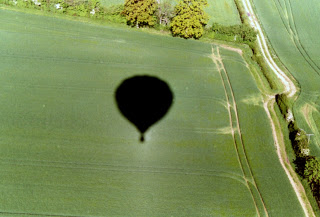
 The balloon’s shadow chasing us is a favourite photo as also is this one of the burners in full flame!