Unknown's avatar

About johnshortlandwriter

John the Writer: It is as natural for me to write as it is for me to eat or drink (sometimes I forget to do both when the ink is flowing). For years I would write – then shuffle the words until satisfied - then shred it. The act of writing was enough. One day I thought that seemed just a tiny bit silly so saved them on the computer and Life in the English Cotswolds was born. That was in 2009 and to my surprise people like you came along and liked what you saw. Since then, over 180,000 of you have visited, commented and become ‘friends’. Thank you! 2012 saw the very first Chipping Norton Literary Festival take place with which I was closely involved for several years. It was there that I was approached to write my book, Why Can’t my Garden Look Like That?, published a year later by How To Books, an imprint of Constable & Robinson and now part of Little, Brown. Over the years, my blog has expanded to cover many topics ranging from travel to family history and much else. This has brought a new audience with it for which I am both delighted and grateful. John the Gardener: The earliest image of me gardening is one of me as a child of about four using – well that’s too strong a word for it – a rake. Gardening is in my blood for every member of my family have been keen amateur gardeners (I am the only one doing it for a living). Whether it was aunts, grandparents or my father, everywhere I went they were in the garden tending flowers and vegetables or in the greenhouse potting up seedlings. Indoors, around the table, the talk was all about plants. Despite that, I started off my working life (apart from a short stint on a remote Exmoor farm) in the rag trade – selling men’s and women’s fashions. All the time, the great outdoors beckoned so it was off to horticultural college as a mature student before becoming Head Gardener to several large, country estates. That was twenty years ago now and every day I realise that not only did I make a great career move but just how lucky I am. Another sideways step brought me to where I am now – designing gardens, showing others how to garden and looking after gardens. And, of course, writing about it. John the Countryman: I have lived in the country all my life. As a child I spent my time exploring the lanes, woodlands and orchards of the Chilterns, that range of glorious, chalk hills cloaked with beech trees. Each spring they become carpeted with tens of thousands of bluebells. It was here, as a small boy, that I learnt about the wild plants and animals that share our world, a magical place. In more recent times I moved to the Cotswolds – only 50 miles away yet a completely different range of hills both geologically and in character. Here, there are wide open views and skyscapes, dry stone walls and rushing streams and some of the prettiest towns and villages in Britain. I now live in a tiny stone cottage beside the winding river in the photo above, all tucked way in a secret valley. Bliss. Horses and dogs play an important part in my life too. More bliss. John the Explorer: The description is a tad exaggerated but I have had my moments. I guess that spending a night in a hostel for down and outs in the Rocky Mountains (how did I mistake it for a hotel and why didn’t I leave, I often ask myself), being stuck in a blizzard in an Indian reservation at 3 am in the morning in the far north of Canada or getting caught up in an attempted coup in Sudan probably allows me some claim to the title. Recent years have seen my exploring closer to home, in considerably more comfort and a lot less scary. Well, in principle, it is. I spend a lot of time on Exmoor, my spiritual home of over 45 years, and Ireland is another place that I visit frequently. Strangely, things still don’t always seem to go quite to plan …

Stll Waters Run Deep

A little, winding river flows through the heart of our secret valley. As far as rivers go it isn’t still, it isn’t deep and it certainly isn’t wide – you can jump across it in places. But it is important: in its very short journey of 15 miles from start to finish it passes through several historic country estates where it has been broadened to form ornamental lakes for fishing and pleasure. The photograph on the header of this page shows the river just above our home.

You wouldn’t believe

there was our valley in this photograph. It’s just the other side of this hedge – no wonder no-one knows it’s there! It’s also time to meet She-dog, our lurcher, who insisted in being included in the photograph.


Outside our cottage

and just downstream, the river has formed ‘our’ lake (really only a little larger than a pond, but that description doesn’t seem to give it enough dignity) where, today, I watched a kingfisher perched on a low bough of a willow. A flash of iridescent blue and orange and it was gone, its shrill call giving warning to all around.

Pretty as they are, the lakes were built for a purpose. In winters past, their frozen water would be carried to specially built ice houses: pits made from brick or stone, deep underground. When full they would be sealed making ice available throughout the summer months. Of course, this was only available for the wealthiest few and it was in the kitchens of the gentry that ice cream recipes were devised – a luxury unimagineable to the poor cottagers. They often struggled to feed themselves the most basic diet.
<
Many of these ice houses still remain, usually derelict and unsafe, but sometimes restored and open to the public to view.

Add to Technorati Favorites

Speaking to a 5000 year old soldier…..


I stopped off in Enstone today, a small village just a few miles north of Blenheim Palace. I wanted to meet the Old Soldier, the name locals give to the largest of the Neolithic stones that were placed here 4000-6000 thousand years ago.

All that remains of the burial chamber are these few stones but they are mighty impressive nevertheless. Hidden amongst trees, it is easy to pass them by even when you know they are close, despite the Old Soldier being 9ft high.
>
Our Cotswold landscape must have looked very different when these stones were placed here – and how did they place them with only manpower available? Of course, this is one of the big mysteries of Stonehenge, the world famous stone circle 2 hours drive away. Whereas Stonehenge gathers hundreds of visitors each day, hardly anyone calls in to pay their respects here and it feels a silent and lonely place.
Legend has it that if you cannot find the stones – and sometimes you can’t – the Old Soldier has gone to the village pub to quench his thirst. One assumes in human form which is a scary thought!

Old Mont lived just a mile from the stones in Fulwell, a tiny hamlet of no more than a dozen houses. The very end cottage, made out of our local, mellow stone was his house, now marked by a ‘blue’ plaque . The local shepherd has become quite a celebrity since his death some years ago: a story teller persuaded to put his tale into a book [Lifting the Latch] and his few possessions into the Woodstock museum. He would find his own fame far more surprising than meeting the Old Soldier down the pub and the hollyhocks flowering by his garden wall far more impressive!

Add to Technorati Favorites

Of Blue Skies and Blue Flowers

The sun is shining and the rain has stopped! The wind is still cool but it feels good not having to walk with head tucked low against the elements.

The lane outside our cottage is narrow and winding as it climbs out of the secret valley. To the right the river follows its meandering course below us and, on the left, the lane is bound by an ancient hedgerow, full of wild flowers.

Crane’s-bill is in full bloom there now and has been for a few weeks. This is the Geranium pratense of gardens and flowers so profusely in this part of the Cotswolds it could be our county flower. In places the banks and verges are dominated by this plant creating a sea of colour – and when the wind moves it, it has the appearance of rippling water.

In the garden I like growing it amongst shrub roses where it can hook onto the thorns and peep out amongst the more exotic rose flowers. Once the first flush of crane’s-bill flowers are over, I cut the whole plant down to ground level and within days new leaves and flowers start to appear again. And when the contractor’s cut the roadside verges it is always the crane’s bill that shows through first.

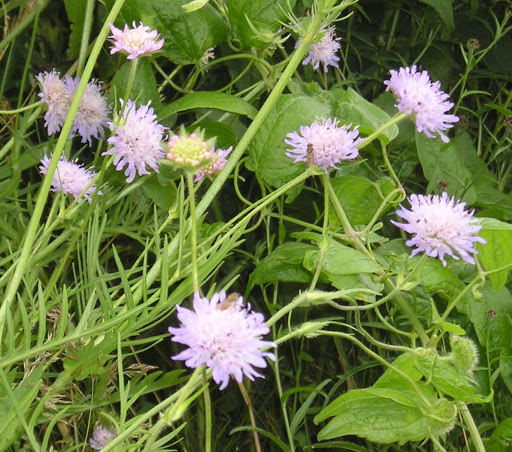
Blue seems to dominate this hedge. First the blue-purple of the dog violets and bluebells, now there is also wild scabious with its little powder puffs of flowers. It would be interesting to try to recreate this mixture in a meadow garden. I shall have to persuade a client to let me have a go!

Add to Technorati Favorites

Rain, Rain & even more Rain!

After all the scorching weather we had a little while ago, now it won’t stop raining. Suddenly temperatures dropped from the upper 80’sF (scorching for England!) by 20 degrees and, day after day, we have woken to grey skies and rain lashing the windows. There have been times when the sun breaks through to remind us that it is still mid summer and we can get on with our outdoor work in comfort.

The garden has been overdue for a tidy as working with other people’s gardens takes up most of our hours at this time of year. This weekend we were able to cut the tall hedges and they look a lot better for it – not a job I especially enjoy but a sense of satisfaction once done.

Hand clipping box hedges is a joy however, providing you have plenty of time for accuracy. There is nothing worse than a ragged, uneven finish to a formal hedge. Powered hedge trimmers rarely do a good enough job and the slow, rythmic sound of hedging shears is mesmeric.

I have heard that the dreaded box blight is in the area. Let’s hope that it doesn’t find any of ours!

Welcome!

A very warm welcome to my first blog!

Over the coming weeks and months I hope to share with you life in one of the most beautiful and unspoilt areas of southern Britain. You will see from my profile that I have many interests, mostly connected with gardening and the countryside and these will be included. I do hope that you will find the time to visit regularly and to offer your feedback so that I may improve the blog further. So, please, get emailing!

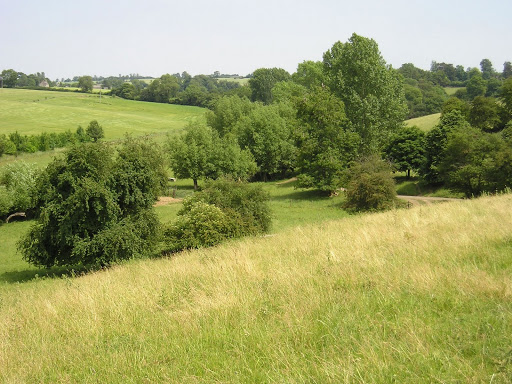
This is the top of ‘our’ secret valley , taken in high summer – a place full of wild flowers and birds and, nowadays, the occasional otter. More of that to come……