
This year is proving to be one of extremes. Weather wise, first it was snow, then late frosts, then rain, more recently drought and scorching temperatures. And it also seemed to be a similar situation with wildlife. The tree blossom and wild flowers have been amazing with every month some new blooms outrivalling those of the previous month’s.
.
 .
.
Now it seems July is to be the month of wasps. There are hundreds in the garden, indeed probably thousands, and they are everywhere. And if that isn’t bad enough, the very hot weather we’ve been having seems to have made them far more aggressive. Normally they do not prove to be troublesome until the fruit ripens in late summer, this year it’s different. And I’ve already been stung once this week which is very bad news for me – I suffer from a severe reaction, although never yet been hospitalised, fortunately. I keep my drugs and sprays with me – and a mobile phone, in case help is needed – and also keep my fingers tightly crossed. This, like the recent advice from a doctor to stay indoors, is not too much help for someone who earns their living by gardening.
. .
.
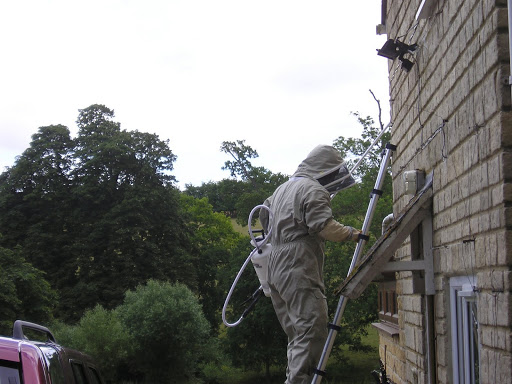
Fifteen wasp nests in four days has surely got to be a record and so I have been keeping the pest control man busy. It’s a pity to destroy them but better I get them first than the other way round! I remind myself that during the spring they live on aphids and the like and are, therefore, valuable pest controllers themselves. Then I remind myself of the pain, discomfort and swelling, and sometimes injections I get, and they have to go.
. .
.
I commended myself on my bravery, taking these photos, as the wasps went into the attack as the chemical jet entered their nest. But such is my devotion to get a new post out – I’m becoing a true blogger news hound!
.  .
.  .
.
My heightend awareness of wasps this week made me also notice these holes in a deserted timber garage. They were the homes of a small colony of wood wasps. Unlike the common wasp which live communally in their hundreds (the largest of our nests turned out to be the size of a football), wood wasps are more solitary, each one occupying their own chamber.
.  .
.
They are quite placid compared to their aggressive cousins and, I believe, unable to sting a human being. The largest ones look terrifying but this species was small, about half the size of the common wasp. There are about 500 species of solitary wasp in Britain and I can’t identify any of them. I felt totally at ease photographing them inches away and they completely ignored me. Perhaps word had got round what I did to them further down the secret valley!
.
 .
. .
. .
.
I’m now looking forward to the first frosts and a wasp free winter!

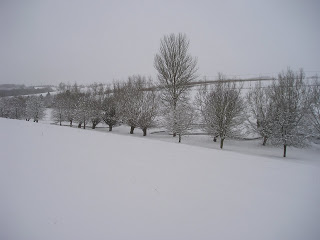

 I’ve had to rely on a ski trip photo for really deep snow
  Our snowfall – just a dusting despite the warnings of up to eight inches forecast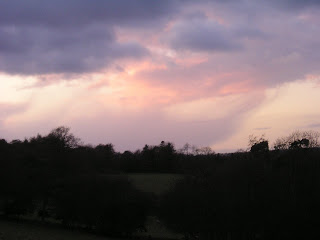

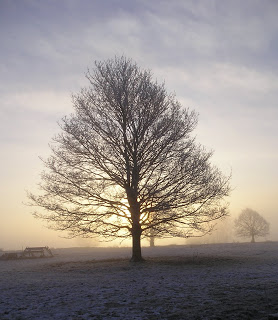
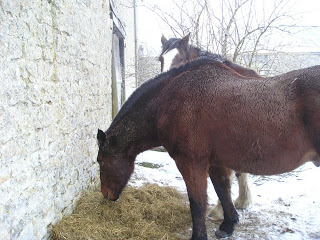
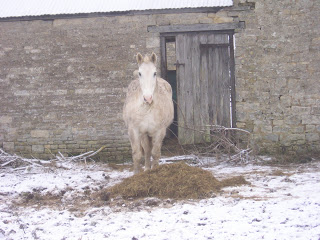 “Why does he keep taking all these photos?”
 The holly is one of those species (relatively few in number) that have separate male and female plants. To have a crop of berries like the ones above it is necessary to have both sexes growing within pollination distance and, of course, it is only the female that will carry berries. In our garden we have a magnificent specimen of England’s wild holly, Ilex aquifolium, but being male, is relatively boring (that isn’t meant to be as sexist as it reads!). It towers above roof height and doesn’t deserve the space it takes other than it provides us with shelter and a place to hang the bird feeders. How much better value it would be if it had been a variegated leaf sort. Fortunately there are lots of berried hollies growing wild in the secret valley for picking.
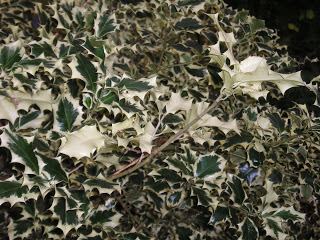 This holly is Argentea Marginata, a variegated form of our native holly and, being female, carries berries, making it very garden worthy. The occasional stem has pure white leaves. Ilex aquifolium grows naturally throughout the west and south of Europe, North Africa and west Asia. An oddity of holly common names is that many of the male plants have female names, and female plants male, so the variety Silver Queen, for example, is a non-berrying male. Very confusing!
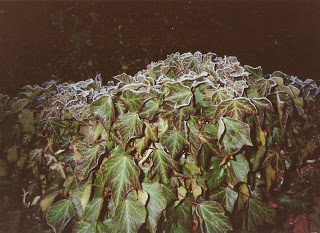 I’m not a great fan of Ivy. There are lots of different leaf shapes and colours but, generally, I think they are rather dull, although, I do admit, they can be useful in dark, dry corners where little else will grow. This wild ivy, Hedera helix, above, growing on a corner of our
  Mistletoe – the plant of lover’s, or at least, of those trying to sneak a kiss from the unsuspecting. In England it grows wild, often on fruit trees in orchards or on poplars and always difficult to reach. Invisible for much of the year, once the tree’s leaves have fallen in the Autumn, there it is hanging in great bunches high, high up.
 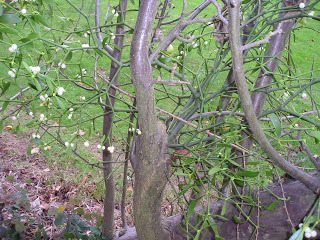 It is rare to find a plant growing as low as in the photo above and it gives a great opportunity to see how it attaches to the host plant. There are no visible roots: the stems of the mistletoe just grow from the trunk like young branches, easily identified by their dull green (as against brown) bark. Does mistletoe, Viscum album, ever kill the host tree? I have never seen this but I have seen quite sizeable boughs torn off a tree by the weight of the mistletoe bunches and, one assumes, the mistletoe must sap the strength of them. But then, mistletoe does carry green leaves so must produce a certain amount of its own food. Any idea, anyone?



 Life in the English Cotswolds
