
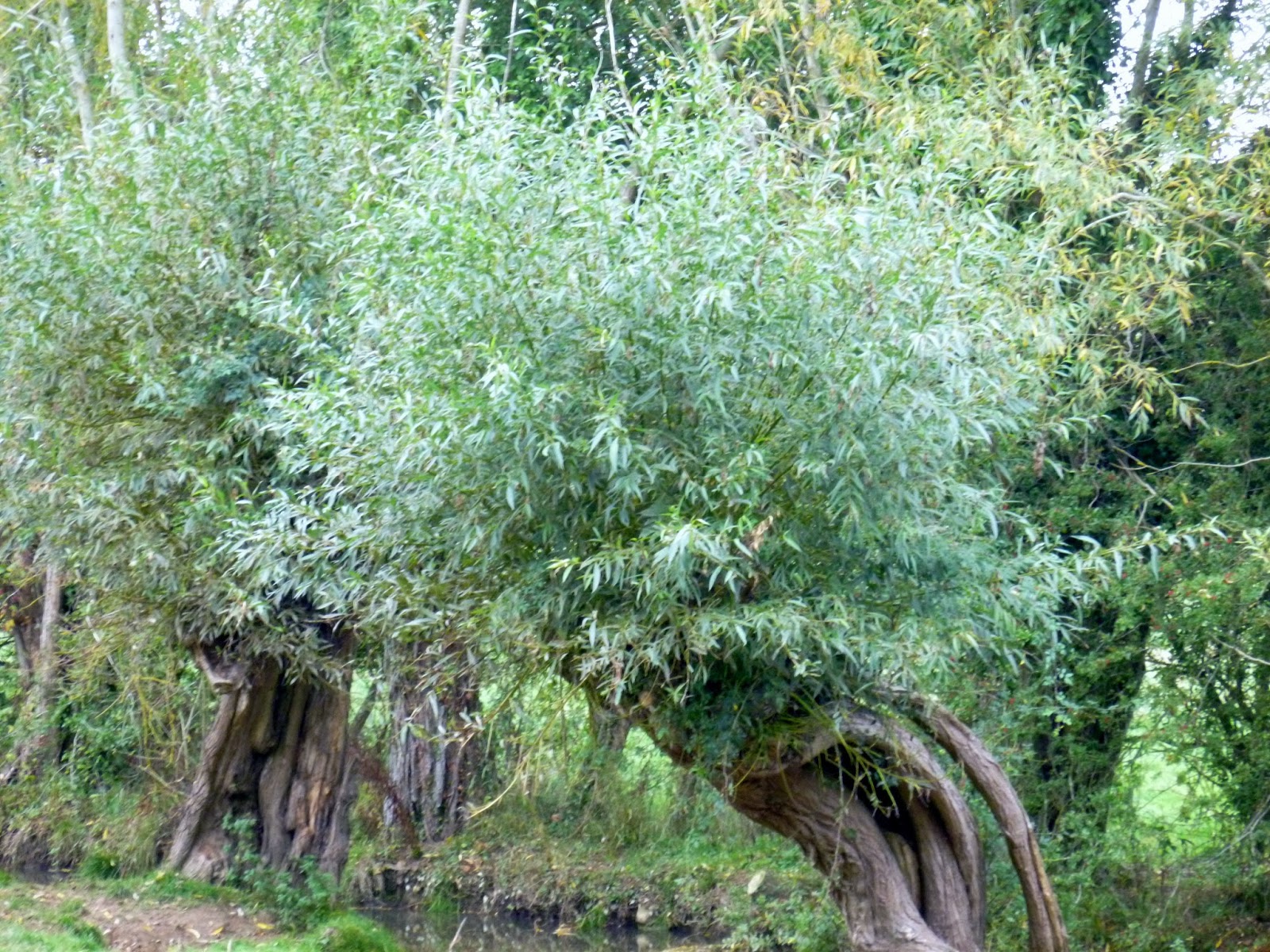
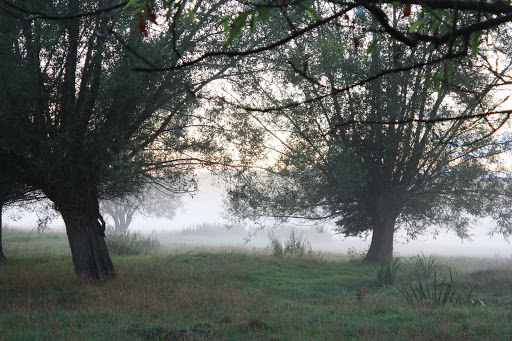
We’ve gone naked here in the secret valley. Not literally, it’s far too close to winter for that sort of jolly jape. While we are busy putting on additional clothes, our lovely old willows that line the little winding river have been stripped of their top growth.
Gone are their branches and along with them so have the other plants that find a home in their mossy nooks and crannies. It is pollarding time and the lovely view that I have been used to seeing every day since I moved here twelve years ago has changed dramatically. Fortunately, all will return in abundance in due course.

Change, of course can be a good thing and it is interesting how spacious and full of light the valley now seems. It is also a good thing for the trees for without this drastic treatment they sometimes topple in storms. Pollarding actually prolongs the life of those tree species that can cope with such treatment. As a child I played in a woodland known as Burnham Beeches and there, some of the pollards are over five hundred years old. These old pollards support a huge variety of wildlife that has adapted over the centuries to the practice.


Pollarding has been carried out since man’s earliest farming days and can really be considered as just another form of pruning. By cutting the branches above the reach of grazing animals, they can regrow without being damaged. In the past, cattle were allowed to roam in these ‘wood-pastures’ and in Burnham Beeches the practice has been reinstated after a gap of about two hundred years. The White Park cattle above are kept at Adam Henson’s, Cotswold Farm Park. Now endangered, this native breed is being used to graze freely in the Beeches which keeps the forest floor clear and improves diversity.

The timber from pollarding was used in a number of different ways. Most commonly, it provided firewood, with the trees cut every fifteen years, which is the case with our willows. Sometimes the pollards were cut more regularly to provide fodder for livestock.

It is surprising to see just how quickly new growth restarts. Without branches and leaves to support, the energy rising through the tree from its root system forces it to renew itself. The willows below are a little further up the valley and were pollarded in the early spring of this year. As can be seen they already have grown six feet or more.
Pollarding of trees isn’t just practised in the depths of the country. It is frequently carried out in our towns and cities as street trees are kept within bounds. In the garden it is a good way to create interest – even a smallish garden can create a lime walk to give all year round appeal. The coloured stem willows are especially good for this purpose too as they quickly become dull and too large when left unchecked.
It will take time to become used to seeing the ‘new look’ secret valley, now so very different from the image that has become the trademark of this blog. In the past, cutting the trees would have given a team of men work for the whole winter. Now one man with a machine achieves it in five days. It may not be such a romantic notion but watching the tractor driver manipulate the claws of the cutter at every conceivable angle demonstrated that the old techniques have been replaced with skills every bit as impressive.


If you fancy trying your hand at pollarding you have a few months left to build up your courage! In the UK and those places with a similar climate it should be completed by mid-February.
More reading: click on the links below
Conservation of ancient pollards
Chalara in ash trees
White Park cattle and other endangered farm breeds
Adam Henson’s Cotswold Farm Park











 Now the snow has gone and the seed heads, not quite as pristine as before, have recovered but still live up to their name. They swamp the lower, trimmed parts of the hedge and it is hard to imagine how the field maples, hawthorn, sloes and other woody plants cope and survive.
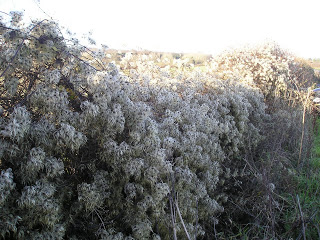 Three days ago, the birds began singing once more and claiming their territories so Spring can’t be too far off (I’m being optimistic here as the sun has been shining too). The Old Man’s Beard will, like garden clematis, be amongst the first to send out new shoots and leaves, in the process knocking off the old seedheads. For a short while the hedge has the opportunity to flourish before the clematis flowers appear. Although blooming in their thousands, individually they are quite insignificant and it is the scent that is the more noticeable – not the perfumed scents of roses and honeysuckles but honeyish, delicate yet cloying too, somehow. And the bees, especially the bumblebees can’t get enough of their nectar.
 As a young child, I once stayed at a schoolfriend’s grandparents and in their garden was an old chalk quarry, long disused. I would love to revisit it now but have no idea where it was – for years I believed that the village was called Loose Chippings. It was only once I grew up that I realised that this was the sign that council workers had put up after repairing the road outside their house! There must, I assume, have been trees in the pit – and it was certainly overgrown – for the Old Man’s Beard had sent up its long vines high into the tree tops. Where this happens the stems become quite thick, strong and woody and we spent many happy hours there swinging through the trees Tarzan-like. They have also done this outside our cottage, where the hedgerow has grown into treelike proportions, although only once, (when I felt confident no-one would see me), have I swung on them. The exhilaration was the same and proves the thought that men never truly grow up but remain little boys that need to shave.
 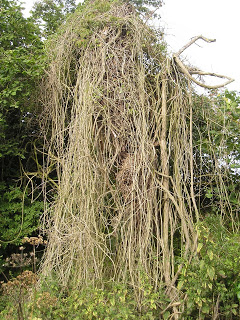 Virgin’s Bower and Traveller’s Joy are two of the other common names given to Clematis virginica. The first, one assumes, because of its tendencies to drape across other plants: how lovely it would be slumber gently beneath its shade on a warm day, breathing its scent and listening to the bees droning. According to my Herbal, in the past, wayfarers would make tea to soothe away headaches, wrap soaked cloths around their weary feet and treat blisters and saddle sores. No wonder it was called Traveller’s Joy. I love to think that along our little lane, the old drover’s would sit on the grassy roadside banks and rest, perhaps stopping for some ale at the old inn next door to us (and our only neighbour), their sheep and cattle drinking from the secret valley’s meandering river. Did they also think, like me, this place to be so special? I doubt it, somehow.
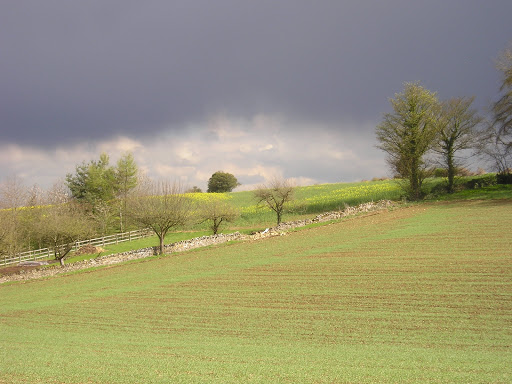
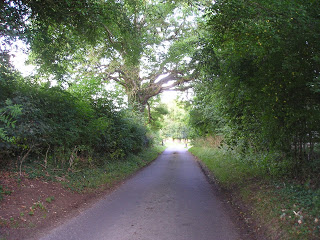 To call it an avenue would be rather pretentious, but the roadside plantings of beech and cherry create the first thought that you may be going somewhere rather special. And as you begin to pass beneath their canopy, the hills start to rise on either side. These are rarely, if ever, treated with any chemicals and wild flowers, including orchids, abound.
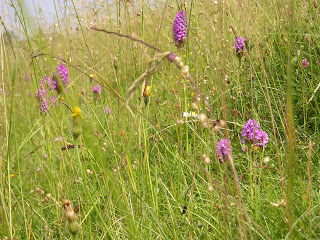 But there is still no hint of our little, winding river. Then, as the avenue ends and on a sharp bend there it is! The first glimpse is of the old sheepwash, where the river was widened and deepened although still almost jumpable, for everything about the secret valley is miniature: the hills, the river, the road. Beyond the sheepwash come the meanders – the photo of these snake like bends are in the blog’s header title.
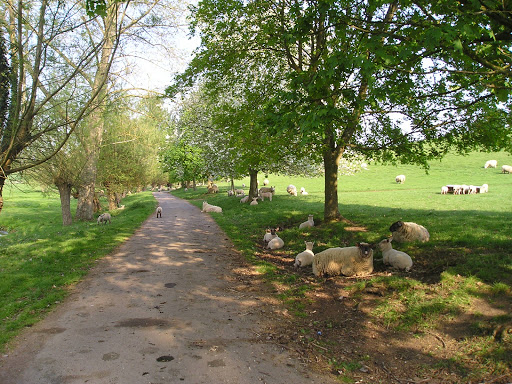
  Our little stone cottage lies further along the road – and this is now the original old drove road, for the one that we have travelled so far has probably only been in place since about the late 1700’s. More of the drover’s in another post. Below is the view from the house looking back towards the meanders – we may only have just one other house nearby but there are dozens of sheep for neighbours!
 Just below the cottage, the river passes beneath the lane and snakes its way around us, travelling through lush meadows. Watercress and meadowsweet grow along the water’s edge and little rickety, make-do bridges made from old telegraph poles criss-cross from one bank to another. Ancient, gnarled willow trees line the banks, more about these can be found in an earlier post:
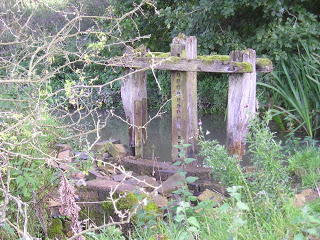
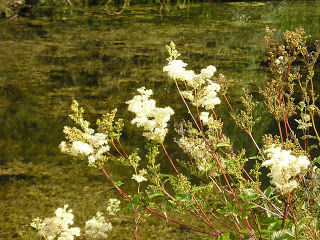 And tucked away beyond the bridges are the remains of the old mill workings. The culvert is barely noticeable until the river levels rise and the water diverts towards the mill. We’ll travel there another day.
 Life in the English Cotswolds