
Much has been written about creating wild flower meadows in recent years. Many gardening magazines infer that somehow you must be lacking in something if you don’t rush out there and then and rip up your precious lawn to create the daisy and orchid studded turf depicted in medieval tapestries. There is much to be said for doing this (and I’ve done a few in my time too). However, the reason why most of us don’t do it is purely down to lack of space and time, and also most of us still like to see a reasonably weed free patch of green grass at the centre of our gardens. Now don’t get me wrong, anything that reduces the amount of chemicals used and encourages wildlife has got to be a good thing and our gardens, collectively, could – and should – make one vast nature reserve.
But why restrict yourself to wild flowers in grass? Very few articles suggest using them in herbaceous borders, or amongst shrubs, but I have been planting them like this for some years now and the results can be terrific. This flower border in the photo was taken 14 months after planting and looks very much like a traditional, English flower border. But there are some differences and those are the wild flowers intermingling with the more usual garden plants.
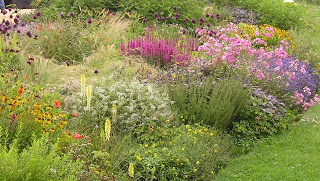
Purple Loosetrife, Lythrum salicifolium, grows wild in boggy places and by stream edges so seems an unlikely candidate for the border. I have found it to be a great choice which copes well with ordinary soil conditions. In the hot, dry summer we have had this year they have only grown to about half their normal height of 3-4ft but their cerise colour and longevity have still made them a worthy addition. In the photograph above they are the bright pink ‘blob’ in the centre, growing separately to the surrounding plants.

Here they are being grown as a companion to a bright pink ground cover rose, a combination that I’m not so keen on (even though I did plant them myself). They are a bit too strident and close in colour for my taste but others have stopped and admired them so there they remain.
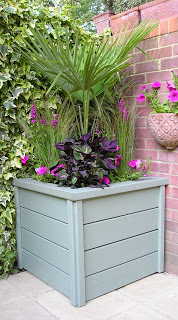
I have also experimented growing them in containers where, of course, you can easily give them the moister conditions they would naturally prefer. Here, their colour makes them quite an exotic addition to the matching colour petunias, the purple leafed coleus and tropical looking (but hardy) palm.
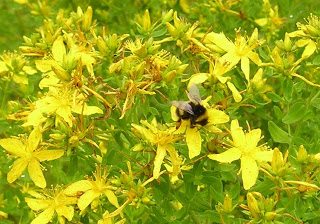
Another reason for growing wild flowers is that, of course, they are great attractants of the local insects. A clump of the herbaceous St John’s Wort, this one is Perfoliate St John’s Wort, Hypericum perfoliatum, always are covered, when in flower, with bees and other beneficial, pollinating insects. The flowers are miniature versions of the shrubby Hypericum ‘Hidcote’ and all the better for being small. In the wild, they grow (as many wild flowers do) quite happily amongst grass and other plants. In the garden, I find they combine well with Wormwood, the tall, shrubby Artemisia.
.
The pale blue flowers of the Field Scabious, Knautia arvensis, continue for months on end and combine well with most other colours. Growing them in the garden gives you the opportunity to notice them in detail. In the wild, it is less likely that you would see how the outer petals of the flower uncurl before the inner ones. Grow them with exotic looking Icelandic poppies or, like here, with tall, purple, Salvia.
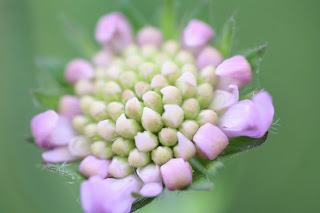

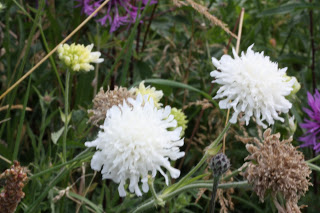
Wild flowers often are generous with their flowering, not only in the quantity of blooms and their exuberance. Sometimes, they offer a ‘sport’. The most common variant from the norm is white and this pure white version of scabious was a delightful bonus. I like the way the buds start off a creamy colour.
Recently, I have tried growing Lady’d Bedstraw, Galium verum. It is working quite well and the rather acid yellow looks good with lavender. In fact, this flower is all the better for propping itself up against its neighbours as it is a bit inclined (in an unlady-like way) to sprawl, otherwise.

 One word of caution about introducing wild flowers into the garden: sometimes, they like garden conditions just too much. If in doubt, plant a small number of plants in an area where you can control them should they take off. I didn’t do this with one of my childhood favourites, Toadflax. It took me three years of painful weeding to extract the final pieces from more delicate plants. I have gone back to admiring it where it belongs – along roadside verges and on waste ground.

And one final plea: please grow and enjoy our native, wild flowers but do source them from a reputable nursery. Apart from being illegal to dig or uproot a plant in the wild, as gardeners we are supposed to conserve plants ……





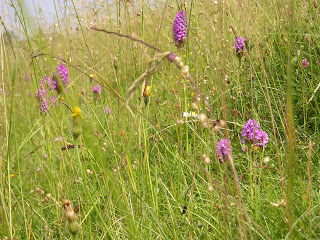
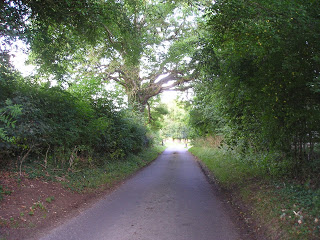 To call it an avenue would be rather pretentious, but the roadside plantings of beech and cherry create the first thought that you may be going somewhere rather special. And as you begin to pass beneath their canopy, the hills start to rise on either side. These are rarely, if ever, treated with any chemicals and wild flowers, including orchids, abound.
 But there is still no hint of our little, winding river. Then, as the avenue ends and on a sharp bend there it is! The first glimpse is of the old sheepwash, where the river was widened and deepened although still almost jumpable, for everything about the secret valley is miniature: the hills, the river, the road. Beyond the sheepwash come the meanders – the photo of these snake like bends are in the blog’s header title.
  Our little stone cottage lies further along the road – and this is now the original old drove road, for the one that we have travelled so far has probably only been in place since about the late 1700’s. More of the drover’s in another post. Below is the view from the house looking back towards the meanders – we may only have just one other house nearby but there are dozens of sheep for neighbours!
 Just below the cottage, the river passes beneath the lane and snakes its way around us, travelling through lush meadows. Watercress and meadowsweet grow along the water’s edge and little rickety, make-do bridges made from old telegraph poles criss-cross from one bank to another. Ancient, gnarled willow trees line the banks, more about these can be found in an earlier post:
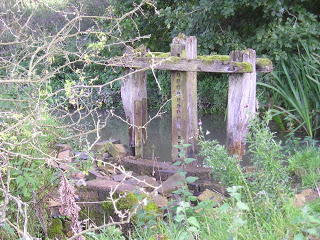
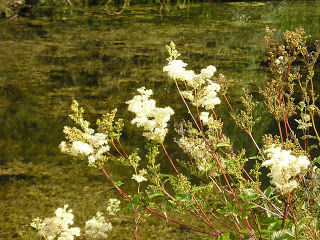 And tucked away beyond the bridges are the remains of the old mill workings. The culvert is barely noticeable until the river levels rise and the water diverts towards the mill. We’ll travel there another day.
 Wild flower meadows are quite easy to create whether on the big scale or in the garden. Of course, the species rich meadows of the Chilterns and Cotswolds have evolved over centuries and have a wealth of insect and plant life to show for it. In the garden you just have to be a little more realistic and be grateful for every bug and butterfly that comes along and colonises it. Hopefully wild orchids, like the Pyramidal orchids below, will arrive too.
 The golden rule of all meadows is to reduce fertility. As soon as fertility rises, usually through feeding, the grass sward thickens and out competes the flowers. The photo below is of ‘our’ bank and shows, as a golden haze, the unimproved grassland – thin, tall and sparse and too steep for the tractors to get onto and spray. The brighter green grass above and below is where the tractors can reach, the grass has been fed and, consequently, there are few wild flowers.
 Late summer wild flower meadows require a different maintenance regime to those which have an abundance of spring flowers and, as it is that time of year, I shall concentrate on the former. Now is the time to cut the ‘hay’ whether on the bigger scale such as in this orchard or, by hand, in the garden. It is important to get the timing right – you need to leave it late enough for the seeds to fall from their heads to increase more. Leave it too late and bad weather knocks the grass and plants flat to the ground when it becomes a devil of a job to cut. The difference is a task that is a joy to do or one that is totally hateful!
 Hardheads, the local name I learnt for Knapweed in my Chiltern Hills childhood, is a favourite flower of mine. Although normally purply-mauve (above), I found this bi-coloured one and some pure white flowered ones growing in an old meadow – rarities, indeed. I live in hope that they might appear one day in the secret valley!
 Neglect does not create a meadow. If you don’t work at it all you will end up with is a sheet of docks, nettles and thistles as has happened in this garden here – not a pretty sight!
 Life in the English Cotswolds