
Designing your own garden is, I think, far trickier than designing someone else’s. One of the problems is that emotion gets in the way. I’m not suggesting that there shouldn’t be passion in design but far too often one is tempted to hang onto things that have no place in the new design, whether it is a plant or a pot – or in this example, far too many pots!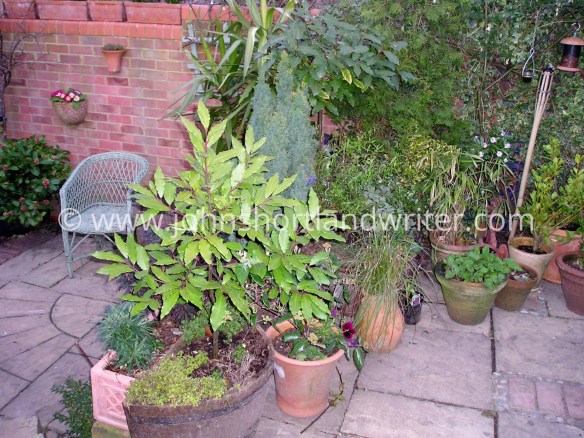
The garden shown here was quite a good size but difficult for it was on a gentle slope and there was need for a central path to lead to sheds at the far, and lower, end. To avoid splitting the garden in half, large circular stepping stones had been randomly placed but the result was a confusing mish-mash of shapes and plants. The only place the eye focused on was the rotary washing line!
You don’t need to be a great artist to design a garden. A simple method is to take photographs, turn them into black and white (for colour confuses the eye) and pencil sketch over them. Here, we were quite keen to improve on the circular theme.
The final result was a series of circles, each with a low retaining wall and a step down to allow for the change in level. Trellis was used to screen the sheds. Although the hard landscaping took up more of the garden than before, the remaining planting area was far more useful and could be crammed with plants. The little walls made perfect low seats.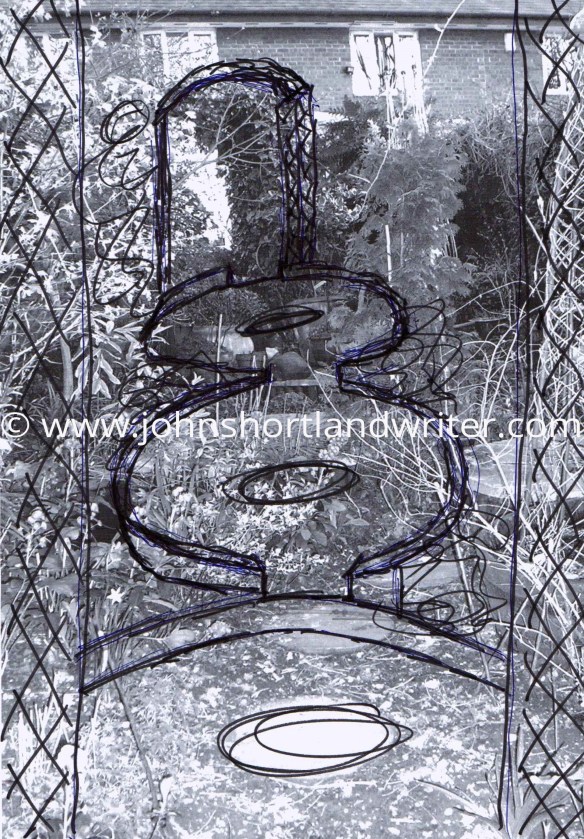

And what happened to all the pots? Most of these were discarded in favour of a large, custom-made, L-shaped timber box. This gave a better space for planting as well as making a feature in its own right. Water-retaining gel crystals were added to the planting soil reducing the need for regular watering.
You can find more ideas on all aspects of easy, trouble-free design, plants and gardening techniques in my book, Why Can’t My Garden Look Like That? To take a peek inside the covers click on the link here.


 .
. .
. Going…..


 The lavender hedge not only gave me plenty of lavenders, it also softened the curved and hard edge of the stone path that extended the whole length of the border. An unforeseen bonus was with the reflected heat from the stone – it seemed to heighten their scent, filling the air along with myriads of bees and butterflies that were attracted to it. Another good bee plant was Purple Loosetrife, Lythrum salicifolium, a native plant normally found in damp places and by pond edges. This is a garden cultivar ‘Robert’, which is shorter than the type and was quite at home in ordinary garden soil. The ground cover rose ‘Magic Carpet’ was a close match in colour, the result quite strident but tempered by the lighter centre of the rose flower. I wouldn’t describe this as me at my most subtle!
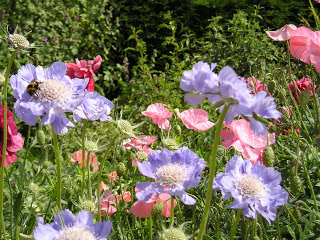
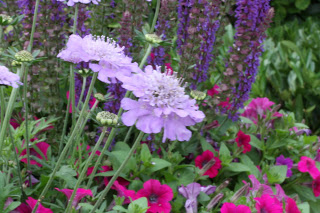
 A much quieter planting and taking cottage style to it’s extreme was this combination of Icelandic poppies and scabious. I didn’t notice the bumblebee at the time but it really ‘makes’ the photo!
  The Magic Carpet rose looks much easier on the eye planted against lavender and red sage.
 Climbing roses are a passion – no garden should be without at least one. This is a David Austin variety called Snow Goose and is one of my signature plants: it goes into many of the gardens I work with. It is easy, disease free, relatively low growing (about 9ft) so ideal for all sorts of odd corners. It sadly lacks scent which normally would rule it out for me. Certain plants such as roses, sweet peas and pinks, for example, have to have scent, for surely that is their ‘raison d’etre’. Here Snow Goose is growing through Photinia davidiana ‘Palette’ which is being trained as a wall shrub. I love the way the tiny white flowers of the Photinia mimic the rose and the white splashes on the leaves are emphasised by the flower colour.
  Rosa glauca is another rose that I use regularly. It is grown mostly for its wonderful foliage although the flowers are pretty, if somewhat fleeting. This shrub rose will grow to 6ft or more but to get the best foliage and stem colour it is best to prune it hard. Cut back severely it sends out these long, dusky wands which are perfect for cutting for use in the house. Here it is teamed with the Oriental poppy ‘Patty’s Plum’. The poppy was planted inside a trio of the roses which hides the poppy’s leaves as these tend to become rather shabby. The thorns of the rose also hook the floppy stems of the poppy flowers which means that there is no need for staking and tying in: why bother with a chore like that when nature can do it for you?
  A combination of blues against a blue sky using Love-in-a-Mist (Nigella), Salvia nemerosa ‘Rugen’ and two Iris, ‘Jane Phillips’, pale blue with a pleasant scent and ‘Deep Blue’ with its dark, almost black flowers. The tall, ferny foliage in the background is the giant scabious, Cephalaria giganteum. Its pale yellow flowers give a complete colour variation to this part of the border as the iris fade and the Cephalaria opens to glow like moonshine behind the nigella and salvia.
 Life in the English Cotswolds