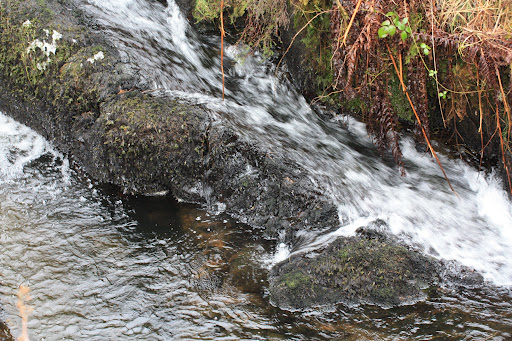
The Earliest Signs of Spring

As I write this the rain is lashing against the window panes and beating down upon the glass roof of the conservatory; unrelenting, its endless patter has been sounding since before dawn.  In the last hour the wind has risen and the silver birch, its downward hanging branches blowing first this direction and then the other, sheds its brittle twigs, nature’s way of pruning out the dead wood.
The silver birch silvered by frost

There is no way of casting yourself free from the weather on a day like this.  From every room of the house the rain calls, the views of the secret valley are as montone as the sky; all shape is blurred and merges into one, no defined hills, no defined trees, no defined river bed, even the clouds have been replaced by a heavy, all-oppressing  blanket of grey.  It is as if the life-force has been drained from the landscape.
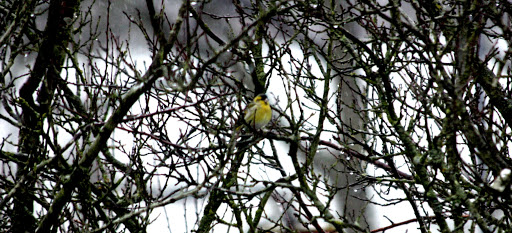
Siskins are exotic looking winter visitors
A flash of colour reminds us that this is not the case.  The colder air travelling towards us from the north has driven before it birds desperate to find slightly better conditions.  Far too exotic looking with their bright yellow bodies and sooty black head and bib to be outside the tropics, siskins have arrived to feed on the nut feeders.  They prefer the tiny, black niger seeds but the goldfinches are having none of it; they want to keep those for themselves.  Flurries of feathers, a mix of yellows, golds and reds fall as they scrap – the delicate lttle goldfinch is obviously tougher than it looks.  From time to time, flocks of long-tailed tits descend too to take their place in the food queue; they usually prefer to feed high up in the trees, their search given way by the soft, contact calls they make to keep together.
Siskin vie with Goldfinch for the niger seeds
Long-tailed Tits only visit the feeders in bad weather
It is the birds that tell us that spring is really not so far away.  First it is the robins, their sweet, melodic song sounding as if it should come from a bird twice their size, perhaps a blackbird.  Then it is the turn of the giant sized birds, the raven and the red kite, not with song but with the aerial acrobatics of their courtship displays.  Buzzards follow too but they are more content to circle ever higher, mewing to one another, attraction enough it seems.  All three birds have been rarities for most of the twentieth century but the reintroduction of the red kite in the 1980’s helped protect the buzzards from persecution.  The ravens followed later, arriving in the secret valley with the dawn of the new century – now all three are seen daily.
The forked tail is the easiest way to recognise the red kite
Winter aconites are the first of the flowers to appear, their yellow button flowerheads opening on fine days to prove that they are closely related to  wild buttercups both in flower shape and colour.  Nothing will hold them back and if they become covered in snow or rimed in frost it is of little consequence to them: they are back as pert as ever once the thaw comes.  Snowdrops quickly follow, also uncaring of the weather although they do bow their heads as if allowing their shoulders to take the brunt of it.
Winter aconites flower early whatever the weather
Every tree and shrub show signs of life too.  The hazel, its catkins stubby, hard and green for many weeks begin to lengthen, to grow brighter and looser until they live up to their old and descriptive country name of lamb’s tails.  Knocked back and discoloured by frost they soon restore or are replaced by others threefold.  Others are less precocious and prefer to show the signs of spring more discreetly.  The hawthorn leaf buds show signs of swelling and take on a brighter hue; the blackthorn and cherry flower buds also are clearly visible promising snowstorms of white and pink petals in a month or two.
Buds start to swell slowly at first

In the flower borders, life is stirring.  The hellebores lift their heads in shades of mournful maroons and creamy whites; the daffodils show their buds too almost as soon as they push through the soil waiting to open once they have reached their full height.  The day lilies are the earliest of the herbaceous plants to send out their leaves, their bright lime green shoots creating an attractive foil to the showier spring bulbs weeks before they send out spray after spray of exotic looking flowers.  Spring is just around the corner…

Hellebores flower early in the year
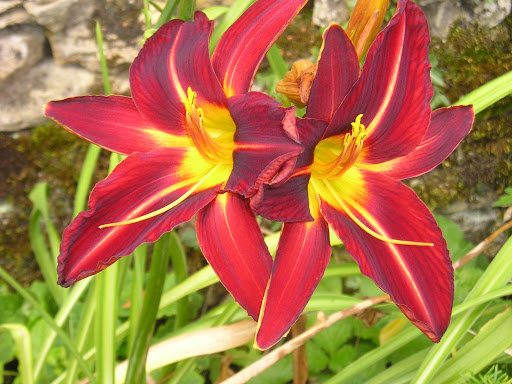
The day lilies won’t flower for some months but their leaves are amongst the first to show

In the meantime, the rain has turned to snow.  The countryside is turning white and still the wind howls.  Another day of winter to be crossed off the calender before we can relax and say “Spring has come”.

Add to Technorati Favorites

A Year in Review: 2012 July – December


Where does the time go?  Christmas has been and gone, as have the New Year celebrations and here we are already at the end of January’s first week. I’m beginning to understand those lines of William Davies’ “We have no time to stand and stare.  Not that my life has too many cares fortunately and, of course, I’m exceptionally lucky living where I do and working outdoors – I have plenty of time “… to see, when woods we pass
Continuing on from my review of the first six months …

July: we had a rare fine evening in a year filled mostly with rain, an opportunity for the lucky few to go hot air ballooning.  We had a surprise visitor when Charles Teall, who lives a few miles away, dropped unexpectedly into the secret valley.  We joined him and his balloon team for drinks by the river, a lovely way to end a flight.  Some years earlier Charles had flown me across the Cotswolds before landing to a champagne breakfast – but that’s another story.

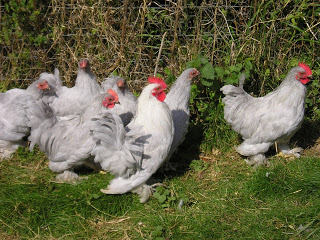
Another surprise was when I found an abandoned bantam egg and hatched it out, capturing the moment on video, now uploaded to YouTube.  You can watch it by clicking here.

August: You don’t go on holiday to Ireland for the weather, especially the west coast lashed as it is by frequent Atlantic Ocean storms.  To everyone’s great surprise, we had unbroken sunshine and high temperatures day after day.  We even swam in the millpond calm sea.  At night we were treated to the most glorious sunsets, every evening more dramatic than the previous one.


September:  Britain has a long and proud history but we tend to forget about the days before the Conquest in 1066.  We had been invaded and settled many times prior to that but the Romans left us with a road system that is still much used today.  Their houses have long since disappeared although there are many excavated ruins that can be visited.  Cirencester was one of the premier cities of the time and the museum there houses many artefacts including some remarkably intact mosaics, the subject of a post.

October:  Their are numerous new diseases affecting our trees and one species that has been hit badly is the Horse Chestnut.  The leaves become infected with leaf miners and cankers weaken the tree further.  This, in time, may kill the tree but short-term affects the quality of their fruit – the conkers of childhood games.

November:  Trees also featured this month along with a visit to my earliest schooldays.  The larch was my introduction to nature cleverly made magical by my school teacher, Miss Vine.  Larch still are my favourite tree: we have a good number of them here in the secret valley where they give me still as much pleasure at all times of the year as they did all those years ago.

December: With the year whizzing by there were no posts this month other than to wish you all a happy holiday and start this review with the first six months of the year.

Every year has its memories but 2012 will be recalled  as the year of the Queen’s Diamond Jubilee and the London Olympics.  2013 looks like being an especially memorable one for me but you will have to wait a little longer before I reveal all!
 

And just in case we are all rushing about far too much let us remember the words of William Davies:

What is this life if, full of care,
We have no time to stand and stare.

No time to stand beneath the boughs
And stare as long as sheep or cows.

No time to see, when woods we pass,
Where squirrels hide their nuts in grass.

No time to see, in broad day light,
Streams full of stars, like skies at night.

No time to turn at beauty’s glance,
And watch her feet, how they can dance.

No time to wait till her mouth can
Enrich that smile her eyes began.

A poor life this if, full of care,
We have no time to stand and stare.

Leisure from Songs of Joy and Others, 1911


Add to Technorati Favorites

Happy New Year


Happy New Year
 
 
Best wishes for 2013
from
the secret valley
 
 
Johnson 

Add to Technorati Favorites

A Year In Review: 2012 The First Six Months

One of the signs of getting older is that the days, weeks, months and years go by ever faster – this seems rather unfair as you are likely to have relatively few ahead of you.  Not that I plan to leave this world just yet (well, not if I can help it), it is just that 2012 was the anniversary not just of the Queen’s Diamond Jubilee but also of mine which has focussed the mind, rather.

As the time has sped by so fast I thought I would review the year, if only to remind myself what I’ve been doing the past twelve months.

January:  To London for the New Year.  Whenever we visit ‘The Smoke’ (I wonder if anyone still calls it that now that the days of dense smog have long gone) it always ends up rather ‘foody’.  That trip was no exception; we ate our way up the Kings Road, ate our way around Sloane Square and finally ate our way to Fortnum & Mason arriving in time for afternoon tea.  Fortnum’s is the most wonderful grocery store on the planet – whereas, most people, especially those from overseas, visit Harrods, Fortnum’s is the one place you really shouldn’t miss.  Everything about it is delightful and its afternoon teas are legendry.  We did squeeze in a visit to the National Portrait Gallery but why show you images of great works of art when you can see photos of Fortnum’s?  Add it to your list of ‘places I must visit before I die’.


February:  A visit to Snowdonia staying at a friend’s isolated chapel house on the side of the mountains.  The weather was quite kind to us considering the time of year so we were able to do a lot of walking.  To our dismay, our favourite spot that we had christened ‘The Enchanted Forest’ because of its lichen encrusted trees and great mossy hummocks had been clear felled and all signs of it destroyed.  This may sound like wanton vandalism but the trees had been planted for timber production regardless of the impact they had on the scenery.  Now years later, there is a move to restore the mountains back to their original state which is, I’m sure, admirable and an ecologically sound thing to do.  The trouble is that we loved this silent, brooding woodland that no-one, it seemed, apart from us ever visited and now it is gone.  And with it has gone our desire to return but, who knows, perhaps we shall one day.

March:  Recording the life of a hedgerow seemed like agood idea at the time.  It was supposed to have become a month by month photographic notebook of the changes that took place during the year but sadly March turned out to be the first and only entry.  As April arrived I took more photographs but when it came to blogging them they had disappeared (reappearing months later – one of the mysteries of computer technology).  Then came the rain – and it has rained ever since – and the project was abandoned, apart from a vain attempt in May.  The hedge, which is in the little lane that leads from our cottage up the hill out of the secret valley, is an ancient relic from the time of the Wychwood Forest, cleared in the very earliest days of British history.  It is mentioned in the Domesday Book, that great list of the plunder of William the Conqueror, written in 1086.  Although the forest has retreated by many miles there are still some fine trees standing and wild flowers that would normally be found in woodland still grow on its grassy banks.  I shall make a resolution to resurrect the project in 2013.
April:    Part of my everyday job as a practical gardener is pruning, a subject which is a mystery to many people and often fills them with terror at the very thought of wielding secateurs to a treasured shrub.  Mahonia is one of those useful winter flowering plants that so often look dreadful as they become ever more gaunt and ungainly.  This was the case with one in a client’s garden so it seemed a good idea to photograph the process of restoration and blog about it.  That post has rapidly become my most read and I am glad to be able to report that the plant is thriving.  Now covered in new flower buds and almost ready to open, it will welcome the New Year with the scent of lily-of-the-valley.  If you have one in your garden, cut a few flowers for a shallow vase to fragrance the house.

May:   Despite the rain that seems to have fallen incessantly since April, we had a fine, dry day for the most important day in my social calendar of 2012 which was also an important one for the Queen too.  The Pageant of the Horse was held in the grounds of Windsor Castle and celebrated the Queen’s sixty year reign through her association with and love of horses.  Horses, riders and other performers representing every country from around the world that the Queen has visited gave us a show that both we and she will never forget.  It was a quite remarkable and memorable experience; apart from the showmanship and being so close to the Queen and Prince Philip, we had a private ‘Haka’ from the Cook Islanders when they noticed us still seated after the bulk of other visitors had left.  Very exciting!

 
June:  The Jubilee celebrations continued withthe River Pageant held in London on the Thames in pouring rain, this time.  A much smaller river, the Coln, featured in a post ‘The Most Beautiful English Village’ about the exquisite Cotswold village of Bibury.  With its clear, trout-filled waters fast running past ancient stone cottages, it is hardly surprising that it is protected by the National Trust and much visited by sightseers.  It is said that visitors often don’t realise that it is not a living museum and sometimes walk into people’s private gardens or houses to be surprised to find the owners eating their lunch or watching television.


To read any of the posts mentioned above, just click on the links in green.  July to December will appear soon.


Add to Technorati Favorites

Bonkers about Conkers!

Every little boy – and many a gown-up one as well – loves toplay conkers at this time of year.  Or at least, I assume they still do; it is possible that it may have been banned from the school playground under health and safety grounds.  When you think of it – not only did we frequently impale our hands with the meat skewer we had pinched from the kitchen drawer to pierce the conkers with, we quite often cut ourselves with our penknives as we trimmed the strings to the right length. And what about those shattered splinters flying through the air like vegetative shrapnel – no-one thought about wearing eye protection then.

However, the traditional sport of conkers isn’t threatened so much by legislation as by the recently imported leaf miner moth (Cameraria ohridella) which first appeared in southwest London in 2002.  With no predators it has spread at an alarming rate and now it is reckoned that nearly all trees in England and Wales are infected by it.  The moth’s presence can be detected by the brown-black blotches that cover the leaves, disrupting the trees ability to synthasise fully.  This in turn weakens it which has made them much more susceptible to disease, especially bleeding canker which is now threatening their very existence.   In some years, leaf damage is more severe and the leaves can drop very early indeed.  As a consequence, some trees are looking in very poor shape.


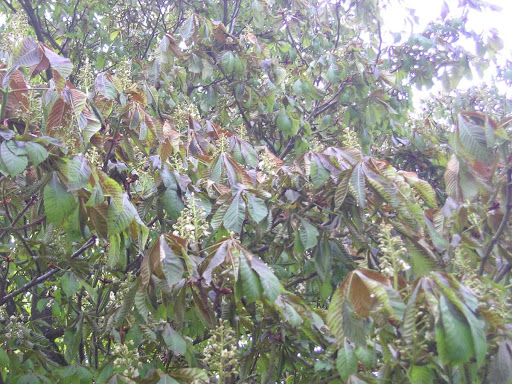
The secret valleyhas numerous mature Horse Chestnuts.  They are fine trees, up to 100ft or more tall and look especially splendid in spring, their white flower spikes contrasting with the freshness of their newly opened green leaves which, at that time of year, are still unblemished.  In the 400+ years since they were introduced to Britain from the Balkans, they have become an integral part of a child’s growing up.  We learnt how branches of the ‘sticky’ buds, the dormant leaf buds, becoming ever more shiny and sticky as the sap rises within the tree, can be cut and forced to open into leaf early in a jam jar of water.  On hot summer days we learnt, usually when lying beneath the trees in their cooling shade, how to make ‘fish bones’ by shredding the leaves with our fingers until just the skeletal veins of the leaves remained.  When we wanted to be nasty we knew that we could hurl the hard, green nutshells armed with their sharp spikes to embed in our enemy’s backs or scratch their legs if they were wearing shorts.  And, of course, we held conker competitions.

Horse Chestnuts in full bloom on a fine late spring day
 
Now with all the trials of pests and disease plus the dreadful summer weather, conkers are few and those that have matured barely half their normal size.  It has even been suggested that brussel sprout competitions may have to be held instead although I doubt if they will give the satisying dull thud of the real thing even if they were frozen first.  However, this years World Conker Championships have taken place this month as normal – it was first held in 1965 and, unlikely as it seems, attracts competitors from all around the world.  You can find out more by clicking on the link below.
Not all is gloom and doom for the Horse Chestnut for it is now thought that some bird species are beginning to learn about this new food source and research is being carried out by the University of Hull and others to monitor this suspected behaviour.  There is little that we, as gardeners or conservationists can do at this stage to assist other than to report any signs we see of birds feeding on the trees.  We just have to hope that the Horse Chestnut doesn’t disappear from our countryside in the same way that the Elm did in the 1970’s and 80’s.

The difference in size between the two trees is quite marked – as is the autumnal tints of the frost damage part of the smaller one 
 
In the secret valley, we also have a number of the smaller, red flowered Horse Chestnut, Aesculus x carneaca, and this does not seem to become infected to the same degree as the white flowered, Aesculus hippocastanum.  Although they do produce conkers unfortunately they are neither of a size or quality suitable for a serious round of conkers.  Horse Chestnuts, by the way, are poisonous to horses – they get their common name by the scars on the branches where the leaves once were: a perfect horseshoe complete with marks where the nails would be. 
 
When you get to know a place intimately – whether it’s a garden or a landscape – you notice things that the casual observer misses.  In the late spring of 2011, we had a biting frost that killed off not all but some of the new young growth of numerous trees – just where it touched.  Some trees remained unscathed, others  were totally destroyed and some just part.  This is what happened to one of a pair of Horse Chestnuts visible from our little stone cottage.  One tree has always been much more stunted than the other, although as their girths are the same, I assume they were planted at the same time.  They stand side by side but one, when the river bursts its banks is under water for a few days longer than the other.  Is it this that has caused it to be so much shorter or is it this rare burning of the leaves by frost?  It took months for the tree to recover, finally sending out new spring green leaves and flower buds at the end of July contrasting greatly with the remainder of the tree whose leaves had not been harmed.  Likewise, the older leaves turned their autumn colours and fell earlier than the newer ones.  This year the tree, which now looks quite poorly, has reversed with the damaged leaves turning golden – in the ten days since the photograph was taken, they have fallen while the remaining leaves are yet to get their autumn tints.

Almost hidden from view, our old stone cottage stands well above the little winding river

 In 2011, we had a very late frost blackening both the leaves and flowers – it took months for the tree to recover


The secret valleywill be a much poorer place if all the Horse Chestnuts succumb to disease and have to be felled.  Let us hope that future generations can play beneath them as we have done.

Sources:
British conkers getting smaller
World Conker Championships
Conker Tree Science Project

Add to Technorati Favorites

Dropping In Unexpectedly

We are sociable animals here in the secret valley and nothing pleases us more than when friends call in unexpectedly as they pass by.  It doesn’t matter whether there is just one or twentyone, we can always find enough in the store cupboards to water, and feed them too if needbe.  More often than not, they are on their way somewhere so a cup of tea, or something a little stronger, is all that is required.

Not the secret valley but still in the Cotswolds.  If you click on the photo to enlarge it you can see that the river Windrush has as many twists and turns in it as our little river

Most of the time visitors arrive by car or on foot for the lane that brings you into the valley is as inviting and sinuous as the little winding river itself: it takes you across cornfields, through trees which create, at this time of year, a leafy tunnel before entering a fold in the hills lined with an avenue of cherry and lime trees.  It is here that you get your first glimpse of the river and beyond the meanders the lane turns sharply over the bridge taking you a few more yards to the door of our home.

The villages of Lower and Upper Oddington – you can clearly see the lines of the old ‘ridge and furrow’ field plough marks that can date back a thousand years or more

The secret valley, as I have mentioned before, is a landscape in miniature.  Everything is small – the road, the hills, the views, the river, even the stone built bridge you can pass over without noticing it.  If it all sounds very idyllic that is because it is.

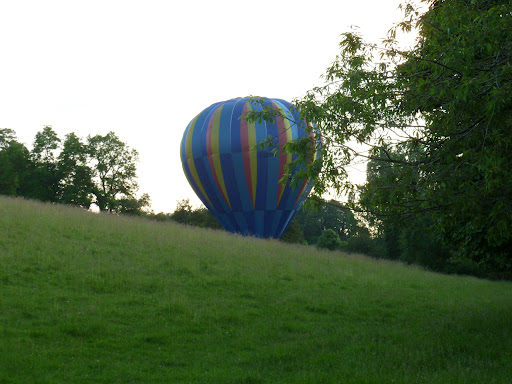
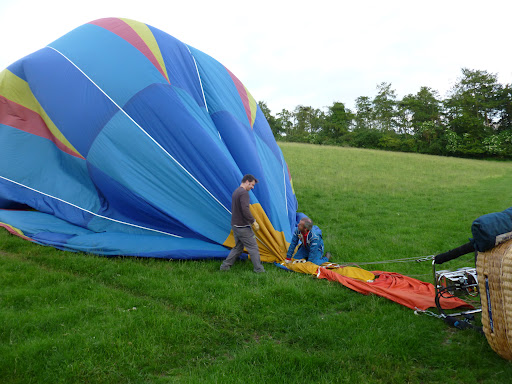
A couple of weeks ago we had some very unexpected guests although we could hear them arriving for quite a while before they finally did so.  It was the unmistakeable sound of a hot air balloon losing height.  Hidden by trees we could not see who was landing but went off to investigate – She-dog leading the way – and to assist if required.  The multicoloured stripes told us it belonged to Charles Teall who lives some miles away and who had once taken me for a flight, although on that occasion we had not landed on our doorstep – for details of that flight click here.

Charles’ wife, Liz, incidentally, is a very talented potter and we have some very nice pieces of her work.  She, like myself, is interested in traditional folk music but, unlike me, she can sing and play the whistle and tabor; she also belonged until recently to a local Morris dancers side.  Have a look at her work by clicking here.

By the time we reached it, the balloon had already landed.  It never fails to surprise me just how large it is and just how small the basket is.

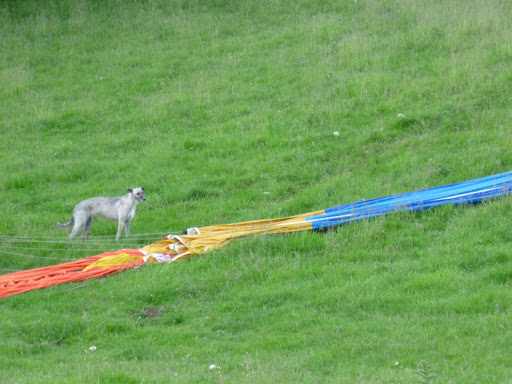
She-dog is normally fairly cautious and we thought that she would be nervous of the balloon.  As always, she proved us wrong and felt it important to inspect every part of the balloon: below, the folding meets her approval.  Talking of approval, those of you that follow She-dog’s exploits may have been wondering what is the latest on puppy news: there isn’t any.  On the last two occasions she has refused to co-operate.  She obviously felt that once was quite enough!

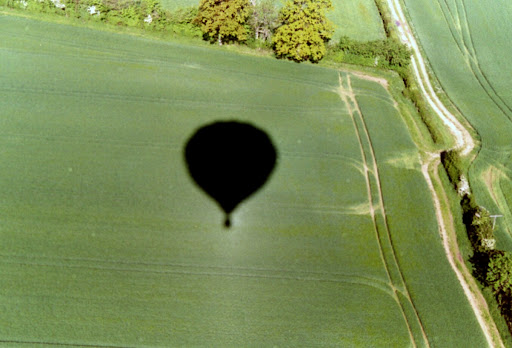
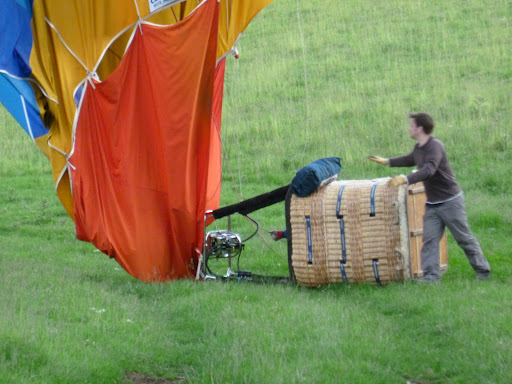
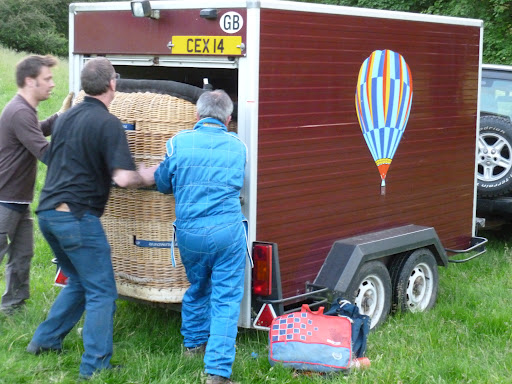
I am always surprised how neatly everything folds away and into such a small space.  There is always a mobile support team to assist where necessary so our help wasn’t required.  Once packed we were able to catch up with the latest news over a drink and reminisce about our trip flying over the Cotswolds.  The aerial shots were all taken on that day.

The counties of Oxfordshire and Gloucestershire, which form the greater part of the region known as the Cotswolds, have some of the best surviving examples of ridge and furrow.  To find out how these were created, click here.

Add to Technorati Favorites

The Day I Became a Mother!

I have kept poultry since childhood ever since returning with my parents from a farm on Exmoor with a box containing half a dozen bantams smuggled into the back of their car. When one laid an egg en route and started cackling, my mother was furious. Fortunately we were too far into our journey for them to be taken back.  In time, she became equally fond of them and even allowed them to wander into the house to be given scraps of food.

The original bantams were farmyard mongrels but since I came to live in the secret valley I have kept Lavender Pekins.  These are allowed to wander the fields, even though they become supper for the fox, for there is nothing more delightful than to see happy hens striding down to the river or up the valley and (hopefully) back again. 

Bantams – or Cochins, as they are called in Canada and the USA – are ideal as garden birds for they do very little damage unlike their full sized relatives.  We keep those too but they are – with difficulty – kept firmly beyond the fence. I have written about the bantams in an earlier post and this can be seen by clicking here.

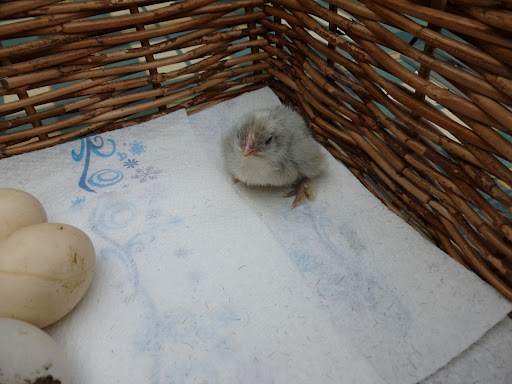
The other day I came across a couple of abandoned bantam eggs put them into a basket, kept them warm and waited to see what happened.

What a result!  An hour later it was dry and fluffy ….. and making even more noise!

Add to Technorati Favorites

Still Falls The Rain

The title of this post is taken from the poem by Edith Sitwell, that most eccentric of twentieth century English poets.  I am using it for its literal sense, for the rain just won’t stop falling, whereas Sitwell wrote Still Falls The Rain as her response to the London Blitz in the 1940’s.

It has not been an easy gardening year.  We were bracing ourselves for the coldest and snowiest winter ever, for after two years of freezing temperatures and snow at greater depths than for a decade or more, we were warned of worse to come ….. it didn’t.  Instead we had a relatively mild time of it but with virtually no rain whatsoever.  Then came March:  temperatures in the 70’s and day after day of unbroken sunshine and the garden couldn’t work out what to do next.  Some plants flowered earlier than normal whereas others refused to break out of their winter dormancy.  And still no rain; the little river that winds its way through the header of this blog and the secret valley ran lower than midsummer and by the old sheepwash it was almost possible to walk across it in hiking boots.

Then came April and the day water shortages and a hosepipe ban were announced.  All the hose reels were wound up to be stored away and we worried about how we were to keep the parched ground alive.

We did not need to worry for, reminiscent of the day in the 1980’s when Michael Fish, the weather forecaster said “What hurricane?  We don’t have them in this country….” (the next morning half of England’s trees had been flattened), the rain started to fall.  And it hasn’t stopped falling.  We have the occasional sunny interlude when you could almost think it is spring but, for the most part, the skies remain leaden and heavy.  Day after depressing day it is dark and gloomy with a cold northerly wind blowing and the rain lashes against the window panes.

The ground, so hard from months of drought, could not absorb the deluge and the water, so desperately needed, runs down the lanes and over the fields and banks into the river.  Our pretty little tinkling stream has become a torrent and the sheepwash island, coloured golden with  its Kingcups in full bloom, has disappeared from view completely.  Opposite the sheepwash on the other side of the lane, the water is running off the hill and new springs have appeared where they haven’t been seen in years.

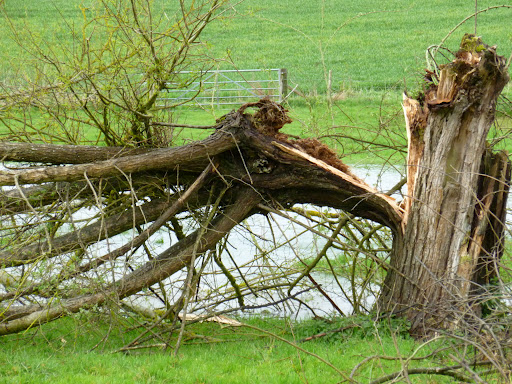
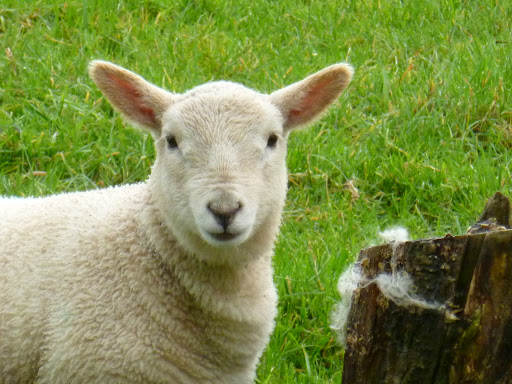
The secret valley is flooding and looks more like how it should have appeared in winter.  The sheep and their lambs have been moved to safer pastures and the pastoral scene of a few weeks ago has all but gone.  Gales have accompanied the worst of the downpours creating their own havoc and the old willow pollards, heavy with top growth are splitting and falling.  The damage, although it looks devestating, will not affect them too much for they will regrow once the broken timber has been cleared, for this is nature’s own way of pollarding them.

In the meantime,  we watch the flood water rise all around us.  Our little stone cottage, built in the 1850’s, sits safe, high above the river, which snakes around two sides of the building.

As for gardening, weeds continue to grow for they have adapted to the extremes of the English climate over millenia.  The nurtured plants of the flower border struggle and produce some oddities.  The tulips that usually look bedraggled after just one shower, have remained resilient and daffodils that have normally finished weeks ago are still in bloom, thanks to the cool conditions.  The wet weather has also benefitted the cowslips and the bluebells and they seem even more intense in colour if, in the case of bluebells, that is possible. A quick look around the secret valley at the trees also shows contradiction:  some are in full leaf and others – almost 50% of them – are still to show their leaves so have a wintry look about them.

Tulip ‘Peppermint Stick’

It has been a dry and sunny day today and tomorrow is also supposed to be quite pleasant.  The forecast is for more rain to come and the cool conditions to continue at least until the beginning of June.  And when I wake up on Monday and hear the rain hitting the bedroom windows, as forecast, my first awareness will be to hear in my mind the haunting voice of Edith Sitwell saying “Still falls the rain, still falls the rain ……”

To listen to Edith Sitwell reciting Still Falls The Rain click on the link below:
http://www.youtube.com/watch?v=b6_2x948EEw

Add to Technorati Favorites

Hedgerow Update 1

When I wrote my initial post on the ancient hedgerow that leads uphill out of the secret valley I intended to update it on a monthly basis (click here).  What a failed idea that has proved to be!  For March 10th  was as hot a day as any summer’s and that, coupled with a very dry winter, created the worst drought for many years.  The day that I had intended to walk the hedge (and also the day that a hose pipe ban was announced) the heavens opened and we have had torrential rain ever since.  I have been soaked to the skin most days because of work – I had no intention of a second soaking whilst carrying out hedge surveying upon my return home.

A break in the clouds, however, allowed me to sprint up the lane snapping away with the camera moments before the next deluge. No time to marvel at the way nature responds to climate or to look carefully to see what species of plants might be new to my eyes.  The only wildlife I saw was a solitary snail, pale lemon in colour and rather pretty – if you can describe a snail as such – which dropped off it’s grass blade perch the moment I got the camera in focus.  I’m sure I heard it giggling in the undergrowth.
Here is what I did see.

Cowslips
Cowslips (Primula veris) are a great favourite of mine bringing back memories of early school for ours had a play area that was carpeted with them.  Years ago no-one worried about picking great bunches of them or digging some up for the garden which we all did yet the numbers there didn’t seem to diminish.  However, overpicking (or perhaps spraying roadside verges) meant that the cowslip became a scarce plant.  Happily, they are now seen sporadically along the Cotswold lanes although not on my old school playground which became a high density housing estate in the ’80’s. Along our hedge, cowslips appear in small numbers which, hopefully, will increase over the years.  Further up the valley a field grazed only by sheep and never sprayed is a yellow carpet at this time of year and on warm, still days, the faint smell of honey wafts around transporting me back more years than I care to admit to.

    Cowslip meadow in the secret valley

Primroses

The last few primroses are still in bloom, quite late for this time of year and no doubt, like some of the daffodils, lasting longer because of the cool, damp weather.  Primula vulgaris, their botanical name, sounds like a misnomer for their is nothing vulgar about them, for every part of a primrose is pretty, whether it is the palest lemon of their petals, the deeper yellow throat or the fresh green of their leaves.  Even the ribbing and lines of their veins create attractive patternss and textures.  Vulgaris does, of course, mean common – there is nothing common about them in appearance either!

The hot March had an odd effect on plants. Some revelled in it, throwing caution to the wind and paraded their summer finery early, whereas others seemed to remember the old saying about not casting a clout ’til May is out. Proven right, when cold returned in April, they now seem reluctant to even expose a leaf and, as a result, the hedgerow is bright green  in places, yet bare and wintry looking in others.

 Field Maple

Field Maple is a classic old hedgerow plant.  Left to grow untouched it makes a medium sized tree of, to my mind, simple but great beauty.  However, it is usually trimmed to make a reasonably dense, twiggy barrier.  Like all maples the flowers and leaves emerge together but I had never noticed before the rich mahogany colour of the leaf buds. Acer campestre.

Ground Ivy

 A plant so common and so small as to be overlooked, Ground Ivy (not related to ivy but to mint)has to be viewed on hands and knees to see its quiet beauty: tiny, mauve, hooded trumpets darkening at the throat.  According to my old herbals it was used for all sorts of ailments from the uterus to inflamed eyes and everything in between.  Glechoma hederacea, in a greyish variegated form is often used in hanging baskets where it is seen trailing in ugly, thick ribbons.  Leave it where it belongs – trailing over the ground at the foot of a hedgerow.  Perhaps it should be used in the garden in this way? 

 Jack-by-the-Hedge

Jack-by-the-Hedge or Garlic Mustard is a common plant and quite a useful addition to early spring salads for its shredded leaves have a mild garlic taste.  In the photo above it grows along with stinging nettles and the fine leaves of Cleavers or Goose-grass.  It is the food plant of the Orange Tip Butterfly which is quite regularly seen throughout the secret valley, although scarce so far this spring due to weather conditions.  Occasionally they fly into the house and require rescuing – not always as easy as in this photo!

 Orange Tip Butterfly – only the male is coloured orange

Bluebells with White Dead-Nettle

Bluebells, Hyacinthoides non-scriptus, are another of the ancient woodland indicators (click here for more details of this term) and they flower the whole length of the hedgerow.  In the Chiltern Hills, the area where I spent most of my life, the beechwoods are renowned for their Bluebell carpets (photo below).  Here, they grow more sparsely, with the occasional white flowered sport growing amongst them. In the photo above, it is the white flowered dead-nettle they mingle with.  The dead-nettle, Lamium album, is not related to the true nettle and has no sting, just an unpleasant smell when the leaves are crushed.  In the garden it is a nuisance with a white, running root, quite thick and brittle unlike the stinging nettle’s yellow, fibrous root system – a useful way to tell them apart if uncertain, apart from the sting, of course.

A bluebell wood in the Chiltern Hills in Spring

 Burdock leaves
The large leaves of Burdock, Arctium minus, are already forming rosettes.  It will be a while before they send up their spikes of lilac flowers, reminiscent of those of the thistle and even longer before the troublesome round seedheads, the burs, stick to clothing and She-dog.

The secret valley in flood
It was at this point that the heavens opened once again giving me just time to take a snap of the little winding river.  It’s clear, sparkling waters have been transformed by rain to a swirling, brown muddy spate that has now burst its banks spreading out across the valley.

Add to Technorati Favorites

The Constant Drip

When I was a small child I was traumatised by the sound of water, even a dripping tap would trigger nightmares of drowning.  This was not because my life had ever been at risk, although it could be argued that my afterlife was: it was down to baptism by total immersion.  My soul might have been saved by water but it was years before water became something that I would delight in, rather a problem for a lad that was brought up on the banks of the Thames, that great English river that flows sluggishly from its source to London and the North Sea beyond, a distance of 215 miles.

                                        
                                                   The River Thames at Marlow

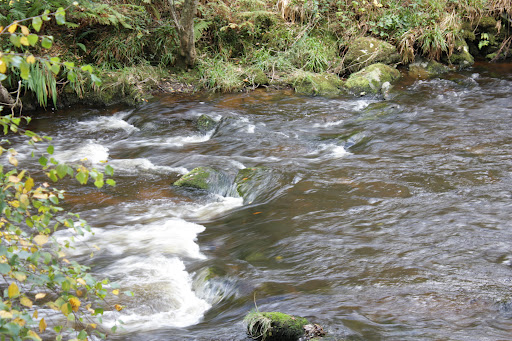
It was not until, as a young teenager visiting the West Country, I came across clear, rocky bottomed streams that were so unlike the silty bottomed, muddy waters of the Thames and the smaller brooks back home.  At first the sight and the sound of their fast flow rather unnerved me but there was a swift and dramatic change once I discovered the joys of splashing about, ‘tickling’ for trout and generally getting soaked. Not only could I not get enough of them, I ended up living beside one here in the secret valley.  Our river, to be truthful, is a compromise: it likes to believe it is of world class comparable with the Amazon or the Zambezi as it winds through the landscape in great (or in reality, miniature) curves and sweeps.  Sometimes it is slow moving half hidden by lush foliage that spills over its banks but in other places it is as fast running and noisy as a Devon stream as it gurgle and clinks its way over rock and pebble.
Our little river in the secret valley


    In winter, our river doesn’t look quite so inviting!

Recently I was staying high in the mountains of Snowdonia.  The house that we were in had to its right, a larger river crashing noisily downwards and, to its left, a much smaller gully with an equally fast flow.  ‘Our’ house, which inreality belongs to a friend, is not exactly standing on an island; more it is the solid filling of a watery sandwich. The main river, the term is used loosely for it is even more jumpable over than the one back in the secret valley, tumbles down the mountainside in a series of rocky chasms interspersed with quieter small pools.

One of the nicest aspects of returning to a place time after time is that certain things become so familiar, whether it is buildings or the wider scenery does not matter.  This is good for once you stop looking at the overall picture, the detail becomes more noticeable and things that would be overlooked if you only ever visited once begin to stand out.  Here there is little in the way of buildings, apart from the numerous ruins that stand as ghosts to a time when the hills were more densely populated with miners and farm workers.  On my morning walk and musing on how terrified I had once been by the sound of water, I began to notice the change in pitch and volume which alters constantly as you pass by.  Where the water falls several feet, not surprisingly the noise is at its greatest but, even there, it can be a deep sound or a lighter one, depending on the rate of flow and whether it lands on rock, water or pebble.

Then there are the waterslides: these can be steep or barely inclined, narrow or wide, fast or slow flowing.  Whichever they are, for me they are the most visually exciting of all with their water moving effortlessly, literally sliding along the surface and their ‘shushing’ sound building up to a more dramatic crescendo as the rock bed alters in character once more.

       A massive waterslide on Exmoor …..

                                                            ….. and a smaller one in Snowdonia

And then, of course, there is the sound that once traumatised me but that I now find the most fascinating of all, perhaps because they entice you to explore: they draw you further into their world, often a secret one.  The sound of dripping.  Sometimes it is obvious where it is coming from and where it is landing but often it is a sound that demands you to seek it out and then, not infrequently, only one half of the equation can be solved, if you can find the source you cannot find the landing place or vice versa.

Higher up the mountain is an old disused slate mine, long abandoned and with its shaft open for all to explore. Little natural light enters the low tunnel entrance and unable to see far inside there is only the sound of water seeping through the roof landing in the shallow water that collects in the passage below.  Here the sounds are as varied as those of a xylophone, the music made being both enchanting and unnerving; it is both welcoming and threatening at the same time. 

Not a place for the faint-hearted!

I may have got over my old phobia of scary water sounds but, I have to admit there is still one place that makes me shudder.  Just up the track beyond the mine there is a patch of grass and moss that has to be crossed and here, if you pause, you can hear the sound of fast moving water and the crash of a waterfall but there are none in sight.  The sound comes from below ground under your feet – childhood anxieties rise if I loiter here and as I continue my walk I notice, with wry amusement, that it is at an increased pace.

Add to Technorati Favorites