Writing Words of Silence

I have exchanged a couple of comments recently with ExmoorJane after one of her posts got me thinking.  I spend a lot of my time thinking, it goes with the day job.  Now these thoughts are not usually high powered for I don’t spend my working hours in a dynamic office environment; I spend them – often on my own – in the real, green environment.  And that’s the problem: there are so many things to distract me.  A few days ago it was the fault of the jackdaws – they suddenly had realised that spring is around the corner and were in full display flight, tumbling and diving and generally making an awful lot of noise.  So I spent far too long wondering why I hadn’t noticed their courtship before.

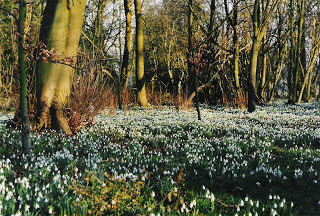
Yesterday it was the fault of the snowdrops and the winter flowering aconites.  They are to blame because they are in full flower a few weeks earlier due to the unseasonably mild winter we have had so far.  Some years ago I organised a visit to some gardens renowned for their display of snowdrops and we had to search hard to find one in flower – that was the 10th February.  Nature, like some people, can  be fickle.  The photo below shows a different garden’s snowdrops: it is the garden of what I call the ‘reincarnation’ house.  They are at their best now.
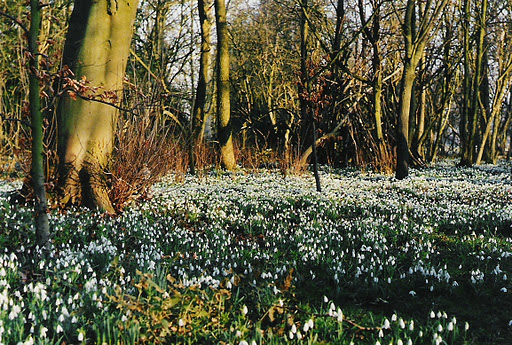
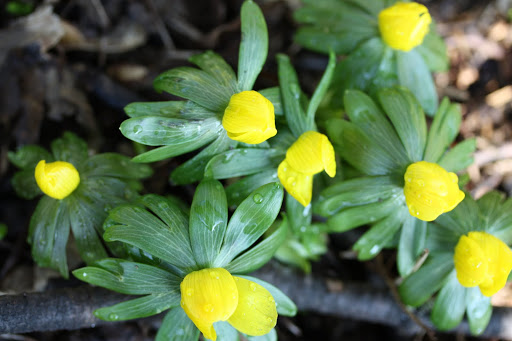
The aconites were more fully to blame. Seeing the hundred or so yellow blooms staring up at me from the foot of our garden hedge made me decide to take a walk as, not far from our little cottage, further down the secret valley lies a very special woodland.  At this time of year it is a yellow carpet of flowering aconites, an extremely rare sight for they are not native to this country.  No-one knows by whom or when they were planted for there is no sign of there ever being a house nearby; they are of no value as a commercial crop unlike snowdrops that were sent to London in bunches for selling once the age of steam made it possible to transport them quickly.

But all this pondering can most squarely be laid at Jane’s doorstep.  In her post on writing she mentioned that she sometimes writes just for the sheer pleasure of seeing words and thoughts on paper.  Then, satisfied, she destroys the work for there is no need or desire to share it.  I thought only people that were mad – or, at least, people that were a bit dotty – did that.*  And, insecure person that I suppose this shows me to be, I thought I  was the only one that ever fitted this description and did such a bizarre thing.  This is why I started writing a blog: I came to the conclusion it would be quite nice to keep my work somewhere secret so that I could look at it from time to time.  I decided Blogger would be quite a good place to store it, along with a few favourite photos.  I knew, of course, that the world in theory could see it but why would anyone want to stop and read something that I had written?  It never occurred to me that some of you might do so and some even come back regularly for more.  So on my way back from the aconites I was visualising Jane and myself scribbling away and ceremoniously (for it always seemed to be part of the ritual) tearing up the sheets of paper with our precious words on them.

I had walked along our little winding river to reach the wood but struck off over the hill for the return home.  This route always fascinates me because, from the top, the valley is totally invisible tucked away deep within the folds of the landscape.  One moment the ground almost appears flat and then, suddenly you are looking down into the secret valley.  The slopes are steep and grazed only by sheep, wild deer and rabbits and are, later in the year, awash with wild flowers of all kinds, including rare wild thyme, the subject of one of my earliest posts.  I sat myself down to admire the view, for I never tire of it despite seeing it every day, and pondered on what gives a person the desire to write, to play around with words, arranging them and rearranging them for hours on end.
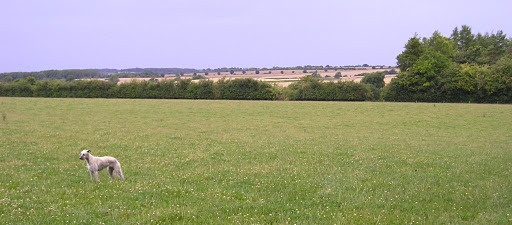
And then this thought came:  what do you do when words just aren’t adequate to describe the sights or the emotions?  How do you describe the indescribable?  Take a photograph – after all, a photo is supposed to say a thousand words.  But what if a thousand words still aren’t enough?  What if ten thousand words still aren’t enough?  Besides, an image only allows the viewer to create their own words, it can never convey those that the writer might be thinking.  How do you describe the intangible?  So I sat on the bank, looking across the secret valley, muffled up against the chill east wind and came to this simple conclusion – the only way out of this conundrum of how to express these silent words is to write a post about it.

* Well, I thought she did but I can’t see it now.  Perhaps I am dotty, after all :-{

PS Don’t forget you can find me on Facebook now and get regular updates from the secret valley

Add to Technorati Favorites

What A Difference A Year Makes

The British are always going on about the weather and I’m no exception.  My very first words upon waking are “What is the weather doing?” and my final words before sleeping are “What will the weather be doing?”.  I make no apologies for this: it’s part of our make-up as a nation.  It’s because, I was once told, that whereas other countries have seasons, Britain just has weather.  It’s not quite that simple, we do have seasons – Spring, Summer, Autumn and Winter – just like any other temperate country, it’s just that in the UK they get a bit muddled up.

I write this, snug in front of the woodburner – not that much heat is getting past She-dog who thinks this has been lit solely for her pleasure and comfort – listening to a gale rattling the window panes and whistling around the eaves.  The rain is lashing down and there is absolutely no need for me to ask what the weather is doing this evening.  However, I have been told that I have said “Listen to the weather” several times. I could have said how remarkable it is that only yesterday I had my lunch sitting in the garden.  Yes, really.

I should admit that I am a hardy sole as I work outdoors all year and so am less affected by cold than most and I also should admit that I was wearing a coat and gloves and sitting in a sheltered, sunny spot. Regardless of those finer details, yesterday I commented how last year to the day we were up to our necks in snow in the worst wintry weather the Secret Valley had had for years.  And, even more remarkably, the snow came when you would expect it  –  in midwinter but (and there’s always a ‘but’ where British weather is concerned) in the Cotswolds we rarely get snow before January …..   But it was still rather remarkable to be sitting there, surely and remark worthy?

What is even more remarkable is that all of this week I have been planting out herbaceous plants and laying turf; late even by our odd climate standards.  We have had frosts: there were three quite hard ones in October, then none until the last week of November and then a couple more last week and none since.  In between, we had two weeks of warmish air and thick fog which was enough to make even me depressed. 

The spirits, even on those damp, grey days, were uplifted by the huge array of flowers that have reappeared.  There are always a few late roses hanging on determinedly until Christmas Day, looking bedraggled and ragged but not this time.  Some of them have given up but others have almost as many blooms as midsummer.  There are pots of herbaceous Salvia nemerosa ‘Mainacht’ that have regrown after their end-of-season haircut and are in full bloom once again.  Primroses and cowslips are showing colour.  Today I counted over twenty different summer flowering plants still going strong.  That’s a bit of an exaggeration, I really mean showing the odd flower or two.  All the plants have become muddled so we have Winter Jasmine as you would expect but not alongside spring flowering Forsythia.  And we have evergreen, flowering shrubs such as Viburnum and Sarcococca as we should have at this time of year – but not alongside the newly unfurling purple leaves of Cotinus cogyggria.  Where, or more to the point, when will it all end?  Possibly quite soon.

It isn’t just the garden that is confused.  On the farm the cattle are still out grazing the fields.  They should be inside by now but with plenty of grass still available in the fields they can be out for a little longer. 

While I am here writing about a bit of wind and rain, the north of England and Scotland, in particular, are bearing the brunt of 100mph gales and heavy snow.  Perhaps we are quite fortunate, after all.  The rain here is only supposed to last a few hours and tomorrow is forecast unbroken sunshine once more.  Which reminds me, I  really must start talking about the lack of rain we have had in recent months.  The little winding river is running lower than it ever has and can be easily walked across in places in just walking boots where the water flows over gravel .  It should look, at this time of year, like the photograph I use on the header to this blog.  Instead it looks like midsummer again with the water, where it flows deeper, still choked with watercress.  Oh well!  I suppose I should be grateful that I am still able to go out and pick it in December – I can make a store of some delicious hot soup to drink when the weather realises it is winter.

All the photographs, except for She-dog in the snow, were taken over the past week or two.  When the frost has been hard the Secret Valley has looked at its best.

Add to Technorati Favorites

Shh! Don’t Tell The Weather Man!

I hardly dare mention it but I think Spring is finally coming to the Cotswolds. After I wrote about it back in February, the man from the Met Office sent us cold again. Hard frosts put spring on hold. To be fair, as I also wrote, the Cotswolds may be one of the most beautiful places to live in the south of England but the hills are also one of the coldest. Our spring is always two or three weeks later than places even as close as Oxford or Gloucester.
.

.
Early spring sunshine comes to the ancient Cotswold town of Burford
.

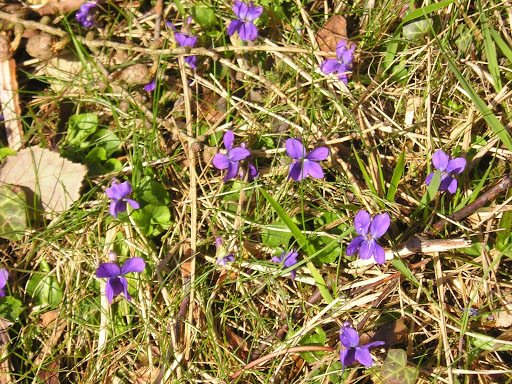
The past few weeks have been unusually dry which has meant that tidying up the garden – or, in my case, gardens: my own as well as clients – has progressed rather well. A nice drop of warm rain now would work a treat and not interfere with time schedules. At last, in the secret valley, leaves are unfurling properly, daffodils are blooming and the lone primrose has been joined by many more as well as purple and white violets.
.

.

.

Wherever I have lived, there has always been one hawthorn that opens its leaves days before the rest, even when planted as a hedgerow. I’ve often wondered if this is a genetic thing which means, I presume, that it could be cloned to have a whole group of early leafing ones. Or is it a combination of warmth and soil conditions in that particular spot? When I retire and have more time (a contradiction as the two never happen according to friends who are trying it) I will take cuttings and carry out a controlled experiment. It will give me the opportunity to blog about it if I am still able to sit in front of a computer!

.

.
I wonder if I could get a whole hedge of early flowering hawthorn? It will be another six weeks or more before they will be in bloom in the secret valley.
.

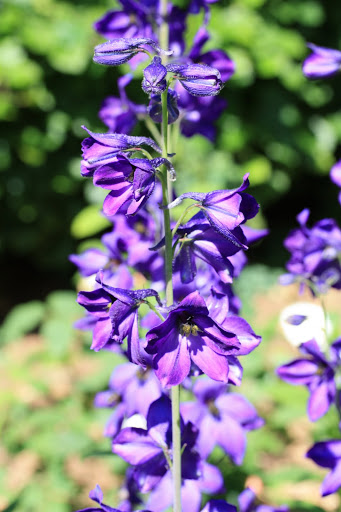
The snowdrops and aconites have now finished flowering. The little ruff of green leaves are all that is left of the latter. They look so similar to the taller herbaceous aconites or Monkhoods whose green ruffs are also poking through the ground now. They are all part of the buttercup family so are related but so unalike one another at their flowering time. I love the tall purple spires of the Monkshoods in mid to late summer: not as delicate as delphiniums, another favourite, but at least slugs don’t eat them and they don’t need staking, a real plus.

.

.

.

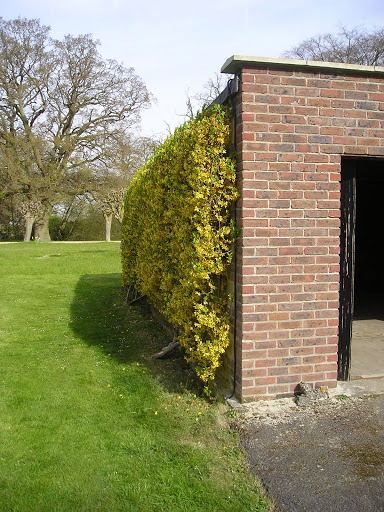
Forsythia is in full bloom. These I enjoy in other gardens but never plant them in my own unless the garden is huge and they can be planted a long way off. They show up from quite a distance and when seen too close, are too strident for my taste. The non flowering shrub later in the summer is a coarse affair too, dull and not warranting the space unless livened up by a clematis or other climbing plant. In the photo below it is grown as a wall shrub and it works well in disguising this unattractive garage. Despite being cut hard back to the wall each year in early summer it is always smothered in bloom by March.

.

The same applies to the common flowering currant. The standard pink is a wishy-washy thing and the deeper coloured, named varieties such as King Edward VIII, is as strong in colour as the forsythia – a plant to be enjoyed in other gardens. For those of you that thought the currants were always pink (although there are white flowered versions) and smelt of cat’s pee – and I include myself in this category for many years – there are three others that are well worth making space for.
.
.

Ribes odoratum, has pale yellow flowers and is beautifully scented. It is a bit of an untidy shrub in my experience, suckering freely but not a nuisance. It grows in happy neglect in a hedgerow – an ideal spot for it to do its own thing – and is really only noticed by the spicy fragrance as you wander past.
.
Ribes lauriflolium is a new plant to me. Unlike the others which all originate from the States, this currant is found in the wild in China. Looking at descriptions on the internet I wonder if they are correct or if there is a lot of variation in the stock, which is possible. I bought mine described as white, evergreen and not too hardy. It has survived -16C this winter, has been deciduous (perhaps it keeps its leaves in milder winters, I rather hope not) and is white flowered. Others are described as yellow and growing to only 1 ft – mine is already 3ft but that may be because it is tucked behind our dry stone wall. The one thing they all agree on and I can confirm is the exquisite scent of lilies of the valley. Do try to grow one if you can find it.

.

.
I have since discovered that this isn’t a ribes at all! See my next post to reveal all!!
.
My final choice of flowering currant is another favourite, Ribes speciosum. It is reminiscent in bloom of fuchsia and, like them, are pollinated in their native environment by humming birds. Hailing from California, in UK gardens it requires shelter and grows best against a warm wall where it can be trained on wires or left free growing. This photo was taken in the botanical gardens in Dublin on a glorious spring day.
.
.

Warmth, blue sky and sunshine. The clocks go forward an hour this weekend giving us more evening daylight. I’m almost feeling optimistic about the days to come – something a gardener should never be!
.
.
.
.
Add to Technorati Favorites

Spring Is Around The Corner!

The first signs of spring are always welcome and especially so after the winter that we have had this time. Frosts arrived early in the season, followed by snow that lay both deep and long, which is unusual for the south of England.
.

Winter in the secret valley: sheep wait patiently for food by our little winding river
.

The Cotswolds are known, however, for their colder and longer winters compared to the rest of the region. Here, about as far inland as you can be on a small island, we have little benefit from the warming effect of the sea and we are also hill country. Elsewhere may be showing signs of spring but in the secret valley these are still hard to find – an elder twig just breaking into leaf is the only green that I can find so far.

.

.

The aconite wood, ‘though, is a sight to behold and has been flowering for a couple of weeks now. How many plants can there be? Surely, tens of thousands. When and why were they planted here, for they are not native to this country. An old country chap told me it used to be called Summer House Woods but there is no sign of a building here and the ‘big’ house that owns the land is some distance away.

.

.

This snowdrop wood was planted by nuns over a hundred and fifty years ago and is attached to my ‘reincarnation’ house. Snowdrop woods, unlike aconite ones, are not uncommon but never fail to impress. Even a small group in a garden are eagerly awaited and we have plenty here where they spill out beyond the garden boundary and peep out from amongst the hedgerow that borders the lane.

.

.

The Cornus mas is also flowering now. It grows in our garden against the house wall, facing east. Despite this, it perfoms regularly and is easy to keep pruned to shape. This one, is the variegated leaf variety which is quite slow growing compared to the standard type and so is ideal as a wall shrub. In late summer it carries edible scarlet berries, hence its common name of Cornelian Cherry.

..

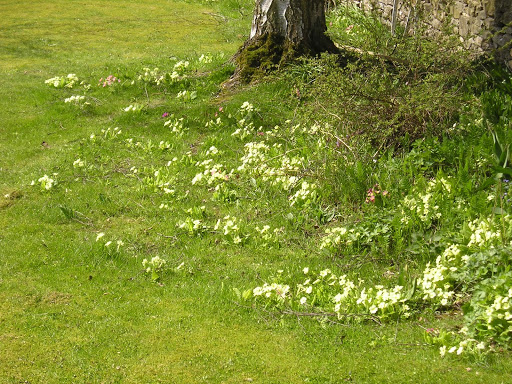
Also in the garden, I found a single, wild primrose, sheltered by the old garden roller, in flower. Later, the garden, and especially the lawn, will be covered with their flowers. Daffodils, although beginning to flower elsewhere will be a few more weeks before they do up here. But even in the Cotwolds they are showing colour in the warmth of our towns – which makes shopping just a little bit more enjoyable.

. .

.

When in town, I was surprised to find that oldest of symbols of spring – the green man. He was standing tall and lofty down a back street unnoticed and forgotten. Closer examination revealed that he was an old column and ball, the remaining one of a pair of stone entrance pillars from some long demolished house. Now covered in ivy, I wondered why it had been left and what was its history.
.

.

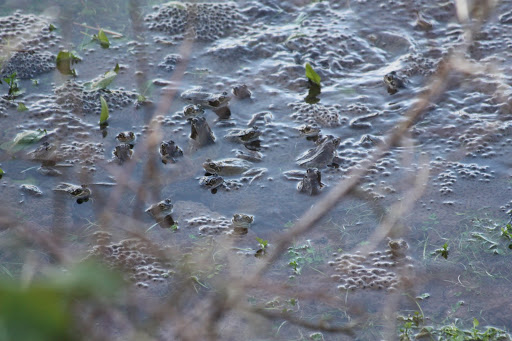
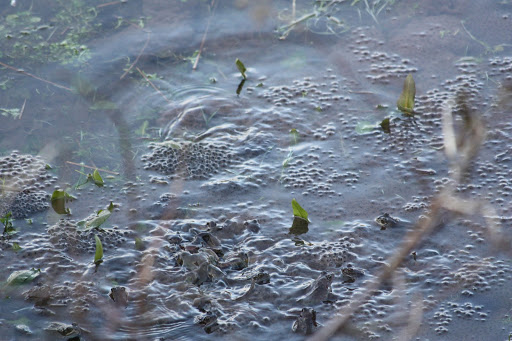
Further afield still, I came across a small pond in a field. The croaking of hundreds of frogs drew my attention to it and in the photo below there are over forty heads poking out above the water. As I approached, sensing danger, they fought one another to get below the surface, making the water look as if it was a boiling cauldron. A few days later, when I returned, all was quiet and the surface of the water completely covered in frogspawn. Like the daffodils, it will be some weeks before our secret valley frogs start marching across the lane and entering the house in their quest to reach the lake below our garden.

. . . .

.

.

.

Add to Technorati Favorites