
Where does the time go? Christmas has been and gone, as have the New Year celebrations and here we are already at the end of January’s first week. I’m beginning to understand those lines of William Davies’ “We have no time to stand and stare…“. Not that my life has too many cares fortunately and, of course, I’m exceptionally lucky living where I do and working outdoors – I have plenty of time “… to see, when woods we pass …“
Continuing on from my review of the first six months …
July: we had a rare fine evening in a year filled mostly with rain, an opportunity for the lucky few to go hot air ballooning. We had a surprise visitor when Charles Teall, who lives a few miles away, dropped unexpectedly into the secret valley. We joined him and his balloon team for drinks by the river, a lovely way to end a flight. Some years earlier Charles had flown me across the Cotswolds before landing to a champagne breakfast – but that’s another story.

Another surprise was when I found an abandoned bantam egg and hatched it out, capturing the moment on video, now uploaded to YouTube. You can watch it by clicking here.
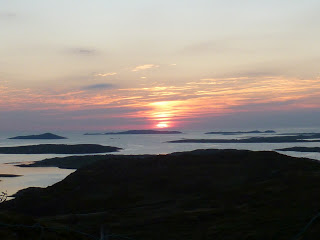
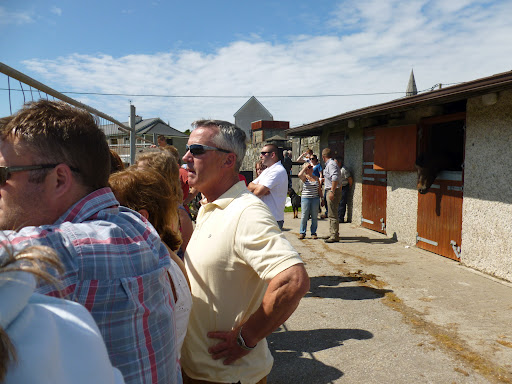
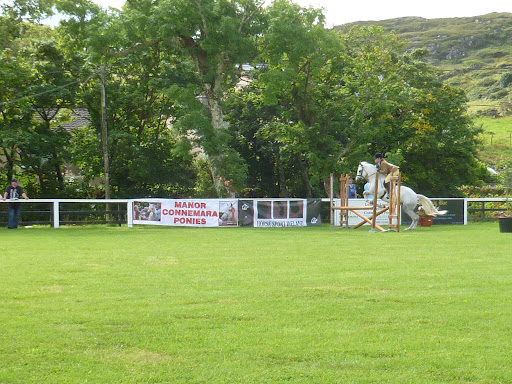
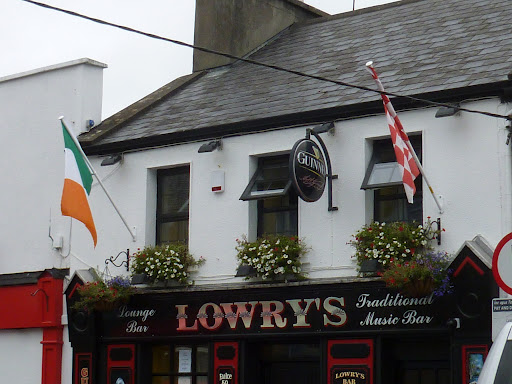
August: You don’t go on holiday to Ireland for the weather, especially the west coast lashed as it is by frequent Atlantic Ocean storms. To everyone’s great surprise, we had unbroken sunshine and high temperatures day after day. We even swam in the millpond calm sea. At night we were treated to the most glorious sunsets, every evening more dramatic than the previous one.
September: Britain has a long and proud history but we tend to forget about the days before the Conquest in 1066. We had been invaded and settled many times prior to that but the Romans left us with a road system that is still much used today. Their houses have long since disappeared although there are many excavated ruins that can be visited. Cirencester was one of the premier cities of the time and the museum there houses many artefacts including some remarkably intact mosaics, the subject of a post.

October: Their are numerous new diseases affecting our trees and one species that has been hit badly is the Horse Chestnut. The leaves become infected with leaf miners and cankers weaken the tree further. This, in time, may kill the tree but short-term affects the quality of their fruit – the conkers of childhood games.

November: Trees also featured this month along with a visit to my earliest schooldays. The larch was my introduction to nature cleverly made magical by my school teacher, Miss Vine. Larch still are my favourite tree: we have a good number of them here in the secret valley where they give me still as much pleasure at all times of the year as they did all those years ago.

December: With the year whizzing by there were no posts this month other than to wish you all a happy holiday and start this review with the first six months of the year.
Every year has its memories but 2012 will be recalled as the year of the Queen’s Diamond Jubilee and the London Olympics. 2013 looks like being an especially memorable one for me but you will have to wait a little longer before I reveal all!

And just in case we are all rushing about far too much let us remember the words of William Davies:
What is this life if, full of care,
We have no time to stand and stare.
No time to stand beneath the boughs
And stare as long as sheep or cows.
No time to see, when woods we pass,
Where squirrels hide their nuts in grass.
No time to see, in broad day light,
Streams full of stars, like skies at night.
No time to turn at beauty’s glance,
And watch her feet, how they can dance.
No time to wait till her mouth can
Enrich that smile her eyes began.
A poor life this if, full of care,
We have no time to stand and stare.
Leisure from Songs of Joy and Others, 1911








 I think the reason we may behave like this is because English weather is nearly always gentle. The landscape that makes up England is beautiful and can be dramatic but not in the way of so many other countries. Take the USA, for example. Where’s our Grand Canyon, our towering redwoods, our Rocky Mountains, our Great Plains and our Niagara Falls? We have them in miniature and, perhaps, that is just as well as we are such a small country. And likewise, our weather: we have heatwaves, we have floods, we have blizzards. But they are rarely anything truly spectacular (except to those poor people affected by them, of course). And so when we were told by the weather men in 1987 that reports of a hurricane were completely exaggerated, we believed them totally. And despite the fact that much of the country was hit hard by it when it arrived, my part of the Chiltern Hills where I lived at the time was not much affected, even though it is one of the most wooded parts of the country.
 The night in January 1990 was different. This time we had winds, whilst not as severe as three years earlier, which created total havoc with the already weakened root systems of the trees. Great swathes of the magnificent beech woods that are the very heart and soul of the Chilterns were flattened in a couple of hours. (I am reminded by my partner, that as the rest of the world cowered in their beds as the trees came crashing down all around, I woke up to say “a bit windy out there” before falling asleep again). As dawn broke the true damage could be seen.
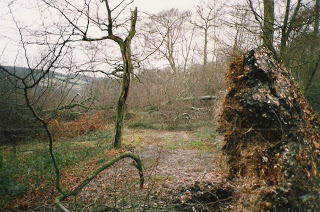 Fast forward twenty years to 2010 and the woodands are transformed. Those of us that remember the 200 year old beech know that the majority are gone and, in their place, are new trees of mixed species. It will be many years before the magnificence of the woods return but they are healing. This photo below is taken from the same spot as the one above. Some of the biggest old stumps have been left, too difficult to move – time has hardly changed their appearance apart from their ‘roof’ of mosses.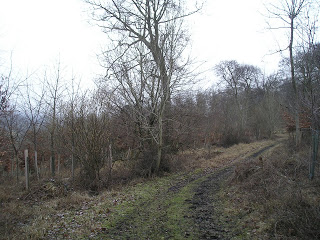
 One of the unforeseen benefits of the hurricane is the increased amount of light reaching the woodland floor, for beech trees cast a dense shade where little can grow, other than where the canopy is lightest. Apart from the view to the valley below, which was unseen before, many wild flowers are better now than ever. Roll on April when we can see the blue carpet of tens of thousands of bluebells disappearing into the distance.
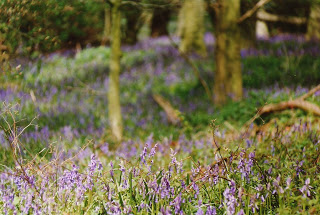 Oh! And I nearly forgot to say, the weather today is a mix of sunshine, cold winds, rain and sleet. Don’t forget to tell the next person you meet!
 I’ve had to rely on a ski trip photo for really deep snow
  Our snowfall – just a dusting despite the warnings of up to eight inches forecast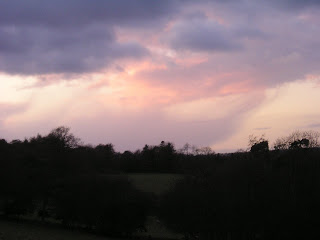

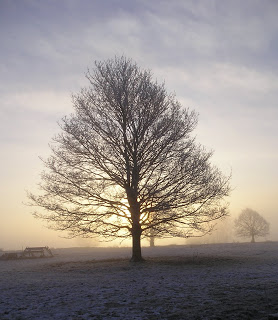
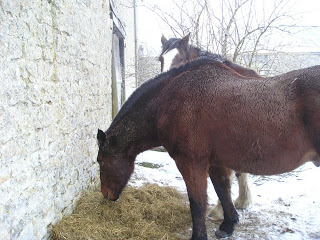
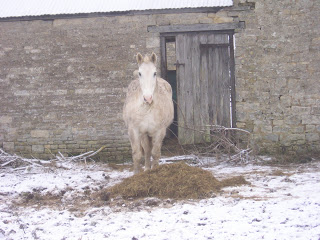 “Why does he keep taking all these photos?”
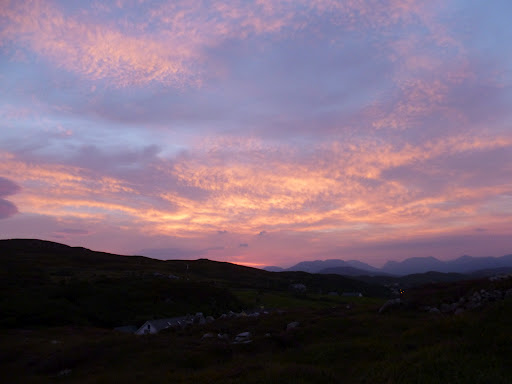
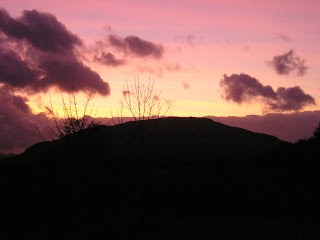
 Sometimes it seems as if flowers have inspired the sunsets! Here is the rose Rosa x odorata ‘Mutabilis’ trying to outdo another mountain sunset. This rose starts with the most intense pink bud and, as the flower fades, turns to the softest apricot, ending up with this wonderful colour combination.
 This old mossy wall was the starting point for a mini parterre – the ‘moss’ is made from the box (boxwood) framework, the ‘stones’ from variegated Iris and Cotton Lavender. The wall reminds me of our garden wall in the secret valley (Sunday 20th September 2009) but this one is in north Wales and is a hard, cool grey and silver granite unlike our soft, mellow Cotswold stone. This planting is tiny compared to the usual grand parterre designs and has been used to link two levels of a small garden.


 So let your imagination take you where it will. Sometimes the combinations don’t work but, more often than not, there will be some exciting discoveries to be made and a lot of fun will be had along the way. And make sure you tell me all about them……
 Life in the English Cotswolds