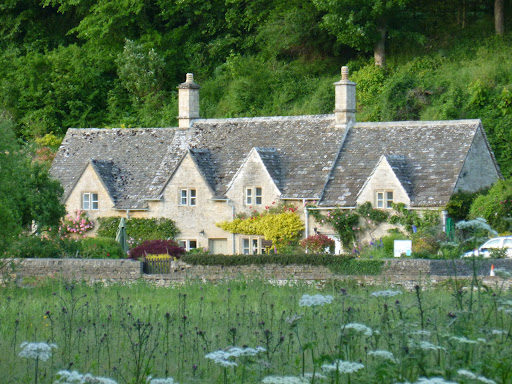
The tiny village of Bibury has long been recognised as one of the prettiest places in the Cotswolds and is much visited by tourists. It is everything you might magine an old English village to be; so much so that some visitors, according to local gossip, not realising that it isn’t a theme park creation, walk into people’s homes to have a look around.
Ancient cottages in mellow Cotswold stone, a crystal clear, trout-filled river running alongside the main street, an old mill and a great pub offering food and accomodation all make Bibury “the most beautiful English village” as William Morris, the Arts and Crafts textile designer described it when he visited during the 1800’s.
The old cottages are so perfect and their setting so tranquil that they appear to have created an ethos amongst their owners: each house and garden has to be more well maintained than their neighbours. The only weeds I saw there were across the river in the marsh and, of course, not only were they growing where they belong – in a wild setting – but there were only the most attractive ones such as Yellow Flags, the bog irises and the flat, white heads of the hogweeds.
No English village is complete without its church and pub and Bibury has both. The church of St Mary’s dates back to the 12th century and is well worth seeking out for it is tucked away down one of Bibury’s few side streets.
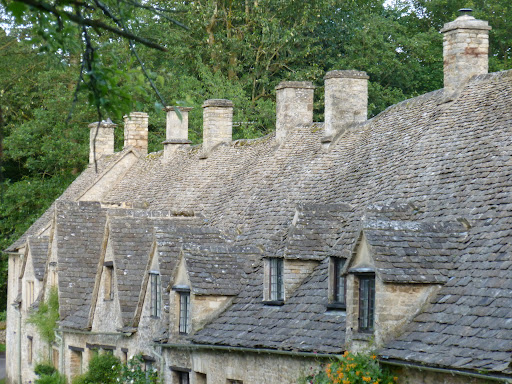
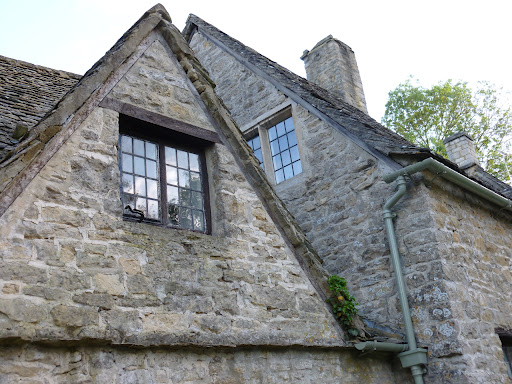
Exploring Arlington Row gives visitors an opportunity to see just how higgledy-piggledy the construction of old house are. The old stone walls and mismatched rooflines and windows are juxtaposed seemingly at random – a modern planning departments nightmare.
Despite, the large numbers of tourists (for we all like to believe that we fall out of that category and will be the only persons there), Bibury is well worth making the effort to visit. It is situated close to Cirencester, one of the most important Roman towns in the UK, with its wealth of history and it is also within easy reach of Oxford. If I had to choose only one place to take a visitor to see, I think that Bibury would be highly placed on the list.
Let me know – especially overseas readers, please – which would be the one place that epitomises old rural living in your country.
When I wrote my initial post on the ancient hedgerow that leads uphill out of the secret valley I intended to update it on a monthly basis (click here). What a failed idea that has proved to be! For March 10th was as hot a day as any summer’s and that, coupled with a very dry winter, created the worst drought for many years. The day that I had intended to walk the hedge (and also the day that a hose pipe ban was announced) the heavens opened and we have had torrential rain ever since. I have been soaked to the skin most days because of work – I had no intention of a second soaking whilst carrying out hedge surveying upon my return home.
A break in the clouds, however, allowed me to sprint up the lane snapping away with the camera moments before the next deluge. No time to marvel at the way nature responds to climate or to look carefully to see what species of plants might be new to my eyes. The only wildlife I saw was a solitary snail, pale lemon in colour and rather pretty – if you can describe a snail as such – which dropped off it’s grass blade perch the moment I got the camera in focus. I’m sure I heard it giggling in the undergrowth.
Here is what I did see.
Cowslips
Cowslips (Primula veris) are a great favourite of mine bringing back memories of early school for ours had a play area that was carpeted with them. Years ago no-one worried about picking great bunches of them or digging some up for the garden which we all did yet the numbers there didn’t seem to diminish. However, overpicking (or perhaps spraying roadside verges) meant that the cowslip became a scarce plant. Happily, they are now seen sporadically along the Cotswold lanes although not on my old school playground which became a high density housing estate in the ’80’s. Along our hedge, cowslips appear in small numbers which, hopefully, will increase over the years. Further up the valley a field grazed only by sheep and never sprayed is a yellow carpet at this time of year and on warm, still days, the faint smell of honey wafts around transporting me back more years than I care to admit to.
Cowslip meadow in the secret valley
Primroses
The last few primroses are still in bloom, quite late for this time of year and no doubt, like some of the daffodils, lasting longer because of the cool, damp weather. Primula vulgaris, their botanical name, sounds like a misnomer for their is nothing vulgar about them, for every part of a primrose is pretty, whether it is the palest lemon of their petals, the deeper yellow throat or the fresh green of their leaves. Even the ribbing and lines of their veins create attractive patternss and textures. Vulgaris does, of course, mean common – there is nothing common about them in appearance either!
The hot March had an odd effect on plants. Some revelled in it, throwing caution to the wind and paraded their summer finery early, whereas others seemed to remember the old saying about not casting a clout ’til May is out. Proven right, when cold returned in April, they now seem reluctant to even expose a leaf and, as a result, the hedgerow is bright green in places, yet bare and wintry looking in others.
Field Maple
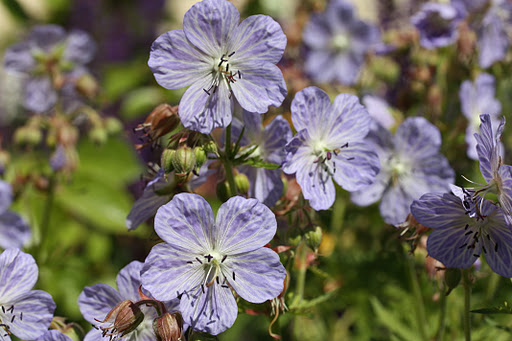
Field Maple is a classic old hedgerow plant. Left to grow untouched it makes a medium sized tree of, to my mind, simple but great beauty. However, it is usually trimmed to make a reasonably dense, twiggy barrier. Like all maples the flowers and leaves emerge together but I had never noticed before the rich mahogany colour of the leaf buds. Acer campestre.
Ground Ivy
A plant so common and so small as to be overlooked, Ground Ivy (not related to ivy but to mint)has to be viewed on hands and knees to see its quiet beauty: tiny, mauve, hooded trumpets darkening at the throat. According to my old herbals it was used for all sorts of ailments from the uterus to inflamed eyes and everything in between. Glechoma hederacea, in a greyish variegated form is often used in hanging baskets where it is seen trailing in ugly, thick ribbons. Leave it where it belongs – trailing over the ground at the foot of a hedgerow. Perhaps it should be used in the garden in this way?
Jack-by-the-Hedge
Jack-by-the-Hedge or Garlic Mustard is a common plant and quite a useful addition to early spring salads for its shredded leaves have a mild garlic taste. In the photo above it grows along with stinging nettles and the fine leaves of Cleavers or Goose-grass. It is the food plant of the Orange Tip Butterfly which is quite regularly seen throughout the secret valley, although scarce so far this spring due to weather conditions. Occasionally they fly into the house and require rescuing – not always as easy as in this photo!
Orange Tip Butterfly – only the male is coloured orange
Bluebells with White Dead-Nettle
Bluebells, Hyacinthoides non-scriptus, are another of the ancient woodland indicators (click here for more details of this term) and they flower the whole length of the hedgerow. In the Chiltern Hills, the area where I spent most of my life, the beechwoods are renowned for their Bluebell carpets (photo below). Here, they grow more sparsely, with the occasional white flowered sport growing amongst them. In the photo above, it is the white flowered dead-nettle they mingle with. The dead-nettle, Lamium album, is not related to the true nettle and has no sting, just an unpleasant smell when the leaves are crushed. In the garden it is a nuisance with a white, running root, quite thick and brittle unlike the stinging nettle’s yellow, fibrous root system – a useful way to tell them apart if uncertain, apart from the sting, of course.
A bluebell wood in the Chiltern Hills in Spring
Burdock leaves
The large leaves of Burdock, Arctium minus, are already forming rosettes. It will be a while before they send up their spikes of lilac flowers, reminiscent of those of the thistle and even longer before the troublesome round seedheads, the burs, stick to clothing and She-dog.
One of the greatest and most picturesque, natural aspects of lowland Britain is its patchwork of fields divided by neatly clipped hedgerows. In hill country, or where there is a wealth of stone, the fields are divided by dry stone walls and the Cotswolds are renowned as much for these as for the limestone cottages and houses built of the same material. Here, domestic and farm buildings merge into one with the landscape for, as the fields were cleared of stone, it was natural to use it as a building material.
However, the Cotswolds also have their fare share of hedgerows and these often go unnoticed – overshadowed by the craftsmanship, colour and texture of the old walls. In the secret valley we are fortunate for we have both: outside our little cottage – also built of stone 160 years ago – one side of the lane is bordered by a hedge, the other a dry stone wall. At a glance, the hedgerow is unremarkable whereas the wall attracts attention for its weathered appearance and moss encrusted stones. But not all is as it seems.
The wall was probably built at the time of the great land enclosures, when large areas of England were partitioned, the ground cleared and ‘improved’ to grow crops (or here, in the Cotswolds, more likely wool) and may not be more than a couple of hundred years old – ‘new’ to us Brits. However the hedge, shabby and overgrown in places, could well be a relic of the ancient wildwood, the forest that once covered most of lowland Britain in the days of pre-history before man started cutting it down. ‘Our’ hedge would almost certainly have been part of the Wychwood Forest, a royal hunting ground, for written records go back to the time of the Domesday Book of 1086. As the forest was cleared (for more details click here) to make way for fields, it was easier to leave strips standing than to create new dividers.
How do we know that it is an ancient hedgerow and not one planted at the time of the enclosures? There is an accepted formula for dating them known as Hooper’s Law: the number of tree and shrub species found in a thirty metre section x 100 is equal to the age of the hedge. It is normal practice to take three thirty metre sample lengths and apply an average for greater accuracy. There is also a second method of deciding if the hedge is of ancient origin: by the types of wild flowers that grow in it. Certain species are very slow to spread, or perhaps only would normally grow in certain conditions such as woodland shade. These key species are known as ancient woodland indicators and we have a number of them growing at the foot of our hedge.
What is even more remarkable is that the plants tell us what is old and what is new hedge with such accuracy that it is possible to follow the old even after it has left the roadside. For our little lane that winds uphill as it leaves the secret valley to join the main road (‘Turnpike‘) is also part old and part new. Before the Turnpike was built in the late 1700’s, the lane beyond our house took a sharp turn left and crossed the fields, it’s way now marked only by sunken turf and yes, you’ve guessed it, also by the old hedge and its associated flora.
I always consider March to be the start of the gardening year, the month when nature turns its back on winter and spring moves rapidly forwards. Leaf buds burst, seedlings germinate and the first of the flowers remind you that long, hot days are not too far away. It is the same with the plants that are beyond our garden gate. And so on our first really warm, sunny day of 2012 I have decided to embark on a new project: to catalogue and photograph a year in the life of our hedge on a month by month basis. Watch this space!
Forsythia: Another spring bloomer and again just the odd flower rather than branches being smothered in flower. Perhaps not so surprising, as flower arrangers would know – the tight buds that cluster along the bare stems will burst into flower early when brought into the warmth of a house in a similar way to the ‘sticky buds’ of the horse chestnut bursting into leaf indoors. Here, forsythia has been trained as a tightly clipped shrub to screen an ugly garage wall, the warmth and protection of which also makes the flowers open a week or two before normal.
Ferns: Some of the shabbier looking ferns had been cut dowm to ground level as part of the autumn tidy. I hadn’t expected them to burst back into growth …..
Daisy: There have even been odd wild daisies flowering in the lawn (we have mowed twice this month too). The Erigeron daisy that you see growing in profusion amongst the ruins of ancient Rome has been flowering in our garden as if it was still midsummer; it is smothered in blooms.
Geraniums: The hardy herbaceous sort. Like the ferns, they had been given the chop some time ago but are coming back into leaf and flower. Some of the hardy salvias are doing the same thing.
Mallows: I have seen hollyhocks still in flower on my travels around the Cotswolds. They are majestic when they are grown well but my favourite of all is the musk-mallow, Malva moschata, which is a wild flower that is often brought into gardensl. I grow both the pink and the white versions and they self sow happily in the borders without ever becoming a nuisance. It wouldn’t matter, you couldn’t have too many!
Roses: There are nearly always roses out on Christmas Day and we always exclaim how extraordinary a sight it is. They are poor, wet, bedraggled specimens carefully left in place by even the hardest pruners as a reminder of warm summer days. For the most part that is the case this year too. What we don’t expect to find are bushes smothered in beautiful blooms still wafting scent but this is the case in one rose garden I attend. I am uncertain as to the variety but there are three of these amongst forty other bushes – all shrub roses. They really are a joy to see.
Much has been written about creating wild flower meadows in recent years. Many gardening magazines infer that somehow you must be lacking in something if you don’t rush out there and then and rip up your precious lawn to create the daisy and orchid studded turf depicted in medieval tapestries. There is much to be said for doing this (and I’ve done a few in my time too). However, the reason why most of us don’t do it is purely down to lack of space and time, and also most of us still like to see a reasonably weed free patch of green grass at the centre of our gardens. Now don’t get me wrong, anything that reduces the amount of chemicals used and encourages wildlife has got to be a good thing and our gardens, collectively, could – and should – make one vast nature reserve.
But why restrict yourself to wild flowers in grass? Very few articles suggest using them in herbaceous borders, or amongst shrubs, but I have been planting them like this for some years now and the results can be terrific. This flower border in the photo was taken 14 months after planting and looks very much like a traditional, English flower border. But there are some differences and those are the wild flowers intermingling with the more usual garden plants.

Purple Loosetrife, Lythrum salicifolium, grows wild in boggy places and by stream edges so seems an unlikely candidate for the border. I have found it to be a great choice which copes well with ordinary soil conditions. In the hot, dry summer we have had this year they have only grown to about half their normal height of 3-4ft but their cerise colour and longevity have still made them a worthy addition. In the photograph above they are the bright pink ‘blob’ in the centre, growing separately to the surrounding plants.

Here they are being grown as a companion to a bright pink ground cover rose, a combination that I’m not so keen on (even though I did plant them myself). They are a bit too strident and close in colour for my taste but others have stopped and admired them so there they remain.

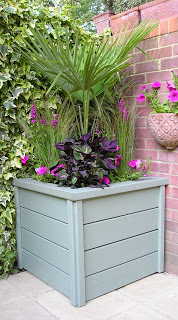
I have also experimented growing them in containers where, of course, you can easily give them the moister conditions they would naturally prefer. Here, their colour makes them quite an exotic addition to the matching colour petunias, the purple leafed coleus and tropical looking (but hardy) palm.

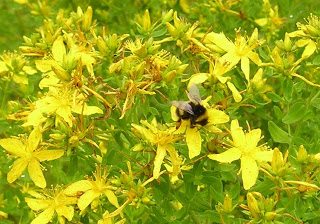
Another reason for growing wild flowers is that, of course, they are great attractants of the local insects. A clump of the herbaceous St John’s Wort, this one is Perfoliate St John’s Wort, Hypericum perfoliatum, always are covered, when in flower, with bees and other beneficial, pollinating insects. The flowers are miniature versions of the shrubby Hypericum ‘Hidcote’ and all the better for being small. In the wild, they grow (as many wild flowers do) quite happily amongst grass and other plants. In the garden, I find they combine well with Wormwood, the tall, shrubby Artemisia.
.
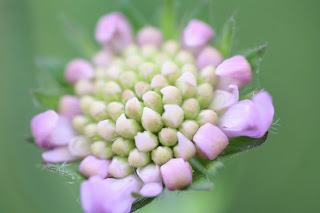
The pale blue flowers of the Field Scabious, Knautia arvensis, continue for months on end and combine well with most other colours. Growing them in the garden gives you the opportunity to notice them in detail. In the wild, it is less likely that you would see how the outer petals of the flower uncurl before the inner ones. Grow them with exotic looking Icelandic poppies or, like here, with tall, purple, Salvia.


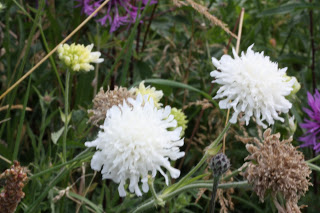
Wild flowers often are generous with their flowering, not only in the quantity of blooms and their exuberance. Sometimes, they offer a ‘sport’. The most common variant from the norm is white and this pure white version of scabious was a delightful bonus. I like the way the buds start off a creamy colour.

Recently, I have tried growing Lady’d Bedstraw, Galium verum. It is working quite well and the rather acid yellow looks good with lavender. In fact, this flower is all the better for propping itself up against its neighbours as it is a bit inclined (in an unlady-like way) to sprawl, otherwise.

One word of caution about introducing wild flowers into the garden: sometimes, they like garden conditions just too much. If in doubt, plant a small number of plants in an area where you can control them should they take off. I didn’t do this with one of my childhood favourites, Toadflax. It took me three years of painful weeding to extract the final pieces from more delicate plants. I have gone back to admiring it where it belongs – along roadside verges and on waste ground.
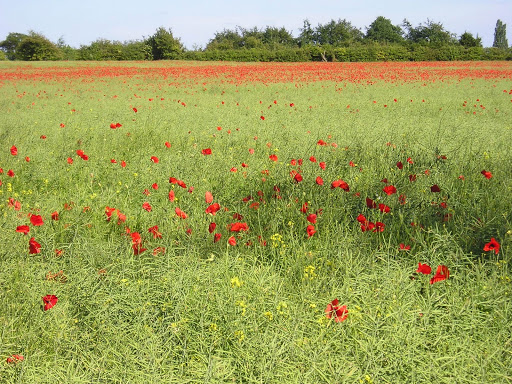
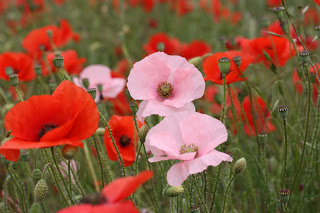
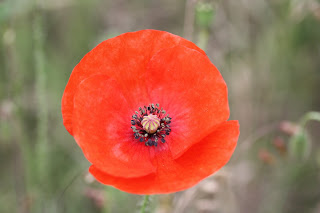
Everyone seems to love poppies. It doesn’t matter if they are the delicate crepes of the Icelandic or big and blousy Oriental poppies – even ‘though the latter so often lie sprawling across the ground, flattened by the weather or their own weight. But most loved of all are the wild scarlet poppies that create a violent red gash across acres of wheatfields.

Despite being forever linked with the trauma and sadness of the Great War, poppies refuse to lower our spirits. Perhaps they even comforted and uplifted the tortured bodies and minds of the survivors of the battlefields. The famous lines from In Flanders Field have immortalised poppies in poetry but thirty years earlier that great (but now almost unknown) British naturalist, Richard Jefferies, was eulogising “proud poppies, lords of the July fields….no abundance of them can ever make them commonplace….”. How right he was.

Even the odd, single flower, struggling in a bit of dirt at the side of some waste ground, brings joy and admiration but it is, en masse, when the sight of thousands of them in flower in a cornfield stops you in your tracks and, for a moment, loses you in a heady delirium of colour.
When the steep, wild flower filled grass banks that make the ‘walls’ of the secret valley have given way to the flatter, arable lands and the lush water meadows and meandering river lie far below, the fields become larger and hidden by high hedgerows. The character of the secret valley is much changed up here: those unfamiliar with it would not know of its existance it is so concealed. The old field names reflect this – lower down the names end with the words ‘banks’, ‘close’, ‘grounds’, ‘meadows’, now they all end with the word ‘downs’ and you could be forgiven thinking that you were on vast rolling downland, for the eye leaps over the valley to more cornfields beyond. And, a few days ago, I climbed the old, timber stile that pierces the hedgerow to walk in the field known as’17 Acre Downs’ to be greeted by the lords of the July fields.

However it was not the sight of crimson stretching as far as the woodland in the distance that stopped me in my tracks for there, at my feet, was a single, pure white poppy. Just one amongst tens of thousands of scarlet.


.

.
.
.
.

.
.
.
.
.
.
.
.
.I never did get to see the fritillary fields of Oxford and the Upper Thames. Perhaps next year. If fritillaries are the flowers of the lowlands (albeit rare) then it has to be the cowslip that can lay claim to the title for the hills of the Cotswolds. These little, short stemmed wild primulas (Primula veris) have a simple beauty – they look good growing in the garden but even better in the fields and hedgerows where they belong.

Cowlsips grow in plenty in the secret valley and I have noticed this year that they abound along the old drovers road, as do bluebells – don’t they look good growing in combination? Is this because these green lanes are never sprayed with chemicals and the thick hedgerows that line them prevent any spray drift from reaching? The field below is at the top of the secret valley and is a haven for wild flowers – soon there will be orchids showing. The farmer likes to see them so has never tried to ‘improve’ the ground in the agricultural sense and, as a consequence, the field is also full of birds and bees and butterflies.


However, to see the truly stunning cowslip meadows, you have to travel out of the secret valley. Just a few miles up the road is this field where the cowslips grow in the tens of thousands, so dense that it is impossible to walk without trampling several plants at once. Few people see them as they are ‘off the beaten track’ which is a pity in some respects, for they should be enjoyed and marvelled over.

So the Easter holidays are with us once again: a time of our gardens and countryside bursting with new vigour, the smell of fresh, green growth, gentle, warming breezes and longer daylight hours to enjoy it all.
Primroses and violets are the traditional wild flowers of Easter and our lawn is dotted with dozens of them. We avoid mowing them when in flower, after that we don’t worry yet the numbers increase with every passing year.

The pretty, native Wood Anemone, Anemone nemerosa, blooms in profusion in favoured places – usually in sheltered woodland. Sometimes they are found on banks, perhaps showing where ancient woodland once stood, for Anemone nemerosa is one of the ‘indicator’ plants. Ancient woodland is classified in England as woodland growing prior to 1600 and although a number still stand many were cleared centuries ago.
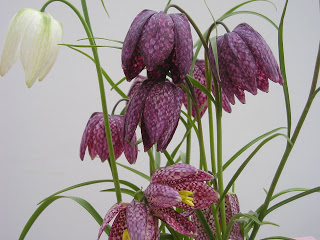
The Snake’s Head Fritillary, Fritillaria meleagris, is an extremely rare plant in the wild although there are water meadows around Oxford and the Cotswolds where they carpet the ground – a spectacular sight. Fortunately, they grow quite easily in our gardens and the corms are readily available from reputable bulb merchants, who only source them from grown stock. Sadly, there are still occasions when bulbs and corms are marketed from illegally collected wild stock.
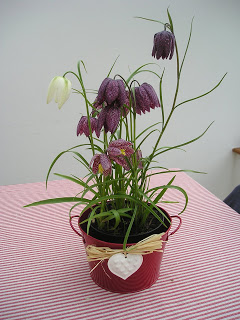
They make fine, if somewhat short-lived house plants. We like to have them indoors at Easter and they can afterwards be planted in the garden to bloom again another year. When seen close-up, it is obvious from their markings why one old name that country folk give to them is Chequers.
It is not only flowers at Easter that should be thriving. The wild birds are singing and building their nests and sheltered beneath a large clump of Oat Grass, the wild Mallard duck, lay their eggs each year in our garden. As soon as they hatch, their mother leads them to the safety of the river below the house.

This is the joy of Easter – or it usually is. Not in 2010. The primroses and violets may be blooming but the weather is more of winter than spring with the season up to six weeks behind this year. There is hardly a leaf showing on the trees and bushes of the secret valley and the river has burst its banks with the continuous rain we have had the past few weeks. Any duckling that ventured onto the water would soon be swept away in the torrent our gentle stream has become.
However, She-dog is thoroughly enjoying running through the flood waters – especially where it is shallow enough to admire her reflection!