An Arty Family?

Eighteen months ago I was contacted by a gallery in Cheltenham about their researching an artist for they had acquired four watercolours of London street scenes painted during a ten-year period from 1885.  They were by Edward Angell Roberts who had lived with Mary Ann Shortland, an ancestral cousin of mine.  Although they described themselves as husband and wife in official documents, Edward was already married to the exotically named Josephine Bartolozzi Vestry Anderson.

New Street, Spring Gardens
Edward Angell Roberts, 1885

Edward was born in Kennington in the English county of Surrey in1836.  His father was a tea merchant and aspiring gentleman which presumably he became for by the age of fifteen, Edward was being educated at Christ Church Hospital, a school for sons of clergy and gentlemen.  It was a good springboard for Edward for in 1855 he was promoted to Deputy-assistant to the Commissary of the Inland Revenue before proceeding to becoming Clerk to the War Office.  In his spare time, he painted.

Old Wooden Houses, The Strand
Edward Angell Roberts, 1887

The four watercolours show great artistic detail of places within a stone’s throw of the War Office, in London’s Pall Mall.  They are New Street, Spring Gardens (1885), Old Wooden Houses, The Strand (1887), Garden House, Clements Inn (1895) and Pump Court, Temple (1895). They have since been sold at auction to a buyer in the United States.

Garden House, Clements Inn
Edward Angell Roberts, 1897

Edward had married Josephine in 1858 and the census, three years later shows them living apart.  Whether that was a temporary separation is not known for shortly after they had two children, a girl in 1864 who died in infancy and a boy in 1866. However, by 1871 he was living with Mary Ann and Josephine and the son disappear from record.  It is thought that they may have moved to Ireland for the son reappears in the English 1901 census return and claimed to have spent time there.  As for Edward and Mary Ann, they never married (or had children) for in his will, Edward leaves his estate to Mary Ann Shortland, spinster.

Pump Court, Temple
Edward Angell Roberts, 1897

I began to wonder if we had other artists in the family for several of my cousins, my sister and my father were all artistic,  I always felt that the skill had passed me by until some kind person exclaimed that through my career as a garden designer,  I paint with flowers, a description I rather hold onto.  It is true that there are some similarities for a new garden is a blank canvas waiting to be given a backwash of green and then daubed with the colour shapes and textures of flowers.  Below is a rather poor quality photo of one of my early designs inspired by a Japanese Imari plate which was, I suppose, quite any arty approach to take!!

Garden design inspired by Japanese Imari Plate
John Shortland, 1999

Another ancestral cousin painted and illustrated books on the town of Rye.  Marian Eleanor Granville Bradley was the granddaughter of the Dean of Westminster Abbey, George Granville Bradley.  Mostly remembered for her line drawings, occasionally they or paintings of hers are available for sale at auction.  An only child, born in the United States, she returned to England sometime during the 1880s.  She never married and died in 1951.  Her pencil sketches of Rye appear very simple at first sight and, like Edward Angell Roberts, belie the attention to detail that is executed.  Interestingly, a couple of her close relatives are described as ‘oil and colour merchants’ so it seems that art provided a living for my family in more ways than one…

Ship and Anchor, Rye
Marion Eleanor Granville Bradley,1920

And finally, there is Uncle Les – not my uncle at all but (yet another) cousin of my father and, in the convention of the time, known to me as Uncle.  I only met Les the once for he died quite suddenly when I was young.  However, I did get to know his widow well, so it came as rather a surprise when I was sent this little pen and ink drawing of (I think) a house in Kingston-upon-Thames many years after her death. 

Edwardian House
Arthur Leslie Shortland, 1935

A few lines on Josephine.  With a name like hers, curiosity got the better of me and so enquiries were made and she turned out, as hoped, to be ‘interesting’.  She was a close relative of Madame Vestris, a famous, if not infamous actress, contralto opera singer and theatre manager.  Madame Vestris probably deserves a full article of her own!

Madame Vestris, c1831 [Wikipedia]

Family history research is always uncovering something fascinating, puzzling or new – I wonder what it will turn up next?

With thanks to Andy Shield of Brave Fine Art , Cheltenham www.bravefineart.com }for sending me copies of the four paintings

Thirty Years On – Sadness & Celebration (part one)

How time flies by.  I know that’s a bit of a cliché to open with but, even so, it hardly seems possible that thirty years could have passed since that early spring day in 1994 when I locked the door of Shortlands clothing and footwear store for the very last time, and wondering where my career would go to next.  I was in my early forties and knew that I would have to do something to earn my keep and pay the mortgage but what?  It was a time of great sadness, not just for me and my family but also for our loyal staff some of whom had been with us for many years.  Thirty years on it seems time to write the shop’s story to celebrate it having been at the centre of community life for the best part of a hundred years.

Shortlands in the 1990s

The shop that was to become Shortlands began with my great-grandfather, William Bradby Langston, who had already established shops in Marlow High Street and in nearby Lane End. He was quite entrepreneurial, something he and his brothers inherited from their mother.  Poor Sophia, widowed in 1863 at the age of 34 with five children under the age of 13 and a baby due at any time needed to provide for herself and her family.  She set up a shop in her front living room which later expanded to become Langstons Department Store in Reading, Berkshire.  As well as those already mentioned, she and her sons between them also had shops in Boscombe (Hampshire) and Ilford (Essex).  Unsurprisingly, she is remembered as being rather a force to be reckoned with – you can read her life story, Rebel in the Family, by clicking here.

The first generations of retailers
l to r: My great-great grandmother Sophia Langston (nee Bradby); my great-grandfather William Bradby Langston; my grandfather Arthur Shortland

William opened his ‘Boot and Shoe Warehouse’ in Marlow in 1884 at the age of 22.  Seven years later he opened another, opposite the first, specialising in boating and tennis shoes as well as other sporting footwear.  When a newly built parade of shops became available in Bourne End in 1899 he established what was to become Shortlands.  At first the shop was tiny but by 1904 he had expanded to sell not just shoes but also mens and boys clothing.   Four years later William’s daughter, Nellie, married Arthur Shortland who had come to Marlow to work for William a few years earlier.  The newly married couple came to Bourne End and by 1915 Arthur was listed as the owner in Kelly’s Directory.

Langstons – the Bourne End branch c1910

The shop continued to prosper and during the 1920s the adjoining shop was purchased and ladies clothing and footwear as well as carpets, haberdashery, dress fabrics and knitting wools, soft furnishings, household linens and luggage were added to create Bourne End’s own department store.  The 1920s photo below shows my grandfather Arthur using the steam (clothes) press although it was a (much hated!) task given to my father Hedley as soon as he returned from school.

Langstons, now expanded and with my grandfather’s name on the fascia 1920s

My grandfather, Arthur Shortland using the steam press,1920s

With the outset of WW2 my father joined the army and it was left to the older generation, including my great-aunt Edith Shortland, to run the business.  Both the Langstons and the Shortlands were deeply religious and scrupulous in the way they behaved towards others.  My mother would tell the story of how when some silk stockings arrived (which were rationed and in short supply) she rather assumed that she would have a pair. She was told quite firmly that her name would go on the bottom of the list like anyone else – she never did get her stockings.  Aunt Edie was quite diminutive but with a voice that belied her stature.  One day she spotted a lady conceal some goods inside her coat.  “Jesus saw you do that” came a thundering voice from nowhere; the woman screamed, dropped the goods and her shopping and was last seen running down the street fearing the wrath of God was upon her!  After the war, my father returned to the business along with his brother Jack, later to be joined by their cousin Maurice Phipps.

A retailing family : four generations

During the 1960s the shop expanded again.  The garden and old shoe repair workshops at the rear of the property were built over and a new shopfront installed.  Made of aluminium, it was considerably ahead of its time and was featured in several design magazines both here and on the Continent.  By the late 1970s both my father and my uncle Jack had died and soon after the shop was due for another major refit.  The interior, as well as the fascia, was modernised and the displays became more open and accessible to customers.  Until that time stock was kept hidden away in drawers and boxes – if you wanted to buy something it was necessary to ask and an assistant would show what was available.  Personal service, nowadays a rarity, was the norm back then.  How times have changed!  To make space for the improved selection of clothing, all of the other departments closed and the shop concentrated on mens and womens fashions and footwear for all the family.  The toiletries and gift department was retained; the soaps and potpourri helping to make the shop always smell rather nice!

The ‘new and modern’ shopfront in 1969 featured in design magazines of the timeby the 1990s it was looking tired and old-fashioned
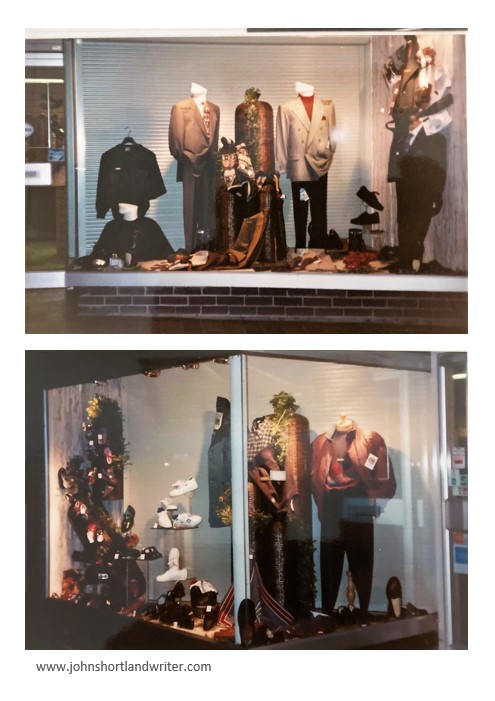
By the 1990s the displays were brighter and (to use 2020s speak) more ‘on trend’

I suppose it was because the shop was ‘always there’ that we have no photographs of the shop interior through the decades which is rather sad.  Fortunately, I did take a few in the early 1990s and these will probably trigger some memories for local people.  The 1990s brought new challenges for the business with recession and changing shopping habits sounding the death knell for businesses like ours.  I had joined the firm in 1971 and my business partner, John Pheby had begun even earlier, as a lad, working for the family.  It was a hard but inevitable decision that we decided to close and were fortunate to find a buyer almost immediately.  They converted the property to three shops and the accommodation and stockrooms above to flats.  Since that time Bourne End has changed quite considerably and most of the old shop names (and several of the buildings too) have disappeared.   I believe that there must be photos of the interior held by local people somewhere – it would be wonderful to see them.  I seem to recall Jean Peasley taking photos during our last few days…

Menswear Department, 1990
a small section of the Ladies Fashions Department 1990

So, what happened to our employees?  In the early days of my tenure there was Ivy Taplin (Akela to us cubs of the late 50s!), Yvonne Ludgate, June Charlton (later to become June Billinghurst), Cissy Hyde, Mrs Faulkner, Liz Hill and Diana Spokes.  Later, Pauline Harvey, Marjorie Kane, Wendy Manley, David and Marian Bratter, Diane Douneen, Kath Bowdrey, Iris Halstead and Cissy Vickers. I’m afraid I can’t remember the names of them all but some of those listed will be familiar to Bourne End locals – please don’t be offended if I have left you out, you were all valued!  The younger generation I purposely have not named but they aren’t forgotten either – I still keep in touch with several of them thanks to social media.  It was thanks to a succession of great staff through the years that the business was so successful.  It seems appropriate to thank our loyal customers too – I can still picture many of them and the frequent kind comments that I still receive on social media shows that they haven’t forgotten Shortlands either which, after all this time, is rather humbling as well as very special.

Ladies Shoe Department display 1990

And what have I been doing the past thirty years?  Retailing had been a passion for my family for generations but I decided to follow another of the Shortland passions and forge a new and very different career – you’ll have to wait a short while for part two to find out what but the photo below may give a clue!


Part Two of this blog focussing on the last thirty years is now published and can be found by clicking on the link here