Unknown's avatar

About johnshortlandwriter

John the Writer: It is as natural for me to write as it is for me to eat or drink (sometimes I forget to do both when the ink is flowing). For years I would write – then shuffle the words until satisfied - then shred it. The act of writing was enough. One day I thought that seemed just a tiny bit silly so saved them on the computer and Life in the English Cotswolds was born. That was in 2009 and to my surprise people like you came along and liked what you saw. Since then, over 180,000 of you have visited, commented and become ‘friends’. Thank you! 2012 saw the very first Chipping Norton Literary Festival take place with which I was closely involved for several years. It was there that I was approached to write my book, Why Can’t my Garden Look Like That?, published a year later by How To Books, an imprint of Constable & Robinson and now part of Little, Brown. Over the years, my blog has expanded to cover many topics ranging from travel to family history and much else. This has brought a new audience with it for which I am both delighted and grateful. John the Gardener: The earliest image of me gardening is one of me as a child of about four using – well that’s too strong a word for it – a rake. Gardening is in my blood for every member of my family have been keen amateur gardeners (I am the only one doing it for a living). Whether it was aunts, grandparents or my father, everywhere I went they were in the garden tending flowers and vegetables or in the greenhouse potting up seedlings. Indoors, around the table, the talk was all about plants. Despite that, I started off my working life (apart from a short stint on a remote Exmoor farm) in the rag trade – selling men’s and women’s fashions. All the time, the great outdoors beckoned so it was off to horticultural college as a mature student before becoming Head Gardener to several large, country estates. That was twenty years ago now and every day I realise that not only did I make a great career move but just how lucky I am. Another sideways step brought me to where I am now – designing gardens, showing others how to garden and looking after gardens. And, of course, writing about it. John the Countryman: I have lived in the country all my life. As a child I spent my time exploring the lanes, woodlands and orchards of the Chilterns, that range of glorious, chalk hills cloaked with beech trees. Each spring they become carpeted with tens of thousands of bluebells. It was here, as a small boy, that I learnt about the wild plants and animals that share our world, a magical place. In more recent times I moved to the Cotswolds – only 50 miles away yet a completely different range of hills both geologically and in character. Here, there are wide open views and skyscapes, dry stone walls and rushing streams and some of the prettiest towns and villages in Britain. I now live in a tiny stone cottage beside the winding river in the photo above, all tucked way in a secret valley. Bliss. Horses and dogs play an important part in my life too. More bliss. John the Explorer: The description is a tad exaggerated but I have had my moments. I guess that spending a night in a hostel for down and outs in the Rocky Mountains (how did I mistake it for a hotel and why didn’t I leave, I often ask myself), being stuck in a blizzard in an Indian reservation at 3 am in the morning in the far north of Canada or getting caught up in an attempted coup in Sudan probably allows me some claim to the title. Recent years have seen my exploring closer to home, in considerably more comfort and a lot less scary. Well, in principle, it is. I spend a lot of time on Exmoor, my spiritual home of over 45 years, and Ireland is another place that I visit frequently. Strangely, things still don’t always seem to go quite to plan …

Still Falls The Rain

The title of this post is taken from the poem by Edith Sitwell, that most eccentric of twentieth century English poets.  I am using it for its literal sense, for the rain just won’t stop falling, whereas Sitwell wrote Still Falls The Rain as her response to the London Blitz in the 1940’s.

It has not been an easy gardening year.  We were bracing ourselves for the coldest and snowiest winter ever, for after two years of freezing temperatures and snow at greater depths than for a decade or more, we were warned of worse to come ….. it didn’t.  Instead we had a relatively mild time of it but with virtually no rain whatsoever.  Then came March:  temperatures in the 70’s and day after day of unbroken sunshine and the garden couldn’t work out what to do next.  Some plants flowered earlier than normal whereas others refused to break out of their winter dormancy.  And still no rain; the little river that winds its way through the header of this blog and the secret valley ran lower than midsummer and by the old sheepwash it was almost possible to walk across it in hiking boots.

Then came April and the day water shortages and a hosepipe ban were announced.  All the hose reels were wound up to be stored away and we worried about how we were to keep the parched ground alive.

We did not need to worry for, reminiscent of the day in the 1980’s when Michael Fish, the weather forecaster said “What hurricane?  We don’t have them in this country….” (the next morning half of England’s trees had been flattened), the rain started to fall.  And it hasn’t stopped falling.  We have the occasional sunny interlude when you could almost think it is spring but, for the most part, the skies remain leaden and heavy.  Day after depressing day it is dark and gloomy with a cold northerly wind blowing and the rain lashes against the window panes.

The ground, so hard from months of drought, could not absorb the deluge and the water, so desperately needed, runs down the lanes and over the fields and banks into the river.  Our pretty little tinkling stream has become a torrent and the sheepwash island, coloured golden with  its Kingcups in full bloom, has disappeared from view completely.  Opposite the sheepwash on the other side of the lane, the water is running off the hill and new springs have appeared where they haven’t been seen in years.

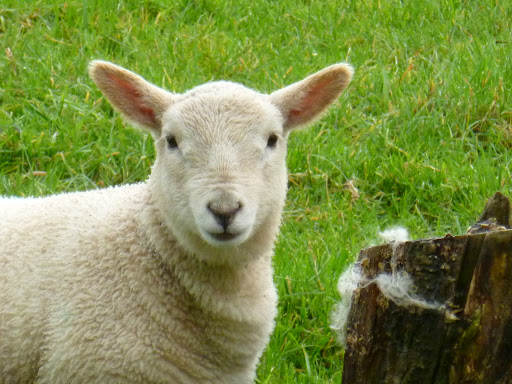
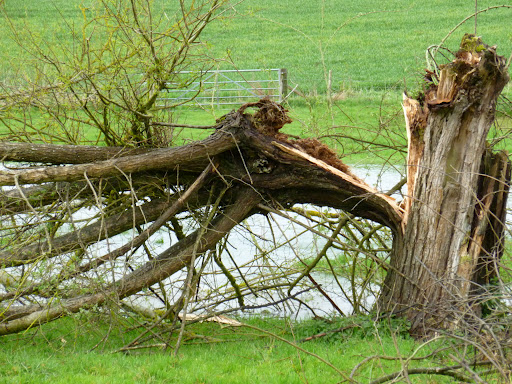
The secret valley is flooding and looks more like how it should have appeared in winter.  The sheep and their lambs have been moved to safer pastures and the pastoral scene of a few weeks ago has all but gone.  Gales have accompanied the worst of the downpours creating their own havoc and the old willow pollards, heavy with top growth are splitting and falling.  The damage, although it looks devestating, will not affect them too much for they will regrow once the broken timber has been cleared, for this is nature’s own way of pollarding them.
In the meantime,  we watch the flood water rise all around us.  Our little stone cottage, built in the 1850’s, sits safe, high above the river, which snakes around two sides of the building.

As for gardening, weeds continue to grow for they have adapted to the extremes of the English climate over millenia.  The nurtured plants of the flower border struggle and produce some oddities.  The tulips that usually look bedraggled after just one shower, have remained resilient and daffodils that have normally finished weeks ago are still in bloom, thanks to the cool conditions.  The wet weather has also benefitted the cowslips and the bluebells and they seem even more intense in colour if, in the case of bluebells, that is possible. A quick look around the secret valley at the trees also shows contradiction:  some are in full leaf and others – almost 50% of them – are still to show their leaves so have a wintry look about them.

Tulip ‘Peppermint Stick’

It has been a dry and sunny day today and tomorrow is also supposed to be quite pleasant.  The forecast is for more rain to come and the cool conditions to continue at least until the beginning of June.  And when I wake up on Monday and hear the rain hitting the bedroom windows, as forecast, my first awareness will be to hear in my mind the haunting voice of Edith Sitwell saying “Still falls the rain, still falls the rain ……”

To listen to Edith Sitwell reciting Still Falls The Rain click on the link below:
http://www.youtube.com/watch?v=b6_2x948EEw

Add to Technorati Favorites

Hedgerow Update 1

When I wrote my initial post on the ancient hedgerow that leads uphill out of the secret valley I intended to update it on a monthly basis (click here).  What a failed idea that has proved to be!  For March 10th  was as hot a day as any summer’s and that, coupled with a very dry winter, created the worst drought for many years.  The day that I had intended to walk the hedge (and also the day that a hose pipe ban was announced) the heavens opened and we have had torrential rain ever since.  I have been soaked to the skin most days because of work – I had no intention of a second soaking whilst carrying out hedge surveying upon my return home.

A break in the clouds, however, allowed me to sprint up the lane snapping away with the camera moments before the next deluge. No time to marvel at the way nature responds to climate or to look carefully to see what species of plants might be new to my eyes.  The only wildlife I saw was a solitary snail, pale lemon in colour and rather pretty – if you can describe a snail as such – which dropped off it’s grass blade perch the moment I got the camera in focus.  I’m sure I heard it giggling in the undergrowth.
Here is what I did see.

Cowslips
Cowslips (Primula veris) are a great favourite of mine bringing back memories of early school for ours had a play area that was carpeted with them.  Years ago no-one worried about picking great bunches of them or digging some up for the garden which we all did yet the numbers there didn’t seem to diminish.  However, overpicking (or perhaps spraying roadside verges) meant that the cowslip became a scarce plant.  Happily, they are now seen sporadically along the Cotswold lanes although not on my old school playground which became a high density housing estate in the ’80’s. Along our hedge, cowslips appear in small numbers which, hopefully, will increase over the years.  Further up the valley a field grazed only by sheep and never sprayed is a yellow carpet at this time of year and on warm, still days, the faint smell of honey wafts around transporting me back more years than I care to admit to.

    Cowslip meadow in the secret valley

Primroses

The last few primroses are still in bloom, quite late for this time of year and no doubt, like some of the daffodils, lasting longer because of the cool, damp weather.  Primula vulgaris, their botanical name, sounds like a misnomer for their is nothing vulgar about them, for every part of a primrose is pretty, whether it is the palest lemon of their petals, the deeper yellow throat or the fresh green of their leaves.  Even the ribbing and lines of their veins create attractive patternss and textures.  Vulgaris does, of course, mean common – there is nothing common about them in appearance either!

The hot March had an odd effect on plants. Some revelled in it, throwing caution to the wind and paraded their summer finery early, whereas others seemed to remember the old saying about not casting a clout ’til May is out. Proven right, when cold returned in April, they now seem reluctant to even expose a leaf and, as a result, the hedgerow is bright green  in places, yet bare and wintry looking in others.

 Field Maple

Field Maple is a classic old hedgerow plant.  Left to grow untouched it makes a medium sized tree of, to my mind, simple but great beauty.  However, it is usually trimmed to make a reasonably dense, twiggy barrier.  Like all maples the flowers and leaves emerge together but I had never noticed before the rich mahogany colour of the leaf buds. Acer campestre.

Ground Ivy

 A plant so common and so small as to be overlooked, Ground Ivy (not related to ivy but to mint)has to be viewed on hands and knees to see its quiet beauty: tiny, mauve, hooded trumpets darkening at the throat.  According to my old herbals it was used for all sorts of ailments from the uterus to inflamed eyes and everything in between.  Glechoma hederacea, in a greyish variegated form is often used in hanging baskets where it is seen trailing in ugly, thick ribbons.  Leave it where it belongs – trailing over the ground at the foot of a hedgerow.  Perhaps it should be used in the garden in this way? 

 Jack-by-the-Hedge

Jack-by-the-Hedge or Garlic Mustard is a common plant and quite a useful addition to early spring salads for its shredded leaves have a mild garlic taste.  In the photo above it grows along with stinging nettles and the fine leaves of Cleavers or Goose-grass.  It is the food plant of the Orange Tip Butterfly which is quite regularly seen throughout the secret valley, although scarce so far this spring due to weather conditions.  Occasionally they fly into the house and require rescuing – not always as easy as in this photo!

 Orange Tip Butterfly – only the male is coloured orange

Bluebells with White Dead-Nettle

Bluebells, Hyacinthoides non-scriptus, are another of the ancient woodland indicators (click here for more details of this term) and they flower the whole length of the hedgerow.  In the Chiltern Hills, the area where I spent most of my life, the beechwoods are renowned for their Bluebell carpets (photo below).  Here, they grow more sparsely, with the occasional white flowered sport growing amongst them. In the photo above, it is the white flowered dead-nettle they mingle with.  The dead-nettle, Lamium album, is not related to the true nettle and has no sting, just an unpleasant smell when the leaves are crushed.  In the garden it is a nuisance with a white, running root, quite thick and brittle unlike the stinging nettle’s yellow, fibrous root system – a useful way to tell them apart if uncertain, apart from the sting, of course.

A bluebell wood in the Chiltern Hills in Spring

 Burdock leaves
The large leaves of Burdock, Arctium minus, are already forming rosettes.  It will be a while before they send up their spikes of lilac flowers, reminiscent of those of the thistle and even longer before the troublesome round seedheads, the burs, stick to clothing and She-dog.

The secret valley in flood
It was at this point that the heavens opened once again giving me just time to take a snap of the little winding river.  It’s clear, sparkling waters have been transformed by rain to a swirling, brown muddy spate that has now burst its banks spreading out across the valley.

Add to Technorati Favorites

Pruning Mahonia

One of the biggest concerns for many people, even experienced gardeners is how and when to prune.  The quicker growing the plant (Wisteria is a good example), or the more spiny it is, the less likely it is to be given the chop – the first is intimidating by size, the latter by pain.

A close relative of that most vicious of shrubs, the Berberis, is Mahonia and the garden cultivars,  Charity and Winter Sun, brighten up many a dark corner with their spikes of yellow, lily-of-the-valley scented flowers on a cold winter’s day.  There they grow untroubled by pest or disease becoming ever taller, lankier and ending up just plain, downright ugly.  All of this can be prevented by pruning with the additional bonus of having flower spikes at nose height.

The Mahonia in the photo below has not been left to grow tall but been given a regular clipping with shears to form a ball shaped shrub: this often happens to plants that have to be kept under control resulting in a garden full of ‘blobby’ shapes.  For a Mahonia that, by nature, wants to be upright, this is an especially hideous way to end up.  The shrub to the fore is Sarcococca, the Winter Box, also clipped to a ball shape, a style that does suit that particular plant although, in my opinion, it is more attractive when allowed to grow naturally.

By April, the elongated flowerheads (raceme) will have faded to be replaced by bluish berries.  This is the sign that pruning time has arrived.  Mahonias are very tough, coping with temperatures as low as -20 degrees Centigrade and I have pruned them in frosty weather without loss.  It is always best, however, to do any pruning task when the weather is more clement.
The difficulty with seeing inside a shrub that is growing as densely as this particular Mahonia is easily resolved by simply cutting off a few of the top clusters of leaves anywhere.  Once you can see what you are doing life is much more straightforward and those first random pruning cuts can be rectified later.  In the photo below a branch has been revealed to show how the leaves join the main stem.  The newer growth at the top is a much paler green than the darker, older wood but both have leaves growing from it.
The pruning cut can be made anywhere between the leaves – I tend to be quite drastic and only leave one or two leaves in place.  It can be seen that I have cut this stem hard back into the older, darker wood – new growth will shoot from this point giving flowers again by the following winter.
Gradually, the shrub opens up to expose many branches of varying ages.  The older they are the more gnarled and twisted they have become.  Once these are readily visible it is possible to cut some of the oldest growth much harder still: this thins out the plant allowing more light and air to reach its centre.

Although no growth is visible below the cut, dormant buds will break and create new branches.  Again, these will flower the following winter but, of course, at a much lower height than before.
The end result is a shrub that has had much of its centre removed or lowered.  In this particular example, I have left more of the outer growth in place as this gives a more attractive appearance through the summer.  Next Spring this outer growth will be pruned more severely exposing the newer growth inside which can be pruned much more lightly.  By the Spring of 2014 this  mahonia will have been transormed back to its natural shape, a mass of healthy stems, leaves and flowers.

It was only when I returned to the bonfire that I appreciated the beautiful pale jade tones of the underleaf, not normally noticeable.  Another feature of Mahonia is the bright yellow colour of the cut stem – one that it shares with its Berberis cousins and, like them, the root system is also coloured yellow, a useful way of identifying what root system belongs to it when digging in a crowded shrubbery.

 Click on any of the photographs to enlarge them

Add to Technorati Favorites

The Constant Drip

When I was a small child I was traumatised by the sound of water, even a dripping tap would trigger nightmares of drowning.  This was not because my life had ever been at risk, although it could be argued that my afterlife was: it was down to baptism by total immersion.  My soul might have been saved by water but it was years before water became something that I would delight in, rather a problem for a lad that was brought up on the banks of the Thames, that great English river that flows sluggishly from its source to London and the North Sea beyond, a distance of 215 miles.

                                        
                                                   The River Thames at Marlow

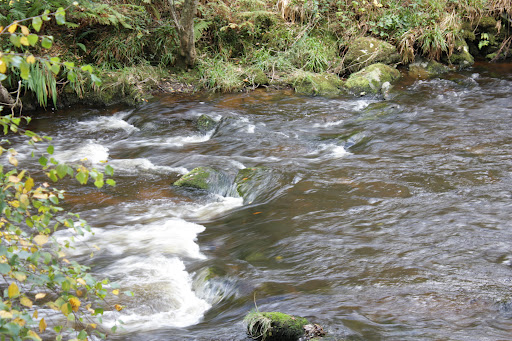
It was not until, as a young teenager visiting the West Country, I came across clear, rocky bottomed streams that were so unlike the silty bottomed, muddy waters of the Thames and the smaller brooks back home.  At first the sight and the sound of their fast flow rather unnerved me but there was a swift and dramatic change once I discovered the joys of splashing about, ‘tickling’ for trout and generally getting soaked. Not only could I not get enough of them, I ended up living beside one here in the secret valley.  Our river, to be truthful, is a compromise: it likes to believe it is of world class comparable with the Amazon or the Zambezi as it winds through the landscape in great (or in reality, miniature) curves and sweeps.  Sometimes it is slow moving half hidden by lush foliage that spills over its banks but in other places it is as fast running and noisy as a Devon stream as it gurgle and clinks its way over rock and pebble.
Our little river in the secret valley


    In winter, our river doesn’t look quite so inviting!

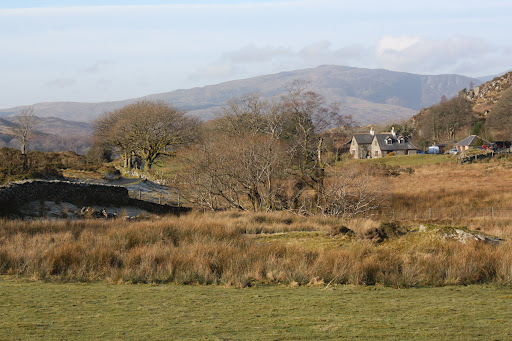
Recently I was staying high in the mountains of Snowdonia.  The house that we were in had to its right, a larger river crashing noisily downwards and, to its left, a much smaller gully with an equally fast flow.  ‘Our’ house, which inreality belongs to a friend, is not exactly standing on an island; more it is the solid filling of a watery sandwich. The main river, the term is used loosely for it is even more jumpable over than the one back in the secret valley, tumbles down the mountainside in a series of rocky chasms interspersed with quieter small pools.

One of the nicest aspects of returning to a place time after time is that certain things become so familiar, whether it is buildings or the wider scenery does not matter.  This is good for once you stop looking at the overall picture, the detail becomes more noticeable and things that would be overlooked if you only ever visited once begin to stand out.  Here there is little in the way of buildings, apart from the numerous ruins that stand as ghosts to a time when the hills were more densely populated with miners and farm workers.  On my morning walk and musing on how terrified I had once been by the sound of water, I began to notice the change in pitch and volume which alters constantly as you pass by.  Where the water falls several feet, not surprisingly the noise is at its greatest but, even there, it can be a deep sound or a lighter one, depending on the rate of flow and whether it lands on rock, water or pebble.

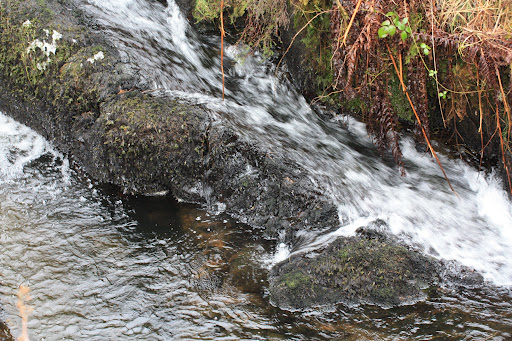
Then there are the waterslides: these can be steep or barely inclined, narrow or wide, fast or slow flowing.  Whichever they are, for me they are the most visually exciting of all with their water moving effortlessly, literally sliding along the surface and their ‘shushing’ sound building up to a more dramatic crescendo as the rock bed alters in character once more.

       A massive waterslide on Exmoor …..

                                                            ….. and a smaller one in Snowdonia

And then, of course, there is the sound that once traumatised me but that I now find the most fascinating of all, perhaps because they entice you to explore: they draw you further into their world, often a secret one.  The sound of dripping.  Sometimes it is obvious where it is coming from and where it is landing but often it is a sound that demands you to seek it out and then, not infrequently, only one half of the equation can be solved, if you can find the source you cannot find the landing place or vice versa.

Higher up the mountain is an old disused slate mine, long abandoned and with its shaft open for all to explore. Little natural light enters the low tunnel entrance and unable to see far inside there is only the sound of water seeping through the roof landing in the shallow water that collects in the passage below.  Here the sounds are as varied as those of a xylophone, the music made being both enchanting and unnerving; it is both welcoming and threatening at the same time. 

Not a place for the faint-hearted!

I may have got over my old phobia of scary water sounds but, I have to admit there is still one place that makes me shudder.  Just up the track beyond the mine there is a patch of grass and moss that has to be crossed and here, if you pause, you can hear the sound of fast moving water and the crash of a waterfall but there are none in sight.  The sound comes from below ground under your feet – childhood anxieties rise if I loiter here and as I continue my walk I notice, with wry amusement, that it is at an increased pace.

Add to Technorati Favorites

Hedgerow History and a New Project

One of the greatest and most picturesque, natural aspects of lowland Britain is its patchwork of fields divided by neatly clipped hedgerows.  In hill country, or where there is a wealth of stone, the fields are divided by dry stone walls and the Cotswolds are renowned as much for these as for the limestone cottages and houses built of the same material.  Here, domestic and farm buildings merge into one with the landscape for, as the fields were cleared of stone, it was natural to use it as a building material. 

The overgrown hedge on the left; the drystone wall starts a little further up on the right of our little country lane 

However, the Cotswolds also have their fare share of hedgerows and these often go unnoticed – overshadowed by the craftsmanship, colour and texture of the old walls.  In the secret valley we are fortunate for we have both: outside our little cottage – also built of stone 160 years ago – one side of the lane is bordered by a hedge, the other a dry stone wall.  At a glance, the hedgerow is unremarkable whereas the wall attracts attention for its weathered appearance and moss encrusted stones.  But not all is as it seems.

 The drystone wall was probably built only a couple of hundred years ago

The wall was probably built at the time of the great land enclosures, when large areas of England were partitioned, the ground cleared and ‘improved’ to grow crops (or here, in the Cotswolds, more likely wool) and may not be more than a couple of hundred years old – ‘new’ to us Brits.   However the hedge, shabby and overgrown in places, could well be a relic of the ancient wildwood, the forest that once covered most of lowland Britain in the days of pre-history before man started cutting it down. ‘Our’ hedge would almost certainly have been part of the Wychwood Forest, a royal hunting ground, for written records go back to the time of the Domesday Book of 1086.  As the forest was cleared (for more details click here) to make way for fields, it was easier to leave strips standing than to create new dividers. 

In places, the hedgerow is barely recognisable for trees have grown to huge proportion

How do we know that it is an ancient hedgerow and not one planted at the time of the enclosures?  There is an accepted formula for dating them known as Hooper’s Law: the number of tree and shrub species found in a thirty metre section x 100 is equal to the age of the hedge.  It is normal practice to take three thirty metre sample lengths and apply an average for greater accuracy.  There is also a second method of deciding if the hedge is of ancient origin: by the types of wild flowers that grow in it.  Certain species are very slow to spread, or perhaps only would normally grow in certain conditions such as woodland shade.  These key species are known as ancient woodland indicators and we have a number of them growing at the foot of our hedge.

 Bluebells are an ancient woodland indicator.  Here their new leaves emerge at the foot of the hedge – it will be several weeks before they flower

What is even more remarkable is that the plants tell us what is old and what is new hedge with such accuracy that it is possible to follow the old even after it has left the roadside. For our little lane that winds uphill as it leaves the secret valley to join the main road (‘Turnpike‘) is also part old and part new.  Before the Turnpike was built in the late 1700’s, the lane beyond our house took a sharp turn left and crossed the fields, it’s way now marked only by sunken turf and yes, you’ve guessed it, also by the old hedge and its associated flora.


 The ‘old’ road had been trodden for centuries by countless generations of drovers moving their cattle and sheep to market.  It was probably still used after the opening of the turnpike in the late 1700’s to avoid paying the tolls

I always consider March to be the start of the gardening year, the month when nature turns its back on winter and spring moves rapidly forwards.  Leaf buds burst, seedlings germinate and the first of the flowers remind you that long, hot days are not too far away.  It is the same with the plants that are beyond our garden gate.   And so on our first really warm, sunny day of 2012 I have decided to embark on a new project: to catalogue and photograph a year in the life of our hedge on a month by month basis.  Watch this space!

In places, the ancient hedgerow is still tightly clipped and, over time, has become very wide

Add to Technorati Favorites

Snowdonia: The Enchanted Forest – Death & Destruction

On our third day in Snowdonia we awoke again to brilliant sunshine.  Despite the hard frost that had turned every surface a sparkling white it did not seem especially cold for there was no wind.  A walk to the ‘enchanted’ forest beckoned, a great favourite of ours for it is a magical place with its mossy hummocks, hidden waterfalls and lichen encrusted conifers.  It is a place of total silence apart from the sound of water and ravens croaking overhead.  

There is an old track that leads to the forest  made by the miners that quarried for slate a long, long time ago before the trees were grown, for this is naturally a barren landscape of rock and bog and heather and bilberry.  The trees were planted – non-native conifers – in rows so that the forests appear from a distance as odd shaped rectangles stuck onto a landscape, rarely looking part of the natural scheme of things.  They support little in the way of wildlife either, perhaps a little shelter for some passing deer but nothing in the way of food apart for the flocks of crossbills that occasionally winter here feeding on the cones.  Yet, despite all these negatives, the enchanted forest is well, enchanting. 

Not anymore.  We reached the forest gate but, apart from a few trees clustering around the entrance as if trying to escape into the more open spaces beyond, there were just a few damaged and sad looking individuals, all their companions having been clear felled.  It was a shocking sight, looking as if a tornado had ripped through them, leaving just rows of broken stumps and, occasionally, an upturned root ball.  Sadder still, the tussocks and moss covered mounds that created the ‘Brothers Grimm’ feel had all been destroyed with them.  Instead of walking through a cool tunnel of overhanging branches we ventured along a broken landscape; there was not one section recognisable or familiar. 

Now it is quite possible that the original landscape will be restored as part of the overall long term plan, for Snowdonia is a National Park.  Or, perhaps, the forest will be replanted or allowed to regenerate from self-sown seedlings.  Having got over the initial shock of seeing the landscape looking at its worse, I hope it will be the former.  The trees really are out of place here and, for the first time (if you can see beyond the devastation) there are wide, uninterrupted views of bleak, harsh mountainside – Snowdonia as it should be.
Whatever the outcome, it will be interesting to watch how nature repairs itself.  One thing is quite certain: the landscape will never look the same in my lifetime.  Perhaps it may look better?

To see more of the enchanted forest in all its former glory, click on the link here.
.
.
.
Add to Technorati Favorites

.

Where’s The Snow in Snowdonia? (Only in it’s name)

We have been back to Wales for a week’s holiday staying in a remote converted chapel belonging to a friend.  It is good to be back for the isolation is complete – no cars, no houses, no roads, no broadband and no television.  Well, there is television but being rather impatient with non-living things (and also quite a number of people that just might fall into that category) I cannot be bothered to work out just which of the several remote controls switch it on.  But best of all – and rather surprisingly considering all the dire warnings we have been given by the weathermen – no snow.


Last winter when we were here, a blizzard struck the day we arrived.  Gradually, as the supply of logs and oil for heating dwindled and the water supply froze resulting in our collecting it from the stream outside, our resolve and sense of fun also started to diminish.  Put it down to advancing years: in my twenties or thirties I would have considered it to be ‘quite a laugh’.  Not so these days – I could cope with the water and lack of central heating but I am not so good when the wood burner isn’t blazing away.  However, we saw Snowdonia last year as few visitors do; a snow covered landscape with more falling so thickly that it was difficult to see, when out walking, where either my partner – or more importantly She-dog – was even though they were just yards ahead of me.


This year it was different, we left home with the (as it turned out, innacurate) knowledge that we were driving into blizzards and we hoped that we would reach our destination before being marooned, despite having to travel over two high passes and up a track steep enough to make a mountain goat think twice before tackling it. This time we came prepared with a vast amount of food and with three times the amount of warm clothing that any two people could wear over an entire winter.  As we reached the town of Shrewsbury the forecast rain began to fall; it would only be a matter of time as we entered Wales and gradually climbed in height that it would change to snow.  The rain grew steadily heavier and the road ever steeper until we reached the first summit and, surprise, there was not a hint of whiteness anywhere.  The second pass, higher still, was similar although the surrounding peaks did have a dusting of snow. We reached our destination with the rain still falling and the temperature ever rising – it was now fifteen degrees warmer than when we had left home in the Cotswolds, further south and many hundreds of feet lower.


The next morning we woke to sunshine, having no guilt about not getting out of bed in darkness at some ridiculously early hour as every other day of our lives.  Looking out of the bedroom window, the surrounding mountains still wore their apology of snow – it was a scene from the end of March or even April.  The calls from concerned Cotswold friends telephoning (we still have one piece of technology that works here) to confirm our safe arrival quickly turned to irritation when they discovered we were fine and they were blanketed in five inches of overnight snowfall.  It was hardly our fault that they had to work twice as hard at looking after our chickens and horses in our absence and, it seems, my suggestion that carrying buckets of unfrozen drinking water out into the fields was a good daily exercise did not help.


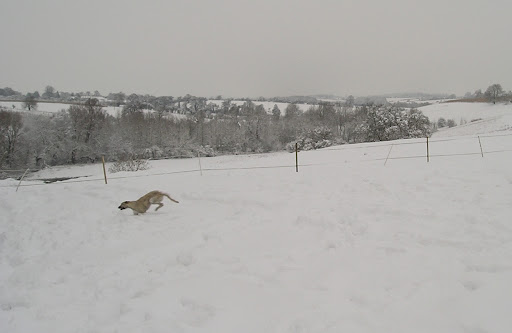
Last year She-dog had a thoroughly enjoyable holiday here as well.  Like most dogs, she revels in human company and snow and her days were spent in a mix of snowy walks and long uninterrupted periods of sleep in front of the fire.  This time we are here on our own.  It has been commented on that She-dog has not featured much in recent posts – all that is about to change for she has  gone away on an adventure of her own: if all goes well, in about ten weeks time she will be having puppies once again and, this time, we might just keep one for ourselves.

Add to Technorati Favorites

Writing Words of Silence

I have exchanged a couple of comments recently with ExmoorJane after one of her posts got me thinking.  I spend a lot of my time thinking, it goes with the day job.  Now these thoughts are not usually high powered for I don’t spend my working hours in a dynamic office environment; I spend them – often on my own – in the real, green environment.  And that’s the problem: there are so many things to distract me.  A few days ago it was the fault of the jackdaws – they suddenly had realised that spring is around the corner and were in full display flight, tumbling and diving and generally making an awful lot of noise.  So I spent far too long wondering why I hadn’t noticed their courtship before.

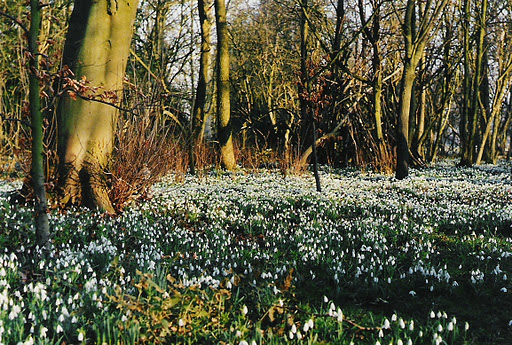
Yesterday it was the fault of the snowdrops and the winter flowering aconites.  They are to blame because they are in full flower a few weeks earlier due to the unseasonably mild winter we have had so far.  Some years ago I organised a visit to some gardens renowned for their display of snowdrops and we had to search hard to find one in flower – that was the 10th February.  Nature, like some people, can  be fickle.  The photo below shows a different garden’s snowdrops: it is the garden of what I call the ‘reincarnation’ house.  They are at their best now.

The aconites were more fully to blame. Seeing the hundred or so yellow blooms staring up at me from the foot of our garden hedge made me decide to take a walk as, not far from our little cottage, further down the secret valley lies a very special woodland.  At this time of year it is a yellow carpet of flowering aconites, an extremely rare sight for they are not native to this country.  No-one knows by whom or when they were planted for there is no sign of there ever being a house nearby; they are of no value as a commercial crop unlike snowdrops that were sent to London in bunches for selling once the age of steam made it possible to transport them quickly.

But all this pondering can most squarely be laid at Jane’s doorstep.  In her post on writing she mentioned that she sometimes writes just for the sheer pleasure of seeing words and thoughts on paper.  Then, satisfied, she destroys the work for there is no need or desire to share it.  I thought only people that were mad – or, at least, people that were a bit dotty – did that.*  And, insecure person that I suppose this shows me to be, I thought I  was the only one that ever fitted this description and did such a bizarre thing.  This is why I started writing a blog: I came to the conclusion it would be quite nice to keep my work somewhere secret so that I could look at it from time to time.  I decided Blogger would be quite a good place to store it, along with a few favourite photos.  I knew, of course, that the world in theory could see it but why would anyone want to stop and read something that I had written?  It never occurred to me that some of you might do so and some even come back regularly for more.  So on my way back from the aconites I was visualising Jane and myself scribbling away and ceremoniously (for it always seemed to be part of the ritual) tearing up the sheets of paper with our precious words on them.

I had walked along our little winding river to reach the wood but struck off over the hill for the return home.  This route always fascinates me because, from the top, the valley is totally invisible tucked away deep within the folds of the landscape.  One moment the ground almost appears flat and then, suddenly you are looking down into the secret valley.  The slopes are steep and grazed only by sheep, wild deer and rabbits and are, later in the year, awash with wild flowers of all kinds, including rare wild thyme, the subject of one of my earliest posts.  I sat myself down to admire the view, for I never tire of it despite seeing it every day, and pondered on what gives a person the desire to write, to play around with words, arranging them and rearranging them for hours on end.

And then this thought came:  what do you do when words just aren’t adequate to describe the sights or the emotions?  How do you describe the indescribable?  Take a photograph – after all, a photo is supposed to say a thousand words.  But what if a thousand words still aren’t enough?  What if ten thousand words still aren’t enough?  Besides, an image only allows the viewer to create their own words, it can never convey those that the writer might be thinking.  How do you describe the intangible?  So I sat on the bank, looking across the secret valley, muffled up against the chill east wind and came to this simple conclusion – the only way out of this conundrum of how to express these silent words is to write a post about it.

* Well, I thought she did but I can’t see it now.  Perhaps I am dotty, after all :-{

PS Don’t forget you can find me on Facebook now and get regular updates from the secret valley

Add to Technorati Favorites

New Year in London

Perhaps it is because London will be hosting the Olympic Games later this year that the capital seemed rather quiet and devoid of people and traffic when I visited it at the beginning of the month.  Although it lacked its usual ‘buzz’ it did mean more comfortable walking and it was definitely easier to catch a taxi.  I imagine when the Games are in full swing you will not be able to move for people and public transport of any type will be crowded.

 We tend to follow the same plan when we visit; not because we want to play safe, it is just that we cannot bear to miss a morning coffee and an almond croissant at the Bluebird cafe.  A slow walk up the King’s Road with it’s exclusive shops and boutiques brings you to Sloane Square – just in time for lunch.  This time we found, to our dismay, that our usual dining spot had closed down so we tried the Botanist, almost opposite, instead.  It proved to be a good choice for the food was excellent, as was the service.  My biggest criticism of it is its name which, of course, with me being a ‘planty’ person had rather appealed.  The decor consisted mostly of pictures of insects so we now refer to it as The Entymologist instead. 

A taxi ride took us to the National Portrait Gallery.  One of our New Year resolutions is to take in a bit more culture as we are becoming rather reluctant to move out of the secret valley, generally preferring the peace and quiet of the rural life.   A trip to ‘the smoke’ from time to time is just what’s needed to stop us from becoming complete country bumpkins.  We hadn’t allowed enough time to look at the pictures in any depth –  we really need to visit when we are not being dictated by the thought of food.  A mental note has been made to visit again quite soon, that time bypassing the restaurants ….. Mmm, we’ll see.

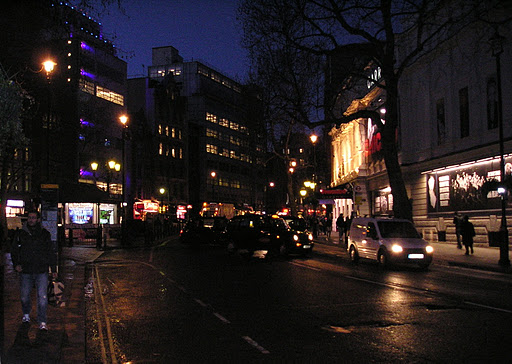
When we came out of the gallery daylight was fading fast and London appeared to have renewed energy.  Somehow a city at night with all it’s lights seems a more exciting place.  I seemed far more aware of statues, theatres and red buses – I’d forgotten just how much I like cities!  I’ve never lived anywhere other than in the country and I’m not too sure how I would fare if I suddenly found myself in one permanently.  Not too well, I would think.

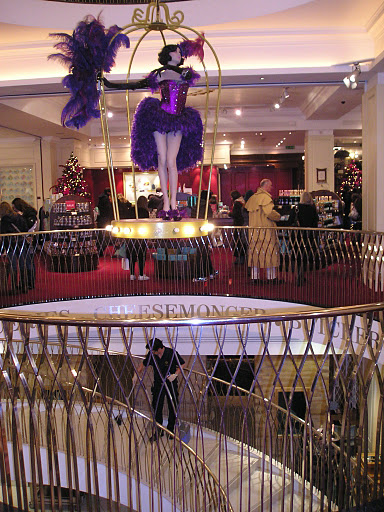
Another taxi ride took us to my favourite London store; favourite perhaps because it is another food place.  Forget Harrods, which I’m afraid I dislike intensely, give me Fortnum & Mason’s anytime. The Christmas windows and decor were still in place but even without those, F & M exudes quality from every pore – or do I mean from every chocolate? 

Who could possibly bite into these white chocolate bears, though?

The first thing I do when I enter the store isn’t to think of my stomach, surprisingly, as I am surrounded by goodies to eat.  I always go to the central circular staircase and lean over to look down which is dramatic, then descend down the old wooden staircase which is equally full of character.

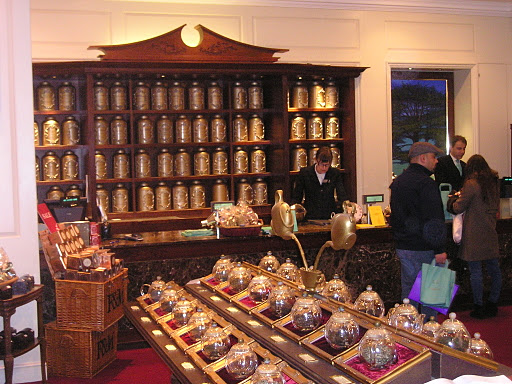
A wander around the coffee and tea halls with their wonderful aromas is another must.

The store has a reputation for making some of the best hampers in England.  I was lucky enough once to be given one for a Christmas present and it was such an exciting treat unpacking it and seeing what all the tins and shiny wrappers contained.  I was rather taken with their picnic hampers but there would be no point in us having one: although we picnic rather a lot because of our outdoor life, they always end up big social events.  What starts off as a casual chat with a couple of friends snowballs and it is not unusual to find twenty or thirty arriving to enjoy the feasting.  Fortunately they usually bring food and drink with them too.  If we had a Fortnum’s picnic hamper it would have to be a quiet, small affair – just the sight of the baskets conjures up images of check tablecloths laid on the grass, eating in the shade of the willows down by our little winding river.

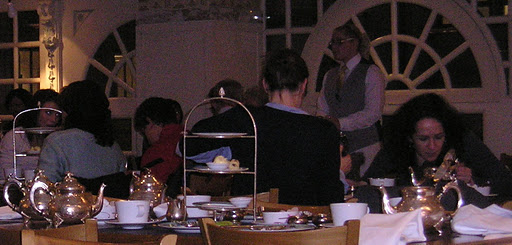
And what would a visit to Fortnum’s be without having one of their splendid traditional afternoon teas?  By the time I had forced down two scones with strawberry jam and Cornish clotted cream and cake, all washed down with a pot or two of Orange Pekoe tea it was time to think about returning home.

If we were lucky and didn’t get held up in traffic jams we would be back in the secret valley just in time for supper.  I think a belated New Year’s resolution ought to be excercise more and eat less …..

PS  Don’t forget you can find me on Facebook now and get regular updates from the secret valley

Add to Technorati Favorites

First Build Your Bank ….

Some time ago I was asked if I could plant a hedge.  Straightforward enough, I thought and as it was to be a native hedge, I was especially keen to do it.  Using only native species is always a pleasure for not only are you maintaining a tradition that is centuries old, it is also excellent cover for twentyfirst century birds and animals.

It was only when I went to visit the site that it was mentioned that it would be rather nice if the hedge could be planted on top of a bank, reminiscent of those that are found in the West Country counties of Devon and Cornwall.

West Country banks use large amounts of stone in their construction and were built to protect livestock from the gales and snowstorms that sweep in from the Atlantic.  Over time they become encrusted in lichens and mosses with ferns, primroses and other wild flowers sprouting from every crevice.  They are usually topped with a beech hedge or, sometimes, gorse (or furze, as they call it on Exmoor).

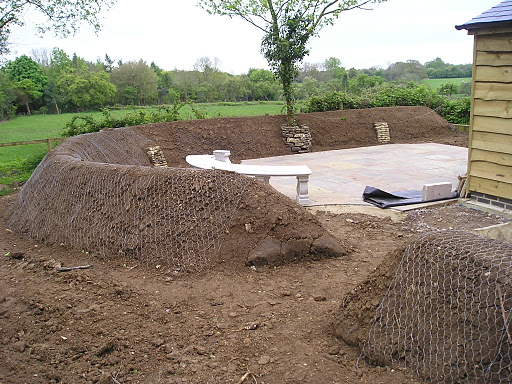
The bank that I had to build was to be similar but faced with turf which would not be as strong. As it was to divide two halves of a garden and (hopefully) not have to keep out determined sheep or cattle, this didn’t matter.  The thing that did matter was that I had to build it in a way that would prevent it from falling down …..

I’ve always found that if you want to create an impression bring in a digger.  There is a morbid fascination in watching a digger at work for the destruction can be immediate and swift.  It certainly would have been if I had been in charge of the controls but, as is so often the case, when you need an expert it is better to bring one in.  I know where I am when it comes to shovels and forks and trowels but it is best not to let me loose with all those knobs and levers.

The ground cleared we were then able to lay out and start building the bank.  We imported the rubble and clod for the base which after being well rammed and compacted could then have a top layer of better quality topsoil spread over the surface.  All was held in place by large mesh chicken wire netting.

Next came the turf and this was laid direct onto the netting and held in place with hazel twig ‘pegs’.  These would gradually rot but not before the turf had grown its roots through the wire.   The netting, too would quite quickly rot (we didn’t use galvanised for we didn’t want it to last for years) and, by then and fingers crossed, the bank would be quite stable and self supporting.

It was with some trepidation when, a few weeks later we cut the top of the turf and the wire out so that we were able to prepare the bank for planting the hedgerow; especially so as we had had some torrential downpours giving me anxious moments about landslips and mudslides.  All, fortunately was well.

Having plants delivered, I find, is always an exciting moment.  It reminds me of when, as a child, I waited for Christmas morning and couldn’t wait any longer to open my presents.  Despite knowing what is coming out of the van, each plant or variety is met with little gasps of delight.   The thrill of knowing that, with luck, they will thrive and continue to grow for many years and may even be there long after I’ve been buried and forgotten is great.

The hedgerow was not the easiest thing to plant but the end result was pleasing.  The final combination was Hawthorn, Field Maple, Wayfaring Tree, Hazel, Dog Rose, Spindle and Hornbeam  with an occasional Honeysuckle to fill the evening air with perfume.  The birds took to it straight away and, in my imagination at least, mice and voles shelter amongst the trunks hiding from mirauding stoats and weasels.  Best of all is the knowledge that, a few years on, the bank is still standing!

Add to Technorati Favorites