One of the pleasures of living on a small island is that you are never far from anywhere – except another country (apologies to Wales and Scotland, I know that you are proud of your separate identities and rightly so).
So last Friday I spent at home in the Cotswolds – limestone country, wide open views and rolling pastures. Saturday I spent walking across Dartmoor (post to follow) – granite country of bleak, open moorland and few trees. Today I spent walking in the Chiltern Hills, my birthplace, a chalk country, densely wooded and secretive. All are beautiful in their own way.

And today was especially special for I was on a mission: looking for rare plants. And with some success, although just as much delight was found in the more common ones, for seeking pleasure from rarity for rarity’s sake is a poor emotion. What could be more charming a discovery than this group of foxgloves in a woodland glade? A common enough plant: I prefer the wild to the garden varieties, that have been bred to have ever larger ‘cups’. Here, the wild plants have a grace and delicacy that is so unlike their brasher relatives.

The group of thistles didn’t seem to be of special interest other than for the pleasure of watching the bumble bees feed from their flowers. But when seen in close detail the flowers really are quite spectacular. Most of these were purple but some that, from a distance, appeared to have prematurely gone to seed turned out to be a variant – they had white flowers. How glad I was that I had dawdled and not just rushed past without giving them a second glance!


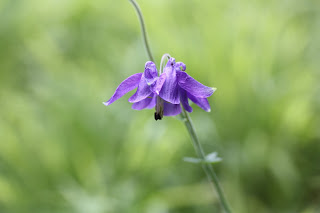
Further into the woodland and growing in dappled shade was the first of the ‘finds’. Our native Columbine (Aquilegia vulgaris) is not often seen. Many that appear wild are garden escapes and are usually close to roads or houses but these were a long way from either. And, again, the flowers have a delicacy and lightness about them. Ladies Bonnets is another country name for them – it is easy to see why.
The Narrow Leaved Helleborine (Cephalanthera longifolia) is also uncommon and it was only after this one was found that we realised that there were over forty plants scattered over the area. Like the Columbine, where the plants were not sheltered by scrub or ferns, the deer had eaten the tops off. The flowers remain closed, making them unavailable to insects so, I assume, the plants self pollinate – perhaps that is why they are not at all common.

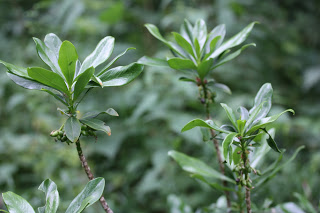
Further still along the path, was this solitary speciman of Daphne laureola, the Spurge Laurel. Although this plant grows quite widely in the Chilterns, this was the only specimen seen today. It flowers in late winter, it’s greenish-yellow flowers lacking the sweet scent of its garden cousins. Already the berry seedheads are forming, these will turn black later in the year. The Mezereon, a popular garden shrub in the past but not grown so widely these days, is also a native but extremely rare. It is known to grow in the Chilterns although I’ve never found one.
Returning once more to open meadows the woodland gave one last surprise: tall Field Maples, Acer campestre, usually grown as a hedging plant. And this is how it would have started out: one trunk, coppiced and layed to create sturdy, stockproof fencing. The original trunk has long disappeared and the ‘new’ stems from around its base have grown to be trees in their own right. For a maple to be of this size – and they rarely are – it would have been planted in Medieval times and it is known that the field that it borders was first created by the Saxons, 1000 years ago.

And as a grand finale, the meadow gave us dozens of Common Spotted Orchids – only common in favoured places, the spots refer to those on their leaves. The Chilterns are a great place for orchids and are home to some of the rarest species – their sites a closely guarded secret.
A most successful and satisying day!


 .
. .
. .
.
 .
. .
.
 .
. .
.
 .
. .
.
 .
. .
. .
.
 .
.




 .
.




 .
. .
.

 .
. .
. Going…..




 The blackened faces of morris men, that attend some wassails, are also there to frighten evil spirits, for this has it’s roots in pagan times and has nothing whatsoever to do with race, as is now sometimes thought. PC means that many morris men no longer do this. The ceremony shown on the video below has both morris men and a wassail queen. I don’t recall seeing the morris when I took part, or a young virgin for that matter, but perhaps that is due to too much cider and too many years passing. There is no wassail singing on the video and only a glimpse of morris dancing – the latter I hope to write about, with other local customs, in the future.
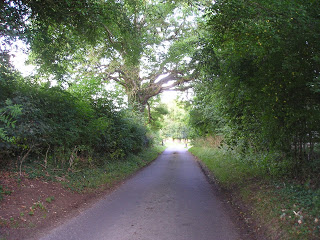 To call it an avenue would be rather pretentious, but the roadside plantings of beech and cherry create the first thought that you may be going somewhere rather special. And as you begin to pass beneath their canopy, the hills start to rise on either side. These are rarely, if ever, treated with any chemicals and wild flowers, including orchids, abound.
 But there is still no hint of our little, winding river. Then, as the avenue ends and on a sharp bend there it is! The first glimpse is of the old sheepwash, where the river was widened and deepened although still almost jumpable, for everything about the secret valley is miniature: the hills, the river, the road. Beyond the sheepwash come the meanders – the photo of these snake like bends are in the blog’s header title.
  Our little stone cottage lies further along the road – and this is now the original old drove road, for the one that we have travelled so far has probably only been in place since about the late 1700’s. More of the drover’s in another post. Below is the view from the house looking back towards the meanders – we may only have just one other house nearby but there are dozens of sheep for neighbours!
 Just below the cottage, the river passes beneath the lane and snakes its way around us, travelling through lush meadows. Watercress and meadowsweet grow along the water’s edge and little rickety, make-do bridges made from old telegraph poles criss-cross from one bank to another. Ancient, gnarled willow trees line the banks, more about these can be found in an earlier post:
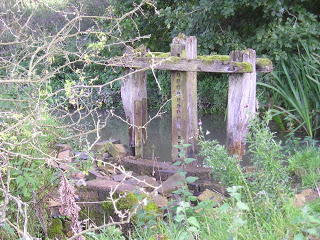
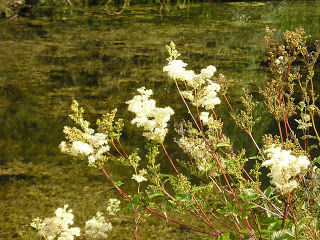 And tucked away beyond the bridges are the remains of the old mill workings. The culvert is barely noticeable until the river levels rise and the water diverts towards the mill. We’ll travel there another day.
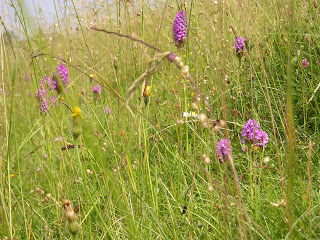
 Wild flower meadows are quite easy to create whether on the big scale or in the garden. Of course, the species rich meadows of the Chilterns and Cotswolds have evolved over centuries and have a wealth of insect and plant life to show for it. In the garden you just have to be a little more realistic and be grateful for every bug and butterfly that comes along and colonises it. Hopefully wild orchids, like the Pyramidal orchids below, will arrive too.
 The golden rule of all meadows is to reduce fertility. As soon as fertility rises, usually through feeding, the grass sward thickens and out competes the flowers. The photo below is of ‘our’ bank and shows, as a golden haze, the unimproved grassland – thin, tall and sparse and too steep for the tractors to get onto and spray. The brighter green grass above and below is where the tractors can reach, the grass has been fed and, consequently, there are few wild flowers.
 Late summer wild flower meadows require a different maintenance regime to those which have an abundance of spring flowers and, as it is that time of year, I shall concentrate on the former. Now is the time to cut the ‘hay’ whether on the bigger scale such as in this orchard or, by hand, in the garden. It is important to get the timing right – you need to leave it late enough for the seeds to fall from their heads to increase more. Leave it too late and bad weather knocks the grass and plants flat to the ground when it becomes a devil of a job to cut. The difference is a task that is a joy to do or one that is totally hateful!
 Hardheads, the local name I learnt for Knapweed in my Chiltern Hills childhood, is a favourite flower of mine. Although normally purply-mauve (above), I found this bi-coloured one and some pure white flowered ones growing in an old meadow – rarities, indeed. I live in hope that they might appear one day in the secret valley!
 Neglect does not create a meadow. If you don’t work at it all you will end up with is a sheet of docks, nettles and thistles as has happened in this garden here – not a pretty sight!
 Life in the English Cotswolds