Turn and run! Nothing can stop them. Around every river and canal their power is growing.
Stamp them out! We must destroy them. They infiltrate each city with their thick dark warning odour*.
Plant hunters have over the centuries introduced many beautiful plants to our gardens but they have also brought in others that have, as they escaped from its confines, become troublesome weeds. Japanese Knotweed, Fallopia japonica, creates problems by damaging river banks and pushing up through concrete, even entering houses; Himalayan Balsam, Impatiens glandulifera, is pretty enough with their hooked pink and white flowers but smothers native plants. Both are difficult and costly to eradicate. But the one that can cause the most trouble – and is undoubtedly the most impressive – is Giant Hogweed.

Long ago in the Russian hills, a Victorian explorer found the regal hogweed by a marsh … he came home to London and made a present of the hogweed to the Royal Gardens at Kew*.
Giant Hogweed, Heracleum mantegazzianum, was introduced to Britain from the Caucasus in Victorian times and soon became a popular addition to parks and gardens for, although similar in appearance to our native Hogweed, Heracleum sphondylium, these were giants in every way. Huge flower heads above equally large leaves reaching way into the sky – up to twenty feet or more in exceptional specimens – were something to marvel at. A hardy perennial, the plants shot up over the course of just one summer adding to its popularity, although it can be a few years before the plant flowers after which it dies. With up to 100,000 seeds from each plant, it soon multiplied and before long had found its way back to the marshy land adjacent to rivers and canals as in its homeland.
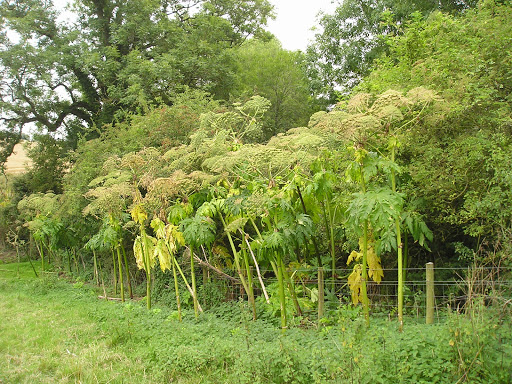
I wonder how long it took the Victorian gardeners to discover the problems associated with the plant for it not only spreads rapidly, it also is extremely toxic. Covered in sharp bristles that scratch the skin it is the sap from the plant that can cause major injury. Skin contact with the sap when exposed to sunlight results in severe dermatitis: itching and redness develop into blisters and dark wheals. These can last for several years. Contact with the eyes is even more dangerous for permanent blindness can follow.
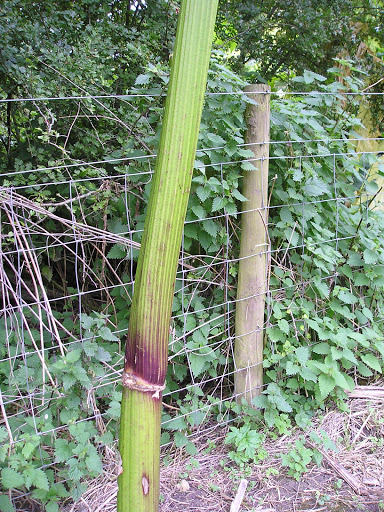
So what do you do if you find Giant Hogweed in your garden apart from turn and run? It can be treated with weed killer and the ideal time to do this is when the plants have a large leaf area but before they flower. It is essential not to handle the plant at any time – even when it is dead – for every part of it including its roots will injure you. If you are tempted to carry out control yourself (and it may be wiser to call in a specialist eradication company (please, not me!)) then you must wear a complete coverall and full face and eye protection. You also need to remember that the clothing will also be contaminated and should be destroyed.

Fortunately, Giant Hogweed is rarely encountered in gardens. You are more likely to find it growing in waste places in the wild and it may be wise to report its presence to your local environmental agency. Attitudes toward it vary from country to country for this is not just a British pest – it is found in many other temperate regions of the world including the USA and Canada.

Perhaps at this point, I should remind you all that the majority of garden plants are harmless enough and that gardening and plants give a huge amount of pleasure. Happy gardening!
* The Return of the Giant Hogweed: lyrics by Genesis, 1971







 More disappointment when Mother told me that I’d imagined it, that she’d never made anything like it and it would be impossible to create wafer like, plate sized shortbreads – if only because it would be impossible to lift or cut them without them breaking. I was determined to prove her wrong and, every so often, she would give me that look that mothers do when I told her of my latest failed attempt.








 .
. .
.

 .
.
 .
.


 The layout of this garden near the village of Oddington is beautifully illustrated from the air – I wonder if the owners were ever so fortunate to see it from above?
 The walled, organic gardens at Daylesford, too, are shown to be quite an unusual shape: the intricate design of the parterre giving way to a less formal area uses this to its advantage – a study in good design.
 Saxon ridge and furrow field systems are also shown in sharp relief. There are a lot of these around the Cotswolds and they can originate from as far back as a thousand years although many were worked up until a couple of hundred years ago. Now preserved and retained as pasture, often the drier, warmer ridges have quite different wild flowers growing compared with the damper furrows.
 We ‘touched down’ in a field not far from the small town of Stow-on-the-Wold, shown in the photo below. Stow is famed for its twice annual Gypsy Horse Fair where travellers gather from all over the UK to buy and sell ponies and catch up with news. It is also well known for its exposed climate as in the local saying “Stow-on-the-Wold where the wind blows cold”.
 The balloon’s shadow chasing us is a favourite photo as also is this one of the burners in full flame!