
So the Easter holidays are with us once again: a time of our gardens and countryside bursting with new vigour, the smell of fresh, green growth, gentle, warming breezes and longer daylight hours to enjoy it all.
Primroses and violets are the traditional wild flowers of Easter and our lawn is dotted with dozens of them. We avoid mowing them when in flower, after that we don’t worry yet the numbers increase with every passing year.

 The pretty, native Wood Anemone, Anemone nemerosa, blooms in profusion in favoured places – usually in sheltered woodland. Sometimes they are found on banks, perhaps showing where ancient woodland once stood, for Anemone nemerosa is one of the ‘indicator’ plants. Ancient woodland is classified in England as woodland growing prior to 1600 and although a number still stand many were cleared centuries ago.
 The Snake’s Head Fritillary, Fritillaria meleagris, is an extremely rare plant in the wild although there are water meadows around Oxford and the Cotswolds where they carpet the ground – a spectacular sight. Fortunately, they grow quite easily in our gardens and the corms are readily available from reputable bulb merchants, who only source them from grown stock. Sadly, there are still occasions when bulbs and corms are marketed from illegally collected wild stock.
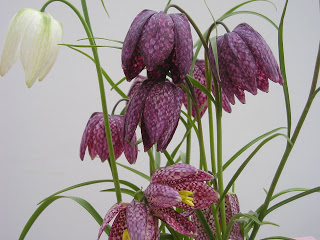
They make fine, if somewhat short-lived house plants. We like to have them indoors at Easter and they can afterwards be planted in the garden to bloom again another year. When seen close-up, it is obvious from their markings why one old name that country folk give to them is Chequers.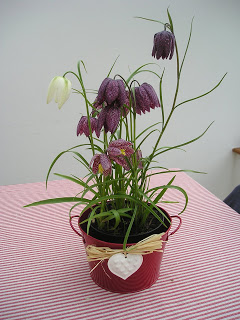
 It is not only flowers at Easter that should be thriving. The wild birds are singing and building their nests and sheltered beneath a large clump of Oat Grass, the wild Mallard duck, lay their eggs each year in our garden. As soon as they hatch, their mother leads them to the safety of the river below the house.

This is the joy of Easter – or it usually is. Not in 2010. The primroses and violets may be blooming but the weather is more of winter than spring with the season up to six weeks behind this year. There is hardly a leaf showing on the trees and bushes of the secret valley and the river has burst its banks with the continuous rain we have had the past few weeks. Any duckling that ventured onto the water would soon be swept away in the torrent our gentle stream has become.
However, She-dog is thoroughly enjoying running through the flood waters – especially where it is shallow enough to admire her reflection!






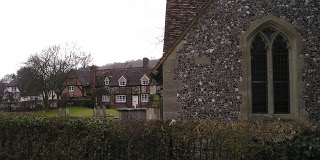
 Turville, is a tiny village, hidden deep in a valley in the Chiltern Hills and is close to where I was born and spent the greatest part of my life (I only came to the secret valley nine years ago). The Chilterns is a place of steep hills, thick with beechwoods that seem to hang onto their very sides – many use the word in their names: Old Hanging Wood near Hughenden, for example. The villages, as a consequence, seem tucked away and forgotten, yet they lie only some 30 miles west of London.
 Chalk and flint are the geological features that make the Chiltern Hills what they are and you are never far from them for the topsoil is thin, as all Chiltern children soon learn. Childhood games need chalk for drawing hopscotch and the flint cuts deep into knees when falling over. Flint also is, or was, the favoured building material for houses and Turville has plenty of fine examples, even the church is made from it.
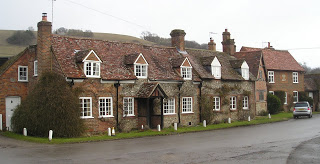 No English village is complete without its pub and Turville is no exception. The Bull and Butcher stands almost in the road. Less common are windmills and Turville lays claim to Cobstone Mill (which really ‘belongs’ to the neighbouring village of Ibstone), standing high above on a steep hilltop. The windmill, like the village has been used in many films such as Chitty, Chitty, Bang Bang and the 101 Dalmatians. In the latter, when the road outside became covered in machine made ‘snow’ I drove past confused – for there were still traces of the snow and it was midsummer. We also had no water for several hours as the filming had used up the village supply in the making of it.
 Turville is popular both with the film crews and visitors because it is so ancient and unspoilt. To get photos like these you have to visit on a grey, winter’s weekday as weekends, especially fine, summer ones, find the narrow lanes choked with cars. The village is so unchanged that even the warning roadsigns, like this old schoolchildren one are decades out-of-date!

 I think the reason we may behave like this is because English weather is nearly always gentle. The landscape that makes up England is beautiful and can be dramatic but not in the way of so many other countries. Take the USA, for example. Where’s our Grand Canyon, our towering redwoods, our Rocky Mountains, our Great Plains and our Niagara Falls? We have them in miniature and, perhaps, that is just as well as we are such a small country. And likewise, our weather: we have heatwaves, we have floods, we have blizzards. But they are rarely anything truly spectacular (except to those poor people affected by them, of course). And so when we were told by the weather men in 1987 that reports of a hurricane were completely exaggerated, we believed them totally. And despite the fact that much of the country was hit hard by it when it arrived, my part of the Chiltern Hills where I lived at the time was not much affected, even though it is one of the most wooded parts of the country.
 The night in January 1990 was different. This time we had winds, whilst not as severe as three years earlier, which created total havoc with the already weakened root systems of the trees. Great swathes of the magnificent beech woods that are the very heart and soul of the Chilterns were flattened in a couple of hours. (I am reminded by my partner, that as the rest of the world cowered in their beds as the trees came crashing down all around, I woke up to say “a bit windy out there” before falling asleep again). As dawn broke the true damage could be seen.
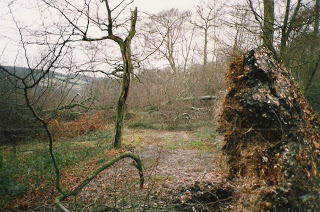 Fast forward twenty years to 2010 and the woodands are transformed. Those of us that remember the 200 year old beech know that the majority are gone and, in their place, are new trees of mixed species. It will be many years before the magnificence of the woods return but they are healing. This photo below is taken from the same spot as the one above. Some of the biggest old stumps have been left, too difficult to move – time has hardly changed their appearance apart from their ‘roof’ of mosses.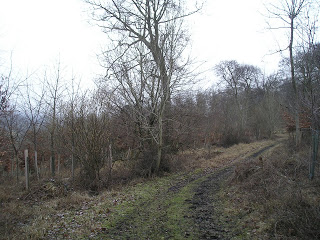
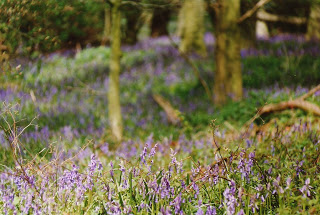
 One of the unforeseen benefits of the hurricane is the increased amount of light reaching the woodland floor, for beech trees cast a dense shade where little can grow, other than where the canopy is lightest. Apart from the view to the valley below, which was unseen before, many wild flowers are better now than ever. Roll on April when we can see the blue carpet of tens of thousands of bluebells disappearing into the distance.
 Oh! And I nearly forgot to say, the weather today is a mix of sunshine, cold winds, rain and sleet. Don’t forget to tell the next person you meet!
 Now the snow has gone and the seed heads, not quite as pristine as before, have recovered but still live up to their name. They swamp the lower, trimmed parts of the hedge and it is hard to imagine how the field maples, hawthorn, sloes and other woody plants cope and survive.
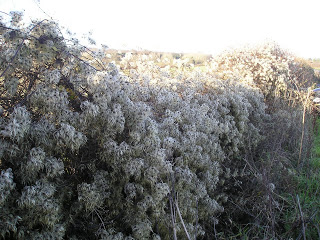 Three days ago, the birds began singing once more and claiming their territories so Spring can’t be too far off (I’m being optimistic here as the sun has been shining too). The Old Man’s Beard will, like garden clematis, be amongst the first to send out new shoots and leaves, in the process knocking off the old seedheads. For a short while the hedge has the opportunity to flourish before the clematis flowers appear. Although blooming in their thousands, individually they are quite insignificant and it is the scent that is the more noticeable – not the perfumed scents of roses and honeysuckles but honeyish, delicate yet cloying too, somehow. And the bees, especially the bumblebees can’t get enough of their nectar.
 As a young child, I once stayed at a schoolfriend’s grandparents and in their garden was an old chalk quarry, long disused. I would love to revisit it now but have no idea where it was – for years I believed that the village was called Loose Chippings. It was only once I grew up that I realised that this was the sign that council workers had put up after repairing the road outside their house! There must, I assume, have been trees in the pit – and it was certainly overgrown – for the Old Man’s Beard had sent up its long vines high into the tree tops. Where this happens the stems become quite thick, strong and woody and we spent many happy hours there swinging through the trees Tarzan-like. They have also done this outside our cottage, where the hedgerow has grown into treelike proportions, although only once, (when I felt confident no-one would see me), have I swung on them. The exhilaration was the same and proves the thought that men never truly grow up but remain little boys that need to shave.
 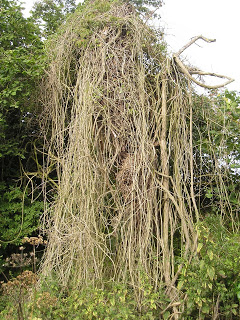 Virgin’s Bower and Traveller’s Joy are two of the other common names given to Clematis virginica. The first, one assumes, because of its tendencies to drape across other plants: how lovely it would be slumber gently beneath its shade on a warm day, breathing its scent and listening to the bees droning. According to my Herbal, in the past, wayfarers would make tea to soothe away headaches, wrap soaked cloths around their weary feet and treat blisters and saddle sores. No wonder it was called Traveller’s Joy. I love to think that along our little lane, the old drover’s would sit on the grassy roadside banks and rest, perhaps stopping for some ale at the old inn next door to us (and our only neighbour), their sheep and cattle drinking from the secret valley’s meandering river. Did they also think, like me, this place to be so special? I doubt it, somehow.

 But for a short time, at least, the ski trails start from my door. And suddenly the valley appears transformed. Perhaps it is due to the mesmeric sound of the skis swishing their way along but the scenery is seen in quite a different way. And the silence is more noticeable too – all is still and quiet apart from the tinkling of water and ice.
 Until you reach the mill race where the water thunders down leaving mini icicles clinging all along the splashed and steep banks. It seems a far cry now from when, on hot days, we dam the water’s exit to raise its level, and swim in the torrent. A jacuzzi spectacular! Oddly enough, the water is warmest where the water crashes down upon you which is invigorating, to say the least.
  Onwards to tranquility again and the split willow – my favourite tree in the secret valley and featured in an early post,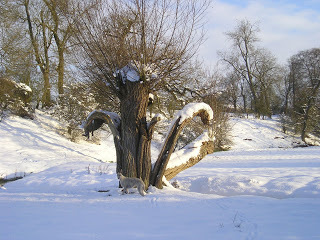
 Home exhausted, but more aware of my surroundings, I notice that even everyday items, such as our rather boring garden furniture, look more interesting when covered in snow. And we have icicles too – haven’t seen those in years!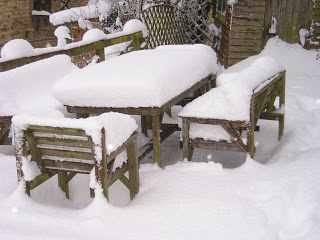


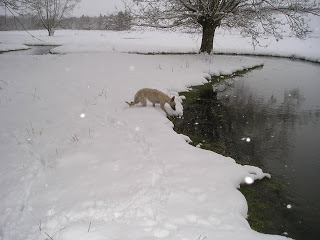 “I’ll pretend to be interested in the river but I’m really hatching a plan….”
  “If I stalk Barney he’s bound to chase me”
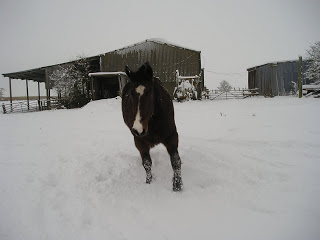 “Call me old and grumpy but I ain’t going no further or faster than this”
 “I’ll go for a gallop on my own then….
 ….and no-one goes faster than me”
 “I seem to have run out of steam”
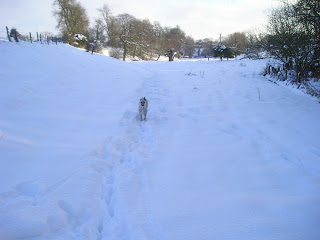 “Let’s plod back up the path to home”
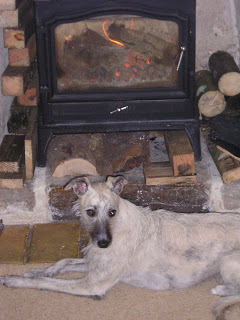 “Thank goodness, the wood burner’s ablaze”
 The view across the secret valley is also very different from the frosted look of Christmas Day (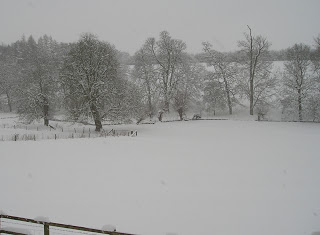
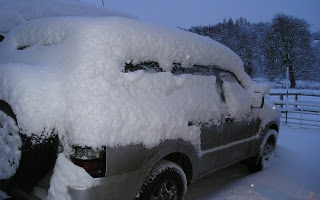 The UK has ground to a halt: airports closed, people trapped in their cars overnight, lorries jack-knifed, cars abandoned where they have slid and the councils running out of grit and salt. The latter doesn’t make any difference to the secret valley for the gritters don’t venture down here anyway. It is good to see the horses are safe, warm and well fed and enjoying the sensation of snow under their feet. And like us, they have beautiful views to look at from their barn during quiet moments. I wonder if they are aware how lucky they are! Or ourselves, for that matter – for in Scotland there is a report of a woman leaving home on Christmas Eve to collect the festive turkey and still unable to reach home, the road being blocked by snow. Apparantly, it is the first time in 36 years she and her husband have been apart.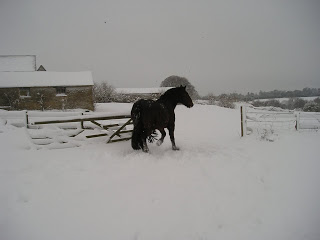
 Down by the river, as the carol says, the snow is “crisp and deep and even”. The water is high, almost to the top of the banks and, if we get a sudden thaw, will almost certainlly flood. However, the forecast is for another ten days of this cold spell with more snow at times – the weather is coming from Siberia so temperatures are likely to plummet further. And we do, in theory at least, still have the remnants of the weather systems from America to arrive yet which reach us about six weeks after they wreak havoc in the States.
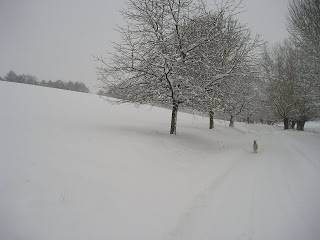
 winter sunshine on silver birch
 Fallow Deer – one of the larger species of deer to be found in England and quite common throughout the country. But like all deer, despite their size, they are remarkably difficult to see and watch. When I lived in the Chiltern Hills, 50 miles to the east of the secret valley, they grazed the field close to my windows, making watching easy. Here, we see them occasionally from the cottage – yesterday was one of those days. In winter, their coats lose their lovely dappled spots and become quite dark – the two pictures below show this, the lower one being taken last summer.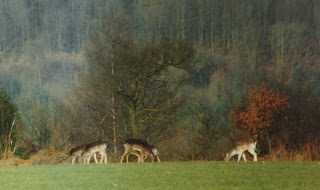
 The Red Kite is one of the great conservation success stories of recent times. Once so common they scavenged in the streets of London (and had a reputation for stealing hats off people’s heads to decorate their nests with. These days they often use plastic instead – the Kites, not the people, I mean, of course). By the 1970’s numbers were down to just a few pairs living in the remotest parts of Wales. A breeding and reintroduction programme started in the 1980’s centered on the village in the Chilterns where I lived. Soon they were a relatively common sight in that area but they have been slow to extend their range. Now we are seeing them much more frequently in the secret valley and they never fail to thrill. The full story of the Red Kite can be found on the Chilterns website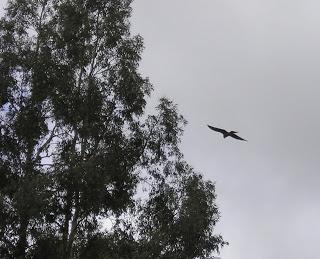
 This photo is most definitely poor quality – I only have a small ‘aim and fire’ camera and took this from an upstairs window. I am hoping to buy a more sophisticated camera with telephoto lenses very soon: another unexpected side effect of blogging has been a rekindled interest in photography. Who knows what will show up on this blog then?
  Life in the English Cotswolds