
The narrow lane that rises up out of the secret valley beyond our little stone cottage is bordered on one side by Cotswold dry stone walls and, on the other, by remnants of an ancient hedgerow. One of the ways of identifying those that date from the original wildwood is by the number of plant species found in them for ‘modern’ hedgerows (those that have been planted after 1600) contain far fewer varieties. One of the plants that dominate the lane is known as Old Man’s Beard. In the photo below, it is difficult to tell what is snow and what is the, somewhat bedraggled, fluffy white seedhead that gives this wild clematis it’s common name.
 Now the snow has gone and the seed heads, not quite as pristine as before, have recovered but still live up to their name. They swamp the lower, trimmed parts of the hedge and it is hard to imagine how the field maples, hawthorn, sloes and other woody plants cope and survive.
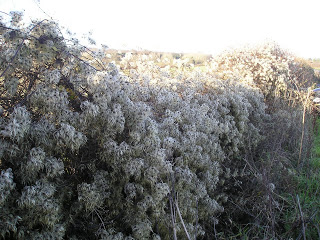 Three days ago, the birds began singing once more and claiming their territories so Spring can’t be too far off (I’m being optimistic here as the sun has been shining too). The Old Man’s Beard will, like garden clematis, be amongst the first to send out new shoots and leaves, in the process knocking off the old seedheads. For a short while the hedge has the opportunity to flourish before the clematis flowers appear. Although blooming in their thousands, individually they are quite insignificant and it is the scent that is the more noticeable – not the perfumed scents of roses and honeysuckles but honeyish, delicate yet cloying too, somehow. And the bees, especially the bumblebees can’t get enough of their nectar.
 As a young child, I once stayed at a schoolfriend’s grandparents and in their garden was an old chalk quarry, long disused. I would love to revisit it now but have no idea where it was – for years I believed that the village was called Loose Chippings. It was only once I grew up that I realised that this was the sign that council workers had put up after repairing the road outside their house! There must, I assume, have been trees in the pit – and it was certainly overgrown – for the Old Man’s Beard had sent up its long vines high into the tree tops. Where this happens the stems become quite thick, strong and woody and we spent many happy hours there swinging through the trees Tarzan-like. They have also done this outside our cottage, where the hedgerow has grown into treelike proportions, although only once, (when I felt confident no-one would see me), have I swung on them. The exhilaration was the same and proves the thought that men never truly grow up but remain little boys that need to shave.
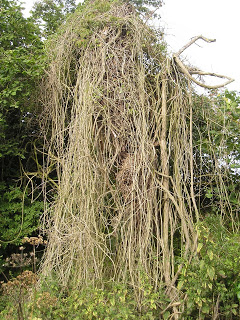 Virgin’s Bower and Traveller’s Joy are two of the other common names given to Clematis virginica. The first, one assumes, because of its tendencies to drape across other plants: how lovely it would be slumber gently beneath its shade on a warm day, breathing its scent and listening to the bees droning. According to my Herbal, in the past, wayfarers would make tea to soothe away headaches, wrap soaked cloths around their weary feet and treat blisters and saddle sores. No wonder it was called Traveller’s Joy. I love to think that along our little lane, the old drover’s would sit on the grassy roadside banks and rest, perhaps stopping for some ale at the old inn next door to us (and our only neighbour), their sheep and cattle drinking from the secret valley’s meandering river. Did they also think, like me, this place to be so special? I doubt it, somehow.

 The blackened faces of morris men, that attend some wassails, are also there to frighten evil spirits, for this has it’s roots in pagan times and has nothing whatsoever to do with race, as is now sometimes thought. PC means that many morris men no longer do this. The ceremony shown on the video below has both morris men and a wassail queen. I don’t recall seeing the morris when I took part, or a young virgin for that matter, but perhaps that is due to too much cider and too many years passing. There is no wassail singing on the video and only a glimpse of morris dancing – the latter I hope to write about, with other local customs, in the future.
 But for a short time, at least, the ski trails start from my door. And suddenly the valley appears transformed. Perhaps it is due to the mesmeric sound of the skis swishing their way along but the scenery is seen in quite a different way. And the silence is more noticeable too – all is still and quiet apart from the tinkling of water and ice.
 Until you reach the mill race where the water thunders down leaving mini icicles clinging all along the splashed and steep banks. It seems a far cry now from when, on hot days, we dam the water’s exit to raise its level, and swim in the torrent. A jacuzzi spectacular! Oddly enough, the water is warmest where the water crashes down upon you which is invigorating, to say the least.
  Onwards to tranquility again and the split willow – my favourite tree in the secret valley and featured in an early post,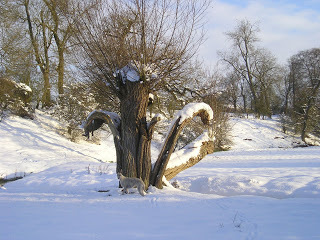
 Home exhausted, but more aware of my surroundings, I notice that even everyday items, such as our rather boring garden furniture, look more interesting when covered in snow. And we have icicles too – haven’t seen those in years!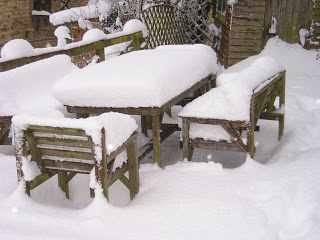


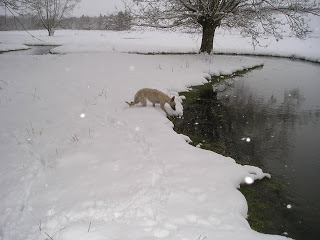 “I’ll pretend to be interested in the river but I’m really hatching a plan….”
  “If I stalk Barney he’s bound to chase me”
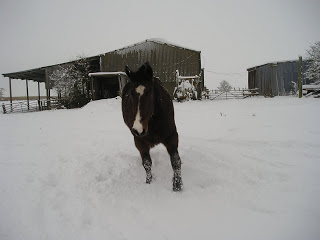 “Call me old and grumpy but I ain’t going no further or faster than this”
 “I’ll go for a gallop on my own then….
 ….and no-one goes faster than me”
 “I seem to have run out of steam”
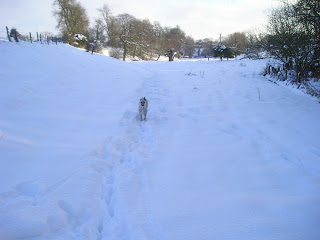 “Let’s plod back up the path to home”
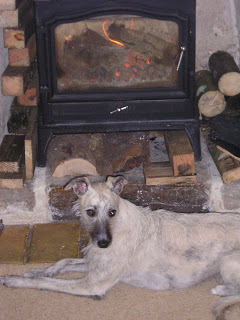 “Thank goodness, the wood burner’s ablaze”
 The view across the secret valley is also very different from the frosted look of Christmas Day (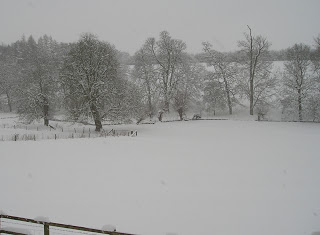
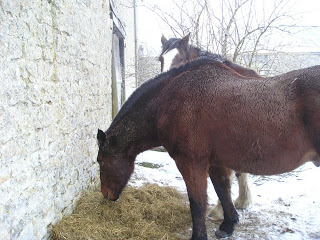
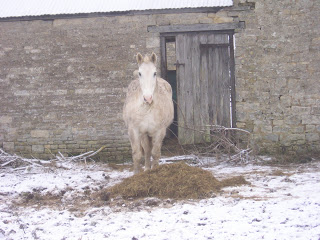
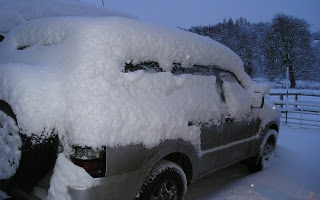 The UK has ground to a halt: airports closed, people trapped in their cars overnight, lorries jack-knifed, cars abandoned where they have slid and the councils running out of grit and salt. The latter doesn’t make any difference to the secret valley for the gritters don’t venture down here anyway. It is good to see the horses are safe, warm and well fed and enjoying the sensation of snow under their feet. And like us, they have beautiful views to look at from their barn during quiet moments. I wonder if they are aware how lucky they are! Or ourselves, for that matter – for in Scotland there is a report of a woman leaving home on Christmas Eve to collect the festive turkey and still unable to reach home, the road being blocked by snow. Apparantly, it is the first time in 36 years she and her husband have been apart.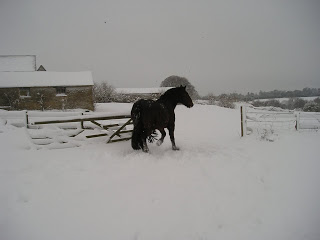
 Down by the river, as the carol says, the snow is “crisp and deep and even”. The water is high, almost to the top of the banks and, if we get a sudden thaw, will almost certainlly flood. However, the forecast is for another ten days of this cold spell with more snow at times – the weather is coming from Siberia so temperatures are likely to plummet further. And we do, in theory at least, still have the remnants of the weather systems from America to arrive yet which reach us about six weeks after they wreak havoc in the States.
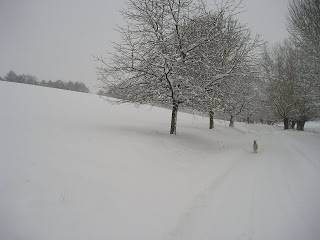
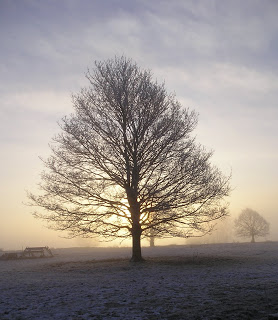
 winter sunshine on silver birch
 Fallow Deer – one of the larger species of deer to be found in England and quite common throughout the country. But like all deer, despite their size, they are remarkably difficult to see and watch. When I lived in the Chiltern Hills, 50 miles to the east of the secret valley, they grazed the field close to my windows, making watching easy. Here, we see them occasionally from the cottage – yesterday was one of those days. In winter, their coats lose their lovely dappled spots and become quite dark – the two pictures below show this, the lower one being taken last summer.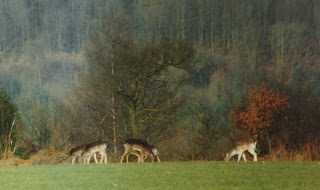
 The Red Kite is one of the great conservation success stories of recent times. Once so common they scavenged in the streets of London (and had a reputation for stealing hats off people’s heads to decorate their nests with. These days they often use plastic instead – the Kites, not the people, I mean, of course). By the 1970’s numbers were down to just a few pairs living in the remotest parts of Wales. A breeding and reintroduction programme started in the 1980’s centered on the village in the Chilterns where I lived. Soon they were a relatively common sight in that area but they have been slow to extend their range. Now we are seeing them much more frequently in the secret valley and they never fail to thrill. The full story of the Red Kite can be found on the Chilterns website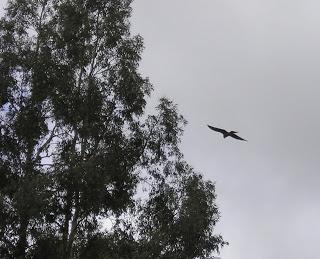
 This photo is most definitely poor quality – I only have a small ‘aim and fire’ camera and took this from an upstairs window. I am hoping to buy a more sophisticated camera with telephoto lenses very soon: another unexpected side effect of blogging has been a rekindled interest in photography. Who knows what will show up on this blog then?
 Well, it’s almost a white Christmas!

 I’ve had to rely on a ski trip photo for really deep snow
  Our snowfall – just a dusting despite the warnings of up to eight inches forecast

 “Why does he keep taking all these photos?”
 Life in the English Cotswolds