

a frosty morning in the secret valley
Whether it really is due to global warming or just chance, (probably a bit of both), but this year has been milder than ever. We have had a couple of slight frosts but not enough to do much damage other than to the really tender plants such as dahlias. This post is really more of a photo shoot of plants that ought to have been long finished. In between, for the benefit of overseas visitors, I will explain about the tradition behind Bonfire Night.

fuchsia megallanica
“Remember, remember the 5th of November, gunpowder, treason and plot” starts the old rhyme that children learn, recalling the day in 1605 when a group of men tried to assasinate King James I by blowing up the Houses of Parliament. The main conspirators were Robert Catesby and Guy Fawkes and it is the latter that is remembered because he was the one that got caught.
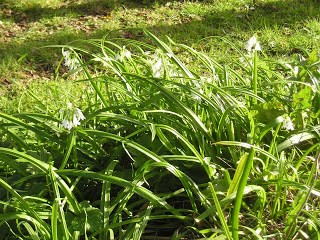
allium triquetrum – don’t they realise it isn’t Spring?
The burning of the guy, as the effigy of Guy Fawkes is traditionally known, represents the death of Fawkes and right up to the recent past (trick or treat seems to have taken over) children would take their guys, which they made, from house to house asking for ‘a penny for the guy’.

a stunted but proud Foxglove
The bonfire is always accomanied with a firework display, these days usually organised affairs by charities or village committees. What happened to the real Guy (which is where the modern day name for any man originates)? He was tortured and taken to the gallows to be hung, drawn and quatered – the baying crowd were cheated of this spectacle as he jumped to his death before the noose was placed around his neck.

a tender Salvia – not sure which one – any thoughts, please?
As for Catesby, he and the other conspirators escaped, but were found three days later and shot. 
this surely has to be the last butterfly of summer?


 Sometimes it seems as if flowers have inspired the sunsets! Here is the rose Rosa x odorata ‘Mutabilis’ trying to outdo another mountain sunset. This rose starts with the most intense pink bud and, as the flower fades, turns to the softest apricot, ending up with this wonderful colour combination.
 This old mossy wall was the starting point for a mini parterre – the ‘moss’ is made from the box (boxwood) framework, the ‘stones’ from variegated Iris and Cotton Lavender. The wall reminds me of our garden wall in the secret valley (Sunday 20th September 2009) but this one is in north Wales and is a hard, cool grey and silver granite unlike our soft, mellow Cotswold stone. This planting is tiny compared to the usual grand parterre designs and has been used to link two levels of a small garden.


 So let your imagination take you where it will. Sometimes the combinations don’t work but, more often than not, there will be some exciting discoveries to be made and a lot of fun will be had along the way. And make sure you tell me all about them……

 Green waste from the garden, as well as other material that will rot down, is brought by lorry to the site and piled up in long lines – windrows -stretching into the distance. The size of these heaps dwarf the heavy machinery used to move it.
  Unlike the compost heaps of our gardens, the temperatures that are built up destroy all harmful bacteria, noxious weed roots and seeds, resulting in a clean, fertile and very marketable resource. The compost shown here is destined to be spread on fields and has made a significant reduction to the amount of synthetic chemicals and fertilisers being used on the farm, so there is a double positive effect to the environment.
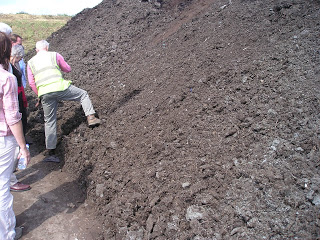 This method of composting can be recreated on a smaller scale. The compost heap below belongs to a large garden which produces a lot of garden waste, whether from flowers and vegetables, from leaves or from the sheep which help to keep the grass low.
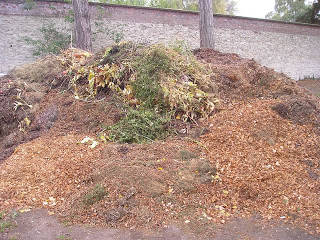 The result is the same: although the temperature does not reach the same height as with the industrial scale, the compost quality is excellent.
  These timber compost bins, with removeable fronts, I make for my own garden as well as those of clients. Ideal for the smaller plot, they last for years, and keep the heaps tidy and easily managed. For smaller gardens still, there are numerous plastic compost containers….
 …..so, there is no excuse! Get composting and help the environment as well as saving money on all those expensive bags of fertiliser…..
 October on Exmoor saw weather changes from day to day: one moment mists, another driving rain and cold winds but, more often than not, warm sunshine. How many times do walkers get fooled into wandering on the moor only to find the mists creeping up the deep coombes (as the valleys are called here) before spreading out across the wider, open spaces where landmarks are few and bogs many? To my knowledge, deaths in the bogs only happen in fiction but a cold plunge to chest height in sticky, peaty water and a twisted ankle miles from anywhere has the potential to be fatal.
 The wild ponies of Exmoor are one of Britain’s oldest native breeds and survive all year finding their feed on the moor. During this month they are gathered up by the local landowners and checked over, branded and the foals weaned. These are normally sold at the annual, local pony sales although this year, for various reasons, the sales have been cancelled leaving a gap in the social calendar, for the sales are one of the great meeting places of the widely scattered population.
 Another meeting point is the local hunt. On Exmoor, there are packs of staghounds as well as fox, for the moors are one of the few places where the Red Deer still run wild in England. With the change of law, only two hounds now hunt the deer, the unfortunate creature having been selected by the Harbourer – a local person who knows both the deer and the moor inside out. Once the correct deer has been found and separated from the rest of the herd, the beast is shot. This is a necessary culling as the population is continually increasing to the detriment of both the moor and the deer themselves.
  Hunting is becoming ever more pouplar as the crowds and cars, pictured, prove. As soon as the hunt moves off across the moor the crowds get left behind and, with the hunt hidden deep in the coombe, the moor seems deserted once again.
 More on Exmoor to follow…..




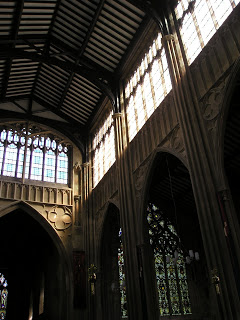
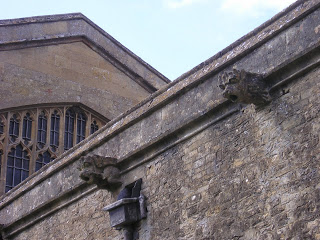
 But it is the walls dividing fields and gardens that are perhaps the most iconic of all the Cotswold scenes. Probably nothing more than heaps of stone thrown to one side when the fields were first cleared, centuries ago, it was the obvious choice for building and permanent too – a good stone wall lasts for decades with virtually no maintenance. However, neglect took its toll.
 A dying art, the old stone walls fell into disrepair until recently when, with an upsurge of interest, building of new walls and repair of the old, has seen the work revived. New, younger blood learning the skills from the dwindling number of ‘wallers’ and with classes available to anyone, means that for the time being at least, the craft seems safeguarded for the future. Here a new walled garden – the classic feature of the English country house – is being created.
 The use of a timber frame as a guide creates the ‘batter’ – the name given to the sloping sides that gives the wall stability. The photos below shows the frame and a new wall being built. Modern techniques tend to use a bit of mortar at the base and also cementing in of the ‘header’ stones along the top. The latter is partially to make the wall more weatherproof (how the old timers would shake their heads at that!) and also to prevent theft of the stone, which is expensive and does disappear at times. Sometimes, the headers are left off altogether and a concrete cap is placed instead which soon weathers down to give an acceptable appearance.
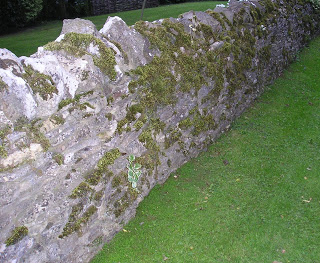
 Our garden in the secret valley has a wall that has stood for over 150 years, below. It will be many years before new walls have the depth of colour and the mosses and lichens of this one.
 Daffodils, or Narcissus if we want to be technical, are one of the first of the bulbs to be planted for they start to send out their roots early in the season as we discover when we dig them up by mistake when weeding. Like all bulbs, they need to be planted in generous quantities to look their best. The photo above shows several hundred lining the old lime avenue of the house I described in an earlier blog ( 21st August 2009:
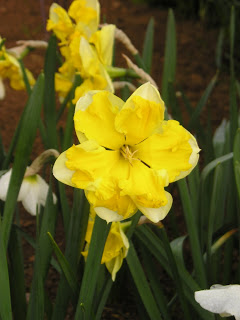
  I am not keen on double varieties – they tend to be top heavy and spend most of their time prostrate. However, I find the Orchid flowering types don’t do this and are quite fascinating to look at. The one above is Dolly Mollinger, the one below Chanterelle.
  Bicolours can also be tricky to my biased eye. I don’t like Scarlet O’Hara (below top), so vulgar in the border! But Jetfire, which is a similar colour combination works well in this wilder setting and is beautifully enhanced by the white bark of the Jacqmontii birch tree (below bottom).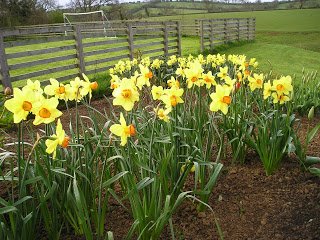
 Scent is all important in any flower and in narcissus it is especially welcome after the bleak winter months. Few scented winter flowers have the freshness of the smell of a vase full of Cheerfulness – a stonger coloured version is Laurens Koster.
 But perhaps the best daffodils of all are the ‘bog standard’ yellow ones. That’s what spring is all about. (Although to be honest, I don’t totally agree with that statement – my favourites are the miniatures but I don’t have any photographs! I will have to take some next March and persuade you all then……)

 A thin, worm ridden, timid creature, when we got Daisy May. We realised she would be too light for us to ride but we took delight in building up her trust and her body. She was sold some time later to be a brood mare.
 Barney is the wonder horse and still going strong after many years. A 17 hands 3″ Irish Draught he is a great companion. His main picture is to the right but he also appears on the one below with Squirrel and Polly, the 30 year old pony that we ‘inherited’ along with the paddock. Barney is another great jumper and will tackle the biggest fences with ease – but in a kind and considerate sort of way.
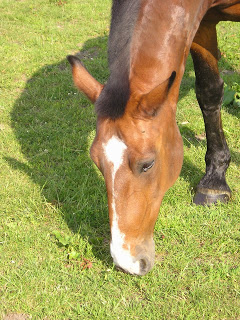 Squirrel was another danger horse who would try his utmost to throw you off when you first mounted him. Providing you stayed on he would settle down and be a good lad for the rest of the day. However, in the end he proved too hot to handle and, just when we were wondering what to do with him, he had to be put down. A good thing probably – I think he might have killed us in the end.
  Now white with age, Henry our grey Irish Draught and Rambo, our young Shire horse, along with Barney make up our stables at the moment. Rambo is ridden occasionally and has all the makings of a good horse as he gets older. Enormous, towering over Barney, but a gentle giant.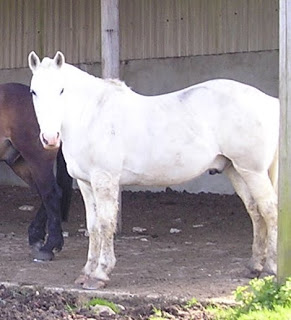
 Carriage driving is not for the faint hearted either! This belongs to a friend and it is great fun when travelling off road and at speed….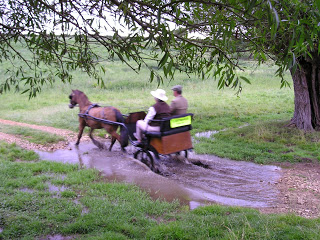

 Life in the English Cotswolds