Harvest Home – well at least a start’s been made

It is a rare sight to see more than one combine harvester in the small sized fields of the Cotswolds. Unlike the fleets of monster machines you see gradually working their way northwards across America, here they work individually or occasionally in pairs.

All the rain we have had this July – the wettest since the late 1800’s – has held up the start of the harvest and the machines have sat idle while the farmers have watched their golden corn, (in England we call wheat ‘corn’), turn black with moulds and the price fall, along with the quality. With modern drying techniques and machinery the crop can be salvaged but how terrifying it must have been, just a few centuries ago, knowing that hunger and possibly starvation was the only certain outcome.

Now the rape is safe in the barns, the wheat is on its way and the barley, still to cut, hopefully before it is lost completely to the weather.

>
I sometimes think that our Cotswold country looks at its best when the fields are golden and the countryside takes on that special late summer look: the photo below is of a cornfield near Leafield, a village just outside the town of Witney. But then, when their season comes, I think that of spring or autumn or winter too for they each have their own special beauty and magic.

40 years ago when I helped on a farm on Exmoor, that wild country, they still harvested using the old fashioned binders. Placing the sheaves of corn upright, six to a ‘stook’ was skilled work and I remember my dismay when the first two rows that I stood toppled over like a pack of playing cards. The binder was considered long out of date even then but it suited the farmer and gave me an insight into a way of life now long lost.

The practice of stubble burning is also lost but this is due its being made illegal, except under special circumstances. Used mostly to get rid of pests and diseases and excess straw, it was an exciting if somewhat frightening sight. Occasionally these fires would get out of control but our changeable climate meant that there was no risk of the ‘wild’ fires of elsewhere in the world, with the devastation that those cause. This photo was taken a few years back from my garden when I lived in the Chiltern Hills, 50 miles away.

Fingers crossed for a few more dry days and the harvest safely in – then we can all celebrate with the Harvest Home.

A day at Gatcombe Horse Trials

Princess Anne, the Princess Royal, each year hosts the Festival of British Eventing at her home, Gatcombe Park. Commonly referred to as the Gatcombe Horse Trials, it is unique in testing the skills of horse and rider at all three levels – novice, intermediate and advanced. This year, apart from being the British Open Championship, it is also a qualifier for the World Cup.

Dressage, Show Jumping and Cross Country make up the three phases of the test and it is the Cross Country that is the most eagerly awaited for both its excitement and, sometimes, drama.
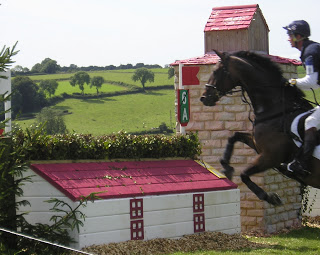
It’s a brave horse and rider that competes Cross Country. Thirty solid obstacles have to be jumped at speed over rough terrain and there are usually plenty of falls and, hopefully, not too many injuries, although fatalities do occur to both horse and rider on rare occasions. Everybody likes to see the jockeys fall off as they jump into and cross the lake – there is usually a cheer as the soaked rider gets back on their mount to continue the race!

Dressage is all about concentration, putting the pair through the technical aspects of riding – very elegant to watch but not when it all goes horribly wrong! The Show Jumping course tests the skill of the rider and the agility of the horse.
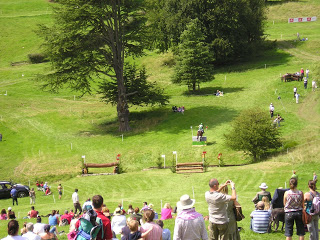
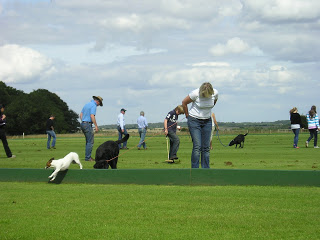
She-dog enjoys these days out but is not so keen on having to remain on her leash. Being a pretty looking creature she is much admired and fussed over by many of the spectators and believes (we haven’t told her any different) that the crowds have come to meet her. As most dog owners know, many a conversation is started over mutual dog patting and here is no exception, apart from the talk soon switching back to horses. The competitive/hunting horse world is quite small and it is remarkable how often you find that you both have mutual aquaintances.

Today, there was no drama. Despite this, the combination of good sport, sunshine and being able to wander through and picnic in beautiful parkland made a good day, none-the-less.

Add to Technorati Favorites

Polo – or how to put a hole in your mint

Cirencester, which is just outside the Cotswold country, is famous for being one of the most important English Roman towns, then known as Corinium. Now it is well known for Polo.

Not the round sweets Polo’s which are advertised as “the mint with the hole” but Polo, that mad game played on ponies.

Like most things associated with horses, Polo really does put a hole in your mint, eating away your money faster than anything. Despite being the sport of Princes and millionaires (who are the only ones that can afford it), it is remarkably accessible to us ordinary folk. You just turn up, pay to get in and watch.

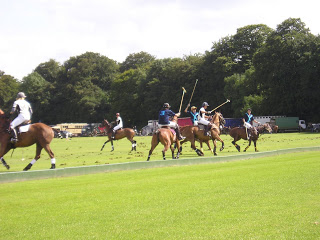
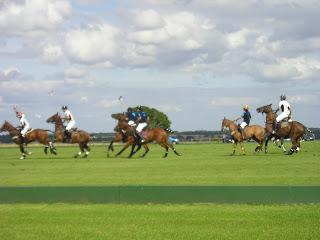
Croquet at full gallop is the best way to describe the game, which is played by two teams of four players. The rules are rather complicated and I will leave you to look those up elsewhere.

So we found ourselves at Cirencester Park, on the edge of town, eating our picnic lunch on the warmest day for ages, hoping that we wouldn’t get trampled on when the ball came our way – which it seemed to do quite frequently.

Swarms of spectators running onto the playing area is an eccentricity of Polo. Carrying out the important task of divoting, or pushing the damaged turf back into the ground is part of the fun and a good way for all to participate. Toddlers and dogs, elderly ladies in twinsets and pearls as well as the rest of us hoi-polloi mix in frenzy of activity. Quite mad!

What Barney would make of it all, I cannot imagine. He is my Irish Draught hunter, a huge 17 hands 3″ unlike the polo ponies that are small and sure footed. Barney’s picture has joined the family portraits on the right hand side of the page. More about him another time….
Add to Technorati Favorites

Poppy Power

Can there be a lovelier flower than the poppy? What other can look so frail yet be so resilient to wind and rain? And how can such a paper thin petal hold such an intensity of colour whether it is the scarlet of the wild, the pale pink of the domesticated or the dazzling purity of the white?
< Poppy seed needs light to germinate and this is why they appear in their thousands in disturbed soil whether it is the ploughed cornfield, the scarred battlefield or just our humble vegetable plots, newly dug. They can survive buried for centuries and have even been known to germinate from seed found in archaelogical excavations.
< In the garden I use them all the time – sometimes the wild and sometimes the cultivated varieties, either mix with all types of plants and in all situations. <

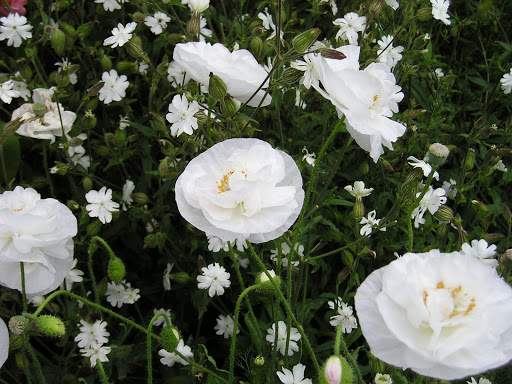
These double white Icelandic poppies weren’t carefully sown in trays and planted out – just a packet of seed thrown onto the ground where I noticed some of our native White Campion (Silene alba) growing in a border. Both flowered for months and when fading pulled up and put onto the compost heap: there will be enough fallen seed of both to germinate again next year.

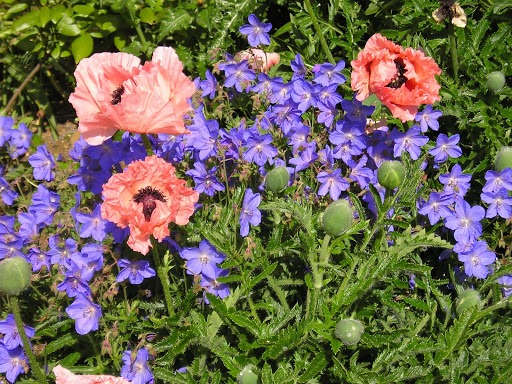
< The pink Oriental poppy shown here is the variety ‘Turkish Delight’ growing amongst Geranium ‘Johnson’s Blue’ (not named, unfortunately, after me!). Unlike most of the poppies which are annuals, the Orientals grow year after year from the same rootstock and require some staking to keep upright unless you cheat like me – the Geranium disguises the partially collapsed, sprawling stems.

< A sea of catmint, ox-eye daisies and bright red Oriental poppies I planted below creates a dramatic walk through an old walled kitchen garden. The poppy is ‘Beauty of Livermere’ and has an extravagance that our smaller native poppy could not achieve. Extravagance in space too for this border will only look good for about two months. Once the flowers fade, which they do together, they are all cut off – leaves and all – to ground level. Within two weeks new growth will appear but there will be no more drama until next year.

Willows

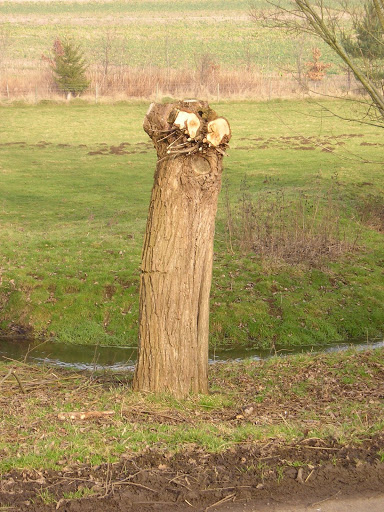
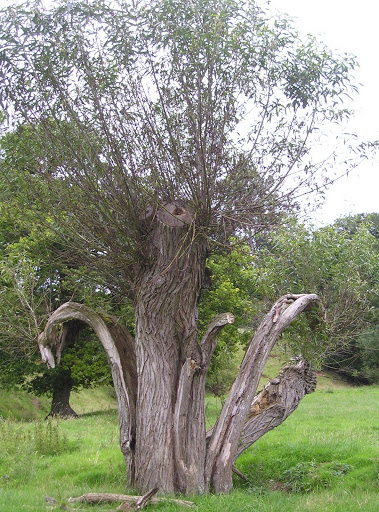
The pollarded willows that line the banks of our river are ancient. Pollarding is the removal of all the top growth of the tree, the timber in the past being used in many ways but, most famously in the manufacture of cricket bats, but now used mainly for firewood. Severe as this pruning is, it prolongs the life of the trees.

Their true age is difficult to determine as they have the strange habit of their outer trunk splitting. This then rots away leaving a relatively young looking trunk to start the process again. I have seen mulberry trees behave in the same way.
In the garden, pollarding (and coppicing, which is the same type of pruning but at ground level) can be used to advantage. The new growth of the coloured bark willows (Salix) and dogwoods (Cornus) are considerably brighter than the older wood and make a good backdrop to the winter garden.
In England, the pruning is carried out in late February, just before the new growth of Spring starts.
The flowering tree in the photo is, yes honestly, another of our pollarded willows. A wild rose – probably from a seed dropped by a bird – has established itself in the crown. It looks spectacular when in full bloom and confuses everyone that finds it!

Add to Technorati Favorites

Stll Waters Run Deep

A little, winding river flows through the heart of our secret valley. As far as rivers go it isn’t still, it isn’t deep and it certainly isn’t wide – you can jump across it in places. But it is important: in its very short journey of 15 miles from start to finish it passes through several historic country estates where it has been broadened to form ornamental lakes for fishing and pleasure. The photograph on the header of this page shows the river just above our home.

You wouldn’t believe

there was our valley in this photograph. It’s just the other side of this hedge – no wonder no-one knows it’s there! It’s also time to meet She-dog, our lurcher, who insisted in being included in the photograph.


Outside our cottage

and just downstream, the river has formed ‘our’ lake (really only a little larger than a pond, but that description doesn’t seem to give it enough dignity) where, today, I watched a kingfisher perched on a low bough of a willow. A flash of iridescent blue and orange and it was gone, its shrill call giving warning to all around.

Pretty as they are, the lakes were built for a purpose. In winters past, their frozen water would be carried to specially built ice houses: pits made from brick or stone, deep underground. When full they would be sealed making ice available throughout the summer months. Of course, this was only available for the wealthiest few and it was in the kitchens of the gentry that ice cream recipes were devised – a luxury unimagineable to the poor cottagers. They often struggled to feed themselves the most basic diet.
<
Many of these ice houses still remain, usually derelict and unsafe, but sometimes restored and open to the public to view.

Add to Technorati Favorites

Speaking to a 5000 year old soldier…..


I stopped off in Enstone today, a small village just a few miles north of Blenheim Palace. I wanted to meet the Old Soldier, the name locals give to the largest of the Neolithic stones that were placed here 4000-6000 thousand years ago.

All that remains of the burial chamber are these few stones but they are mighty impressive nevertheless. Hidden amongst trees, it is easy to pass them by even when you know they are close, despite the Old Soldier being 9ft high.
>
Our Cotswold landscape must have looked very different when these stones were placed here – and how did they place them with only manpower available? Of course, this is one of the big mysteries of Stonehenge, the world famous stone circle 2 hours drive away. Whereas Stonehenge gathers hundreds of visitors each day, hardly anyone calls in to pay their respects here and it feels a silent and lonely place.
Legend has it that if you cannot find the stones – and sometimes you can’t – the Old Soldier has gone to the village pub to quench his thirst. One assumes in human form which is a scary thought!

Old Mont lived just a mile from the stones in Fulwell, a tiny hamlet of no more than a dozen houses. The very end cottage, made out of our local, mellow stone was his house, now marked by a ‘blue’ plaque . The local shepherd has become quite a celebrity since his death some years ago: a story teller persuaded to put his tale into a book [Lifting the Latch] and his few possessions into the Woodstock museum. He would find his own fame far more surprising than meeting the Old Soldier down the pub and the hollyhocks flowering by his garden wall far more impressive!

Add to Technorati Favorites

Of Blue Skies and Blue Flowers

The sun is shining and the rain has stopped! The wind is still cool but it feels good not having to walk with head tucked low against the elements.

The lane outside our cottage is narrow and winding as it climbs out of the secret valley. To the right the river follows its meandering course below us and, on the left, the lane is bound by an ancient hedgerow, full of wild flowers.

Crane’s-bill is in full bloom there now and has been for a few weeks. This is the Geranium pratense of gardens and flowers so profusely in this part of the Cotswolds it could be our county flower. In places the banks and verges are dominated by this plant creating a sea of colour – and when the wind moves it, it has the appearance of rippling water.

In the garden I like growing it amongst shrub roses where it can hook onto the thorns and peep out amongst the more exotic rose flowers. Once the first flush of crane’s-bill flowers are over, I cut the whole plant down to ground level and within days new leaves and flowers start to appear again. And when the contractor’s cut the roadside verges it is always the crane’s bill that shows through first.

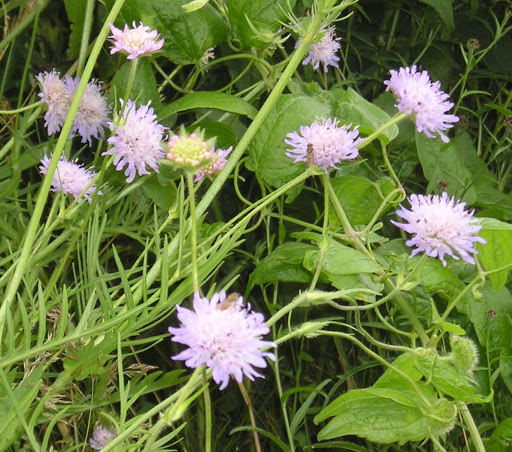
Blue seems to dominate this hedge. First the blue-purple of the dog violets and bluebells, now there is also wild scabious with its little powder puffs of flowers. It would be interesting to try to recreate this mixture in a meadow garden. I shall have to persuade a client to let me have a go!

Add to Technorati Favorites

Rain, Rain & even more Rain!

After all the scorching weather we had a little while ago, now it won’t stop raining. Suddenly temperatures dropped from the upper 80’sF (scorching for England!) by 20 degrees and, day after day, we have woken to grey skies and rain lashing the windows. There have been times when the sun breaks through to remind us that it is still mid summer and we can get on with our outdoor work in comfort.

The garden has been overdue for a tidy as working with other people’s gardens takes up most of our hours at this time of year. This weekend we were able to cut the tall hedges and they look a lot better for it – not a job I especially enjoy but a sense of satisfaction once done.

Hand clipping box hedges is a joy however, providing you have plenty of time for accuracy. There is nothing worse than a ragged, uneven finish to a formal hedge. Powered hedge trimmers rarely do a good enough job and the slow, rythmic sound of hedging shears is mesmeric.

I have heard that the dreaded box blight is in the area. Let’s hope that it doesn’t find any of ours!

Welcome!

A very warm welcome to my first blog!

Over the coming weeks and months I hope to share with you life in one of the most beautiful and unspoilt areas of southern Britain. You will see from my profile that I have many interests, mostly connected with gardening and the countryside and these will be included. I do hope that you will find the time to visit regularly and to offer your feedback so that I may improve the blog further. So, please, get emailing!

This is the top of ‘our’ secret valley , taken in high summer – a place full of wild flowers and birds and, nowadays, the occasional otter. More of that to come……