Before the Swallow Dares: the daffodil in myth, magic & verse

It is a remarkable fact that if you Google search daffodils in poetry, the great bulk of prompts are the same: Wordsworth’s I Wandered Lonely as a Cloud.  Yes, it is a great poem and one I learnt as a very young child at school, now so very many years ago, but how has it come to dominate our thinking?  Like many others, I now only remember the first line and the last, but how lovely it is to imagine William walking in the warm spring sunshine of 1807 through the vales of the Lake District with his sister Dorothy.  Perhaps they had been commenting on the few cotton-wool clouds that drifted across the sky before suddenly coming across a host of golden daffodils

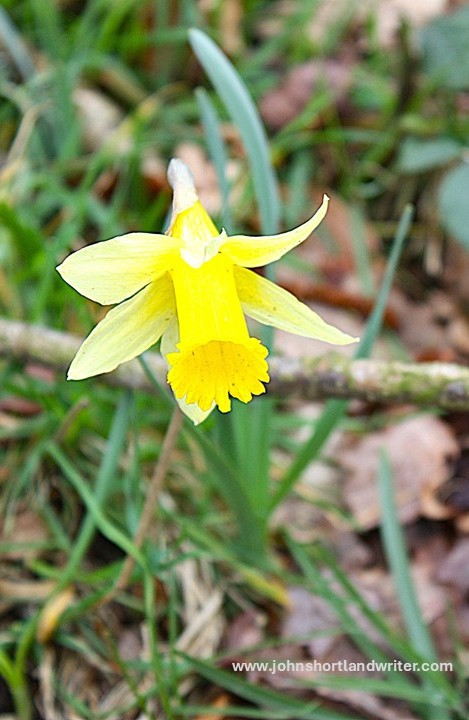
Our native daffodil, Narcissus pseudonarcissus
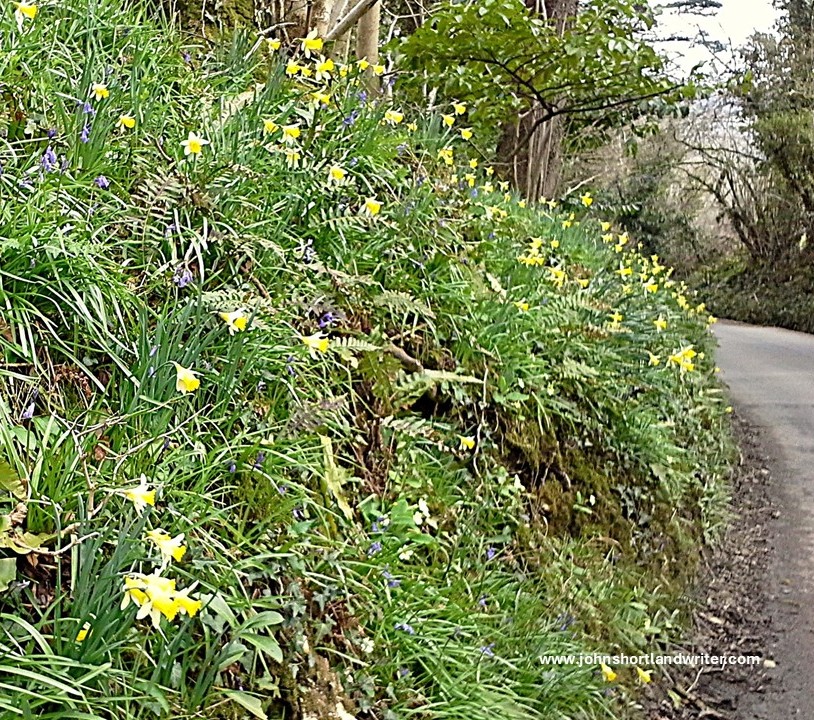
Wild daffodils growing on a Devonshire bank

In more recent times, Ted Hughes has been equally moved by their colour – their bloomers of scrambled egg-yolk.  He also captured perfectly how they appeared quite suddenly after lying seemingly dormant for months on a piece of land that he had purchased.  He delighted not just in their beauty but even more in the opportunity to pick and sell them all, sevenpence a bunch.  Only after, did he regret it, recognising his own frailty in theirs.  Robert Herrick, writing verse three hundred years earlier had come to the same realisation.
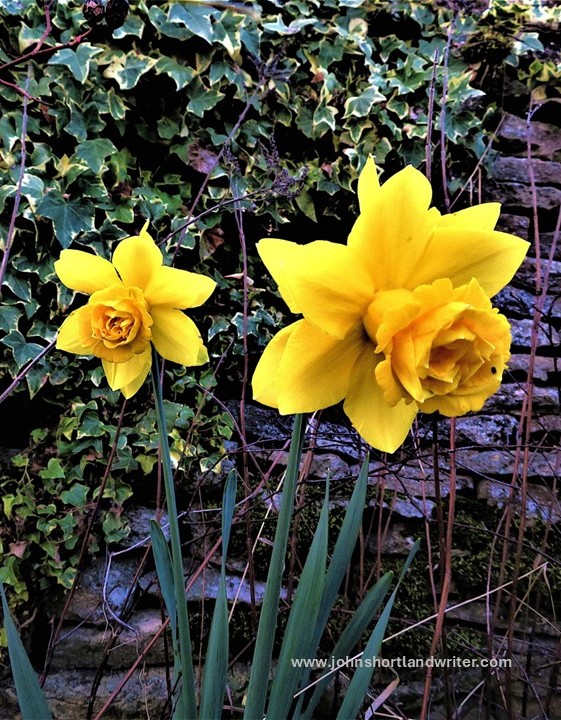
A double variety showing off their “bloomers of scrambled egg-yolk”

Perhaps it is because the daffodils are so eagerly anticipated each spring that we pine when they are all too quickly over.  How we long for some bright golden colour in our gardens after the greyness of winter yet how we resent their dull, decaying leaves that linger far too long after the flowers fall.  In the past, our grandparents would tidy them by tying their leaves into a knot, or worse, cut them off at ground level.  Now we have learnt that it is necessary to let nature take its course if we want plenty of blooms in future years.  From experience, I have found that it is fine to cut the leaves off six weeks after the flowers have finished.  I describe how to avoid seeing this untidiness further down the page.
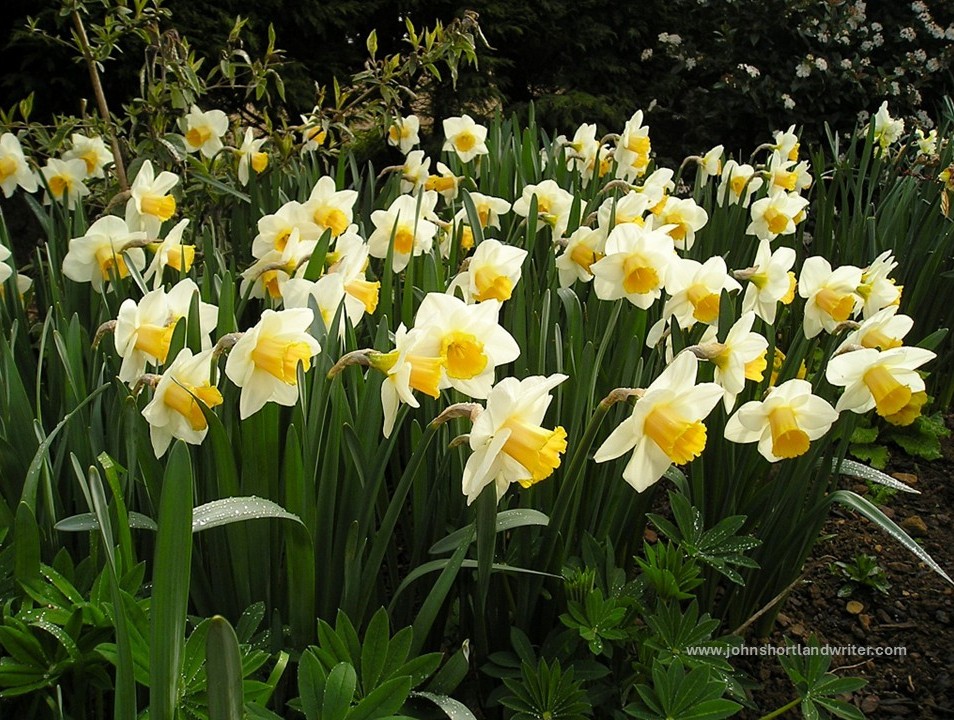
Narcissus ‘Salome’ growing in a garden border

Wordsworth seems to be the only one that ignored the link between the daffodil’s beauty and the mortality of man.  The story of Narcissus reminds us of our own demise.  He was the stunningly handsome youth of Greek mythology who, seeing his own reflection in a pond, became so entranced by it that he remained there and pined away.  From that spot the daffodil sprang and so each year, Narcissus (the botanical name for daffodil) entrances us with its beauty before dying and returning to below ground.
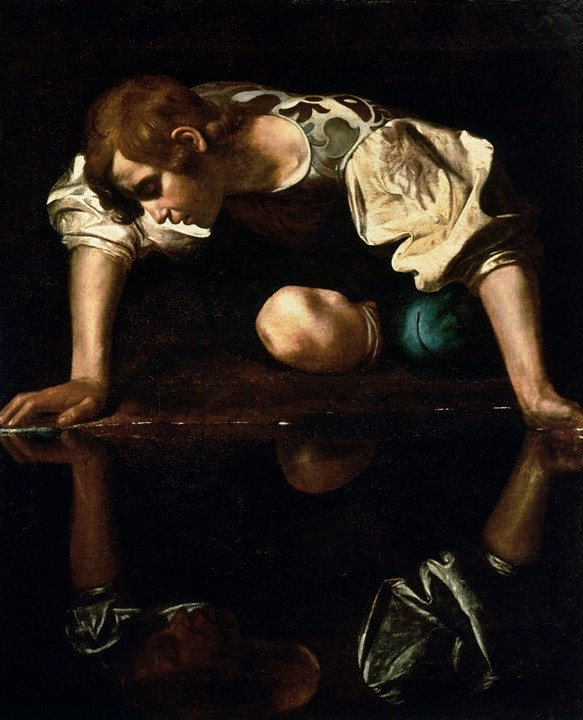
Narcissus gazing at his own reflection by Caravaggio, 1599 [Wikipedia]

In witchcraft and magic the use of daffodils is mostly associated with fertility (rebirth) and rites of spring.  They bring joy and self-esteem (although I would have thought that what happened to Narcissus might be a warning on overdoing the latter!) and bunches of daffodils in the house are a symbol of luck and renewal.  However, a single daffodil is unlucky, perhaps again because of the story of that unfortunate youth.  It is surprising that little seems to be mentioned in spells of the story of Pluto using the flower to entice Persephone into the Underworld, presumably by using the flowers narcotic qualities.   Perhaps it is for that reason that I have found no use for any part of the bulb in herbal medicines for all parts are highly toxic: I once had them growing in a field where sheep and lambs regularly grazed and they avoided eating them; they don’t seem to be eaten by wild animals either.  Anyone getting the sap from the cut stems on their skin will know just how sticky and unpleasant it is although I personally have never had any adverse reaction from it. 
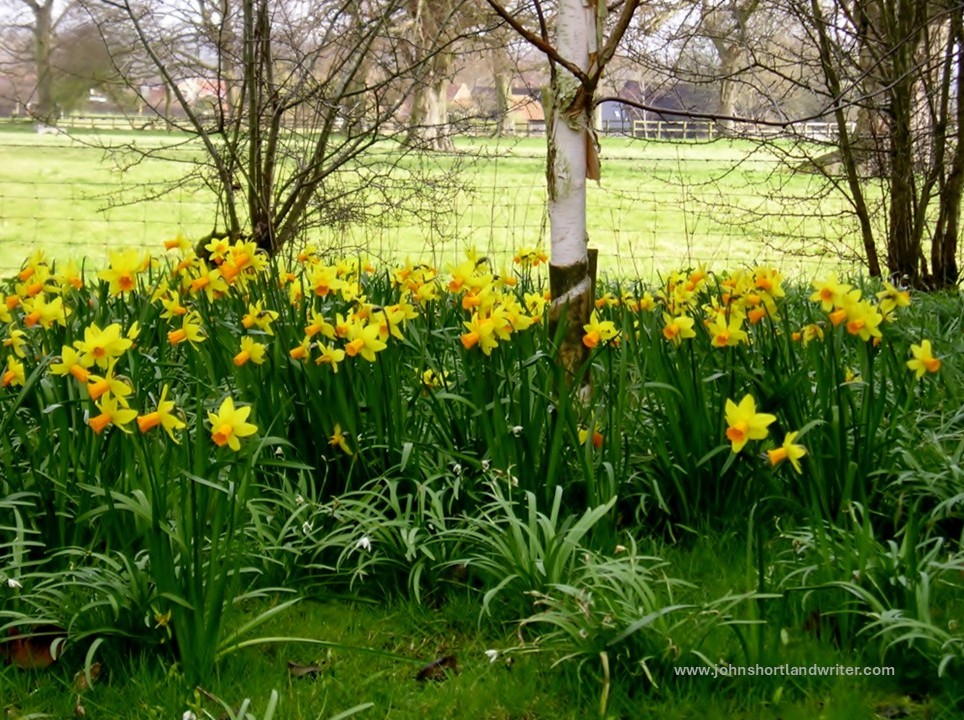
Narcissus Jetfire

I have written before about planting daffodils in the garden so will concentrate here on growing them in grass and their aftercare.  In borders, I always plant the bulbs far back (the flowers are bright enough to be seen but the untidy, dying leaves will be hidden).  On driveways that isn’t always an option but where possible I plant them behind a strip of mown grass which improves the general appearance.  It is essential that the bulbs are planted in groups for a lonely daffodil looks silly as well as unnatural. To make them look as if they have been growing there for decades gently roll handfuls of the bulbs and plant them where they land, and also in varying densities.  To extend the flowering period mix different varieties – my usual combination is Carlton and St Keverne for all yellow flowers, adding Ice Follies if I want to mix in white ones.  Plant as early as possible, say September although I have planted as late as November if the ground isn’t too wet or frozen.  As mentioned, cut the leaves after six weeks from the end of flowering – usually the first week in June in our Cotswolds garden.
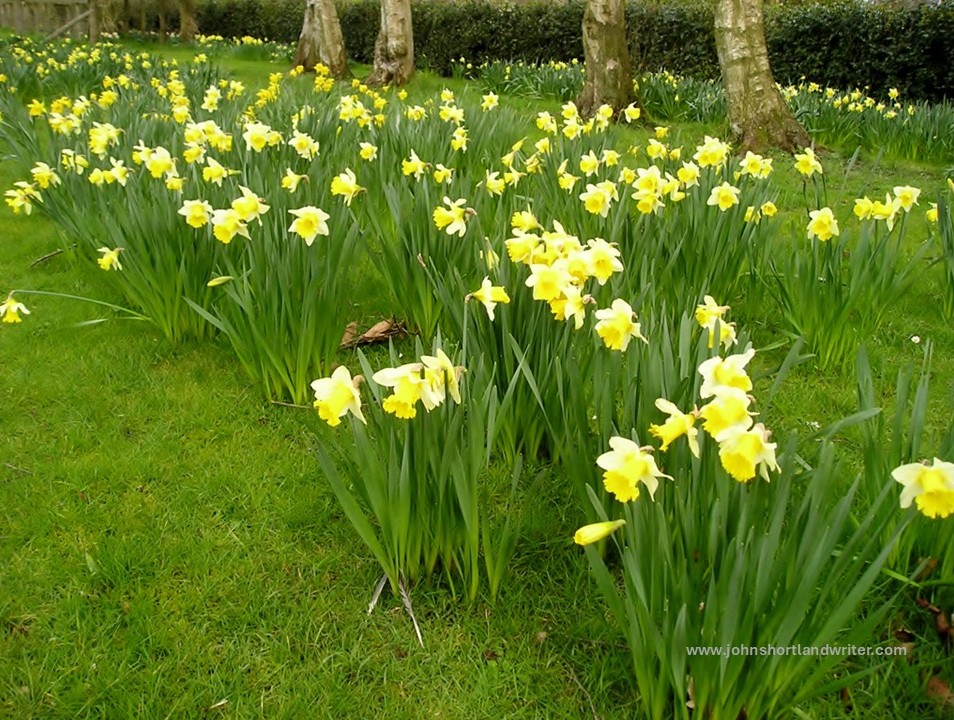
Daffodils naturalised in grass with a short-mown strip in front
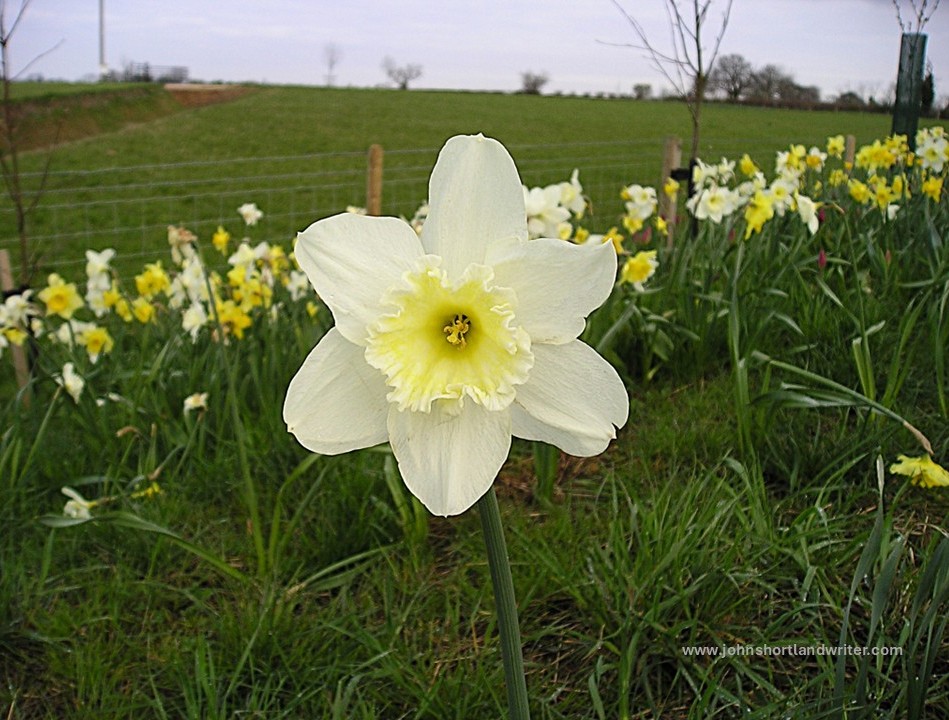
Narcissus ‘Ice Follies’ naturalised with yellow St Keverne & Carlton

I Wandered Lonely as a Cloud
That floats on high o’er vales and hills,
When all at once I saw a crowd,
A host, of golden daffodils;
Beside the lake, beneath the trees,
Fluttering and dancing in the breeze.

Continuous as the stars that shine
And twinkle on the milky way,
They stretched in never-ending line
Along the margin of a bay:
Ten thousand saw I at a glance,
Tossing their head in sprightly dance.

The waves beside them danced; but they
Out-did the sparkling waves in glee
A poet could not but be gay,
In such a jocund company:
I gazed – and gazed – but little thought
What wealth the show to me had brought:

For oft, when on my couch I lie
In vacant or in pensive mood,
They flash upon that inward eye
Which is the bliss of solitude;
And then my heart with pleasure fills,
And dances with the daffodils.
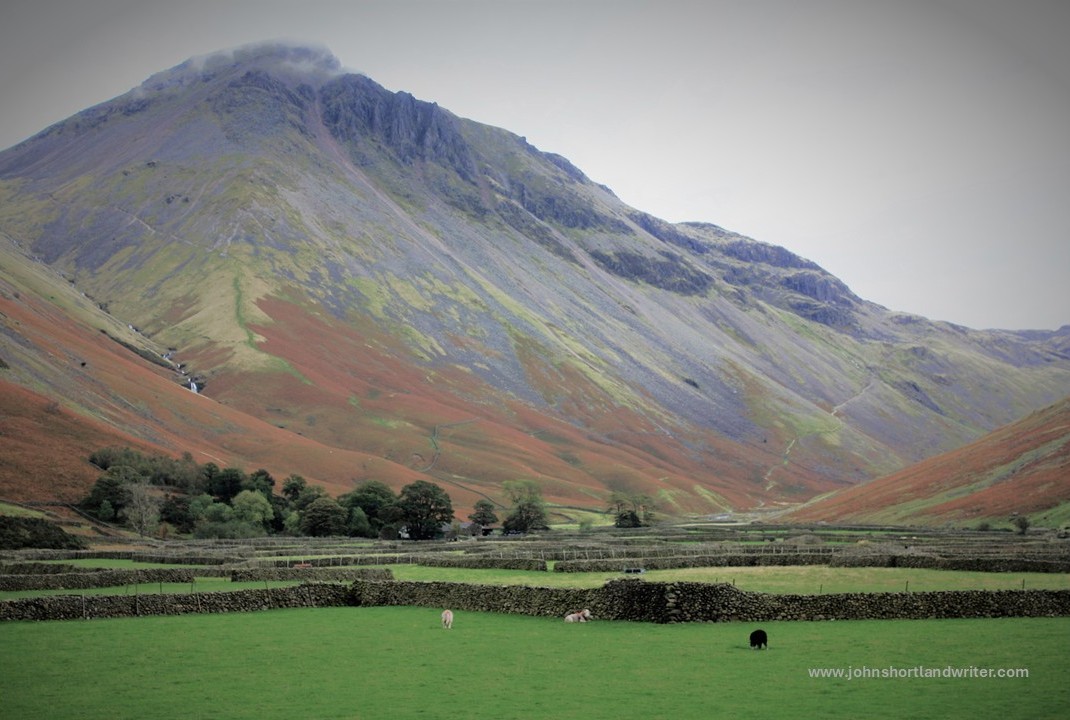

The stunningly beautiful Lake District, now a National Park
Yew Tree Tarn in the Lake District National Park

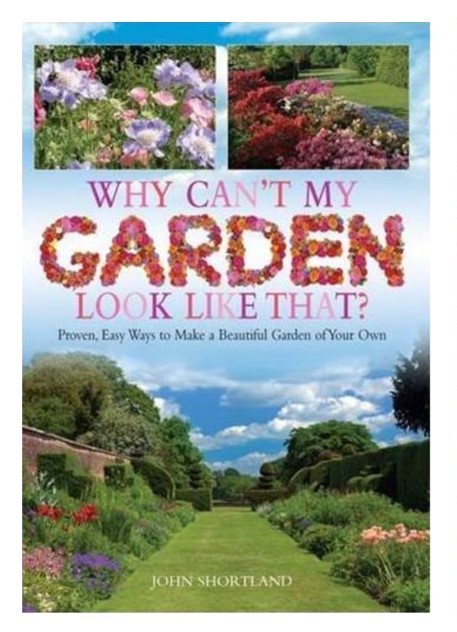
For simple, straightforward ideas and advice on gardening and garden design why not take a look at my book.  Written with no jargon so ideal for first-time gardeners as well as those with more experience.  Available from all good bookshops and Amazon.
Notes:
i)   Before the Swallow Dares is the lovely way Shakespeare writes of daffodils
ii)  Daffodils by Ted Hughes – link here
iii) To Daffodils by Robert Herrick – link here

The Heath

‘We’re off to the heath!” Such excitement whenever my father made this announcement.  It happened perhaps just three or four times a year and when it did it was always a special day.  Almost seventy years of summer sun – for we only ever went there when the sun was shining – have passed and the memory of those innocent days still bring joy.  Much later the heath became my place of refuge when sadness threatened to overwhelm me; under the great tree that had witnessed my journey into adulthood, its shade restored and healed me. 

Many summers have passed since I last sought the shade of the great tree

Going to the heath involved ritual.  The ritual included packing the picnic that my mother had been busy making; the ‘paste’ and cheese sandwiches, rock cakes that required the currants to be removed before being eaten (“no, mummy, they look like eyes”) and the steel Thermos flasks of scalding hot water for tea.  No tea bags in those days so teapot, loose tea and strainer were all added to the basket along with the rug for sitting on.  The rug fascinated me for it was of coarse wool and a faded khaki in colour but, most of all, it had my father’s name written on it in capitals:  SHORTLAND H A 174445, the numbers being those from his army days.  The blanket, he would tell us, had seen the Holy Land, Tripoli, the Pyramids of Egypt and the ancient ruins of Rome.  Being spared the horrors he’d witnessed during World War 2, it seemed to us as if the rug had magical qualities, perhaps it was the carpet that would one day take us to these far-off places as well.  Of equal importance to the outing was the cricket bat, ball and stumps, all to be placed in the boot of the cream Consul car – but only after I’d been lifted out of it for my jumping into the boot was all part of the ritual too.

Being packed into the car boot was all part of the ritual in 1955!
These days, picnics are taken in a lot more comfort…

Driving along the narrow country lanes my sister and I, noses pressed hard against the car window, would comment on every house made of flint, or with a thatched roof, that we passed for we knew the journey so well.  “Oooh, I so wished we lived there…”  After a few miles the car would begin to slow and we eagerly awaited the moment it would stop and we could all clamber out.  Hoisting me onto his shoulders so that I could see over the high hedge, we would look down onto the ‘model farm’.  How I loved it for it looked so much like my toy farm at home with its cows, sheep and horses enclosed by beautifully painted white wooden rails.  Of course, it wasn’t really the miniature farm that my father claimed it to be but set in a deep and steep-sided valley gave it the illusion of being on a much-reduced scale.  One day, I’m not sure how or why, we visited the old farmhouse with its ancient, beamed ceilings.  In one room the main beam was much split with age into which coins had been hammered.  It only added to my sense of awe as the farmer showed me the oldest coins, some of which dated back three hundred years or more.  He also showed me the one he’d placed with the ‘new’ queen’s head on it, the first he’d seen, for Elizabeth the Second had only come to the throne in the year of my birth.

Everything about the farm seemed to be in miniature….

Our next stop would be for a stroll around the village of Fingest.  The church fascinated me for it had beautiful, honey-colour rendered walls quite unlike the other churches in the area.  Its other unique feature was its bifurcated tower which to childish eyes looked as if it was splitting in half.  Best of all, inside the church, was a ladder, so tall that I was sure it must be Jacob’s ladder that I’d learnt about in Sunday School.  I never saw any angels climbing it but I was convinced that if I was allowed to do so I would reach Heaven. In adulthood, I would live in the village for a short while although by then, it was the excellent inn where they served great ale and delicious suppers that I eagerly sought after a long day at work.

The church at Fingest
Jacob’s Ladder – was heaven just beyond the top rung?

Fingest’s neighbouring village of Turville would only be visited on our way back from the heath, my parents stopping off at The Bull & Butcher.  In those days, children were not allowed in pubs and so we were left outside to explore its two streets and to clamber up the steep hill to the windmill.  How carefree those far-off days now seem when small children could be left to freely wander without fear.  The village now is famed for it being the village of the film ‘Goodnight, Mr Tom’, the windmill featured in Chitty Chitty Bang Bang and the church in the Vicar of Dibley.  After I moved from Fingest, I had the pleasure of living within a couple of miles of the windmill (and so close to the heath) for eighteen years.

Time stands still in the ancient village of Turville
The windmill stands high above Turville village

The lanes beyond Fingest become narrower and more enclosed by hedgerow and woodland as you approach the heath, all of which adds to the excitement of finally arriving at its wide-open expanse.  The car parked, out we would spill while mother busied herself with the picnic and my father set up the cricket.  We only had one wicket and so the match didn’t consist of ‘runs’ – our reward was in actually managing to hit the ball at all and the praise we would receive for our skill.  Perhaps this is why the heath holds such affectionate memories for, back in the fifties, fathers didn’t interact hugely with their children – mine was too busy working or tending the garden to make trips out a regular occurrence and my mother, like most women, was unable to drive.  Finally, we would hear mother calling us for tea and after devouring everything in sight we would lie back on the short turf replete and happy.  On one occasion my mother had packed roasted chicken legs, a rare treat for chicken was, in those days, a luxury meat.  Before we had the chance to try them, our little mongrel dog Tammy had snatched them away and into the bracken to eat out-of-sight.  Chicken never again appeared on picnics.

My father in 1963 – a tie was required even for casual dress in those days…

Soon we would be up and eager to explore.  The heath was beautifully unkempt; the rabbits cropped short the wide grass rides allowing the bracken and scrub to grow elsewhere, untouched so it seemed by man.  Along the western edge of the heath an ancient avenue of lime trees grew, their limbs now left to grow in a haphazard, twisted way.  From time to time one of these great boughs would fall to the ground there to gently lie and rot and return to the soil.  By summer, the bracken would have grown tall enough to obscure them from view. We knew where to find them and would crawl alongside beneath a green tunnel of fern fronds.  Tiny, pale toadstools grew from moist fissures in the bark, beetle scurried away from our disturbance and here we learned about nature., much of which seemed magical to young eyes  Later, as I learned patience, I would sit quietly to watch for wildlife: a wren chattering away as it searched for insects, the occasional slow-worm hunting for slugs and not as slow as its name suggests.  Once I was rewarded by a family of stoats moving like a sinuous string of sausages as they followed one another each holding the tail of the one in front in its mouth.  Such excitement!

Casual wear for ladies in 1963: my mother out for a picnic in the country

Magic played an important part in our young lives for everything we didn’t understand surely had to be caused by magic?  We saw regular proof of this in our painting books for they had the word ‘magic’ written across the front cover.  A blank page of paper would be transformed into a colourful picture by just brushing with water from the empty paste jars. The paste jars held the exact amount of water required for ‘art’ without too much risk of spills. In those days of necessity, although the word recycling hadn’t been invented, everything – paper, string, milk and other bottles – were all carefully saved or returned for re-use.  Plastic wrapping and the throw-away society was still to come. 

Evidence of magic could be easily found within these pages!

Further proof of the magical world around us came one day when exploring a new part of the heath.  We’d always thought that one dark, wooded corner looked rather forbidding but like all small boys, I knew better.  Venturing deep inside it, with every twig snapping under my feet making me jump, I came across a small, black pond besides which stood an old hollowed oak.  I squeezed inside the trunk to look up expecting to see sky.  Instead, there was darkness followed by much scrabbling and hissing as dust and twigs dropped onto my head.  Running as fast as I could I found my sister to tell her all about it.  Unbelieving, she and I returned and this time it was she who was hissed at.  Scared witless, we ran back to our parents.  Just an old barn owl we’d disturbed my father had said.  But we knew better, we’d found the door to the magic kingdom of elves and goblins.  How lucky were we that the door hadn’t snapped shut with us inside, never to return, as described in the numerous books that we had read.  Utter nonsense we were told.  That, we realised, was the trouble with grown-ups: they didn’t believe and that was why the magic was hidden from them.
                                                                                     *

I have to admit that it probably was a Barn owl that scared us

From time to time, I still return to the heath although I now live many miles from there. Whenever I do, I am struck at how small this ‘giant’ area to children’s eyes actually is. The difficult stage of my life, where the old tree supported me through despair, have long passed and the memory of it does not overshadow the pleasure that revisiting brings. Despite being a grown-up, I can still feel its magic.  I’m not alone in this for recently I read Hugh Thomson’s book, The Green Road Into The Trees, in which he crosses southern England on foot.  He too, feels the need to return to this very same heath in search of healing and finds it.  He believes that the mysteries of the Ancient World are not as far away from us as we tend to think for our mixed Celtic, Saxon and Viking heritage shapes not just the British landscape but also our souls.  Perhaps that’s where the magic comes from?