Creating Warmth in the Garden

Here, in the UK, we’ve been having the dreariest of winters with what seems weeks and weeks of mild temperatures, heavy overcast skies and incessant rain.  There have been a few cold, bright days but these have been rare.  The view from my window as I write this is of greyness reflected in grey floodwater where our little, winding river has overflown into the field below our house.  Some days it has been so dark and gloomy that the electric lights have had to stay on.  So it seems appropriate to write now about bringing warmth into the garden especially as it is the perfect time to create a new design whether it’s a single bed or a complete redesign.

Floodwater below our house which fortunately sits high enough above it to be ok

Obviously, sun is the most important and easiest way of creating warmth and the garden may already have a patio or other seating area in the sunniest spot.  This isn’t always the most sheltered place however, and there is a world of difference between a welcome, cooling breeze on a hot day and a stronger wind that makes sitting there less comfortable.  There are a number of ways to temper the wind without having to build a solid structure which quite often can create issues with turbulence elsewhere.  The simplest method is by planting, whether a hedge or more open, looser shrubs.  Trellis also works well – we’re aiming at filtering the wind rather than blocking it.  The height does not have to be great to have the desired effect.  The image below shows the early stages of screening using plants – it will also, in time, block out the unwanted view of the road behind.
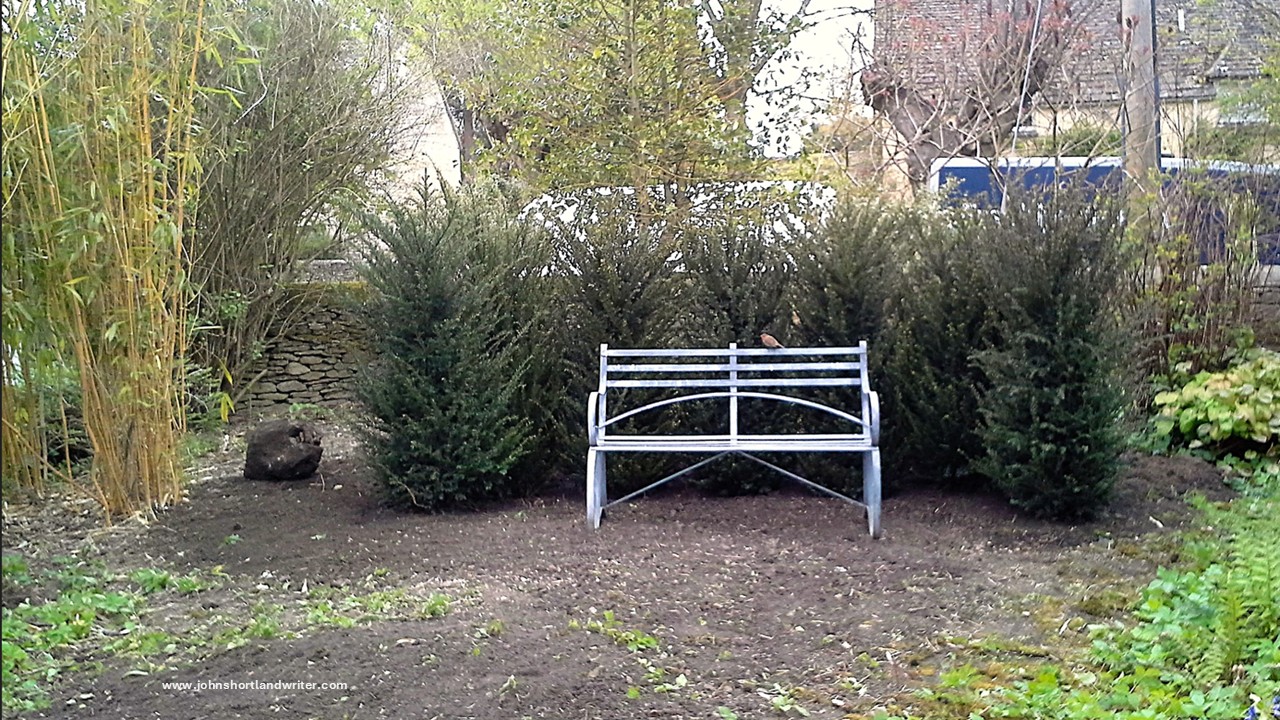
Screening around a small seating area using yew hedging which will become dense within a year. Note the bamboo to the left of the photo with its warm, golden stems

For screening, I often use (as above) yew hedging which gives a good, dark green background and only needs clipping once a year.  It can be bought at various heights and being evergreen, looks good all year round.  Bamboos, now getting rather a bad reputation for being invasive are also excellent if they can be prevented from spreading too widely.  There are some clump forming varieties which are more self-restrained.  In fact, more or less any shrub can be used to make the garden or part of it feel warmer; the secret is to use those with coloured stems or leaves, or flowers that have a hint of the exotic about them.  Bear in mind, ‘though that flowers are often fleeting.
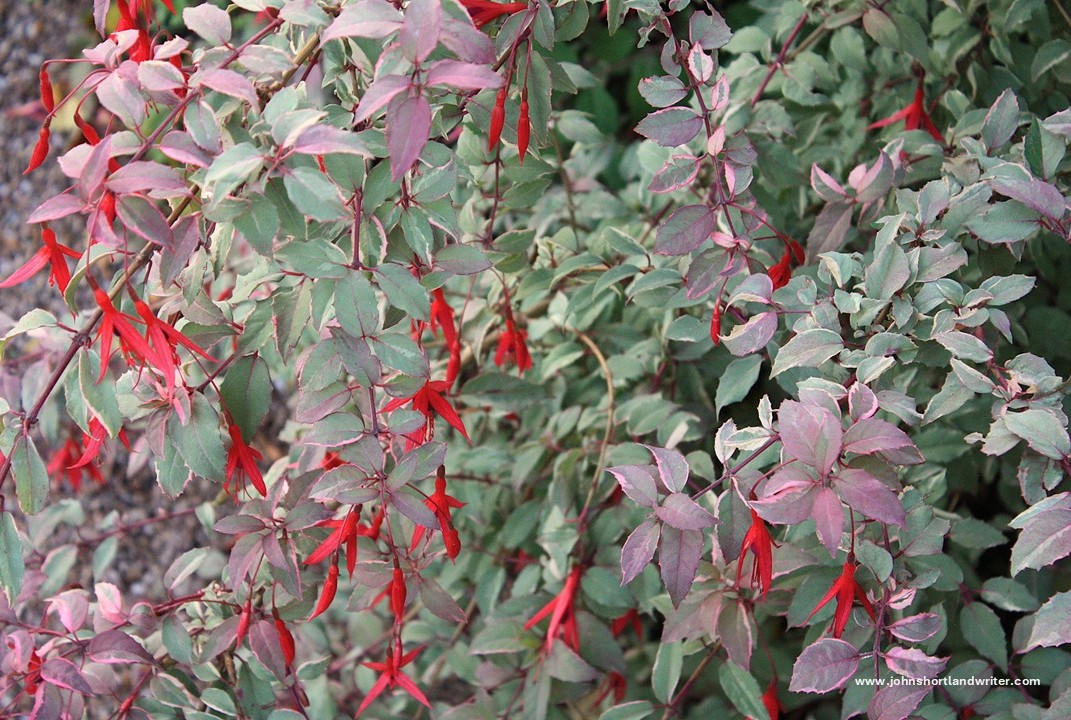
Fuchsia megallanica gracilis ‘Variegata’ : an example of a medium-sized shrub that is hardy, exotic-looking and beautiful
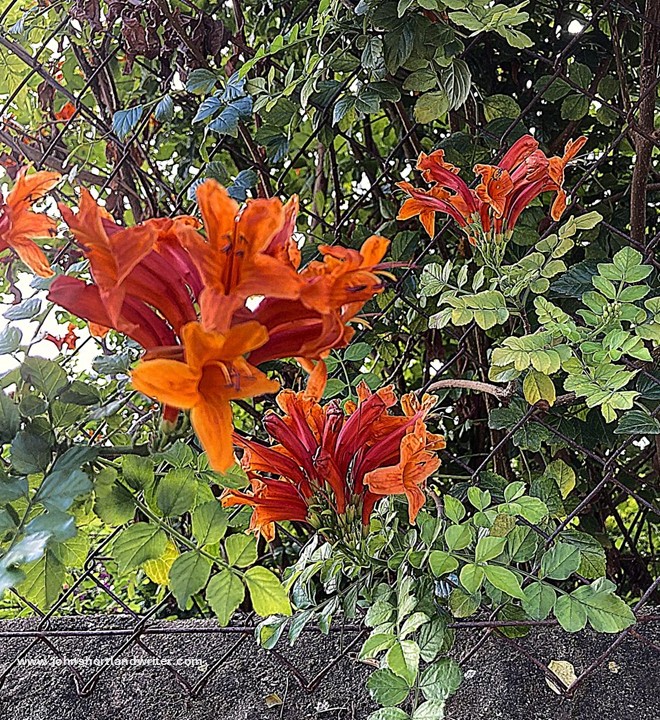
The fiery orange booms of the Trumpet Vine, here climbing through an old wire fence will bring a touch of the Mediterranean to any garden

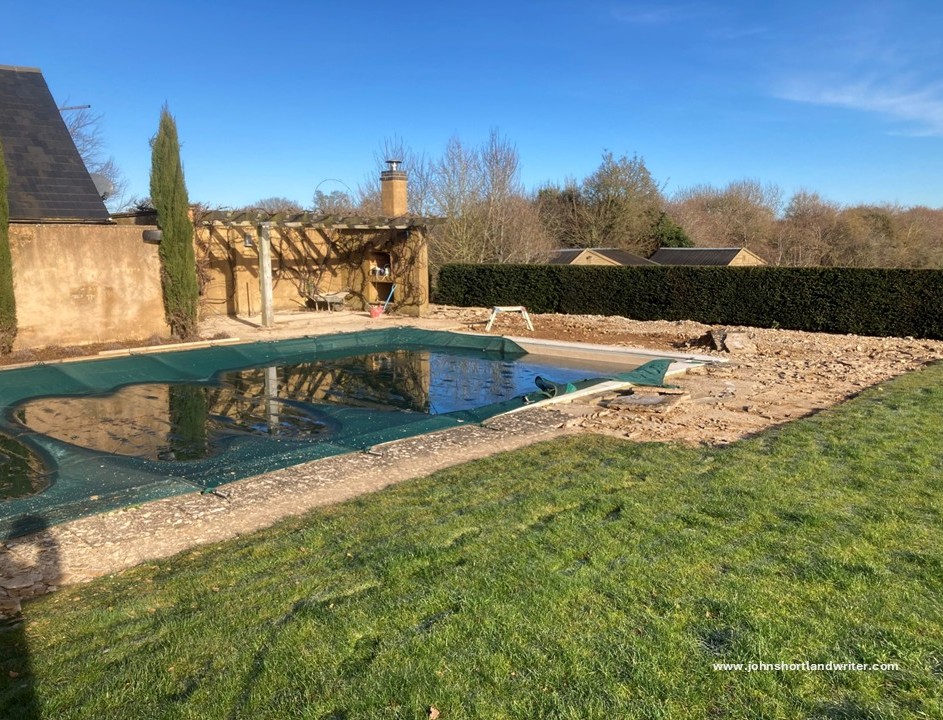
Although we’ve been talking about ways to make the garden feel physically warmer, it is through the planting of the smaller flowering plants that give the real impression of warmth and here the choice is almost limitless.  The rule is to use strong colours and to keep the softer shades to the minimum.  For the example I’m going to use here, I created this ‘hot’ garden which would be at its best during the summer months when the swimming pool is in regular use.  For cooler evenings or for entertaining there is a vine covered pergola adjacent to a built-in fireplace/barbecue.  Note the use of terracotta painted walls which immediately transports you to the Mediterranean.  In fact. Some don’t believe that the two photos below are really of a garden in one of the coldest parts of southern Britain!
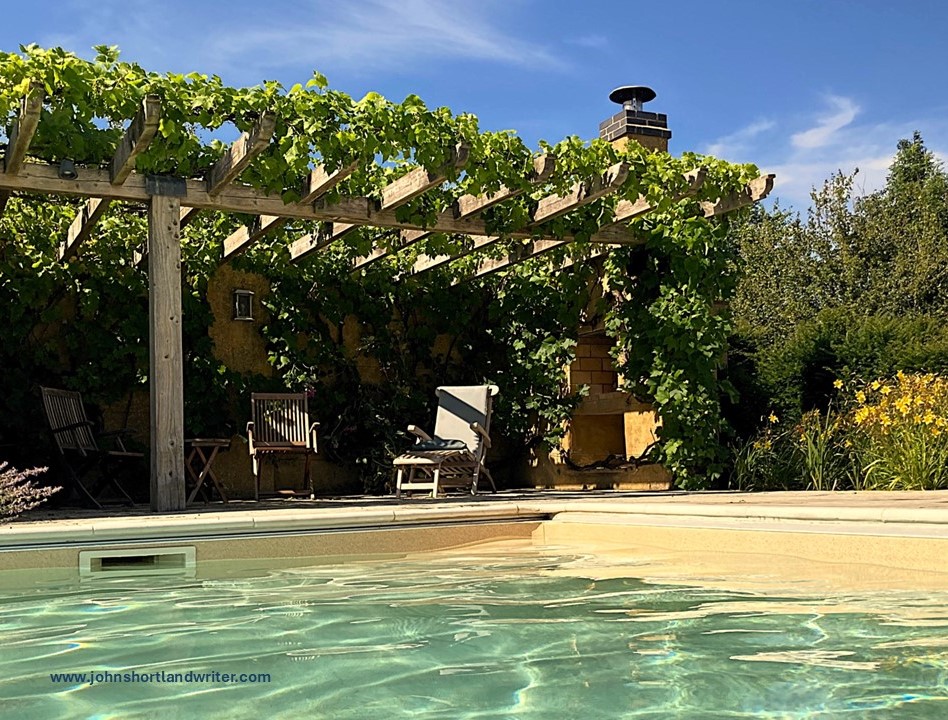
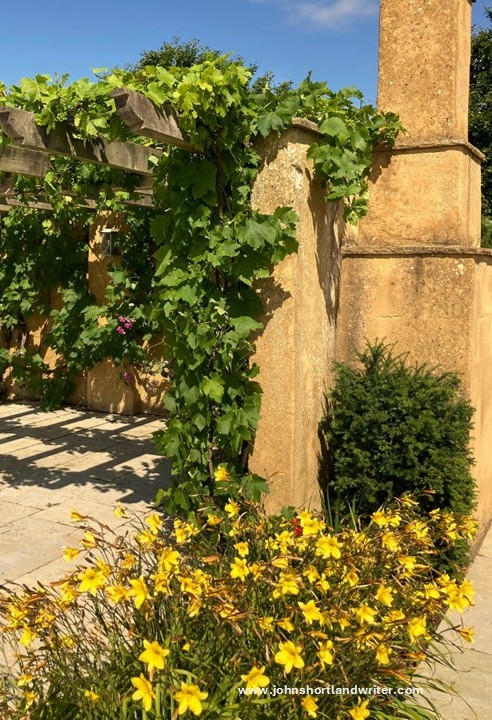
The warm tones of the pool, paving and walls transport you to a warmer climate than the realities of an English summer!
Golden day lilies blend beautifully with the walls of this outdoor fireplace and barbecue area. The grape vine hanging loosely over the beams give shade and the sense of being somewhere other than England

Nearly all of this swimming pool garden is enclosed by yew hedges for shelter and privacy; an existing wall has been coloured terracotta as mentioned above.  Shrubs have been kept to the minimum: there are four Physocarpus Lady in Red’ which has fiery new leaves which darken to burgundy as they mature.  Using the one variety helps to unify the design as well as giving some structure to the borders.  Two figs are trained against the wall and pencil-shaped Italian cypress trees also give that Mediterranean feel (see further note at the end of this blog). 

Transforming a cold garden into a hot one!
In January the garden was almost derelict, by midsummer it had been completed

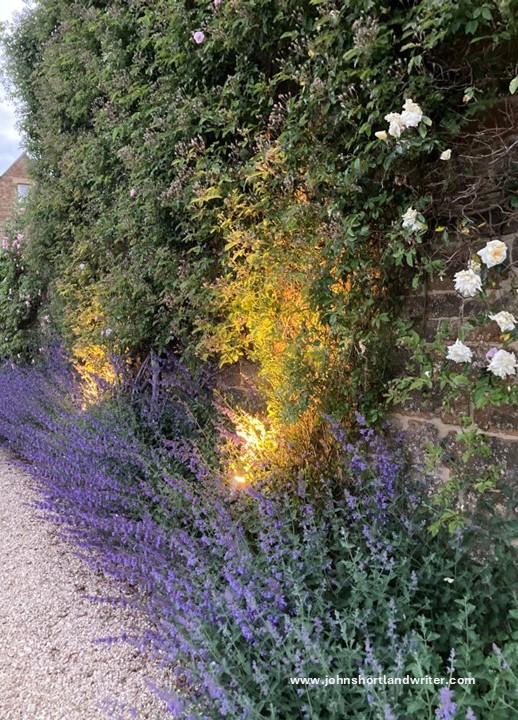
For the planting of the borders, the one against the wall only has catmint (nepeta).  This is a useful plant for it smothers weeds and is equally smothered in blue flowers which compliment its silver-grey leaves.  It is here that two of the Physocarpus are also planted to give a contrast in both height and leaf colour.  As soon as the first of the catmint flowers begin to fade it is important to then cut off every stem to ground level.  This may seem ruthless, especially as there will still be quite a lot of flower on it but within two weeks it will regrow and soon be flowering again.  If left, the first flowering stems die back and the plant looks messy.
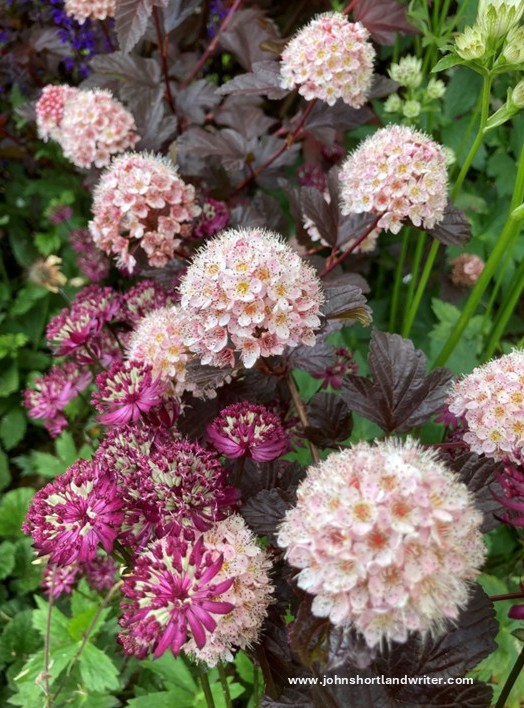
The ball-headed flowers and dark leaves of Physocarpus compliment the contrasting Astrantia ‘Claret’
Catmint (Nepeta) flowering elsewhere in the garden

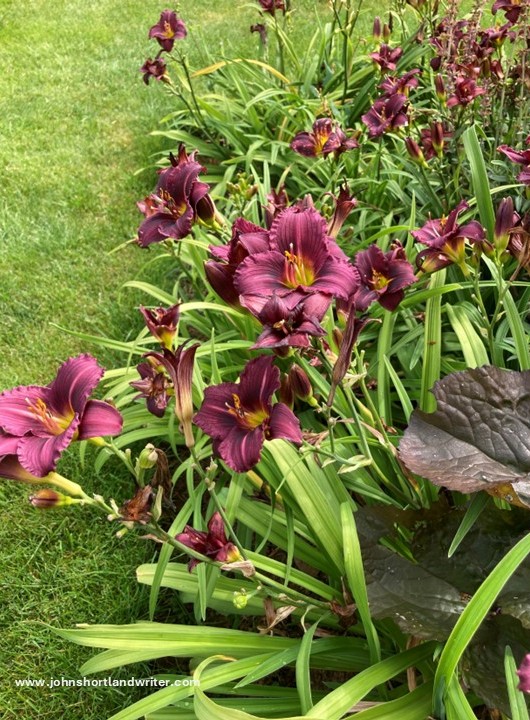
The twin borders are set back from the pool, and again Physocarpus are used as the centrepiece for height.  The burgundy theme is continued with the deep wine-coloured leaves of Ligularia, the papery flowers of Astrantia and trumpet-shaped Day Lilies (Hemerocallis).  The latter are an especially useful plant for they send out their bright green and sword-like leaves early in the spring and they never look untidy.
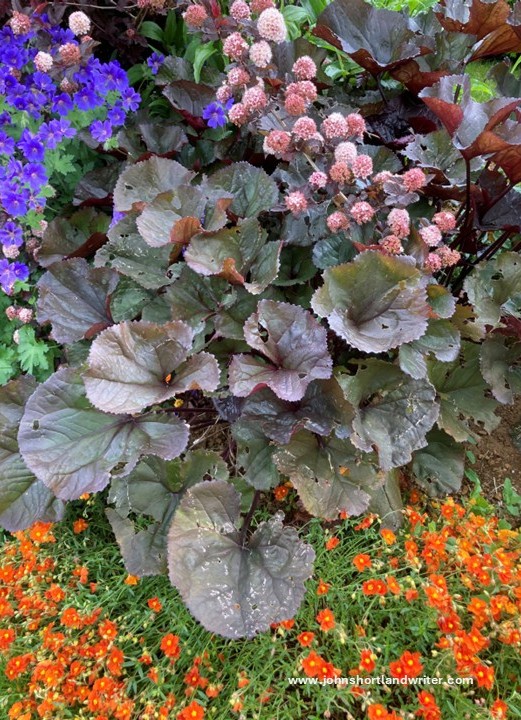
The dark leaves of Ligularia contrast with the tiny orange flowers of Helianthemum. Later the Ligularia will send up spikes of golden flowers
Day Lilies flower all si=ummer if regularly dead-headed. This one is Hemerocallis ‘Little Grapette’

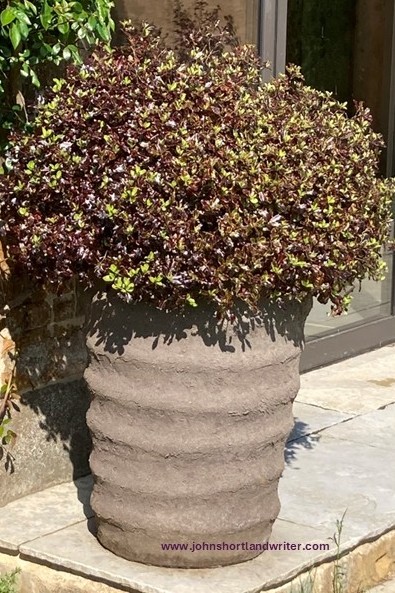
For contrast, and to maintain the hot theme,  I have mostly used oranges and golden yellows, the plants chosen to give continuity of display from June to the first frosts.  These are interplanted with purple salvias and shocking pink echinacea to break the colour – not too many: just enough to emphasise how much orange/yellow there is, if that makes sense.  This part of the garden isn’t used much for the rest of the year but the displays could begin in early spring with golden daffodils, especially the exotic looking orchid varieties, followed by masses of deep-coloured tulips and wallflowers.  For the winter, the scarlet and orange stems of dogwoods would brighten the dullest of days.  My client didn’t want too many pots or planters but I did manage to squeeze in two planted with the wonderful dwarf Pittosporum ‘Tom Thumb’.  Summer pots filled with zinnias and tall spikes of fiery red or orange cannas would really compliment a garden like this, but it’s not to be.

Although the same tone, the shape of the orange daisy-like flowers of the Ligularia contrast well with the trumpet-shaped Hemerocallis ‘Burning Daylight’ in the background
Pittisporum ‘Tom Thumb’: the new pale green leaves turn to burgundy as they age

I hope that this post may have inspired you to be bold with your choice of colour.  I’ve illustrated it with one garden devoted to this style of planting but it can be greatly scaled down to just a single bed or corner – the twin beds above only measure about 5m x 2m each.  Below is a list of the plants that I have used which is by no means, exhaustive for there are endless possibilities to choose from.

Two year on and the the twin borders glow under the dramatic evening light

Plant List
Astrantia ‘Claret’
Echinacea purpurea
Geranium x magnificum
Geum ‘Princes Juliana’
Helianthemum ‘Hennfield Brilliant’
Hemerocallis ‘Burning Daylight’
Hemerocallis ‘Little Grapette’
Ligularia ‘Desdemona’
Nepeta ‘Walker’s Low’
Physocarpus ‘Lady in Red’
Potentilla fruticosa ‘Tangerine’
Rudbeckia ‘Prairie Glow’
Salvia ‘Mainacht’

A note about the Cypress trees.
The cypress were already established and are now beginning to get too large for the space so may end up being removed. When reduced in size they tend to lose their elegant shape.  I am inclined to replace them with Irish Yew which is naturally columnar in shape and withstands pruning.  The golden-leaf cultivar would blend well with the walls as well as contrast with the dark green yew hedging.

If you’ve enjoyed this post and found it helpful and interesting don’t forget that there’s my book that reveals all sorts of gardening tips. Written in an informal, no-jargon way for the newcomer to gardening but also for those with more experience. If you’re not that enthusiastic about your own garden or have little time to devote to it then this is the book for you! Available from bookstores and/or Amazon.

With a foreword by Josceline Dimbleby

Happy Gardening!

2025: The Year in Review – part 2

2026 has come in with a bit of a blast quite literally for we are experiencing a blast of cold air and snow that has swept down from the Arctic.  Here, in our part of the Cotswolds, the snow and ice are more of a nuisance than anything else for there is very little snow cover and the roads have been quite treacherous.  The country folk of yesteryear always said that if the snow hangs around there’s more on the way – time will tell.  It’s been some years since we had deep snow blocking the lanes.

It’s been a few years since we had snow like this

In part 1 of the review (link here), I reflected on the first six months of the year.  It had been quite a successful year for me researching my family history.  I’m fortunate for I can trace them back very many centuries – at the moment I’m reading a book about them in the 1400s!  I also took the opportunity to finally visit the chapel (link here) where one is buried and nothing had prepared me for the splendour of it or how strangely moving the experience was.  I also met with Canadian cousins (this time, living ones!) for the first time and we all commented how strong family bonds can be.  That, and a prompt from you, one of my readers, made me reflect on those other great influencers in our lives, mentors.

The Beauchamp Chapel, named after one of my ancestors, Richard Beauchamp

In June I had written about my first pair of mentors, Dick and Lorna French who lived on a remote farm in Exmoor National Park.  Their story can be found here.  The following month, I wrote about Cyril and Pamela Heber Percy who I first met in my early thirties.  How different they were from Lorna and Dick but how equally valuable were the life lessons they taught me!  The Heber Percy’s had both been brought up by wealthy, landed parents.  Cyril, who was born in 1908, had come from a background that we now associate more with Royalty: it was a house with liveried footman and a strict regime.  Pamela’s family were very different for she was brought up in Ireland where the discipline was far more relaxed.  Both had a deep love for nature and a huge interest in people.  They, like most mentors, had the ability to make you feel very special.  It was with Cyril that I first learnt to fly fish, and it was he that gave me the ability to recognise where the fox had lain and the badger pushed through a hedgerow – more of them in this link here.

It was back to Exmoor for August (link here) to explore the three churches where according to local rhyme and legend no priest would ever go to.  Was it due to them being so remote or was it due to witchcraft?  Or bandits?  Or lepers? Whatever the reason, they are well worth visiting today for they sit in some of the most stunning countryside that you’ll find in England, and in August the hills are cloaked in a purple haze of heather flowers.  One of the three churches is world famous for it was at Oare that Lorna Doone was shot as she stood at the altar on her wedding day.  As with all my blog posts, there are lots of photos to demonstrate what a beautiful area I have been lucky enough to have spent so much time in since my teens.

Oare Church on Exmoor where Lorna Doone was shot on her wedding day

September found me writing about the chance contact by a Cheltenham art gallery asking me for help with a series of watercolours of London street scenes they had acquired.  It turned out that they had been painted by yet another ancestor of mine (they have since been sold and are now in the United States).  My own artistic talent is restricted (as one kind person described it) to painting with plants – I can visualise garden design and create it but I could never offer clients an artist’s impression!  In the blog I explored the various connections I have to people that are skilled artists ranging from present day to those in the past.  It was a fascinating task and not one I’d ever thought much about until I received the prompt from Cheltenham.  To see the London paintings as well as the others I found click on the link here.

One of the four paintings of London that are now in the USA

It was very much back to the Cotswolds for Halloween.  We live very close to the Rollright Stones, parts of which date back six thousand years – so older than Stonehenge.  It has long been a place of ritual and superstition and Rollright and its surrounding villages have an equally long association with witchcraft.  In 1875, a ritual murder was committed.  Poor, elderly Anne Tennent was harmless enough but accused of witchcraft with brutal consequences.  In my research for the blog, I came across a hand-written eye-witness report and had email correspondence with her 4xgreat-grandaughter.  What I hadn’t expected to find was that a similar murder was committed very many years later although the connection to witchcraft was not disclosed until the late 1960s, so well within my lifetime.  And then there are the tales of the mysterious black, headless dog being seen…  When I visited the stones in October offerings had been lain upon them.  Intrigued?  Click on the link here to find out more.

The mysterious Rollright Stones, over 5000 years old and a centre for witchcraft

It had been some time since I last wrote about gardening which is, of course, my hobby turned profession.  One of the constant questions I’m asked – and often a tricky one to answer – is how to screen an unwanted view.  November would be the perfect month for dealing with a problem like that so in Hide that Ugly Wall I looked at the various options.  In the blogpost (link here) we looked at trellis, climbing plants, and ideas for planting in front of the wall, fence or whatever else needed screening.   At the end of the post there is a list of plants of all types and sizes to help with selection.

Screening an ugly wall – in gardening, there is a solution to every problem!

So the year came to an end with reflection upon what had been and 2026 begins a new year of blogging.  As Life in the English Cotswolds enters its seventeenth year all that is left is for me to thank you all for helping to make it such a success.  When I began in 2009 it was to be a short-lived experiment in combining text with images.  I never anticipated that it would be read let alone develop into this!  Now, I hear from people all over the world and have even met a few of you.  It has received awards and featured in national newspapers, and it led to my being involved in setting up a literary festival. It was through this that I was approached to write my book on gardening, Why Can’t My Garden Look Like That?  Who would have thought it?!

Book signing – the publishing contract came as a direct result of blogging

With every good wish for a happy, healthy and peaceful 2026.  I’m very much looking forward to seeing what adventures arise and sharing them here.  If you have any thoughts on topics, ask questions or just fancy a natter I can be contacted through the Get in Touch tab at the top of the page.

Hide That Ugly Wall

We nearly all have one – or, at least, if we haven’t, we have an unwanted view that needs disguising.  Now is the perfect time to deal with it for, if you decide to plant some screening, the soil is moist and still retains some stored summer warmth.  Wait until spring – which you can do – and you run the risk of summer drought and the need for more careful and regular watering.  In the perfect conditions of late autumn/early winter the plant’s roots begin to establish even if you’re unaware of anything happening above ground.

However difficult the position, there is almost always a way to enhance an ugly wall

There are several questions to ask before rushing to the garden centre.  The first is to decide which way the wall faces for the amount of sunlight hitting it will influence the choice of plant – more about that later.  Other factors to consider are will the plants need to be tied into place with strings and wire, and will they need regular maintenance to keep them looking nice and within bounds?  If you’re already beginning to think this sounds like too much hard work or is too complicated, don’t despair – there’s a list of planting options below.  Still baulking at the thought?  An alternative question is, would some sort of decorative screen do the job instead?

A decorative screen masks this unwanted view

One more option to consider is planting in front of the wall, rather than against it.  If there’s room a low maintenance shrub border might be possible.  If space is really tight, then one or two well-chosen plants may work just as well.  For example, trees trained to grow flat against a wall are readily available and can make a statement without hiding the wall completely. Some shrubs will also do this; they are a much cheaper option and usually grow quite rapidly.  In the photo below forsythia, an unusual choice, has been grown against an ugly garage constructed from concrete blocks.  Although it loses its leaves in the winter its dense network of twigs continues to disguise the wall.  For a few weeks in the spring, it looks both exotic and stunning.

Flowering forsythia suddenly looks exotic grown against this ugly garage wall
The Judas Tree (Cercis) flowers on bare wood, its leaves will appear shortly. It has been fan-trained to remain flat against the wall
If space allows, a low maintenance shrub border can work well

For most people, the decision made is to grow a plant that will climb as well as cover the wall.  The plants available can be broken down into two groups – the true climbers (that will need wires on the wall for support), or the ‘clingers’.  These attach themselves to the wall by little sucker-like pads or by hair-like roots.  With the latter it is essential that the wall is in good condition although it is rare for serious damage to happen.  Both types can be sub-divided into deciduous (lose their leaves in winter) or evergreen.  I have found that the majority of clingers benefit from having some wall ties when first establishing to keep them in close contact to the wall.  Once they start climbing they’ll cling without help.

The climbing hydrangea clings to the wall by tiny hair-like roots
Honeysuckle is an example of a climber that needs wires to support it

One option often recommended, is to fix trellis to a wall and it does sound like a quick fix.  My experience is that the plants weave through it – which is, of course, the idea – but that makes for difficult pruning when it is required for it can be tricky to work out which stems need removing and even trickier to disentangle them.  Worse still, trellis has a tendency to rot or break after some years, usually just when the climber has reached its prime.  Replacing it involves cutting the plant back very hard or replacing it along with the trellis.  However, decorative trellis may be an alternative form of wall disguise to consider with, perhaps, just a large pot of plants standing in front of it.

Trellis helps mask this unwanted view. By creating a focal point of the attractive tree, the trellis becomes a feature in its own right and so no plants are being grown on it

Wires are normally very straight forward to fit providing it is done before planting.  I prefer to use a screw-in ‘eye’ rather than the hammer-in ‘vine eyes’ that are the traditional method of fixing.  All that is needed is a drill and a rawlplug and some very basic handyman skills.  The wires should be fitted horizontally and there is no need to create a network of wires heading off in all directions.  The golden rule is to stretch the wire taut and make the plant grow to the wire, don’t add random wires that follow the growth.  Stems should always be tied to the wire rather than pushed behind it and use ties that will stretch or perish in time otherwise they will become strangled as they grow.  It is all much easier in practice – writing down every step makes it sound more difficult than it really is!

A well-trained rose growing on supporting wires. I have enhanced these for clarity they want to be stretched horizontally and spaced about 18″ (45cms) apart
This poor plant has been strangled by its tie; all the upper growth has died

When it comes to planting, whatever the type of plant it is, make a generous planting hole and mix a good quality compost in with the soil.  Often the ground by a wall is dry and full of builder’s rubble or compacted so having a good planting medium around the new plant will set it off on a good start.  At planting, keep the base of the plant at least a foot (30cms) away from the wall if there’s room.  That way it will receive more water when it rains.  One major cause of failure is planting too deep – make sure that the soil is at the same level as the top of the compost that the plant is growing in.  Standing the plant pot in water for a few hours before planting is a good idea too so that the plant is well-watered before it is disturbed – and, if you’re a real beginner to gardening, don’t forget to remove the plant from its pot keeping its soil intact around it.

Solanum crispum (blue) & Clematis montana (white) hiding a garden shed

A list of plant suggestions:
E=evergreen, CL=clinger, N=will cope with north facing wall, Sh=shrub, T=tree

Large walls:
Carpinus (Hornbeam) – N, T, buy pleached or ready shaped
Cercis- T, more tricky to find and you may have to train it yourself but lovely flowers in pink or white and good autumn leaf colour – see photo
Clematis montana – clip back the growth immediately after flowering to keep tidy and within bounds
Ficus (Fig) – N (but won’t fruit), if you like Figs to eat, Ficus is worth considering
Fremontodendron – E, Sh, colourful yellow saucer-like blooms
Garrya – N, Sh, dark green leaves with long green catkins in late winter
Hedera (Ivy) – Cl, E, N, easy to keep under control and provides late nectar sauce for bees and other insects.  Make sure that wall mortar is sound before planting
Hydrangea petiolaris – Cl, Sh, prune after flowering if necessary
Jasminum (Jasmine) – both evergreen and deciduous types are available with scented flowers.  The evergreen (sold as Trachelospermum) needs a warm wall for best results
Magnolia grandiflora – E,Sh, for a high, warm wall.  They need lots of space to thrive
Parthenocissus (Virginia Creeper) – Cl, magnificent autumn color
Prunus lusitanica (Portuguese Laurel) – E, Sh, T, can be grown as a shrub or purchased as a trained tree (see photo)
Solanum crispum – blue or white clusters of flowers.  Vigorous but easily pruned
Vines – prune in winter if necessary
Wisteria – prune twice yearly, midsummer and midwinter

Medium walls:
Actinidia kolomikta – Sh, pretty multi-cloloured leaves best when avoiding strong sunshine
Azara – E, Sh, for a warm wall
Berberis – E, N, Sh, very spiny branches are a good reason for not growing it!  Magnificent red or yellow berries in autumn, much loved by birds
Campsis (Trumpet Vine) – orange trumpet flowers and attractive leaves for a sunny wall
Ceonothus – E, Sh,  smothered in powder-blue flowers during summer
Chaenomoles – E, Sh, white or pink flowers in late winter/early spring
Clematis – plenty of varieties to choose from including evergreen ones – check labels for size as some can require a lot of space
Forsythia – Sh, prune after flowering which takes place in early spring – see photo
Jasminum nudiflorum (Winter Jasmine) – N, Sh, flowers throughout winter
Osmanthus – E, Sh, early-flowering, scented – clip immediately after flowering ends to keep flat against wall
Rhamnus ‘Argenteovariegata’ – E, Sh, variegated foliage, prune to keep flat against wall in spring

Low Walls:
Daphne – E, Sh, very scented flowers but very slow growing
Euonymus – E, N, Sh, Cl, can be grown a sa shrub or clipped flat against a wall, some are self-clinging
Fuschia – Sh, varying heights, the smaller-flowered varieties are more suited for growing against walls
Helianthemum – E,Sh, very low growing but smothered in flowers through summer, clip after flowers to keep tidy
Lavender – E, Sh,likes sunshine for best flowering
Nandina – E, N, Sh – trouble-free, needs no  pruning
Perovskia (Russian Sage) – Sh, silvery foliage and blue spires of flowers from mid-summer.  I’ve grown it successfully on a shady wall although not usually recommend for this.  Prune back by half in late autumn and then again in early spring to keep bushy
Potentilla – E, Sh, bushy long-flowering plants in varying colours

I recommend looking up these plants on Google to see more detail.  Also, there are many roses that can be considered including some that are fine for north walls.  Apples, pears and plums fruit well when grown against walls of any aspect, as do apricots and peaches if the wall is warm and sunny enough.

For similar information on how to make both your garden and gardening more pleasurable, why not take a look at my book Why Can’t My Garden Look Like That? It’s written for newbie gardeners as well as those with more experience and covers everything from design to planting and maintenance.  In it, I reveal some of the secrets that I used when Head Gardener to large, country estates with gardens open to the public, where the garden had to look great all the time.  All written in an informal, no-nonsense approach.  Makes a great gift and is available from bookshops and, of course, Amazon.