Take Ten Roses

Over the years, as part of my work as a garden creator, I’ve had the pleasure of planting several rose gardens, mostly on quite a modest scale.  However, that changed four years ago when I was asked to design a garden from what was a steeply sloping area close to the house.  I had just retired and so the client, whom I’d known for many years, agreed that I would only create the design and oversee the purchase of plants but everything else others would do.  In effect, it meant that I had all the fun tasks without having to commit to working endless hours as their own team of builders and gardeners would do all the hard labour.  Just as well, as the end design involved considerable earth moving and wall building…

The rose garden will be in the middle section
The rose garden laid out but still some way to go before planting…

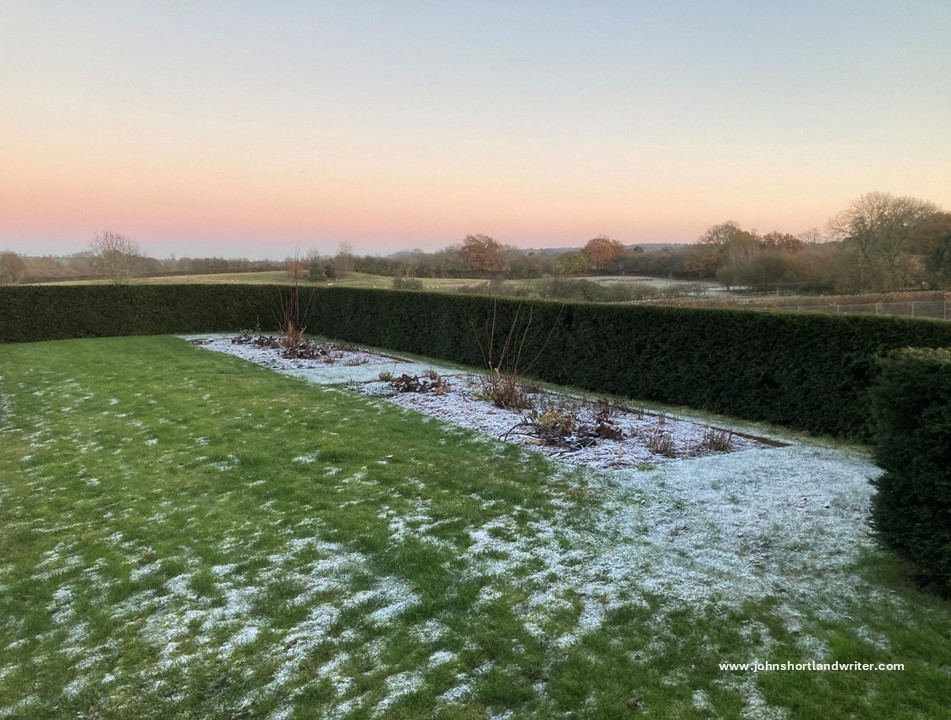
The change of levels meant that a sizeable terrace was needed and at 25m x 8m (82ft x 26ft) I proposed that this would be the perfect place for a formal rose garden.  Roses are beautiful when in flower but look dreary during the winter, especially when seen en masse.  Here they would be hidden from view but during the warm, summer months their heavy scent would rise to entice the garden visitor to literally follow their nose.  Reaching the steps that lead down to the parterre they are hit by a dazzling display of colour creating a (good) visual shock.  With the shelter and warmth provided by the terrace walls and some yew hedging, the roses have thrived.  The photo below was taken this week, just over three years since they were planted.

The rose garden three years after planting

Walking through the parterre I was pleased that I had decided to plant just four varieties, all with rich, vibrant blooms.  However, it also made me ponder on the countless roses that I have grown over the years and which were, to me at least, the best.  Could I restrict myself to just choosing ten?  Well, here goes and not in any special order. 

More images from the rose garden

Queen of Sweden   Surely this must be everybody’s idea of what the perfect rosebud should look like?  It’s a tall, upright rose not unlike the Queen Elizabeth rose although I think it has the edge on that one.  I have only ever grown it in one garden and perhaps unsurprisingly, the owners were Swedish.  I like to think that hasn’t influenced my choice!  It’s good as a cut flower and excellent as a buttonhole.

The Queen of Sweden rose

Rosa de Rescht   I first came across this heavily scented moss rose in the garden of an elderly artist where she grew it as a low hedge lining a pathway.  Over the years, I got to know her well and she told me it had been planted by her mother when she was a child, so it is obviously a long-lived and trouble-free variety.  It is upright, suckers freely but in a good way which means that it never looks straggly or sparce.  Best of all, the suckers flower true to type so can be used elsewhere.  I was given some several years before the artist died and they have flourished in my own garden.  They are disease free and I have discovered that they thrive equally well in semi-shade under trees.  You can read more about this rose here.

Rosa de Rescht, a moss rose

Rosa Ghislaine de Feligonde   This is quite a ‘new’ rose to me.  A climber, I planted it to scramble along the top of a garden wall in a client’s garden where instead it sulked for about three years at its foot.  I was about to remove it as a failure when it suddenly put on a spurt of growth to become the beauty that it is now.  Is it slow to establish or was it just slow in that particular spot?  I don’t know the answer but how glad I am that I didn’t condemn it to the bonfire.

Rosa Ghislaine de Feligonde

Rosa Weichenblau   The so-called ‘blue’ roses are not everybody’s cup-of-tea and I have mixed feelings about them.  Some I love, others, I’m not so keen.  That’s mostly down to colour as the blueness can vary in intensity.  I like this rambling rose enough to have it in my own garden where it flowers happily along an old wooden fence filling the garden with perfume for a relatively short period of time.  This one I tend to let travel where it wants as periodically quite large lengths of it suddenly die.  I’ve never worked out quite why and it doesn’t really matter too much – I just prune it out and fill the space with the new growth which it regularly sends out.

A love it or hate it rose: Weichenblau

The Crocus Rose   A pale, creamy beauty from David Austen.  I grew this shrub rose in a border combined with apricot-coloured roses; the spaces in-between filled with tall spikes of blue campanula and purple salvias.  All were contained behind a clipped box hedge and it created a lot of interest.  One of the advantages of being a working gardener (I always feel the term ‘professional gardener’ sounds rather dismissive to all those very talented and knowledgeable home gardeners) is that I get the opportunity to experiment with both plants and planting styles and in many different sorts of soils.  However, in this instance, I’ve never tried to recreate it despite its success.

The Crocus Rose

Rosa x odorata ‘Mutabilis’   I find this a fascinating shrub rose as it has all the colours of the sunset in one flower: the buds start a very deep pink, the flowers open to a rich pink and gradually fade to apricot.  The result is this multi-coloured rose which, with its single flowers being produced prolifically and over a very long period, the effect is mesmerising.  It is an open shrub rose with rather wiry, lax branches and so it can get a bit straggly over time.  I’ve found that it responds to quite hard pruning although it isn’t as fast to recover as the modern hybrid roses.  In my present garden it copes with quite windy conditions, and in one place it has sneaked its way in amongst a wall-grown climbing rose where it has reached a height of five feet.  I’ve never tried growing it solely in this way, it would be interesting to find out how it looked.  This plant has had several name changes over the years so you may find it offered for sale as Rosa chinensis ‘Mutabilis’ or just Mutabilis Rose.

Rosa x odorata ‘Mutabilis’

Gertrude Jekyll    Named after the Edwardian garden designer, this vigorous rose is usually sold as a climber where it can reach ten feet.  However, if pruned hard each winter and then pruned into shape, it can be grown as a modest sized shrub.  Either way you’ll be treated to these superb blooms.  I grow it as a climber but I do prune some stems quite hard to make sure that I have growth of all heights.  Left to itself all the flowers will be high above eye level on long stems which make fabulous cut flower arrangements in tall vases.

Gertrude Jekyll, usually grown as a climber

Blush Noisette    Probably best described as a short climber.  My experience is growing it in the corner of a high wall where I only tie in the occasional branch, the rest remaining free yet upright.  It is smothered in these small, almost double flowers and if regularly dead-headed will flower throughout the summer.  Completely trouble-free, it never seems to get attacked by disease or pests.

Blush Noisette

Rosa glauca    Don’t be fooled by the garden catalogues showing a pretty pink almost star-like flower for, as can be seen in the lower left corner of the image below, they are fairly insignificant.  This rose (sometimes sold as Rosa rubrifolia) is grown for the colour of its young leaves and stems, making it much more of a foliage plant.  A shrub rose, if left to its own devices the colour fades: to maintain its colour interest it needs to be quite hard pruned during the winter to encourage new growth.  In the photo below, I planted a trio of them in an herbaceous border with the poppy ‘Patty’s Plum’ in their centre.  This poppy always collapses just as it flowers and, as I hoped, here it has become caught on the rose thorns saving me the task of staking and tying them in.  I treat the roses as if they were herbaceous plants and so they are cut to within a few inches of the ground in early winter along with all the other plants in the border.

The poppy ‘Patty’s Plum’ growing through Rosa glauca

Dog Rose   It may surprise you to find included here our wild rose of the hedgerows, Rosa canina.  I’ve only ever grown it once and that is here in my own garden.  Appearing as an unasked-for bird-sown seedling at the foot of iron estate fencing, any attempt I made at cutting it out only increased its vigour.  I don’t like using weedkillers much and so I accepted defeat and decided to try and tame it instead.  We have reached a truce: I prune out only the longest stems it continually produces and it, in return gives me a splendid, if short-lived display of beautiful pink and white blooms that the bees and other insects love.  Left on, I then have another display of bright red rosehips through early winter after which, it has a severe haircut.  The result has become the talking-point of our garden.   As I have learnt over the years, sometimes the most unexpected plants or combination of plants give the greatest pleasure.


A bird-sown wild Dog Rose growing on a garden fence

Creating Warmth in the Garden

Here, in the UK, we’ve been having the dreariest of winters with what seems weeks and weeks of mild temperatures, heavy overcast skies and incessant rain.  There have been a few cold, bright days but these have been rare.  The view from my window as I write this is of greyness reflected in grey floodwater where our little, winding river has overflown into the field below our house.  Some days it has been so dark and gloomy that the electric lights have had to stay on.  So it seems appropriate to write now about bringing warmth into the garden especially as it is the perfect time to create a new design whether it’s a single bed or a complete redesign.

Floodwater below our house which fortunately sits high enough above it to be ok

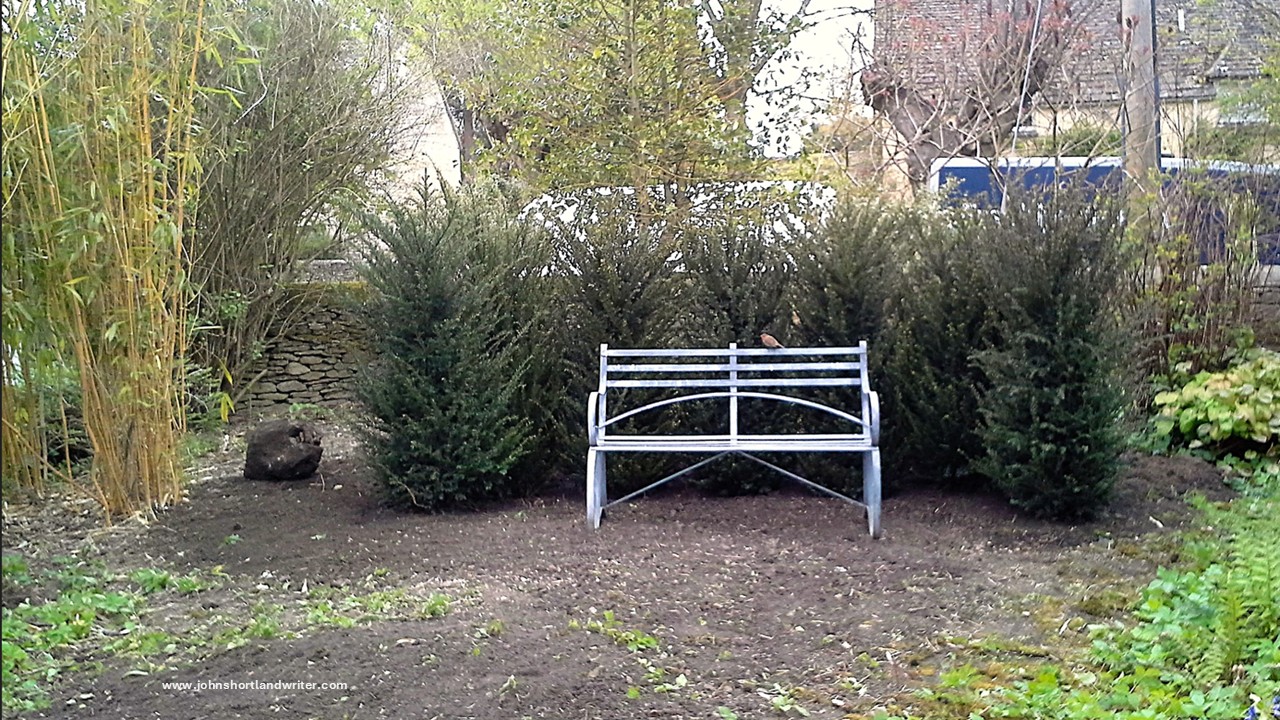
Obviously, sun is the most important and easiest way of creating warmth and the garden may already have a patio or other seating area in the sunniest spot.  This isn’t always the most sheltered place however, and there is a world of difference between a welcome, cooling breeze on a hot day and a stronger wind that makes sitting there less comfortable.  There are a number of ways to temper the wind without having to build a solid structure which quite often can create issues with turbulence elsewhere.  The simplest method is by planting, whether a hedge or more open, looser shrubs.  Trellis also works well – we’re aiming at filtering the wind rather than blocking it.  The height does not have to be great to have the desired effect.  The image below shows the early stages of screening using plants – it will also, in time, block out the unwanted view of the road behind.

Screening around a small seating area using yew hedging which will become dense within a year. Note the bamboo to the left of the photo with its warm, golden stems

For screening, I often use (as above) yew hedging which gives a good, dark green background and only needs clipping once a year.  It can be bought at various heights and being evergreen, looks good all year round.  Bamboos, now getting rather a bad reputation for being invasive are also excellent if they can be prevented from spreading too widely.  There are some clump forming varieties which are more self-restrained.  In fact, more or less any shrub can be used to make the garden or part of it feel warmer; the secret is to use those with coloured stems or leaves, or flowers that have a hint of the exotic about them.  Bear in mind, ‘though that flowers are often fleeting.

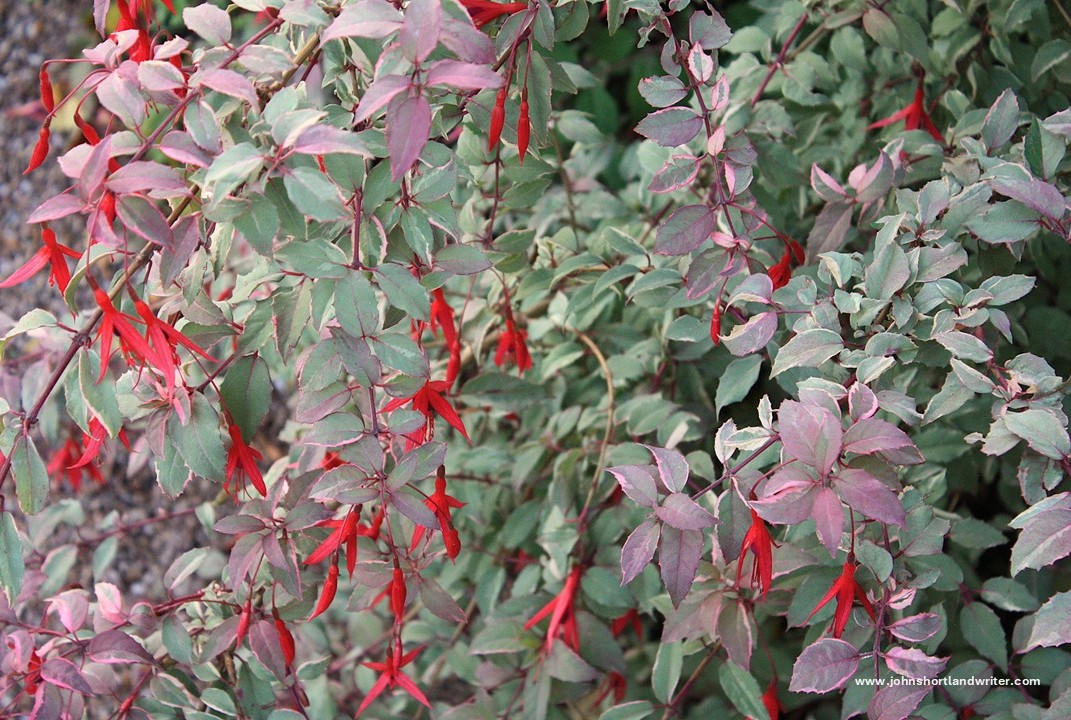
Fuchsia megallanica gracilis ‘Variegata’ : an example of a medium-sized shrub that is hardy, exotic-looking and beautiful
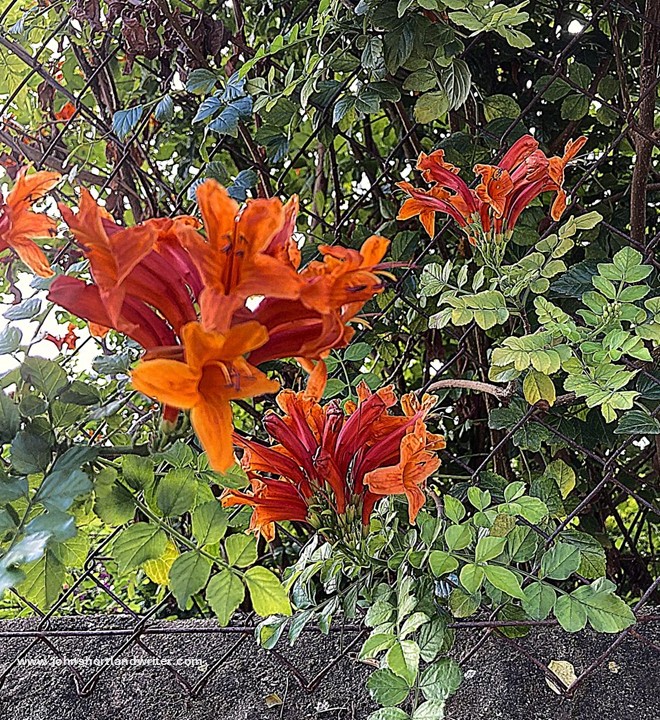
The fiery orange booms of the Trumpet Vine, here climbing through an old wire fence will bring a touch of the Mediterranean to any garden

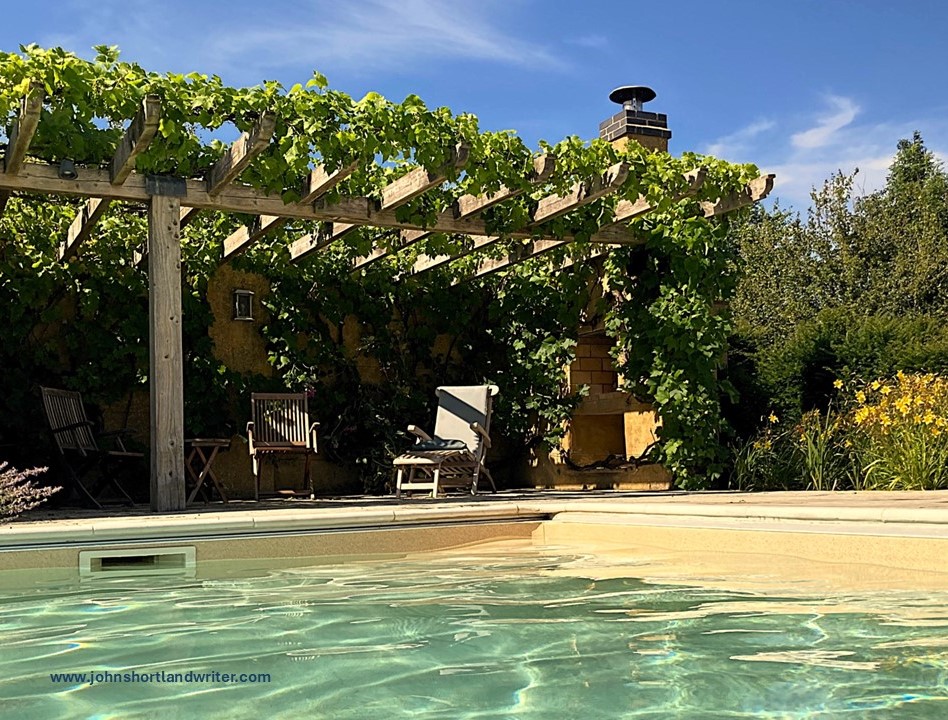
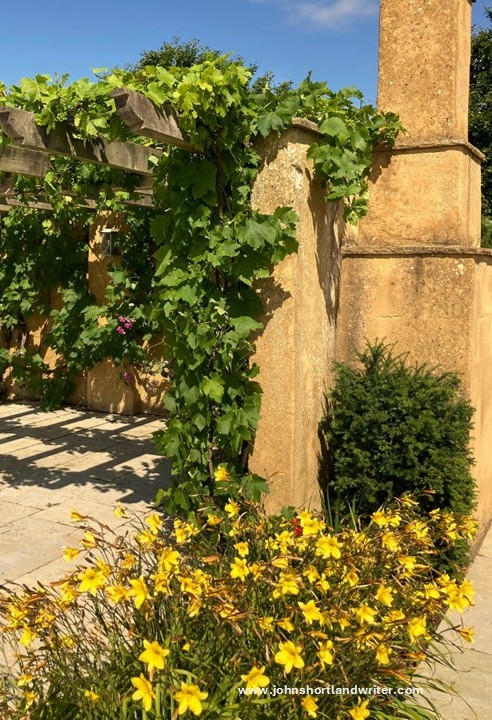
Although we’ve been talking about ways to make the garden feel physically warmer, it is through the planting of the smaller flowering plants that give the real impression of warmth and here the choice is almost limitless.  The rule is to use strong colours and to keep the softer shades to the minimum.  For the example I’m going to use here, I created this ‘hot’ garden which would be at its best during the summer months when the swimming pool is in regular use.  For cooler evenings or for entertaining there is a vine covered pergola adjacent to a built-in fireplace/barbecue.  Note the use of terracotta painted walls which immediately transports you to the Mediterranean.  In fact. Some don’t believe that the two photos below are really of a garden in one of the coldest parts of southern Britain!

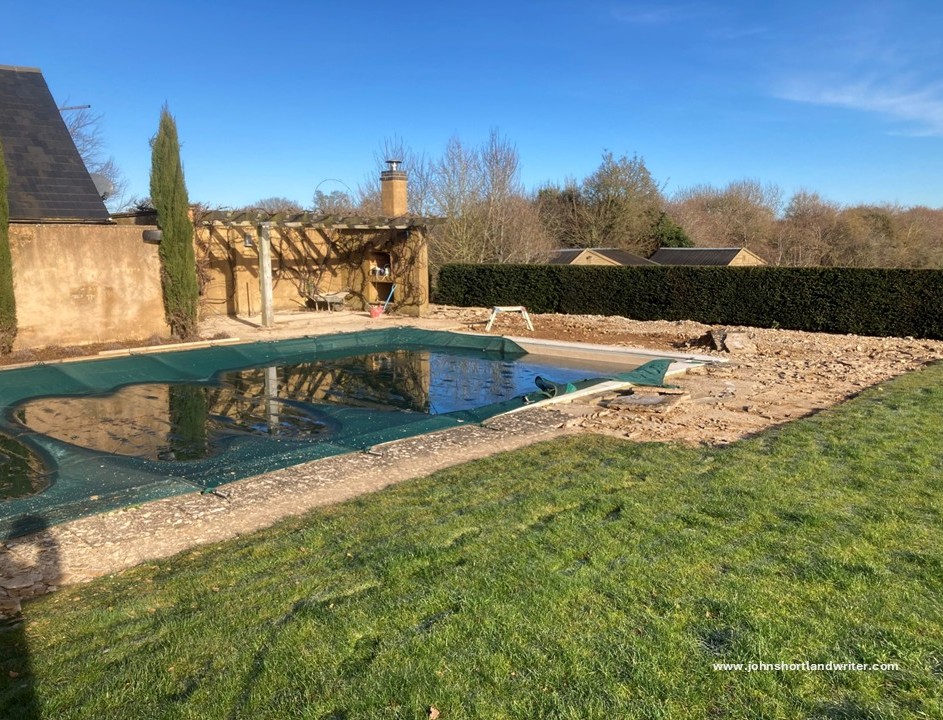
The warm tones of the pool, paving and walls transport you to a warmer climate than the realities of an English summer!
Golden day lilies blend beautifully with the walls of this outdoor fireplace and barbecue area. The grape vine hanging loosely over the beams give shade and the sense of being somewhere other than England

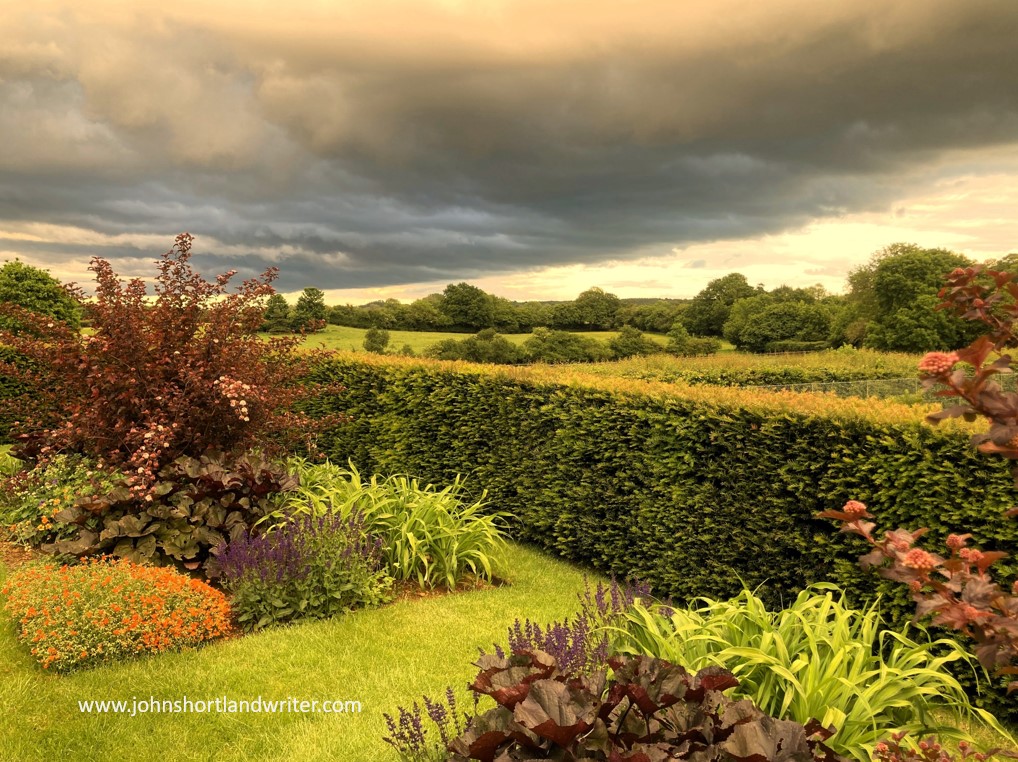
Nearly all of this swimming pool garden is enclosed by yew hedges for shelter and privacy; an existing wall has been coloured terracotta as mentioned above.  Shrubs have been kept to the minimum: there are four Physocarpus Lady in Red’ which has fiery new leaves which darken to burgundy as they mature.  Using the one variety helps to unify the design as well as giving some structure to the borders.  Two figs are trained against the wall and pencil-shaped Italian cypress trees also give that Mediterranean feel (see further note at the end of this blog). 

Transforming a cold garden into a hot one!
In January the garden was almost derelict, by midsummer it had been completed

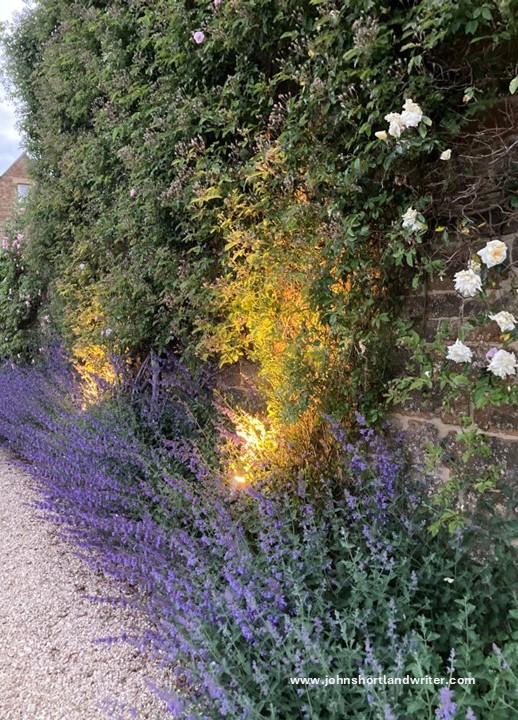
For the planting of the borders, the one against the wall only has catmint (nepeta).  This is a useful plant for it smothers weeds and is equally smothered in blue flowers which compliment its silver-grey leaves.  It is here that two of the Physocarpus are also planted to give a contrast in both height and leaf colour.  As soon as the first of the catmint flowers begin to fade it is important to then cut off every stem to ground level.  This may seem ruthless, especially as there will still be quite a lot of flower on it but within two weeks it will regrow and soon be flowering again.  If left, the first flowering stems die back and the plant looks messy.

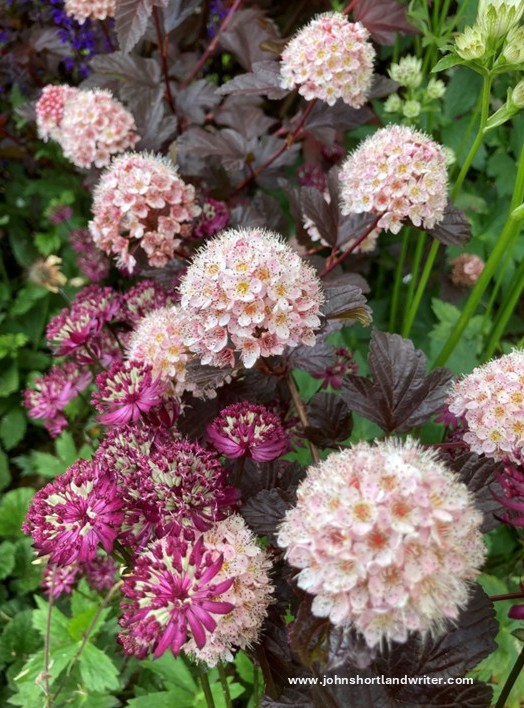
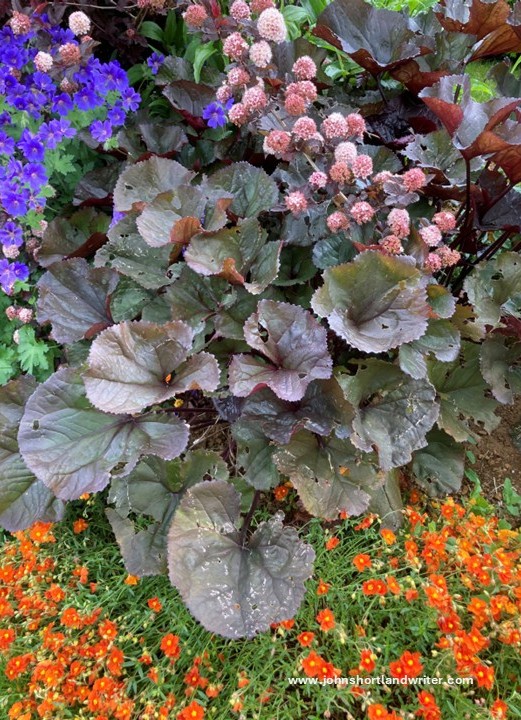
The ball-headed flowers and dark leaves of Physocarpus compliment the contrasting Astrantia ‘Claret’
Catmint (Nepeta) flowering elsewhere in the garden

The twin borders are set back from the pool, and again Physocarpus are used as the centrepiece for height.  The burgundy theme is continued with the deep wine-coloured leaves of Ligularia, the papery flowers of Astrantia and trumpet-shaped Day Lilies (Hemerocallis).  The latter are an especially useful plant for they send out their bright green and sword-like leaves early in the spring and they never look untidy.

The dark leaves of Ligularia contrast with the tiny orange flowers of Helianthemum. Later the Ligularia will send up spikes of golden flowers
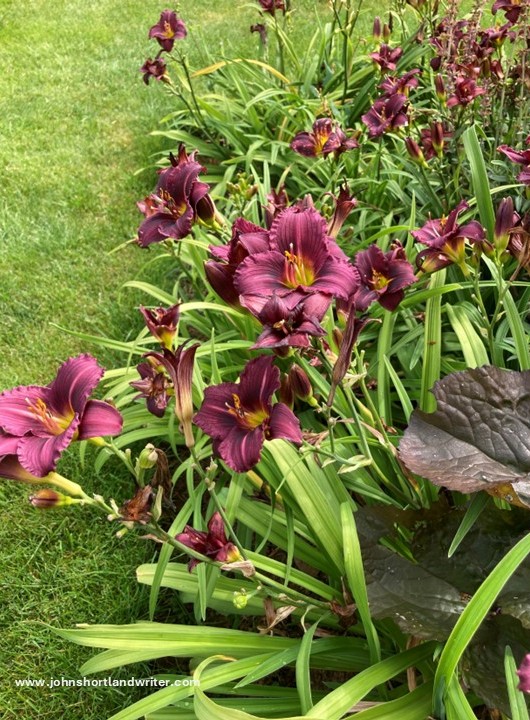
Day Lilies flower all si=ummer if regularly dead-headed. This one is Hemerocallis ‘Little Grapette’

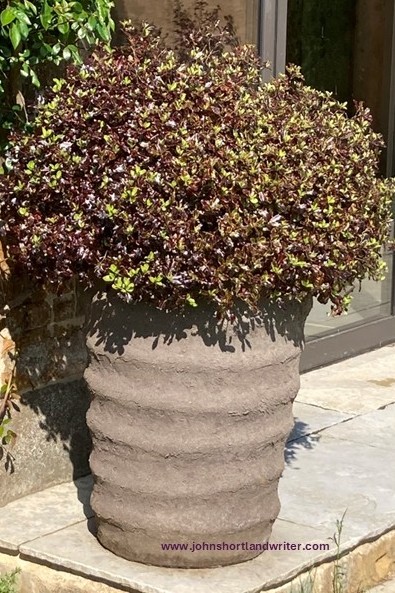
For contrast, and to maintain the hot theme,  I have mostly used oranges and golden yellows, the plants chosen to give continuity of display from June to the first frosts.  These are interplanted with purple salvias and shocking pink echinacea to break the colour – not too many: just enough to emphasise how much orange/yellow there is, if that makes sense.  This part of the garden isn’t used much for the rest of the year but the displays could begin in early spring with golden daffodils, especially the exotic looking orchid varieties, followed by masses of deep-coloured tulips and wallflowers.  For the winter, the scarlet and orange stems of dogwoods would brighten the dullest of days.  My client didn’t want too many pots or planters but I did manage to squeeze in two planted with the wonderful dwarf Pittosporum ‘Tom Thumb’.  Summer pots filled with zinnias and tall spikes of fiery red or orange cannas would really compliment a garden like this, but it’s not to be.

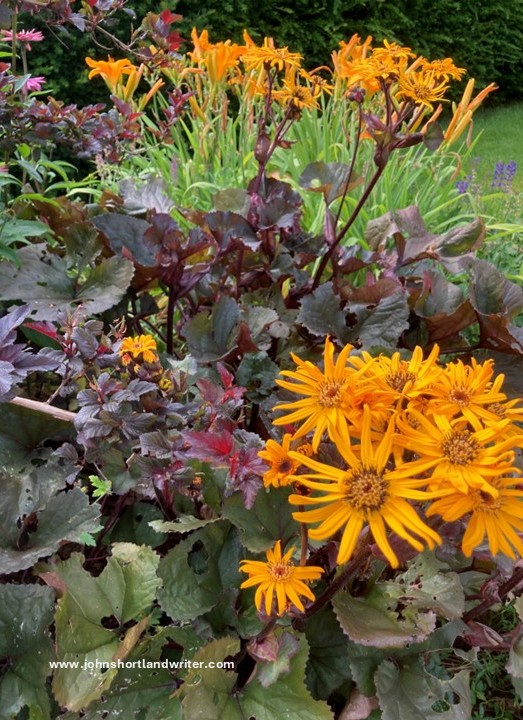
Although the same tone, the shape of the orange daisy-like flowers of the Ligularia contrast well with the trumpet-shaped Hemerocallis ‘Burning Daylight’ in the background
Pittisporum ‘Tom Thumb’: the new pale green leaves turn to burgundy as they age

I hope that this post may have inspired you to be bold with your choice of colour.  I’ve illustrated it with one garden devoted to this style of planting but it can be greatly scaled down to just a single bed or corner – the twin beds above only measure about 5m x 2m each.  Below is a list of the plants that I have used which is by no means, exhaustive for there are endless possibilities to choose from.

Two year on and the the twin borders glow under the dramatic evening light

Plant List
Astrantia ‘Claret’
Echinacea purpurea
Geranium x magnificum
Geum ‘Princes Juliana’
Helianthemum ‘Hennfield Brilliant’
Hemerocallis ‘Burning Daylight’
Hemerocallis ‘Little Grapette’
Ligularia ‘Desdemona’
Nepeta ‘Walker’s Low’
Physocarpus ‘Lady in Red’
Potentilla fruticosa ‘Tangerine’
Rudbeckia ‘Prairie Glow’
Salvia ‘Mainacht’

A note about the Cypress trees.
The cypress were already established and are now beginning to get too large for the space so may end up being removed. When reduced in size they tend to lose their elegant shape.  I am inclined to replace them with Irish Yew which is naturally columnar in shape and withstands pruning.  The golden-leaf cultivar would blend well with the walls as well as contrast with the dark green yew hedging.

If you’ve enjoyed this post and found it helpful and interesting don’t forget that there’s my book that reveals all sorts of gardening tips. Written in an informal, no-jargon way for the newcomer to gardening but also for those with more experience. If you’re not that enthusiastic about your own garden or have little time to devote to it then this is the book for you! Available from bookstores and/or Amazon.

With a foreword by Josceline Dimbleby

Happy Gardening!