Take Ten Roses

Over the years, as part of my work as a garden creator, I’ve had the pleasure of planting several rose gardens, mostly on quite a modest scale.  However, that changed four years ago when I was asked to design a garden from what was a steeply sloping area close to the house.  I had just retired and so the client, whom I’d known for many years, agreed that I would only create the design and oversee the purchase of plants but everything else others would do.  In effect, it meant that I had all the fun tasks without having to commit to working endless hours as their own team of builders and gardeners would do all the hard labour.  Just as well, as the end design involved considerable earth moving and wall building…

The rose garden will be in the middle section
The rose garden laid out but still some way to go before planting…

The change of levels meant that a sizeable terrace was needed and at 25m x 8m (82ft x 26ft) I proposed that this would be the perfect place for a formal rose garden.  Roses are beautiful when in flower but look dreary during the winter, especially when seen en masse.  Here they would be hidden from view but during the warm, summer months their heavy scent would rise to entice the garden visitor to literally follow their nose.  Reaching the steps that lead down to the parterre they are hit by a dazzling display of colour creating a (good) visual shock.  With the shelter and warmth provided by the terrace walls and some yew hedging, the roses have thrived.  The photo below was taken this week, just over three years since they were planted.

The rose garden three years after planting

Walking through the parterre I was pleased that I had decided to plant just four varieties, all with rich, vibrant blooms.  However, it also made me ponder on the countless roses that I have grown over the years and which were, to me at least, the best.  Could I restrict myself to just choosing ten?  Well, here goes and not in any special order. 

More images from the rose garden

Queen of Sweden   Surely this must be everybody’s idea of what the perfect rosebud should look like?  It’s a tall, upright rose not unlike the Queen Elizabeth rose although I think it has the edge on that one.  I have only ever grown it in one garden and perhaps unsurprisingly, the owners were Swedish.  I like to think that hasn’t influenced my choice!  It’s good as a cut flower and excellent as a buttonhole.

The Queen of Sweden rose

Rosa de Rescht   I first came across this heavily scented moss rose in the garden of an elderly artist where she grew it as a low hedge lining a pathway.  Over the years, I got to know her well and she told me it had been planted by her mother when she was a child, so it is obviously a long-lived and trouble-free variety.  It is upright, suckers freely but in a good way which means that it never looks straggly or sparce.  Best of all, the suckers flower true to type so can be used elsewhere.  I was given some several years before the artist died and they have flourished in my own garden.  They are disease free and I have discovered that they thrive equally well in semi-shade under trees.  You can read more about this rose here.

Rosa de Rescht, a moss rose

Rosa Ghislaine de Feligonde   This is quite a ‘new’ rose to me.  A climber, I planted it to scramble along the top of a garden wall in a client’s garden where instead it sulked for about three years at its foot.  I was about to remove it as a failure when it suddenly put on a spurt of growth to become the beauty that it is now.  Is it slow to establish or was it just slow in that particular spot?  I don’t know the answer but how glad I am that I didn’t condemn it to the bonfire.

Rosa Ghislaine de Feligonde

Rosa Weichenblau   The so-called ‘blue’ roses are not everybody’s cup-of-tea and I have mixed feelings about them.  Some I love, others, I’m not so keen.  That’s mostly down to colour as the blueness can vary in intensity.  I like this rambling rose enough to have it in my own garden where it flowers happily along an old wooden fence filling the garden with perfume for a relatively short period of time.  This one I tend to let travel where it wants as periodically quite large lengths of it suddenly die.  I’ve never worked out quite why and it doesn’t really matter too much – I just prune it out and fill the space with the new growth which it regularly sends out.

A love it or hate it rose: Weichenblau

The Crocus Rose   A pale, creamy beauty from David Austen.  I grew this shrub rose in a border combined with apricot-coloured roses; the spaces in-between filled with tall spikes of blue campanula and purple salvias.  All were contained behind a clipped box hedge and it created a lot of interest.  One of the advantages of being a working gardener (I always feel the term ‘professional gardener’ sounds rather dismissive to all those very talented and knowledgeable home gardeners) is that I get the opportunity to experiment with both plants and planting styles and in many different sorts of soils.  However, in this instance, I’ve never tried to recreate it despite its success.

The Crocus Rose

Rosa x odorata ‘Mutabilis’   I find this a fascinating shrub rose as it has all the colours of the sunset in one flower: the buds start a very deep pink, the flowers open to a rich pink and gradually fade to apricot.  The result is this multi-coloured rose which, with its single flowers being produced prolifically and over a very long period, the effect is mesmerising.  It is an open shrub rose with rather wiry, lax branches and so it can get a bit straggly over time.  I’ve found that it responds to quite hard pruning although it isn’t as fast to recover as the modern hybrid roses.  In my present garden it copes with quite windy conditions, and in one place it has sneaked its way in amongst a wall-grown climbing rose where it has reached a height of five feet.  I’ve never tried growing it solely in this way, it would be interesting to find out how it looked.  This plant has had several name changes over the years so you may find it offered for sale as Rosa chinensis ‘Mutabilis’ or just Mutabilis Rose.

Rosa x odorata ‘Mutabilis’

Gertrude Jekyll    Named after the Edwardian garden designer, this vigorous rose is usually sold as a climber where it can reach ten feet.  However, if pruned hard each winter and then pruned into shape, it can be grown as a modest sized shrub.  Either way you’ll be treated to these superb blooms.  I grow it as a climber but I do prune some stems quite hard to make sure that I have growth of all heights.  Left to itself all the flowers will be high above eye level on long stems which make fabulous cut flower arrangements in tall vases.

Gertrude Jekyll, usually grown as a climber

Blush Noisette    Probably best described as a short climber.  My experience is growing it in the corner of a high wall where I only tie in the occasional branch, the rest remaining free yet upright.  It is smothered in these small, almost double flowers and if regularly dead-headed will flower throughout the summer.  Completely trouble-free, it never seems to get attacked by disease or pests.

Blush Noisette

Rosa glauca    Don’t be fooled by the garden catalogues showing a pretty pink almost star-like flower for, as can be seen in the lower left corner of the image below, they are fairly insignificant.  This rose (sometimes sold as Rosa rubrifolia) is grown for the colour of its young leaves and stems, making it much more of a foliage plant.  A shrub rose, if left to its own devices the colour fades: to maintain its colour interest it needs to be quite hard pruned during the winter to encourage new growth.  In the photo below, I planted a trio of them in an herbaceous border with the poppy ‘Patty’s Plum’ in their centre.  This poppy always collapses just as it flowers and, as I hoped, here it has become caught on the rose thorns saving me the task of staking and tying them in.  I treat the roses as if they were herbaceous plants and so they are cut to within a few inches of the ground in early winter along with all the other plants in the border.

The poppy ‘Patty’s Plum’ growing through Rosa glauca

Dog Rose   It may surprise you to find included here our wild rose of the hedgerows, Rosa canina.  I’ve only ever grown it once and that is here in my own garden.  Appearing as an unasked-for bird-sown seedling at the foot of iron estate fencing, any attempt I made at cutting it out only increased its vigour.  I don’t like using weedkillers much and so I accepted defeat and decided to try and tame it instead.  We have reached a truce: I prune out only the longest stems it continually produces and it, in return gives me a splendid, if short-lived display of beautiful pink and white blooms that the bees and other insects love.  Left on, I then have another display of bright red rosehips through early winter after which, it has a severe haircut.  The result has become the talking-point of our garden.   As I have learnt over the years, sometimes the most unexpected plants or combination of plants give the greatest pleasure.

A bird-sown wild Dog Rose growing on a garden fence

Voyage of Discovery – part 2

The Ex-Empress Eugenie (Bonaparte) was so concerned about the men keeping their heads warm that she had made for the sailors of the British Arctic Expedition of 1875 “special woollen wigs” to wear.  Nellie, the ship’s Labrador Retriever, would have preferred the same concern for her welfare.  It was only when Captain Nares, the leader of the Expedition, enquired further that he realised that the “Esquimaux” [sic] chief wanted her as a gift.  Nellie’s black coat had grown thick and luxurious in the freezing temperatures –a jacket made from it would be the most perfect present for his wife.  He assured the captain that the meat wouldn’t go to waste either.  The image below, shows Nellie rescued and safely returned to England the following year. 

Her Majesty’s Ships, HMS Alert and Discovery had left England to rapturous applause.  The Expedition to reach the North Pole had captured the imagination, not just of Queen Victoria and the British people but was causing a sensation world-wide.  The newspapers had explored every detail of the ships from their build to the foodstuffs they would be carrying, their planned route, the sailors, and the most exciting prospect of all: finding a sub-tropical paradise hidden beyond the ice packs.  (To read the story about the ships departure and the build-up leading to it can be read by clicking this link here). The journey would, of course, discover little else other than ice.  Sailing away from port in May 1875 to the sound of cheering and gun salutes the men were in high spirits.  These must have given way to deep trepidation when the two ships parted company from one another to sit out the Arctic winter separately amongst the ice floes.

Sitting out the Arctic winter

The ships had followed the coastline of Greenland northwards before crossing the sea in fine weather to Cape Isabella.  Here the weather changed and they picked their way through floating ice in thick fog.  Reaching Lady Franklin Bay, in the northernmost tip of Arctic Canada on 27th August, the Discovery set anchor for the winter, the Alert continuing its journey for another five days before being unable to progress further.  When the sun finally disappeared below the horizon on October 12th they would be in total darkness for 142 days.  For the sailors, hearing only the sounds of wind and creaking ice, the sense of isolation must have felt all-encompassing.  To make matters worse, the sledging crew that had been dispatched to reach the Discovery to give word of the Alert’s position had returned defeated by the weather.  They had been out on the ice for twenty days, the last two of which they had travelled in total darkness.  Riven with scurvy and affected by frostbite, several of the men needed amputations.  To make matters worse, they reported they had seen no land whatsoever.

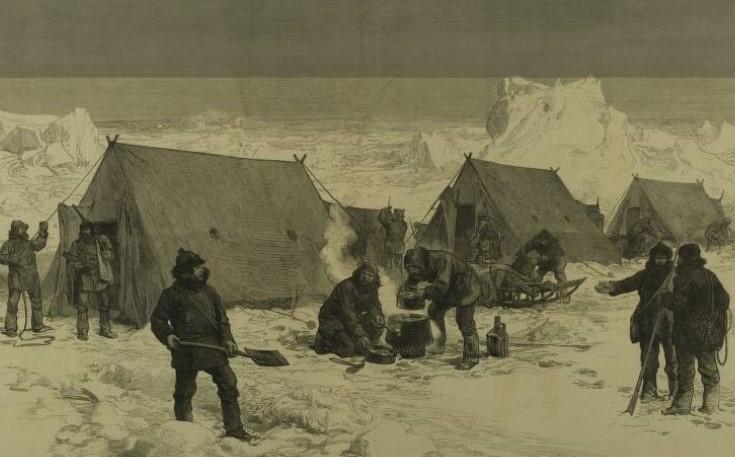
Camping overnight on the ice

It would be interesting to know the feelings of sailor John Langston Saggers during this time and whether he was selected to be one of the sledging party.  Saggers – who is my ancestral first cousin – was aged 18 when he joined the Royal Navy and his conduct had been exemplary.  Five years later he would be aboard the Discovery sailing for the Arctic, perhaps chosen for both his military record and because he had served on Victoria’s royal yacht, HMY Osborne, the ship he would return to in later years.  One can only imagine the tales he must have told in his later years of his Arctic adventure.

Extract from the naval Register for John Langston Saggers [Source: Ancestry UK]

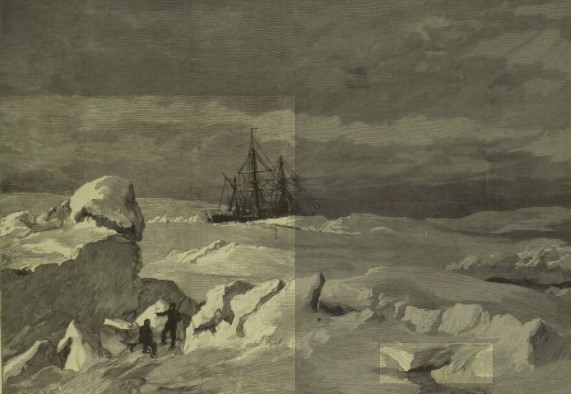
Great care had been taken prior to departure over the welfare of the men.  Apart from warm clothing and adequate food provisions, the sailors were given facilities and equipment to keep them amused during the long winter months.  The ships both had theatres for the men to stage plays and they also had equipment to enable them to venture outdoors.  The men of the Discovery built a theatre on the ice with a 60ft x 27ft stage which they named after Alexandra, the Princess of Wales. They opened it on her birthday, 1st December with a farce, ‘My Turn Next.’  They also created a skating rink by pouring melted water over the ice which refroze to form a smooth surface.  The image below shows the skating rink with HMS Discovery locked in the ice in the background.

The sun reappeared on February 29th and plans were immediately put in place for further sledging expeditions.  With over one hundred degrees of frost recorded, one officer was badly affected by the cold.  He was returned to the Alert, his comrades taking turns to lie alongside him in an attempt to maintain his body temperature.  Although he survived the journey, he died soon after his two badly frostbitten feet had been amputated.  A week later, a small party of men led by Lieutenant Rawson reached the Discovery to tell them all was well.  The newspapers on hearing of it, reported with special pride that as the men’s frostbitten noses, cheeks and fingers were being treated Rawson jovially said, “at least the cheers from Southsea beach [on their departure from England] have now been fairly earned.”

Inevitably, there were a number of deaths amongst the sledging parties

In April the sledging parties started in earnest with small groups of men travelling in every direction.  On board the ships only the chaplains, medical officers and the sick remained alongside half a dozen essential crew members.  Exploring further north than any previous expedition, yet separated from one another, the groups remained unaware of the suffering and deaths of one another.  Although unsuccessful in reaching the North Pole they brought home with them detail of the birds and animals that they found along their way.  Of greater importance for future expeditions, they confirmed for the first time that there was “no open sea” or “an ocean teeming with life” or any “Elysian Fields”, only “an icy desert where all life ends.”  Finally, at the end of July 1876, the Alert broke free of the ice to rejoin the Discovery and together they began their battle through the slowly thawing sea on the start of their long journey home.

The sledging parties prepare to leave

The return of HMS Alert and HMS Discovery to England on Thursday 9th November 1876 was greeted with as much excitement as their departure.  Sailing into Portsmouth they were greeted by the Commander-in-Chief of the Fleet, the Lord Mayor, cheering crowds and massed bands.  The crew were allowed on shore that evening; the papers reporting proudly that “their behaviour has been excellent.”  The following day, back aboard ship, the men received three weeks’ leave and a month’s advance of pay. Over the following weeks the public continued to arrive in the town to visit the ships and an exhibition of the trip. 

This image has an empty alt attribute; its file name is 1876-saggers-john-langston-s173-arctic-expedition-iln-5j-alert.jpg
HMS Alert icebound as well as homeward bound

For the sailors of the Expedition there was still more celebration to come.  In early December the Lord Mayor of London entertained the officers and crews to a banquet at the Mansion House.  The newspapers noted that “all kinds of wines, and pheasants and plover were served, just as if Her Majesty’s Ministers were present.”  The wives and children watched the proceedings from the galleries of the ‘sumptuous” surroundings of the Egyptian Room.  At the end of the evening, the men were presented with gifts of pipes and tobacco.  Queen Victoria also relayed her gratitude to the men, thanking them for their dedication to service, their heroism and commiserating for the loss of life.  She also commanded that “… a medal be granted to all persons of every rank and class who were serving on the Alert and Discovery during the Arctic Expedition of 1875-76…”  For the ordinary seaman and his family, it must have been a sight so beyond their usual experience and one that would never be forgotten.   Records show that Cousin John Langston Saggers received his medal, albeit with an error engraved into the spelling.  Whether it is now in a private collection or still held by a member of his family or has been lost is unknown.

This image has an empty alt attribute; its file name is 1876-saggers-john-langston-s173-arctic-expedition-iln-14.jpg
Mid-day, Thursday, 9th November 1876: HMS Alert & HMS Discovery enter Portsmouth Harbour

*

Of special interest to my American readers

Captain Nares of the Alert stopped at Polaris Bay, Canada to hoist the American ensign and fire a gun salute.  He also erected a brass tablet the expedition had brought with them which read, “Sacred to the memory of Captain F C Hall of the U.S. ship Polaris, who sacrificed his life in the advancement of science on Nov, 8th 1871.  This tablet has been erected by the British Arctic Expedition of 1875, who, following in his footsteps, have profited by his experience.”

*

Over the years there would be many more attempts to reach the North Pole.  It would not be until 12th  May 1926 that Roald Amundsen scientifically proved that he had succeeded.

*

Sources

Ancestry UK

Royal Navy Registers of Seamen’s Services 1848-1939

British Newspaper Archive: The Norwich Mercury, The South London Chronicle, Shetland Times, Fife Herald, The Illustrated London News, Luton Times & Advertiser, The Graphic

British Polar Exploration and Research: A Historical and Medallic Record with Biographies 1818-1999

Wikipedia

The Dog with the Poorly Paw

Deerhounds are the gentle giants of the canine world: despite their size and, to some people, fierce looks (never fathomed that one out!) they are docile, kind and trustworthy.
Sometimes known as Scottish Deerhounds, they are one of the oldest and least changed of breeds.  Scenes depicting hunting with dogs almost identical in appearance to them can be found on ancient pottery or manuscripts and because they have never become a ‘fashionable’ breed the excesses of inbreeding for the showring has not occurred.
  Deerhounds are not for the faint-hearted!
Similar in bone structure to the greyhound, this is most obvious when the dog is wet and its wiry, long coat clings to its body.  Although not as fast on the flat, over difficult ground it can easily outrun them.  It is also slightly larger reaching 32” in big males and can weigh up to 50kgs.  There is little variation in colour, blue-grey being the most prized but in earlier times there were a variety of colours, now all lost.
     the dog with the poorly paw
Tarff, my first deerhound and named after a Scottish loch, proved to be a near disaster.  Soon after he arrived and playing in the garden, he knocked his leg.  After a moment’s yelping it was forgotten by both him and me until his paw started to turn outwards; he had damaged the leg’s growth plate, resulting in the bones growing at different rates.  By the time of his first operation his paw faced backwards; treatment and further operations made it gradually turn again towards the front.  It never quite made it and as a result he was instantly recognisable by his 45 degree turned out foot.  Once strong and hardened it really made no difference to his mobility. 


unruly teenager

Having been told that he was unlikely to survive the operations and during that time was to have no exercise he was spoilt unmercilessly.  Proving the pessimists wrong, he became the deerhound from hell – an unruly and totally undisciplined teenager. An uncontrollable dog with the weight, power and speed of a deerhound can be lethal and a rigorous training regime had to start, carried out in short and frequent bursts.  He excelled himself and became a great companion for several years.

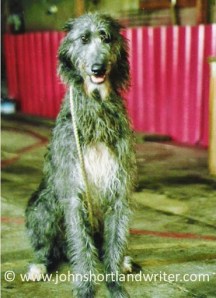
the ‘butter wouldn’t melt in my mouth’ look
It is always heartbreaking when a much loved pet dies, regardless of its age but sadly, as is common with the other giant breeds, deerhounds are not long lived.  Tarff died at just seven years old although others that followed lived to thirteen, a great age for a deerhound.
  just twelve weeks old, the ‘greyness’ comes later

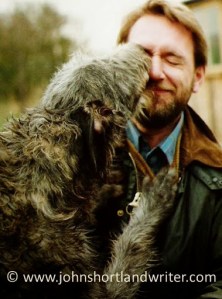
Would I recommend a deerhound?  Probably not, despite their many good traits: they are docile, kind and trustworthy and have no agression in them.  They are also quite silent which can be an advantage – but not if you are looking for a guard dog.  However, they need frequent, although not especially lengthy, excercising and it is essential that they have free running.  Being sighthounds, they are great chasers which can be an issue, especially in suburban areas.  Mine have all proved to be great pets but I doubt if I shall have more despite having unlimited access to open countryside from the back door.   These days I am content to pet other people’s deerhounds assuming the dog allows it for this is another of their odd traits: a deerhound can be aloof at times.  It is the one that decides if cuddles are allowed, if not it will pretend you just don’t exist.


at rest

Links:

UK  The Deerhound Club

USA  Scottish Deerhound Club of America

Update:  I’ve just come across this great new resource for dog-loving visitors and residents of the Cotswolds alike  Dog Friendly Cotswolds