Take Ten Roses

Over the years, as part of my work as a garden creator, I’ve had the pleasure of planting several rose gardens, mostly on quite a modest scale.  However, that changed four years ago when I was asked to design a garden from what was a steeply sloping area close to the house.  I had just retired and so the client, whom I’d known for many years, agreed that I would only create the design and oversee the purchase of plants but everything else others would do.  In effect, it meant that I had all the fun tasks without having to commit to working endless hours as their own team of builders and gardeners would do all the hard labour.  Just as well, as the end design involved considerable earth moving and wall building…

The rose garden will be in the middle section
The rose garden laid out but still some way to go before planting…

The change of levels meant that a sizeable terrace was needed and at 25m x 8m (82ft x 26ft) I proposed that this would be the perfect place for a formal rose garden.  Roses are beautiful when in flower but look dreary during the winter, especially when seen en masse.  Here they would be hidden from view but during the warm, summer months their heavy scent would rise to entice the garden visitor to literally follow their nose.  Reaching the steps that lead down to the parterre they are hit by a dazzling display of colour creating a (good) visual shock.  With the shelter and warmth provided by the terrace walls and some yew hedging, the roses have thrived.  The photo below was taken this week, just over three years since they were planted.

The rose garden three years after planting

Walking through the parterre I was pleased that I had decided to plant just four varieties, all with rich, vibrant blooms.  However, it also made me ponder on the countless roses that I have grown over the years and which were, to me at least, the best.  Could I restrict myself to just choosing ten?  Well, here goes and not in any special order. 

More images from the rose garden

Queen of Sweden   Surely this must be everybody’s idea of what the perfect rosebud should look like?  It’s a tall, upright rose not unlike the Queen Elizabeth rose although I think it has the edge on that one.  I have only ever grown it in one garden and perhaps unsurprisingly, the owners were Swedish.  I like to think that hasn’t influenced my choice!  It’s good as a cut flower and excellent as a buttonhole.

The Queen of Sweden rose

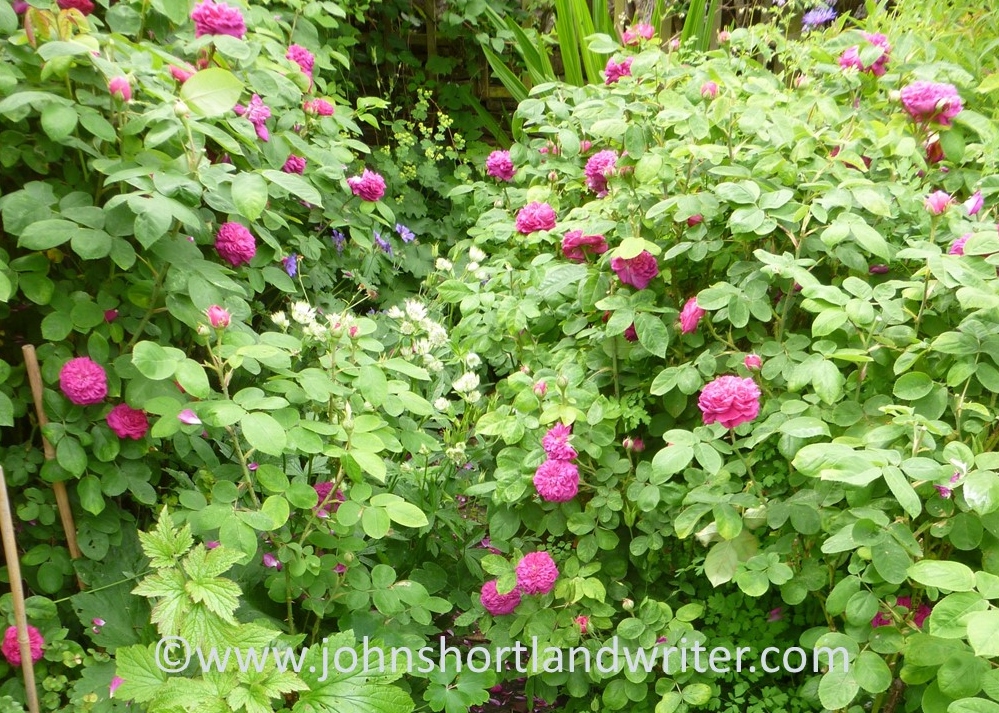
Rosa de Rescht   I first came across this heavily scented moss rose in the garden of an elderly artist where she grew it as a low hedge lining a pathway.  Over the years, I got to know her well and she told me it had been planted by her mother when she was a child, so it is obviously a long-lived and trouble-free variety.  It is upright, suckers freely but in a good way which means that it never looks straggly or sparce.  Best of all, the suckers flower true to type so can be used elsewhere.  I was given some several years before the artist died and they have flourished in my own garden.  They are disease free and I have discovered that they thrive equally well in semi-shade under trees.  You can read more about this rose here.

Rosa de Rescht, a moss rose

Rosa Ghislaine de Feligonde   This is quite a ‘new’ rose to me.  A climber, I planted it to scramble along the top of a garden wall in a client’s garden where instead it sulked for about three years at its foot.  I was about to remove it as a failure when it suddenly put on a spurt of growth to become the beauty that it is now.  Is it slow to establish or was it just slow in that particular spot?  I don’t know the answer but how glad I am that I didn’t condemn it to the bonfire.

Rosa Ghislaine de Feligonde

Rosa Weichenblau   The so-called ‘blue’ roses are not everybody’s cup-of-tea and I have mixed feelings about them.  Some I love, others, I’m not so keen.  That’s mostly down to colour as the blueness can vary in intensity.  I like this rambling rose enough to have it in my own garden where it flowers happily along an old wooden fence filling the garden with perfume for a relatively short period of time.  This one I tend to let travel where it wants as periodically quite large lengths of it suddenly die.  I’ve never worked out quite why and it doesn’t really matter too much – I just prune it out and fill the space with the new growth which it regularly sends out.

A love it or hate it rose: Weichenblau

The Crocus Rose   A pale, creamy beauty from David Austen.  I grew this shrub rose in a border combined with apricot-coloured roses; the spaces in-between filled with tall spikes of blue campanula and purple salvias.  All were contained behind a clipped box hedge and it created a lot of interest.  One of the advantages of being a working gardener (I always feel the term ‘professional gardener’ sounds rather dismissive to all those very talented and knowledgeable home gardeners) is that I get the opportunity to experiment with both plants and planting styles and in many different sorts of soils.  However, in this instance, I’ve never tried to recreate it despite its success.

The Crocus Rose

Rosa x odorata ‘Mutabilis’   I find this a fascinating shrub rose as it has all the colours of the sunset in one flower: the buds start a very deep pink, the flowers open to a rich pink and gradually fade to apricot.  The result is this multi-coloured rose which, with its single flowers being produced prolifically and over a very long period, the effect is mesmerising.  It is an open shrub rose with rather wiry, lax branches and so it can get a bit straggly over time.  I’ve found that it responds to quite hard pruning although it isn’t as fast to recover as the modern hybrid roses.  In my present garden it copes with quite windy conditions, and in one place it has sneaked its way in amongst a wall-grown climbing rose where it has reached a height of five feet.  I’ve never tried growing it solely in this way, it would be interesting to find out how it looked.  This plant has had several name changes over the years so you may find it offered for sale as Rosa chinensis ‘Mutabilis’ or just Mutabilis Rose.

Rosa x odorata ‘Mutabilis’

Gertrude Jekyll    Named after the Edwardian garden designer, this vigorous rose is usually sold as a climber where it can reach ten feet.  However, if pruned hard each winter and then pruned into shape, it can be grown as a modest sized shrub.  Either way you’ll be treated to these superb blooms.  I grow it as a climber but I do prune some stems quite hard to make sure that I have growth of all heights.  Left to itself all the flowers will be high above eye level on long stems which make fabulous cut flower arrangements in tall vases.

Gertrude Jekyll, usually grown as a climber

Blush Noisette    Probably best described as a short climber.  My experience is growing it in the corner of a high wall where I only tie in the occasional branch, the rest remaining free yet upright.  It is smothered in these small, almost double flowers and if regularly dead-headed will flower throughout the summer.  Completely trouble-free, it never seems to get attacked by disease or pests.

Blush Noisette

Rosa glauca    Don’t be fooled by the garden catalogues showing a pretty pink almost star-like flower for, as can be seen in the lower left corner of the image below, they are fairly insignificant.  This rose (sometimes sold as Rosa rubrifolia) is grown for the colour of its young leaves and stems, making it much more of a foliage plant.  A shrub rose, if left to its own devices the colour fades: to maintain its colour interest it needs to be quite hard pruned during the winter to encourage new growth.  In the photo below, I planted a trio of them in an herbaceous border with the poppy ‘Patty’s Plum’ in their centre.  This poppy always collapses just as it flowers and, as I hoped, here it has become caught on the rose thorns saving me the task of staking and tying them in.  I treat the roses as if they were herbaceous plants and so they are cut to within a few inches of the ground in early winter along with all the other plants in the border.

The poppy ‘Patty’s Plum’ growing through Rosa glauca

Dog Rose   It may surprise you to find included here our wild rose of the hedgerows, Rosa canina.  I’ve only ever grown it once and that is here in my own garden.  Appearing as an unasked-for bird-sown seedling at the foot of iron estate fencing, any attempt I made at cutting it out only increased its vigour.  I don’t like using weedkillers much and so I accepted defeat and decided to try and tame it instead.  We have reached a truce: I prune out only the longest stems it continually produces and it, in return gives me a splendid, if short-lived display of beautiful pink and white blooms that the bees and other insects love.  Left on, I then have another display of bright red rosehips through early winter after which, it has a severe haircut.  The result has become the talking-point of our garden.   As I have learnt over the years, sometimes the most unexpected plants or combination of plants give the greatest pleasure.

A bird-sown wild Dog Rose growing on a garden fence

In Praise of Bluebells

Can there be a more delightful spot to linger than a bluebell wood in spring?  The intensity of their colour when seen growing in their tens of thousands would hurt the eyes if not offset by the citrus green of the beech trees they favour growing under.  With early morning sunlight filtering through the branches to strike the woodland floor below, both leaves of beech and ‘bell shimmer and sparkle in the clear light.  As the forest warms the bluebells release their scent but not the heavy, redolent perfume that one might expect. Instead, a fragrance so soft and gentle that for a moment it seems to come from elsewhere; all too quickly it melts away, dispersed by the increasing heat.

Bluebells are one of the key indicator plants of ancient woodland, a term that refers to woodland that pre-dates AD1600, for their bulbs prefer to remain undisturbed where they can slowly establish huge colonies.   Here, in the secret valley where they grow in hedge banks, they can be used to trace the line of an equally ancient drove road for it is thought that the hedgerows and trees that line it are remnants of Wychwood Forest.  Over centuries, the boundaries of the Forest have shrunk as fields were created and the trees cleared for arable land or pasture.  By leaving the field edges untouched the early farmers saved themselves both time and labour and in doing so preserved the bluebells that give me so much pleasure each spring.  The drove road – primarily used for herding livestock long distances to market – passes our little stone-built cottage before diverting across open country.  It is still used as a public right of way.

Bluebells line the old drove road that passes my house

Unsurprisingly for a plant that has been around from time immemorial, the bluebell has numerous regional names – Common Bluebell, English Bluebell, Fairy Bell, Wild Hyacinth to name a few.  Perhaps the best has to be Granfer Giggles.  In Scotland they are known as harebells although to an Englishman harebell would be a completely different plant that grows later in the summer when the bluebells have long ended.  Even the Latin name which is supposed to prevent confusion has changed over time – it is now known as Hyacinthoides non-scripta.  I much prefer the earlier name of Endymion non-sciptus, it sounds more attractive as well as having a romantic Greek legend attached to it.  Illegal to dig up plants from the wild, bluebells are sometimes offered for sale from cultivated stock under either of these names.

Occasionally you may find a white, or even a pink bluebell

For such a well-loved plant – it has been voted England’s unofficial national flower – bluebells do not seem to feature much in poetry.  They are frequently mentioned by name but no-one, as far as I can tell, seems to have written poems specifically about the plant.  Perhaps it is because they are such a common sight and have none of the delicacy of the wild rose, the scent of the honeysuckle or the diminuity of wild thyme. Shakespeare, who seems to have written about absolutely everything (including thyme), only mentions it once: “the azur’d harebell” in Cymbeline.  The Brontë sisters both wrote of bluebells but I’m not sure they weren’t describing later flowering harebells. Emily’s description “waves in summer air”, and Ann talks of a single flower and of its trembling.  Bluebells are quite a stiff flower that don’t wave or tremble that readily whereas Campanula harebells fit the description nicely. I can’t recall even my beloved Richard Jefferies, the Victorian naturalist, waxing lyrical over them as he did over so many other things.  I may be wrong about this for I can hardly call myself a Jefferies’ scholar, more an enthusiast. However, Cicely Mary Baker created a delightful illustration of the flower in her set of Flower Fairies published in 1923 where she describes the bluebell as the king of flowers.

The less-common Harebell – Campanula rotundifolia
It flowers later in the summer and in more open places

It is to the Georgians that I have turned to illustrate our love of bluebells for I have found frequent references to them in old newspapers and periodicals not just in published poetry but also in their fashions.  This description of the sumptuous gown worn by the Princess of Wales when attending the King’s Birthday in 1795 is worth reproducing here: “A gown of superb, embroidered crepe imitating the rays of the sun and intertwined with embroidered white lilies.  Over which a cape of Venetian net embroidered with laurels and Diana’s (presumably the Goddess) crescent”.  Finally, there was another over-cape “embroidered with bluebells (yes!) and held in place by rich cords and tassels”.  As if this wasn’t splendid enough there was “a long train of silver gauze bordered in purple and silver”.  Having spent twenty years in the world of fashion (before I switched careers to horticulture) this has sent me into overdrive!  Sadly, I haven’t found any illustrations for this ensemble but I do have photos of the ‘draft’ for equally exquisite embroidery designed by Norman Hartnell for a robe for Queen Elizabeth II.

Embroidery design by Norman Hartnell for Queen Elizabeth II

Even earlier, in 1786, Mrs Charlotte Smith was publishing her sonnets.  A remarkable woman for the age, she left an unhappy and violent marriage and campaigned for women’s rights and the abolition of slavery.  She wrote fiction and poetry to financially support herself and her children.  This sonnet reminds me so much of my youth where I roamed the bluebell beechwoods of the Chiltern Hills, for which they are renowned.

“Ah, Hills belov’d!  where once a happy child,
Your beechen shades, your turf, your flowers among,
I wove your bluebells into garlands wild,
And woke your echoes with my artless song.
Ah! Hills, belov’d! your turf, your flowers remain;
But can they peace to this fad’ breast restore?
For one poor moment soothe the sense of pain,
And teach a breaking heart to throb no more?

I’m glad to say that my heart is no longer breaking so perhaps the bluebells worked their magic!

A very old photo (hence the strange colour!) of me and my two deerhounds in a Chilterns beechwood at bluebell time

.
.
.

In Need of Winter Cheer – and how to get it

With the long, dark nights now upon us (and the gloomy daily news) we could all do with a little cheer to take us forward.  It isn’t too late to take a small step towards obtaining it for there is nothing quite like flowers in the house to lift the mood.  Now is a good time to plant bulbs for indoor flowering.  The choice is surprisingly large and some can have quite exacting growth requirements but the simplest of these – that anyone can succeed with even if they don’t have green fingers – is the sweetly scented, white-flowering Narcissus Paperwhite.

The delicate looking bloom of the Paperwhite Narcissus

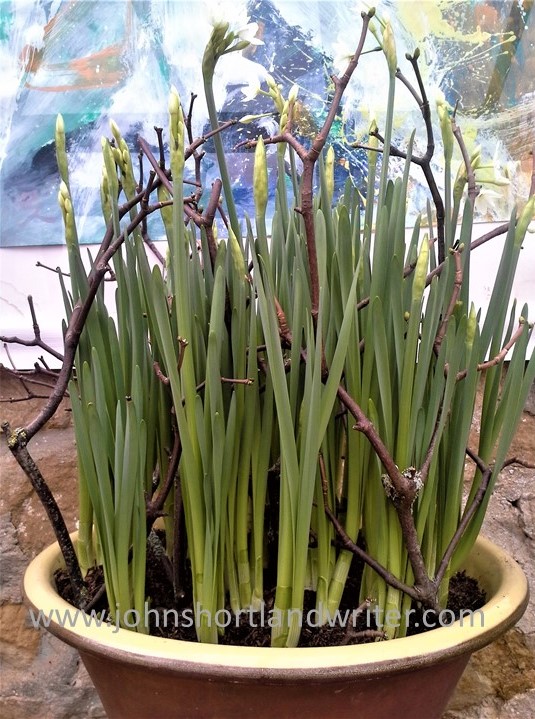
Unlike the majority of Narcissus (Daffodils) they do not require a period of complete darkness to encourage them into growth.  In fact, they do not even need to be planted for they will happily flower just anchored in a bowl or pot of gravel that is kept moist.  However, I think they are better planted in potting compost and look far more aesthetically pleasing.  I never bother with special bulb fibre that is sold for the purpose mostly because I tend to have half-open bags of compost kicking around the place that need to be used up.  If you plant the Paperwhites now and bring them straightaway into the house they can be in flower in six to eight weeks.  Those in the photos below were placed in our conservatory and, with the unanticipated warmth from a week of late autumn sunshine which accelerated their growth, have come into flower in just three weeks from planting.  So much for having them in bloom over Christmas!

Note the use of twigs to provide natural looking support

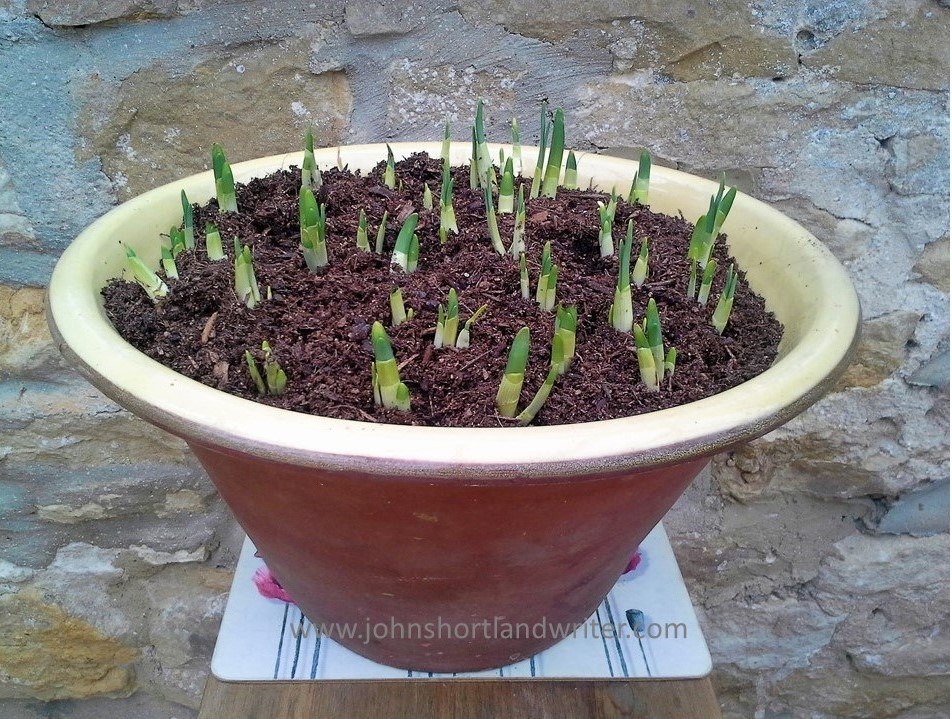
The secret to the planting is to cram as many bulbs as you can into the pot, either in a single or double layer.  If choosing the latter don’t plant directly over one another but stagger them a little so they all have freedom to grow without struggling to push past.  The bulbs in the glazed earthenware pot here were planted in a single layer all touching one another – that way I was able to squeeze in twenty-eight bulbs into a container measuring just twelve inches in diameter. 

Put as many bulbs in the pot as you can squeeze in

Paperwhites have a tendency to flop just when they look their best and the quickest way to prevent this is to push twigs into the compost.  If you do this at the time of planting or very soon after the plants grow strongly through them and look far more natural than when you try to rectify it once they have collapsed.  It is also far less fiddly than using canes and string and looks more natural too.

I have always found hyacinths far more difficult to grow well although I know plenty of people who never seem to have any trouble whatsoever.  They need to be kept in darkness until the flower bud just shows.  I have found them to be rather erratic with their growth and, in the days when I had to provide huge displays for the big country houses I worked for, I grew them in individual, small pots.  By growing more than I really required I could select those of matching height, remove them from their pots and then replant them into the display pots.  They never failed to impress and I never let on how I managed to get such a uniform display!  Far easier are the little grape hyacinths, Muscari, growing here in a glass bowl – an idea I copied after I was given them one year as a gift.

Grape Hyacinths are often sold under the name Muscari

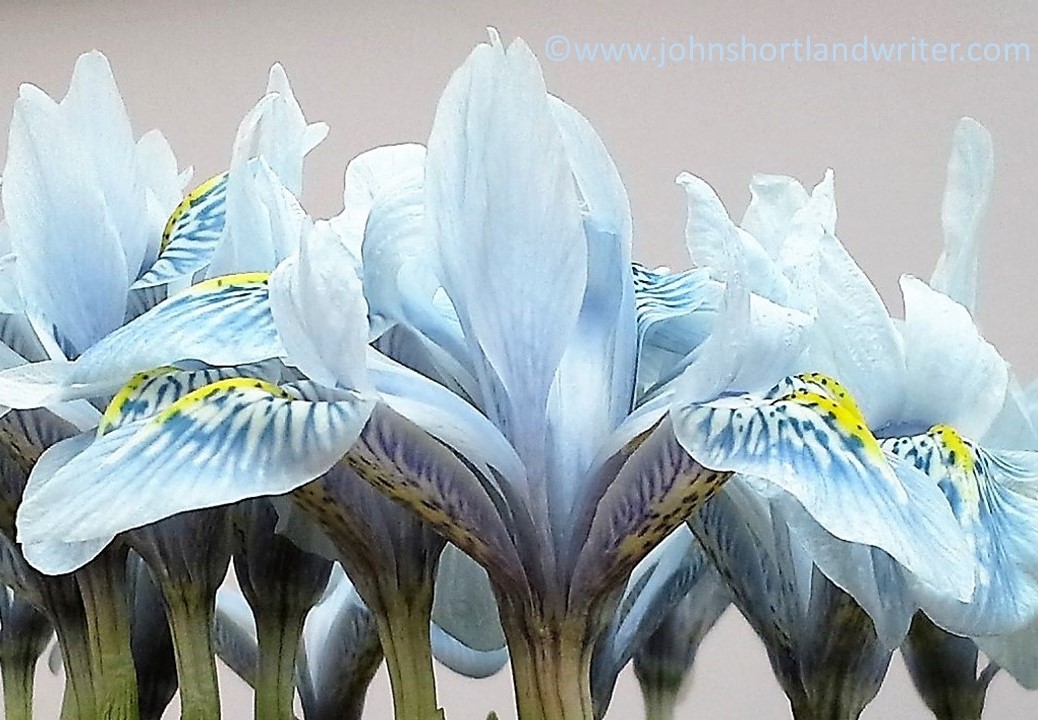
Perhaps one of the loveliest bulbs I have planted in recent years is the miniature iris, Iris ‘Sheila Ann Germaney’ (I have spelt that right!).  Once, again, very easy to grow – just keep them in the dark until they start to grow and then bring them indoors.  After they have finished flowering they can be planted in the garden where they will flower each spring for many more years.

Iris ‘Sheila Ann Germaney’
The Iris’ beautiful markings can be more readily admired when they are indoors

Amaryllis or Hippeastrum are spectacular giants that aren’t to everyone’s taste.  I’m not too keen on them as an individual plant grown on a kitchen window sill although they will bloom there quite happily.  I prefer to use them as cut flowers and for this I tend to grow them in a greenhouse, although a light windowsill would work just as well if you have the space.  They are very straightforward, do not need to be kept in the dark and are often sold complete with pot and compost in gift boxes.  When used as I suggest, several stems placed together in a tall vase look superb.

home-grown Amaryllis used as a cut flower

I have found tulips to be less successful as indoor bulbs although the shorter types should work; I’m just not very keen on those so have never bothered to try.  However, if you have an unheated greenhouse that lies idle through the winter plant the exotic double types there.  Protected from the worst of the cold and rain they flower weeks earlier than normal and can be harvested as exceptionally beautiful cut flowers.

I find tulips for indoors are best grown as flowers for cutting

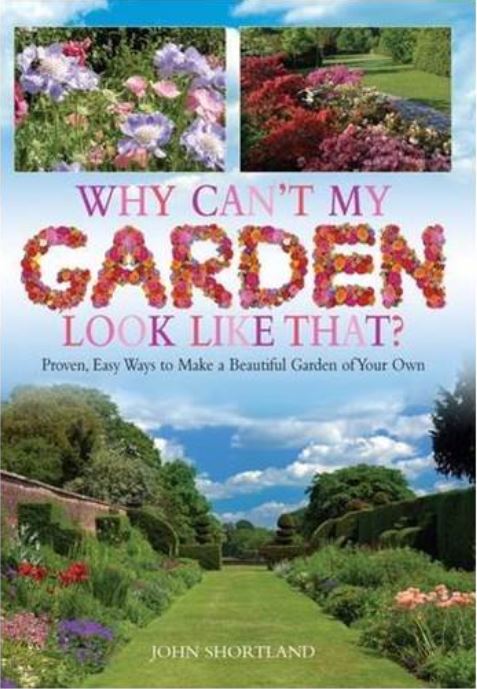
The secret to indoor bulb growing, as with all forms of gardening, is to experiment and find what works best for you.  Over the years, I have tried all sorts, some surprisingly successful and some, if not quite disasters, they certainly weren’t worth bothering with a second time.  With success, you will have an endless supply of colour and scent for your home and, of course, they make great Christmas and birthday gifts.  This last sentence also gives me the excuse to remind you all that my book Why Can’t My Garden Look Like That?  is still available from Amazon or through booksellers and also makes a great gift!  In it you will find all sorts of hints and shortcuts that I used during my years as a Head Gardener when it was essential that the displays both in the house and the garden were as good as they could be.  Happy bulb planting!

A perfect gift!

Rosa de Rescht, Lost in History

Everything about this little grown rose is a conundrum. Even its name is spelt in different ways as it is sometimes listed as De Resht and categorised as a Portland rose and sometimes as a Damask. Wherever it is found in a catalogue one factor that is consistently agreed upon is its scent which is exquisite.Rosa 'de Resht'   copyright

Its history is equally confused with stories of how it was found growing in Persia at the end of the Second World War or how it was brought to France in the early 1800s with numerous other theories of its origin in almost every decade in between.

The rose flowers are of medium size and fully double, magenta in colour with a slight crimson hue. They are repeat flowering although this tends to be in flushes so there are short periods when the plant is quiet. Being double, they are of less value to bees and other insects.

Rosa 'De Resht' (3)   copyright

Rosa de Rescht is an upright rose about 3ft (1m) in height which makes it ideal for use as a small hedge. It suckers sporadically, these often being thrown up some distance from the parent plant. These are never a nuisance and as they come true to type can be severed and grown elsewhere or left to bloom where they wish. The foliage is bluish-green and, in my garden at least, is healthy and free from pests.Rosa 'De Resht' (2)   copyright

As with all roses, care when planting is rewarded although they do cope quite well on poorer, dry soils too. They revel in sunshine but I also have them growing in light shade without any noticeable problems with flowering or growth. Like all repeat flowering roses, removing the fading blooms (dead-heading) encourages new ones to form.

I’m not a great lover of gardens where roses are grown formally on their own – there can be few uglier sights than a rose bed in winter! Rosa de Rescht grows admirably amongst herbaceous plants and this is how I grow them.

Rosa De Resht   copyright

It is unlikely that you will find Rosa de Rescht in a garden centre but it is readily available from specialist nurseries. Peater Beales and David Austin both list it as do some smaller mail order nurseries. A single plant of this variety won’t add much value to a border, buy a minimum of three even for planting in small spaces. In time, you are likely to end up with more but why worry? This little rose is so charming and its scent so sweet you will be only too delighted.