So another year has gone by and I find that one of the benefits of ageing (yes, there are some!) is being aware that time is running out. I say it is a benefit for I don’t find the thought at all depressing, instead it gives an urgency to achieve what I can whilst I can. There is so much more to do, to see and to learn in what time is left. It is possible that I may live to be a hundred for many of my family have lived well-into their nineties and beyond but even allowing for that, it still doesn’t give me too many years to waste.
Time waits fir no man – or woman!!
One of my ancestors, Richard Beauchamp died at the age of 57, which although not a great age by modern standards probably wasn’t too bad for someone dying in 1439. He had a busy and well-documented life but perhaps his biggest achievement was carried out after his death. In his will he left various bequests, the largest portion to the Collegiate Church of St Mary in the town of Warwick for the building of a chapel. Upon its completion his body was transferred there to lie beneath his splendid gilt-bronze effigy. The effigy, along with the chapel’s medieval stained glass and other decorations are considered to be the finest in Europe. In March, I finally visited the tomb where both he and his parents lie, a remarkably emotional moment perhaps because nothing had prepared me for the chapel’s magnificence. To judge for yourself, click on the link here which will take you to numerous photographs as well as the story of my ancestral grandparent’s lives.
Richard Beauchamp, my ancestral grandfather lying in the splendour of the chapel he commissioned for the benefit of his souldetail of the tomb of Richard Beauchamp dating from the 1400s
Spring arrives late in our part of the Cotswolds for the secret valley, although very beautiful, nestles in a ‘frost hollow’. As a result, the bluebells that flower at the foot of the ancient hedgerow than borders our lane are always a couple of weeks later than in many other places. However, when they do bloom, the intensity of their colour never fails to delight. Pretty as they are, they are nothing compared to the bluebell woods of the Cotswolds and the Chilterns, the range of chalk hills where I was raised and lived until I moved here twenty-five years ago. In May, when the bluebells had reached their peak of flowering, I wrote a blog In Praise of Bluebells. Apart from photos of the bluebell woods (including one of me as a much younger man with my two Scottish Deerhounds), I explored the bluebell in history and poetry, link here.
the magnificence of a bluebell wood in MayOccasionally, a white or even a pink bluebell appears
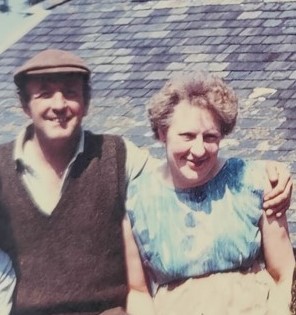
In June, on my Facebook page, I had a casual discussion with a follower about mentors and mentoring. She asked me if I’d ever had any mentors and my answer was ‘yes’: two couples, both of whom came from very different backgrounds to one another as well as my own. She wanted to know more and so I promised to write a blog about them, a post which would honour their contribution to my life and demonstrate the great enrichment such mentors can give. Mentors – part 1 (link here) tells of my chance meeting at the age of sixteen with Dick and Lorna French, who farmed on Exmoor, a National Park in England’s West Country. The farm is very isolated, and the post explores how I ended up living with them after turning up one day unannounced on their doorstep. Regular visitors to my blog or Facebook/Instagram pages will know what a love they imparted on me for this wild and rugged landscape, a place I still visit very frequently. The blog has numerous photos including some of me from early childhood to that gangly sixteen-year-old that Lorna and Dick first knew.
My first mentors: Dick & Lorna French of Brendon Barton, ExmoorExmoor National Park: Aged 16, I suddenly found myself living and working in remote countryside
Find out about my other pair of mentors, Cyril and Pamela Heber Percy, who came from privileged upper-class families in 2025: Part Two (yet to be written but coming shortly!). The blog will also explore what happened in the last few months of 2025
Just occasionally nothing prepares you for a visual and emotional onslaught however much you might have read or seen images of it. I had been planning my first visit to Warwick for a few years. Perhaps it is because it is so close to home – about an hour’s drive north from my part of the Cotswolds – that it had taken me so long to actually go there for, when a place is on your doorstep, you feel you can go at any time and so put it off for another day. As it happened, I finally arrived in the town on the first warm, sunny day of spring when the ancient black and white timbered buildings really stood out against the blue sky.
Warwick is even older than those medieval buildings for it has been inhabited since the 5th century. However, it came to prominence when William the Conqueror built Warwick Castle in AD1068. Today, it is possible to visit the castle and even stay there but this was not the purpose of my visit. I had come to see a later building – the Collegiate Chapel of St Mary, most of which is only a mere three hundred years old. A great fire had swept through the town in 1694 destroying much of it as well as the greater part of the original church. Miraculously, the fire was extinguished saving the chancel and the Beauchamp Chapel built during the 14th and 15th centuries. The crypt is all that is left of an even earlier church built over 900 years ago.
The Collegiate Church of St Mary, WarwickThe 900 year-old crypt – all that is left from the earlier church
I had only been standing in the church a few moments when the organ began to play; the timing could not have been better for it set the mood for the whole visit. Lovely as it was, I moved on quite quickly to the chancel dominated by the tomb and effigies of Thomas Beauchamp and Katherine Mortimer. Both died within a few months of one another in 1369 and their effigies are unusual for they lie there holding hands, signifying not just their undying love but also their equal status for Katherine had brought land and wealth to the marriage. The chancel is also unique for its light and graceful ‘skeleton rib’ vaulted roof simply adorned with the Beauchamp coat of arms clasped by angels.
The tomb of Thomas Beauchamp & Katherine Mortimer who died in 1369 – my ancestral grandparentsThe ‘skeleton rib’ vaulting & Beauchamp crest held by an angel
From the chancel it is possible to glimpse into the Beauchamp Chapel where Thomas’ grandson Richard’s tomb stands. I purposely avoided doing so for I wanted to enter the chapel and to see it for the first time in its full glory. As I mentioned in this blog post’s opening sentence, I was completely unprepared for the visual feast that stood before me. The colour, the light, the opulence, the sun-kissed, bronzed effigy of Richard lying there centre stage was pure theatre – just the effect Richard had planned when he left detailed instructions for the building of the chapel all those centuries earlier. With the organ still playing behind me, I stood in the entrance transfixed, feeling slightly silly for being so moved before descending the steps to explore further. I had finally come to see the burial place of my ancestral grandfather.
Richard’s dramatic tomb lying in the Beauchamp Chapel
A short (but necessary!) history of Richard’s life: Richard Beauchamp was born in England in early 1382, the son of the 12th Earl of Warwick. His godfather was King Richard II although within a very few years Richard’s father, also a Thomas, had fallen out of favour and imprisoned in the Tower of London for treason. Fortunately for him at least, the King was deposed and replaced on the throne by Henry IV; Thomas was released and his titles and land restored. During the King’s coronation in 1399, Richard was knighted and later succeeded to the title of 13th Earl of Warwick at his father’s death in 1401. When Henry V succeeded to the throne in 1413 Richard became one of the new King’s most trusted advisers and given responsibility for the education of his young son, later to become Henry VI. Richard then spent much of his time in France, part of which had been annexed during the Hundred Years War and he died there in Rouen on 30th April 1439.
Richard’s armour is captured in fine detailThe bear and the griffin are Beauchamp heraldic emblems
Richard’s body was brought back to England and buried in a temporary grave in the church, for in his Will of 1437 he leaves detailed instructions for the construction of the new chapel to house his tomb. No expense was to be spared for he wanted it to become one of the finest in England, in which he more than succeeded. The creation of the chapel as one complete and new entity, using only the finest materials and highest quality craftsmanship makes it unique – all the more so, for its surviving almost unscathed by the later Reformation, attempted destruction during the Civil War, as well as the great fire. He was finally laid to rest there in 1475.
The Great Fire of 1694 stopped behind the chapel wall destroying the lower part of the wall paintings
The tomb is, of course, the central feature of the chapel as well as its purpose. Richard lies on an intricately carved and highly coloured marble chest set with fourteen gilded ‘weepers’, namely his children and their spouses. There had been a dispute after Richard’s death within the family over inheritance for Richard had been married twice with children from each. It was Ann that finally inherited the title and estates, a daughter from the second marriage (my ancestor was Eleanor, the second daughter from the first marriage) and so it was she that oversaw the completion of the chapel. Richard’s effigy is of a younger man, his eyes open, his hands outreaching, and dressed in full armour, showing the world that he is ready to enter the Kingdom of Heaven. He gazes upon the stained glass that confirms this story.
Richard’s daughters, some of the fourteen ‘weepers’ that surround the tombAnn, who became the 16th Countess of Warwick in thoughtful pose
The stained glass is another miracle of survival for it is mostly complete. During the English Civil War (mid-1600s) many of the country’s churches and religious icons were damaged or destroyed with the Protestant dogma that followed. The Beauchamp Chapel’s glass was spared much of this with only its lower parts damaged. Although it cannot be seen in my photograph, it was hastily repaired – perhaps a little too hastily for Richard’s head and hands were replaced with those of a woman. The imagery depicts saints and angels in glowing colours, produced at huge expense. Musicians are shown with their instruments and a banner of sheet music runs across the entire window. The notations can be clearly seen and, as instructed by Richard, this is sung in the chapel each September with prayers said for his soul, a practice of huge significance in medieval times. There is a short YouTube video of the choir singing this original music in the chapel, as well as a brief history of the windows which can be found here.
Richard, reborn, raises his arms towards HeavenSection of the East Window surrounded by statues of saints
Within the chapel are many other delights although none overshadow Richard. Tombs of his descendants, the Dudleys (through his eldest daughter Margaret), were placed there. They are resplendent in their own right but do not form a part of this blog. Even the prayer stalls, quite modest compared to other features of the chapel deserve close attention with their heraldic emblems carved into their timbers; they are fine in quality as well as detail. They can more briefly be shown by photos but deserve inclusion.
The tomb of Robert Dudley and Lettice KnollysBeautifully carved prayer stalls, now almost 600 years old
My family connection to the Beauchamps. When you travel back through so many centuries from the present day you are bound to uncover many ancestral grandparents. The problem is the discovering of them for in most families, as in the rest of mine, they lived very ordinary lives that were not well recorded if at all. Just occasionally, it is possible to find one that has risen to fame and this is the case with my paternal grandmother’s family. Granny Shortland’s relatives had been well-known up to the early-1900s for they held high positions within the Church of England and Government. A friend of Tennyson, the Reverend George Bradley had risen to become the Dean of Westminster Abbey. His brothers and sisters had also risen to fame in their spheres of work. These connections, known as ‘gateway ancestors’ enabled the research to progress relatively easily through time to Thomas Bradley – my 8th great-grandfather – who had been Chaplain to King Charles I and later, after the restoration of the monarchy, Charles II. From there the connections to the Beauchamps and even further back are well-researched by historians. It had always been whispered that Granny Shortland had married ‘beneath herself’ – now I know the reasons why!
Granny Nellie Shortland c 1945
Visiting: The Collegiate Church of St Mary and The Beauchamp Chapel is open to visitors free of charge. Guided tours (which are well worth doing) are available at a modest cost, as is a climb to the top of the tower to view the town and beyond. Details can be found on their website here.
Warwick Castle is impressive and a popular attraction. It was the home of the Beauchamps but was built in the 11th century by command of William the Conqueror. It is possible to stay in the castle for short breaks. More details can be found here
There is a useful website (click here) if you are planning a visit to Warwick, which is situated a few miles south of the city of Birmingham and north-west of London.
I think it would be fair to say that the chances of my viewing Earth from the Moon is so improbable that I have never even considered it. That changed when, with an hour to spare en route elsewhere, I decided to explore the Abbey Church of Tewkesbury, little knowing that I would leave having had an out-of-space experience.
Tewkesbury Abbey
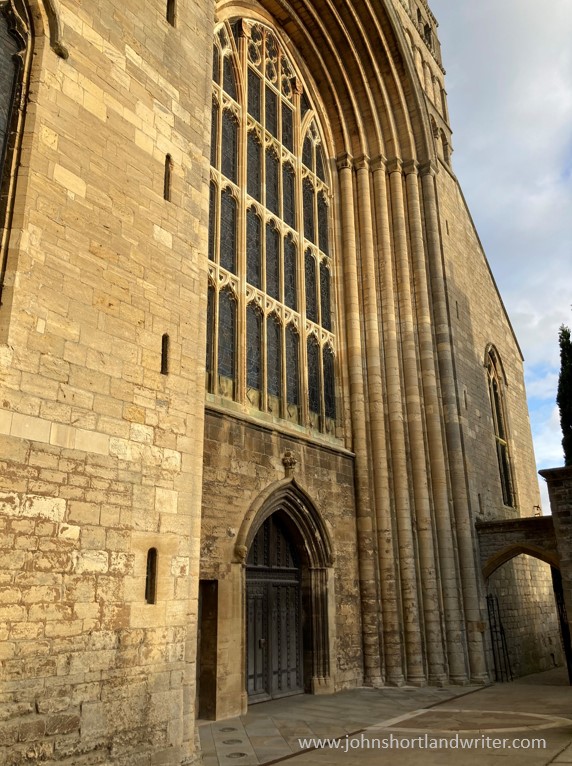
The name Tewkesbury Abbey, as it is usually called, is really a misnomer for the church has been the Parish Church of the Gloucestershire town of Tewkesbury for centuries. When, in 1087, Robert Fitzhamon was gifted Tewkesbury by his cousin William the Conqueror, there had already been a monastery on the site for four hundred years. However, in 1102 the building of the present church commenced, its stone coming from Caen in Normandy, France and floated up the River Severn which passes just yards from the door. For the next four hundred years, as part of the Benedictine monastery, it really was Tewkesbury Abbey.
Ancient buildings line the streets that lead to Tewkesbury Abbey
I’ve driven through Tewkesbury dozens of times. It’s an interesting town with some beautiful old buildings and I’d always intended to stop and explore. With limited time, the town would have to wait for another day. I entered the Abbey church expecting to be overawed by it for it for several reasons: it is now almost a thousand years old, it is one of the finest Norman buildings in England, it has the largest Romanesque cross-tower in Europe and contains more medieval monuments than any other church apart from Westminster Abbey in London. I hadn’t however expected to be be confronted, upon entering, by a large, hanging globe – our Planet Earth.
Planet Earth as seen from the Moon
Rotating slowly, the seven metre diameter Earth sculpture is as seen from the Moon. As Luke Jerram, who created this Gaia exhibit states, “man has been gazing at the moon for Millenia but it was only in 1972, with the Apollo 17 mission, that man was able to see our planet floating through space – a sight that changed our perception of Earth forever.” When standing 211 metres away from the globe, viewers see the Earth to scale, exactly as it was viewed from the Moon.
The Abbey, of course, has many wonders of its own to be viewed. For me, an unexpected delight was the chantry chapel built as a memorial to Isabella, Countess of Warwick and her two husbands, Richard Beauchamp, Earl of Worcester and, later, (another) Richard Beauchamp, Earl of Warwick. Erected in 1430, Isabella’s first husband was killed during the Battle of Mieux and she died in 1439. It was her second husband, the Earl of Warwick, that excited me the most. For his first marriage to Elizabeth de Berkeley (who died in 1422) is part of a long line that I can trace back to in my family tree: Richard and Elizabeth were my 15x great-grandparents. Over the generations, the women in my ancestry have often been rebellious and married against their parent’s wishes (see A Rebel in the Family for an example) – hence the fact that I am just a plain old commoner! Grandfather Richard commissioned another, more splendid brass tomb for himself in Warwick – another place on my list of ‘must visits’.
The Beauchamp Chantry ChapelBronze effigy of Richard Beauchamp who died in 1439 [Wikipedia: Robin Stevenson]
So what caused the Abbey Church to become just a Parish Church? It was, of course, due to the desire of Henry VIII to divorce and remarry brought about his separation from the Church of Rome. His subsequent Dissolution of the Monasteries swept away the buildings and created the spectacular ruins that we find dotted around the English countryside today. A similar fate would have happened to the church in Tewkesbury if it had not been for the argument, fortunately won, that to demolish the church would leave town without a place of worship. How fortunate for us today, for the architecture, history and splendour of the building makes it an almost unique example of early Norman ecclesiastical buildings.
The tall Norman arch is unmatched for size in England
Tewkesbury, as has been stated, is built along the banks of the River Severn, England’s longest river which is subject to tidal bores and rapid changes in it’s flow height. As a result, the town is often flooded. Despite being built so close to the river, the floodwaters have only entered the church on two occasions, in 1760 and, more recently, in 2007. It is often shown in news features totally surrounded by the flood waters.
Modern stained glass at Tewkesbury Abbey
The Gaia exhibit has now ended at Tewkesbury. It is being shown as an ongoing exhibition in the UK at UCL, London; International Centre for Life, Newcastle; Dynamic Earth, Scotland. In Ireland: Trinity College, Dublin. In Canada: Canadian Museum of Nature, Ontario. American readers have the opportunity of seeing it in the USA at Houston Museum of Natural Sciences 12-28 April 2024.







 Life in the English Cotswolds