As it is the festive season it seems appropriate to look at the traditional greenery that we grow in our garden, or gather from the hedgerows, to decorate our homes at this time of year. And of all them it has to be the holly that offers so much as a garden plant.
 The holly is one of those species
 (relatively few in number) that have separate male and female plants. To have a crop of berries like the ones above it is necessary to have both sexes growing within pollination distance and, of course, it is only the female that will carry berries. In our garden we have a magnificent specimen of England’s wild holly,
Ilex aquifolium, but being male, is relatively boring (that isn’t meant to be as sexist as it reads!). It towers above roof height and doesn’t deserve the space it takes other than it provides us with shelter and a place to hang the bird feeders. How much better value it would be if it had been a variegated leaf sort. Fortunately there are lots of berried hollies growing wild in the
secret valley for picking.
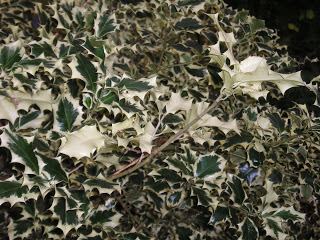 This holly is Argentea Marginata, a variegated form of our native holly and, being female, carries berries, making it very garden worthy. The occasional stem has pure white leaves. Ilex aquifolium grows naturally throughout the west and south of Europe, North Africa and west Asia. An oddity of holly common names is that many of the male plants have female names, and female plants male, so the variety Silver Queen, for example, is a non-berrying male. Very confusing!
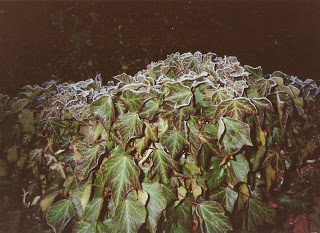 I’m not a great fan of Ivy. There are lots of different leaf shapes and colours but, generally, I think they are rather dull, although, I do admit, they can be useful in dark, dry corners where little else will grow. This wild ivy, Hedera helix, above, growing on a corner of our Cotswold dry stone wall (and it will bring the wall down if we leave it on there much longer), has been transformed, on a cold winter’s morning, by frost which has given the upper leaves an icing sugar edging and highlighted the veins of the lower leaves.
 Mistletoe – the plant of lover’s, or at least, of those trying to sneak a kiss from the unsuspecting. In England it grows wild, often on fruit trees in orchards or on poplars and always difficult to reach. Invisible for much of the year, once the tree’s leaves have fallen in the Autumn, there it is hanging in great bunches high, high up.
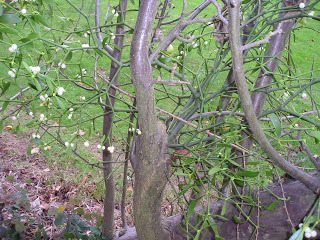 It is rare to find a plant growing as low as in the photo above and it gives a great opportunity to see how it attaches to the host plant. There are no visible roots: the stems of the mistletoe just grow from the trunk like young branches, easily identified by their dull green (as against brown) bark. Does mistletoe, Viscum album, ever kill the host tree? I have never seen this but I have seen quite sizeable boughs torn off a tree by the weight of the mistletoe bunches and, one assumes, the mistletoe must sap the strength of them. But then, mistletoe does carry green leaves so must produce a certain amount of its own food. Any idea, anyone?
For those not familiar with the tradition, it is custom to hang Mistleoe in the hallway at Christmas and to kiss those that stand beneath it.


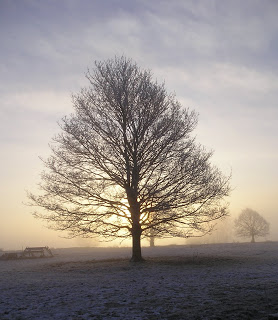
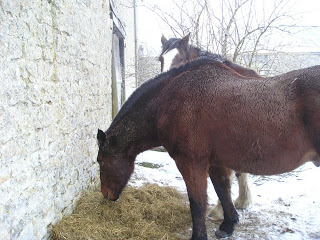
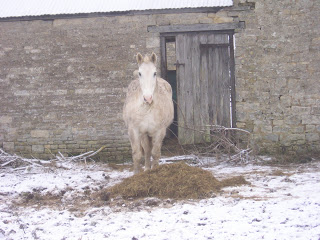
 Well, it’s almost a white Christmas!

 I’ve had to rely on a ski trip photo for really deep snow
  Our snowfall – just a dusting despite the warnings of up to eight inches forecast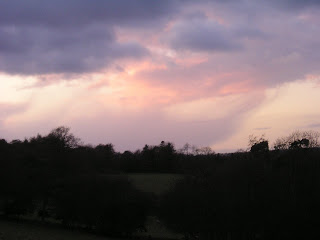

 “Why does he keep taking all these photos?”
 In this week of climate change summits in Copenhagen, there is something rather special in buying produce that is grown locally. The beef for sale from this farm in Duns Tew has travelled less than five miles from village to market. Not only that, but it looks so much nicer than the racks of clinically presented supermarket meat. Why eat meat from, say, Argentina, when you can look at the cattle grazing in fields nearby?
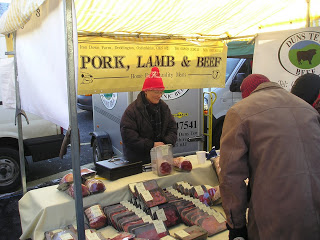 Crowds throng the produce stalls – the queue for bread so long that neither the purchase of some home baking or a photograph was possible. A gap at the cheese stall meant that tastings and subsequent purchases were more easily made. And despite the pushing and jostling, being Christmas, the mood was relaxed and vibrant for a market is a place to meet and chat with old friends as well as make purchases.

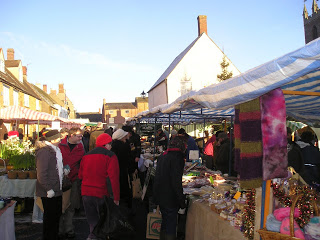 The church, which dates from the 13th century, dominates the market place and is itself busy selling cups of tea and homemade cakes. But when the hustle and bustle gets all too much there are quiet alleyways that you can slip into, away from the crowds. One day, I shall have to return and explore Deddington further, for it is a fascinating place.
 Star shaped almond biscuits from the ladies in the church, buffalo cheese from Somerset, beef from Duns Tew and eggs from another nearby farm made our purchases of the day. The bowl of satsumas were also locally produced – grown in a client’s orangery which we created earlier this year. The holidays are going to be a great time of good and local feasting….
 She-Dog at 10 weeks – smaller than the bantams
  She-Dog watching ‘One Man & His Dog’ (Yes, I know that having a television on the floor under a table is odd but we never claimed to be a normal family)

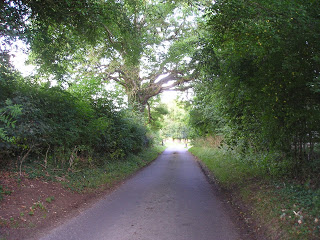 To call it an avenue would be rather pretentious, but the roadside plantings of beech and cherry create the first thought that you may be going somewhere rather special. And as you begin to pass beneath their canopy, the hills start to rise on either side. These are rarely, if ever, treated with any chemicals and wild flowers, including orchids, abound.
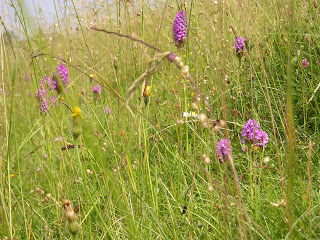 But there is still no hint of our little, winding river. Then, as the avenue ends and on a sharp bend there it is! The first glimpse is of the old sheepwash, where the river was widened and deepened although still almost jumpable, for everything about the secret valley is miniature: the hills, the river, the road. Beyond the sheepwash come the meanders – the photo of these snake like bends are in the blog’s header title.
  Our little stone cottage lies further along the road – and this is now the original old drove road, for the one that we have travelled so far has probably only been in place since about the late 1700’s. More of the drover’s in another post. Below is the view from the house looking back towards the meanders – we may only have just one other house nearby but there are dozens of sheep for neighbours!
 Just below the cottage, the river passes beneath the lane and snakes its way around us, travelling through lush meadows. Watercress and meadowsweet grow along the water’s edge and little rickety, make-do bridges made from old telegraph poles criss-cross from one bank to another. Ancient, gnarled willow trees line the banks, more about these can be found in an earlier post:
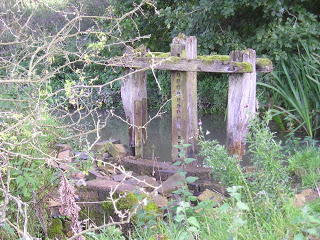
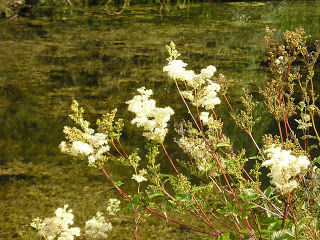 And tucked away beyond the bridges are the remains of the old mill workings. The culvert is barely noticeable until the river levels rise and the water diverts towards the mill. We’ll travel there another day.

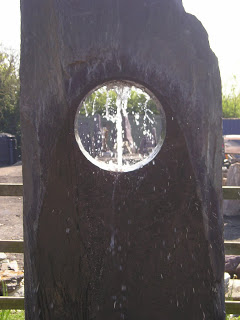
 The pieces with circles carved into them appealed greatly, especially those with water running through. Their smooth interior face contrasted beautifully with the rough, natural surface of the outer faces.
 But then I liked this group of large standing stones – they reminded me of the prehistoric ones that litter our English landscape. The Cotswolds have a good number of these, so it made good sense to continue the tradition. I have written about some of these local stones in the past and we hold them in great affection:
  Time for a reality check. How could we lift these giants into place when there was no easy access? And so we went for this one – as large a piece as two of us could manhandle (and it nearly killed us in the process, as did digging the hole for the reservoir in root infested ground) – but we were happy with the end result.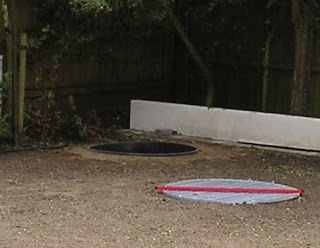

 Life in the English Cotswolds