
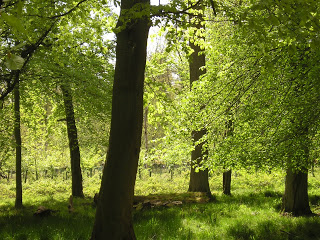
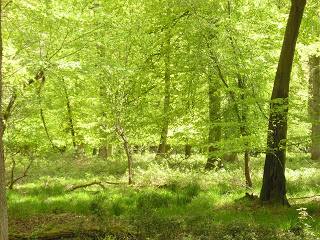
Buckinghamshire, one of the so-named Shire counties, lies to the north-west of London. A long, narrow county; the southern part is renowned for its beech woodlands. Although greatly diminished in size over the centuries, many of them are still there, remnants of the ancient woodlands that once covered much of Britain, although the industries that they supported are long gone.

In the Chilterns the beechwoods can almost engulf the lanes
Straddling the Buckinghamshire/Oxfordshire borders the Chiltern Hills extend diagonally northwards into neighbouring Bedfordshire where they change character from dense woodlands to more open downland. It is within the shadow of the southern woodlands where I was born and where I lived for the greater part of my life before moving to the secret valley in the Cotswolds. Inspired by Enid Blyton’s The Children of Cherry Tree Farm, my childhood was spent crawling around the fields, woods and hedgerows learning as much as I could about the wild birds and animals that lived within them.
Although nowadays the woods appear mostly deserted, they are still made use of. The old tracks and paths that were once used by the men and women that worked and lived there are trodden by walkers, and by the wildlife that remains elusive for only those that move quietly have the pleasure of seeing anything other than a glimpse of a fleeing animal.
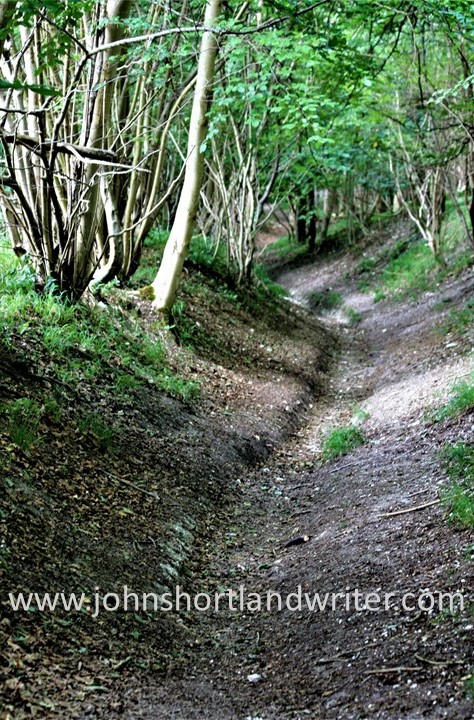
This centuries old track leads down into a deep valley
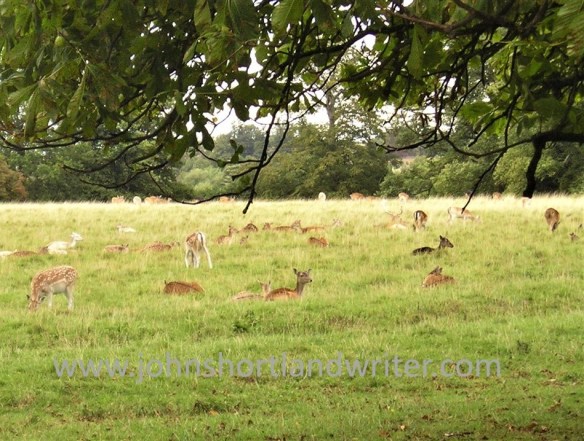
Fallow deer can often be seen at rest in clearings if you walk quietly
The making of chair legs to keep the flourishing furniture industry of High Wycombe, the local market town, was carried out within the woodland by men who would set up shelters there. Known as chair-bodgers, a local dialect word originally confined to this immediate area, they were highly skilled craftsmen who could earn relatively high wages for their work. The Second World War virtually ended the centuries old tradition, the last being Samuel Rockall who died in the early 1960s. I had been unaware of Rockall’s life until I researched for this blog post and it seems as if we may have been related for I have Rockalls in my family tree. In the 1851 census return one of my ancestral cousins is described as a chair turner living in the village where I spent much of my adult life. More research required!

Jonathan Rockall, chair turner and ancestral cousin in the 1851 census return. His wife, Ann, a lace maker,- another local craft

Some of my cousins?! Photo from an old book ‘English Country Life & Work’
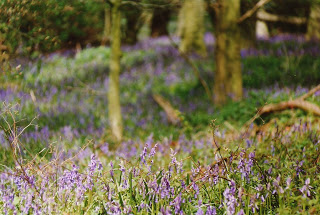
It is, perhaps, springtime when the beech woods are most visited for the forest floor is carpeted with bluebells. The intensity of their colour plus the iridescent green of the tree’s unfurling leaves almost hurt the eyes. With early morning sunshine the scent is unique and difficult to describe – gentle is the best I can come up with. As the day progresses the scent is quickly lost.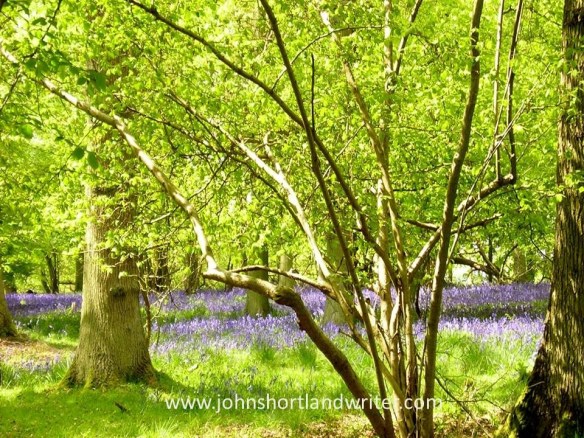
During midsummer, the woods become visually silent: the leaves have turned a dark, leathery green and the bluebells gone to lie dormant for the rest of the year. With autumn, the trees become alive once more with colour, this time as their leaves turn into every shade of copper, gold and brown before they drop to the ground for winter. It is then that the smooth bark of the trees come to the fore with a silvery sheen that catches the low light of a winter’s day. Although it may seem as if the woodlands are sleeping, in places the first bluebells are starting to poke their noses through the leaf litter. Spring is on its way.










 .
.
 .
. .
. .
. .
. .
. .
. The old mortar in the garden is beginning to fill once again!
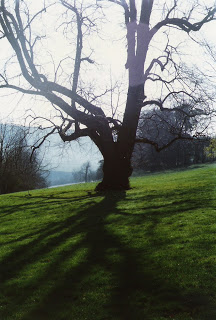


 Turville, is a tiny village, hidden deep in a valley in the Chiltern Hills and is close to where I was born and spent the greatest part of my life (I only came to the secret valley nine years ago). The Chilterns is a place of steep hills, thick with beechwoods that seem to hang onto their very sides – many use the word in their names: Old Hanging Wood near Hughenden, for example. The villages, as a consequence, seem tucked away and forgotten, yet they lie only some 30 miles west of London.
 Chalk and flint are the geological features that make the Chiltern Hills what they are and you are never far from them for the topsoil is thin, as all Chiltern children soon learn. Childhood games need chalk for drawing hopscotch and the flint cuts deep into knees when falling over. Flint also is, or was, the favoured building material for houses and Turville has plenty of fine examples, even the church is made from it.
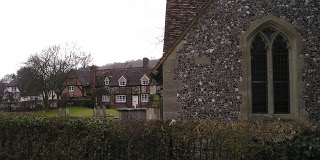
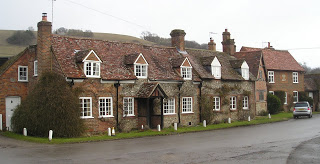 No English village is complete without its pub and Turville is no exception. The Bull and Butcher stands almost in the road. Less common are windmills and Turville lays claim to Cobstone Mill (which really ‘belongs’ to the neighbouring village of Ibstone), standing high above on a steep hilltop. The windmill, like the village has been used in many films such as Chitty, Chitty, Bang Bang and the 101 Dalmatians. In the latter, when the road outside became covered in machine made ‘snow’ I drove past confused – for there were still traces of the snow and it was midsummer. We also had no water for several hours as the filming had used up the village supply in the making of it.
 Turville is popular both with the film crews and visitors because it is so ancient and unspoilt. To get photos like these you have to visit on a grey, winter’s weekday as weekends, especially fine, summer ones, find the narrow lanes choked with cars. The village is so unchanged that even the warning roadsigns, like this old schoolchildren one are decades out-of-date!

 I think the reason we may behave like this is because English weather is nearly always gentle. The landscape that makes up England is beautiful and can be dramatic but not in the way of so many other countries. Take the USA, for example. Where’s our Grand Canyon, our towering redwoods, our Rocky Mountains, our Great Plains and our Niagara Falls? We have them in miniature and, perhaps, that is just as well as we are such a small country. And likewise, our weather: we have heatwaves, we have floods, we have blizzards. But they are rarely anything truly spectacular (except to those poor people affected by them, of course). And so when we were told by the weather men in 1987 that reports of a hurricane were completely exaggerated, we believed them totally. And despite the fact that much of the country was hit hard by it when it arrived, my part of the Chiltern Hills where I lived at the time was not much affected, even though it is one of the most wooded parts of the country.
 The night in January 1990 was different. This time we had winds, whilst not as severe as three years earlier, which created total havoc with the already weakened root systems of the trees. Great swathes of the magnificent beech woods that are the very heart and soul of the Chilterns were flattened in a couple of hours. (I am reminded by my partner, that as the rest of the world cowered in their beds as the trees came crashing down all around, I woke up to say “a bit windy out there” before falling asleep again). As dawn broke the true damage could be seen.
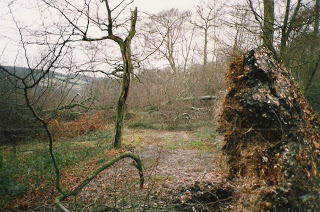 Fast forward twenty years to 2010 and the woodands are transformed. Those of us that remember the 200 year old beech know that the majority are gone and, in their place, are new trees of mixed species. It will be many years before the magnificence of the woods return but they are healing. This photo below is taken from the same spot as the one above. Some of the biggest old stumps have been left, too difficult to move – time has hardly changed their appearance apart from their ‘roof’ of mosses.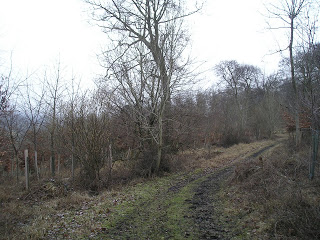
 One of the unforeseen benefits of the hurricane is the increased amount of light reaching the woodland floor, for beech trees cast a dense shade where little can grow, other than where the canopy is lightest. Apart from the view to the valley below, which was unseen before, many wild flowers are better now than ever. Roll on April when we can see the blue carpet of tens of thousands of bluebells disappearing into the distance.
 Oh! And I nearly forgot to say, the weather today is a mix of sunshine, cold winds, rain and sleet. Don’t forget to tell the next person you meet!
 Life in the English Cotswolds