Mentors – part 1

Mentor.  There are dozens of words to choose from when looking for an alternative description of someone who takes on this role: life coach, guide, adviser, confidante, counsellor, influencer to name just a few.  One thing that is certain is that the four people who played such an important role in shaping my life would not recognise any of these terms, not even the word mentor.  And to be honest, it is only with the benefit of hindsight that I recognise them as being mentors at all.

Mentors: Lorna French, Dick French, Cyril Heber Percy, Pamela Heber Percy

If I had to choose just one word, I think it would be guide for that seems to describe what they were during their lifetimes. It is only since they’ve been gone – for sadly,  they have all been dead for more than twenty years – that I actually think of them even as that for their influence was subtle.  They would almost certainly find the description laughable for there was never any conscious effort to take on that role.  It was one that had come about by chance meetings leading to friendship, respect and love.

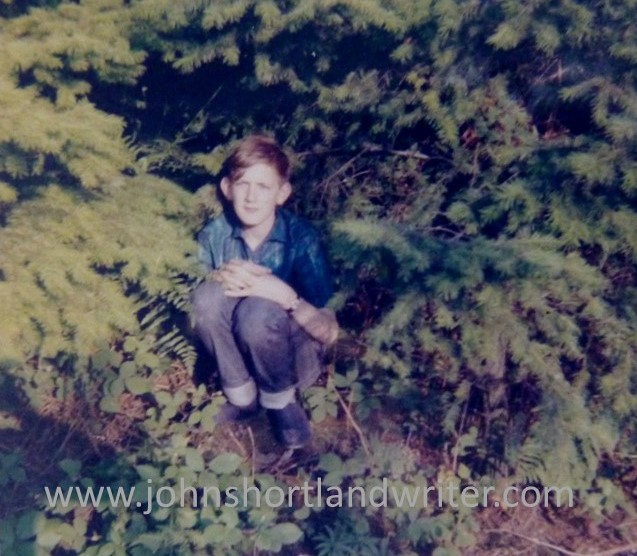
Despite the angelic appearance I wasn’t an easy child!

I was not an easy child – I know that statement is hard to believe now (laughs).  A streak of rebellion has run through our family for generations and although I wasn’t outwardly rebellious, I sometimes made life difficult for those around me.  From the age of fourteen I found school a waste of my time for I had wanted to study sciences and school insisted I did languages instead.  I’m sure they were probably right for studying French and English had come easily to me whereas I’d struggled with even General Science.  To me that was irrelevant for I had desperately wanted to learn botany and biology.  Instead, I now found myself sitting in German classes seething inwardly and resenting every moment of having to learn the difference between der, das and dem or liebe and Lieber.  I began playing truant and found that if I left school after the lunchtime register had been taken nobody seemed to notice and  I could walk the three hours back home through the woods and fields where I could practice my botanising.  I finally stormed out of school halfway through my ‘O-level’ exams before sitting the dreaded German but not before I’d sat French and English.  I passed both with flying colours but my parents were furious.

Me in my element!

More out of desperation, my parents agreed that I could take my bicycle and tent on the train to Exeter and cycle and camp across Dartmoor for two weeks.  It would be my first solo holiday and, I imagine, they agreed in the hope that it would make me appreciate just how fortunate I was to have been given the chance of a good and expensive private education.  I arrived in Exeter in blazing sunshine and armed with maps and far too much self-confidence started my journey westwards.  In those days, with no mobile phones or credit cards to monitor my progress, my parents provided me with stamps and cash so that I could send them a postcard at the end of each day.  I reached Okehampton, a small market town on the fringe of the Dartmoor National Park in a sweat and seeing from my map that I wasn’t that far from the sea instead decided to cycle northwards to Westward Ho, a beach resort on the North Devon coast.

I had reached the sea

Refreshed from an early morning swim in the sea (I’d arrived there at 2.00 in the morning) I looked again at the map and now decided to travel eastwards to a different national park, Exmoor.  I’d read the novel Lorna Doone at school and had loved it and the thought of exploring the rugged and isolated places where she had met and married John Ridd, only then to be shot at the altar of Oare church, filled my imagination.  Little did I know then that soon I would be meeting a real-life Lorna Ridd who with her farmer husband would welcome me into their lives.

Oare Church – where Lorna Doone was shot at the altar on her wedding day

Three days later, having cycled over some tough and exhausting hilly roads I ended up at Brendon Barton, a remote farm perched high on the edge of the open moorland.  It was coming towards the end of my fortnight away and so I knew that I could only stay there for one or two days before the long bike ride back south to Exeter and home.  Venturing into the farmyard I could hear sounds coming from inside the barn where Dick French, the farmer, was working with sheep.  I asked if I could camp in one of his fields but he didn’t look up and instead replied, “be a good lad and bring those last two sheep in here.”  I had never been near a sheep before and so spent the next half an hour running around the yard in circles before finally managing to herd them inside.  I was out of breath, sweating and covered in sheep shit but I found a contentment in my success that I’d not experienced before.  Years later, Dick and I would laugh about that first encounter.  I used to say that I should have just got back on my bike and cycled away to which he would respond with, “when I saw you wouldn’t give up, I knew that you’d do!”

I cycled over Exmoor’s remote, hilly roads
Preparing for a good night’s sleep, Brendon Barton 1968

By my second day on the farm I had helped bring in the cows and Dick had  taught me how to hand milk  them.  Hearing I could ride, he suggested that I took Star, one of their horses up onto the moor to have a look around    The heather was in flower and its deep purple carpet continued to the sea.  Beyond, the coastline of Wales could be seen in the hazy far-distance.  I ventured into a deep combe before crossing a stream and climbing up a ridge.  There I spotted a deserted farm cottage* half-hidden by beech trees.  I stood entranced by the beauty of my surroundings and its all-encompassing silence.  I felt I had found my true home and with no consideration for my parent’s concern, I decided never to leave.  I sent them a postcard saying that I’d missed my train home.  I remained purposely vague as to my whereabouts, just saying that I’d kept back enough money to buy a new railway ticket.

The heather clad hills of Exmoor reach to the sea
Half-hidden amongst the trees stood a deserted farm cottage

A week later I was having my meals in the farmhouse enjoying the banter amongst the farm lads and hearing the discussions about the tasks that needed  to be done around the farm.   By the time harvest came round, my tent had been ditched and I was sleeping in the house in a comfortable bed, receiving a small wage and spending evenings in the village pub with new-found friends.  Dick had said that it would be his wife Lorna (Ridd had been her maiden name) who would decide whether I could stay or not.  She was such a hard-working woman and one more person to care for might be one too many.  Her approach had been that one more would make no difference and so she looked after me while I spent long days working at Dick’s side, listening to his tales and learning about their way of life.  Asked about my parents, they seemed content enough with my explanation that I was spending extended time away having just left school (the term gap year hadn’t been invented then!). 

Brendon Barton 1968I soon moved into the farmhouse and a comfortable bed
Harvest was still carried out the old-fashioned way

Months passed and the harder I worked the more I knew an Exmoor outdoor life was for me.  However, it came to an abrupt end when one day I walked into the kitchen to find my parents sitting there telling me it was time to return home. I was devastated and asked Dick why he hadn’t told me they were coming.  “I knew you’d hide up on the moor,” he’d replied – and he was right!  Although I was pleased to see my parents I pleaded with them to let me stay.  Dick, in the first of his subtle acts of persuasion that I can recall, asked me to help him look at a horse in the barn.  There was no horse, instead we sat and talked about our time together before he reminded me that my home was with my parents and, in time, running our family business.  Don’t forget, he’d said, there’s a room here always available so why not come down for lambing next spring.  To ensure that I did he added, “You’d be doing me a great favour, I could do with your help.”

The barn in 1968 where I had my first taste of farming
I returned for lambing in 1969

Lorna, too, had her subtle ways of persuasion.  “Your parents have said that you can come here for Christmas if you’d like to.  We’ll be on our own and some young company would be good.  It’ll be just the three of us.”  She’d also boxed up the bantam chicks that I’d been caring for so that “you can carry on farming at home.”  After that first Christmas I visited them both for many years, helping on the farm whenever I could, and exchanging letters and phone calls.  They were always my first port of call when I was having difficulties, feeling down or just wanting to celebrate with them.  Life hill-farming is hard, the weather often unmerciful and the hours long but there are also the pleasures of being part of a small tight-knit community that will help one another whatever the reason.  Leading by example, they instilled in me a love of farming and hard work, a sense of duty, generosity of spirit and kindness.  I will leave it to others to decide whether they succeeded or not!  From them, I also acquired an even deeper love for being outdoors regardless of the weather and especially in remote, wild landscapes.  Little did I know then that these skills would be put to the test when, aged forty, I began my career change to follow my outdoor dream, or that Exmoor would still play such an important part of my life today. 

The bantam chicks that Lorna sent back home with me, 1968

Dick and Lorna French died just before the Millenium and the farm was sold to another local farming family, some of whom I’ve now known for almost sixty years. Because of that, I still on occasion visit Brendon Barton and sit in the kitchen drinking tea to discuss farming and, of course, putting the world to rights.  A bonus is that Maria, the new ‘Lorna’ has been creating an extensive garden around the farmhouse, so we have gardening in common too, as well as a lifetime of shared memories.  It would be another fifteen years and then as a man, before I would meet my other mentor couple.  Cyril Heber Percy and his wife Pamela’s lives were worlds apart from Dick and Lorna’s but there were some similarities too.  Part 2 tells their story.

Lorna & Dick French

Have you had a mentor or mentored someone?  What does it take for someone to become a mentor?  Our parents have probably the greatest influence on our lives so why does a mentor s role take on such importance? Let’s hear your story either in the comments below or, if you prefer, by using the Get in Touch tab at the top of this page.  Thanks to Diane Highton for posing the question that triggered this blog!


* The deserted cottage still stands in splendid isolation hidden away behind the trees, albeit now as a ruin.  It has a fascinating history and has been the subject of much research in recent years.  Take a look at the website devoted to the story of Hoar Oak Cottage
Darts, Hardheads & Rocket

I was fortunate in having a country childhood where roaming the fields and woodlands was the norm.  My early schooling was often held outdoors on sunny days, sitting on a warm, grassy bank; best of all, were the long, nature-study walks we were occasionally taken on.  At the age of ten my schooling changed and the open space and fresh air was replaced by a concrete yard separated from a railway line by a high, chainlink fence.  The only shades of green to be seen were the short spikes of Wall Barley Grass that grew wherever they could find a place to take root.  Later, I changed schools again and, although still in the centre of a town, at least now there were extensive playing fields as well as a small wooded area. In the no-man’s land between the closely-mown sports grounds and the trees Hardheads and Rocket grew.   Against the school walls, Wall Barley Grass could be found.

always crawling about the woods and hedgerows!

Wall Barley Grass, which as children we called darts, is a short, annual grass that thrives on waste ground.  It frequently sows itself in cracks in pavements or, as at my old school, the gap between the tarmac playground and the wall.  Despite frequently growing at the base of walls which its common English name recognises, the botanical name for the grass Hordeum murinum means something quite different: murinum = mouse.  So why darts and, for that matter, why mouse?  Surprisingly the reasons behind both names are unwittingly known by countless generations of children.  Our favourite ‘weapon’ of choice, the seedheads when separated from the stalk, can be thrown just like a dart, the point not sticking into a bullseye but on articles of clothing, especially knitwear.  The pinnacle of childish achievement was to attach it unknown to someone at the base of their back.  Over time, with their body movement, the dart would slowly creep upwards until it arrived to prickle their ear or neck in the same way as a pet mouse might.

Wall Barley Grass prefers to grow in the dry cracks of paving and concrete

In researching for this blog, I was surprised to discover that Wall Barley Grass, so commonly seen throughout my (Home Counties) life, is rarely found in Scotland and Ireland.  It is a plant of drier, warmer regions and grows across the Mediterranean area, North Africa, parts of Asia as well as Central and Western Europe.

its old country name is Mouse Grass as it climbs up clothing in a mouse-like way

It is sometimes hard to believe that Centaurea nigra, Knapweed – or as we called it, Hardheads – is a wild flower; it seems to be far too beautiful to be a ‘mere weed’!  A great bee and butterfly plant it grows to about two feet tall and flowers throughout the summer months.  As children we cared not one jot about the flowers, it was the flower buds that we coveted.  A tight, hard ball (hence the name) on a long pliable stalk made them another ideal weapon once we’d tired of darts.  Perhaps ‘bullets’ might have been a more appropriate name for when the stalk was looped around the bud and pulled tightly the bud would ping off at quite some speed.  Unlike darts where stealth was required, hardhead battles were fought openly and at close quarters.  The closer to the opponent the more they stung when a strike was made.

Knapweed or Hardheads has to be one of the most beautiful of British wild flowers
wrapping the stem around the head and pulling sharply to ‘shoot’ your opponent…

On rare occasions, pure white flowers can be found.  These were always treated with respect and never picked.  Even rarer – and I know of only one place where they can be found – bi-coloured hardheads grow.  Hardheads grow throughout Europe, elsewhere in the world it is an introduction.  For me, the first of its flowers are a sure sign that summer has arrived.  A plant of old meadows and chemical free waysides, their purple flowers brighten up many a roadside verge.

a very rare bi-coloured Hardhead

The last of this trio of childhood plants, Rocket, is the only one that we never picked.  They were loved for their appearance reminding us of the sparkler trail of the cheap, unsophisticated fireworks that were the norm in the 50s and 60s.  Rocket, bears no resemblance in any way to the herb that we eat in salads, in fact it has been used as a medicinal herb to relieve many complaints ranging from gallstones to treating snake bites.  Agrimony, Agrimonia eupatoria, to give it its correct English and botanical names, grows to about two feet tall and flowers in mid-late summer on a single stem.  Its pretty, pale yellow flowers are followed by sticky burr-like seedheads that attach themselves to animals and clothing.  They grow on roadside verges and grassland but unlike so many of our native wild flowers that require ancient, unimproved meadows, they prefer relatively young ones of less that fifty years of age.

the long flower stalks reminded us of the cheap rockets of our childhood
close-up, the flowers of Agrimony are really pretty

Just as garden plants can often remind us of people, times and places of the past so darts, hardheads and rocket transport me back to my childhood.  I no longer pluck darts to throw but I do admit that rarely a summer goes by when I don’t check that my knack of firing hardhead bullets hasn’t been lost.  In doing so I remember a time of innocence, old friends and a life of simple pleasures.

carefree days!

A Secret Garden

I have noticed that even those that don’t show the slightest interest in things horticultural love exploring walled gardens, especially if they are overgrown and forgotten.  Perhaps it stirs memories of the children’s novel by Frances Hodgson Burnett published in 1911 in which she shows that when something unloved is cherished and cared for it can become beautiful and healthy, be it a plant or the human spirit.

Houghton_AC85_B9345_911s_-_Secret_Garden,_1911_-_cover

Photo Credit: AC85 B9345 911s, Houghton Library, Harvard University

I have been fortunate over the years in caring for a number of walled gardens in different stages of development yet, regardless of their state, there is something magical in placing the key in the lock and pushing open the door – as nasty, little Mary Lennox discovered in the novel.  As she returned the garden to its former glory so, she too, grew into a loving and loveable child.

Garden Border (4) watermark

Perhaps even more so than the plants and trees within, the beauty of a walled garden comes from the walls themselves.  The brickwork over time has mellowed and seems to release the warmth of a hundred or more summers, even on the greyest of days.  Search the walls and they reveal secrets – a date scratched into a stone, old lead labels revealing the varieties of long-disappeared fruit trees or, occasionally, the name of a much-loved pet buried at its feet.

Walled Garden watermark

The walls in this deserted garden date back to the late 17th/early 18th centuries

Old Plant Tag watermark

Recorded for posterity: the trees may have disappeared but the record of the varieties remain

One of the most rewarding to explore yet emptiest of walled gardens has to be that of Dunmore Park.  The house no longer stands but the garden walls remain crowned by that most eccentric of British garden room follies, the Pineapple.  Here the walls are hollow, fires were lit at its feet and the walls warmed to promote early growth.  Sliding stone blocks could be opened to release the smoke which, filling the garden at night helped to keep frosts at bay.  Clever, those early gardeners.

The Pineapple (11) watermarkThe Pineapple (31) watermarkThe Pineapple (34) watermark

Walled gardens when not open to visitors are more often a place of silence, the only sound to accompany the gardener is that of birdsong and the hum of insects.  It can be a place where your mind can be free from the everyday cares of the outside world.  It can also be a place where your design ideas can run riot either in your head or, if lucky enough, in reality.  The images below show before and after photos of a border I created many years ago, the idea for the colour palette coming from an Imari plate belonging to the owner of the garden.  The border is living proof of an imagination run riot!

Blue & White Border - before watermarkImari Plate   watermark.jpgBlue & White Border - after watermark

All the Colours of the Rainbow

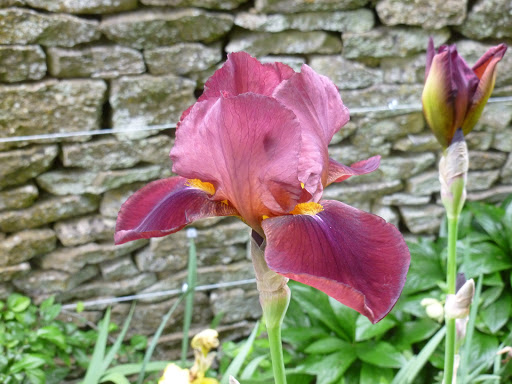
There are certain flowers that I have been aware of all my life.  I’m not sure if that proves that I was an extremely sensitive child or whether it is just because my parents and other relatives only ever talked about gardening.  I can still see pansies growing in the circular bed beneath the apple tree and shrub roses either side of the archway that led to the vegetable garden.  The strawberries grew along the right hand fence and the rhubarb in front of the chicken run and yet we moved from that house when I was just nine years old.  But there is one thing that bothers me: I can recall the Iris, dark blue, growing tall and strong but I can’t remember if they were in the front or back garden. It doesn’t really matter, of course, but it seems odd that I can’t picture them when I can clearly remember my father telling me enthusiastically that “they come in all the colours of the rainbow.”  Despite his passion for them he only ever grew the one colour (which is perhaps odder still) and it was only when I had a garden of my own that more and more colours started to creep in.

An idea that I had wanted to try out for some time, spurred on by this memory, was to plant a border devoted to iris of all colours – a rainbow border.  This requires space, not because the plants take up much room but because they have quite a short flowering time, perhaps just two or three weeks.  This makes such a border rather a luxury, especially in a small garden.
 

I garden for my living – a hobby turned into a career – and I have quite a number of clients with gardens, some of very many acres.  It is in one of these that the rainbow border has been planted.  Confidentiality prevents me from showing the completed border in its entirety so you will have to imagine wave after wave of varying shades of blues, whites, burnt ochres, burgundies, golds and purples.  The effect is breath-taking as is one other thing I’d forgotten from childhood: scent although not all colours are fragrant and those that are vary in strength and quality.  Spectacular they may be when in bloom but blink and they are gone for another twelve months.  Fortunately, herbaceous borders bursting into flower draw attention away from what has now become a dull part of the garden.
In my own garden, I’ve had to be more restrained, poking them into odd spaces where they can get enough sun, yet they still offer surprises.  This yellow variety, Butterscotch Kiss, is a good colour for it is not harsh; best of all its fragrance is overpowering, scenting the whole garden and wafting into rooms through open windows.

Although the Bearded Irises, Iris germanica, arefavourites, there is always room for smaller varieties. The tiniest are the early flowering Iris reticulata which tend to get lost in my borders so are grown in pots.  They flower in February and March.  The Dutch Irises are useful grown in the vegetable garden for cutting but also grow well in the flower garden, flowering about now.  Both types are grown from corms (similar in appearance to bulbs), planted in the autumn.  Iris unguicularis is a perennial, winter flowering iris, ideal for picking and often with a delicate perfume.  In the photo below, it is growing in a pot indoors and flowering on Christmas Day.  In the garden it wants to be placed at the foot of a wall and grown in poor, stony soil.
The bog Iris, Iris sibirica, grows well in wet soil but also adapts quite happily to the garden border providing it is kept well watered until established.  Its leaves are grass-like and the flowers much daintier than their Bearded cousins.
Compared to the standard Iris sibirica above, Flight of Butterflies is more compact and has flowers with emphasised blue and white veining
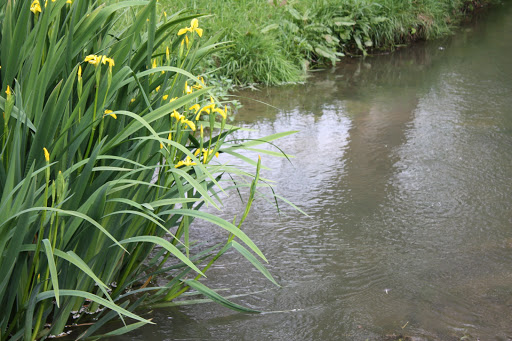
There are numerous types, too, for the pond and these grow standing in several inches of water. Our native Yellow Flag, Iris pseudoacorus, is robust and can be too dominant in smaller areas of water. It is a lovely sight when seen in the wild – we have plenty here in the secret valley growing along the edge of the river, their broad rush like leaves making the perfect resting place for dragonflies .

Add to Technorati Favorites

My Favourite Tree

When I was a small child I was lucky enough to be sent to a school that had once been a large country house.  Its gardens had long been allowed to return to the wild and it was difficult to differentiate between them and the meadows that came with the property.  Lessons on warm summer days were often taken outdoors sitting not on chairs but on a bank of short mown grass.  This sounds – and was, of course – idyllic but rules were strict and we had to sit in rows as straight as the chairs in the classroom.  At playtime we could run about through the longer grass chasing butterflies and trying to catch grasshoppers in our school caps.

Even in those early days I hated being indoors during bad weather and found it hard to concentrate on lessons in the classroom for there always seemed to be something more interesting happening outside.  Our teacher must have felt the same for with the first sign of sunshine we would be back once more in the open air.  It is said that every child remembers the name of their first teacher and mine, Miss Vine, I recall with great affection and gratitude for it was she that first took me on a nature walk.  The walk – the earliest of all my schoolday memories – triggered off a lifelong love of and fascination with nature.

We were led one late winter’s day wrapped up in our gaberdine raincoats, belts tightly buckled at the waist, crocodile fashion in pairs through the meadows further than we had been before.  How exciting to be exploring somewhere new!  When we came to an old wooden gate we passed through onto a wide, open path lined with trees, their trunks as straight as soldiers and towering high above us.  The path instead of being muddy was soft and springy, our feet cushioned by years of fallen needles.  Miss Vine had brought us to a larch wood; an inspired introduction to trees for everything about them is childlike in scale apart from their height which she said led to a magic world way, way above.

We never were told how we might reach the magic world but she pointed out the gifts that were dropped from it so that we might learn all about the birds and animals that lived there.  She picked up a fallen piece of branch with its tiny cones attached, perfect child-sized miniatures of the larger Spruce fircones, and gave it to us to look at and then we all found our own and carried our ‘gift’ back to the classroom to draw it in painting class.

As the months went by we visited the trees often, watching how the hard, knobbly, dead-looking branches opened into soft tufts of the brightest green.  We marvelled at how the cones formed starting off green and pink before turning chestnut and then brown.  And in the autumn we watched as the needles – and it puzzled us that needles could be soft – turned glorious shades of yellow and orange before falling to the ground.
 
During those visits we learnt about different types of trees, about the wild flowers and birds, the animals and other wildlife.  It was only many years later that I realised that Miss Vine had taught us that there really was a magic world – the one that we live in and take for granted every day of our lives.

Add to Technorati Favorites

Mothers Always Know Best (Sometimes)

From early childhood my parents taught my sister and I the skills to be self-sufficent. From my father we were both taught how to grow and harvest things from the garden which ultimately led to me earning my living from gardening. My sister became a skilled plantswoman and, although she has never earnt money from it, now opens her garden to the public each year raising many hundreds of pounds for charity.

My mother was much more interested in being indoors running the home. She was always at her happiest when unexpected visitors arrived and were persuaded to stay for dinner. Somehow, from the depths of her larder (which was always bulging) she would rustle up enough food to feed the proverbial army. Just before she died two years ago, I asked her why she had been so ‘progressive’ teaching me, a boy in the 1950’s, to sew buttons and name tapes, amongst other things, on clothing. She looked somewhat surprised and puzzled at the question and, to my disillusionment, told me it was because she had hated doing them herself. Mothers!

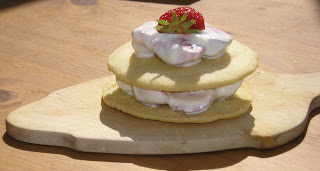
That was not the case when it came to cooking and the three of us loved to bake and baste together so, that by the time I reached my teens, I was able to cook a complete meal from start to finish. At one of my mother’s dinner parties I remembered an amazing stack of ultra thin shortbreads, with layers of clotted cream and rasberries between each one. A final decoration of raspberries and icing sugar on top left an unshakeable image of culinary delight in my mind and one that I had intended to recreate for years.

More disappointment when Mother told me that I’d imagined it, that she’d never made anything like it and it would be impossible to create wafer like, plate sized shortbreads – if only because it would be impossible to lift or cut them without them breaking. I was determined to prove her wrong and, every so often, she would give me that look that mothers do when I told her of my latest failed attempt.
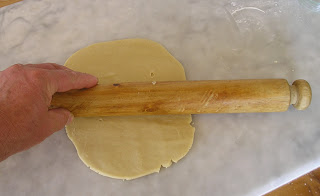
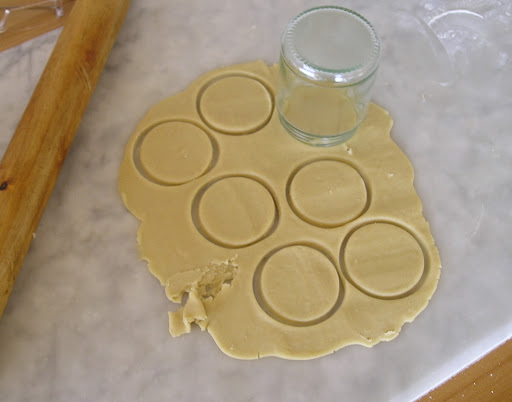
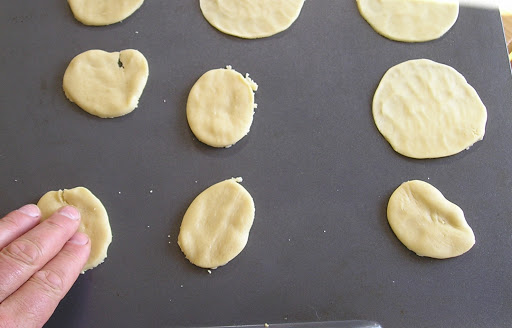
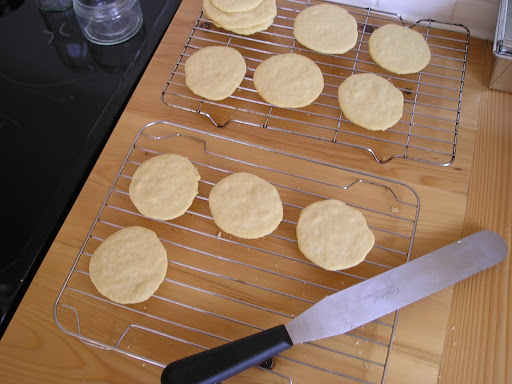
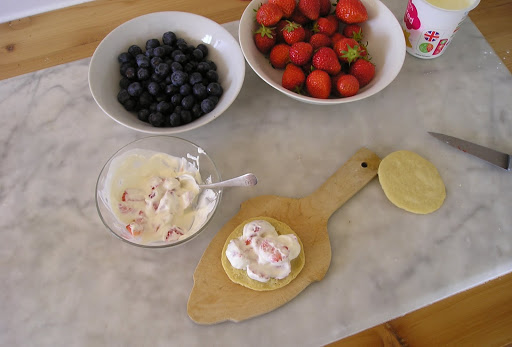
The photographs illustrate the procedure for my ‘wafer stack’


Finally, yesterday, I achieved success, albeit they were much smaller than planned. Now they are individual sized portions but perhaps better for that.

Here is the recipe, which couldn’t be simpler:

4oz butter

2oz icing sugar

6 oz plain flour

pinch of salt

*Put all ingredients into a food processor and whizz until the mix forms a soft ball

*If you just want to make ‘ordinary’ shortbread then press into a flat tin or on a baking sheet with the back of a fork

*Bake for 15 minutes at 180C until firm and only just beginning to colour

*Remove from oven and immediately cut into pieces but don’t remove from baking sheet until completely cool

If you want to try my stack the process is a bit different and a little more time consuming:

*Make as before but instead of pressing down the mixture, roll out as thinly as possible. This won’t be thin enough!

*Cut out rounds – I used a jam jar as I found that if the circles were anything larger they were impossible to lift without them breaking up (Mother did know best!)

*Place on a baking sheet and don’t worry if the rounds are now an odd shape. Flatten with fingers into a round shape making as thin as possible I made 24 altogether from the quantities of ingredients above

*Bake for 5 minutes only at 180C, leave to cool on sheet before lifting

For the filling, use any fruit you fancy. Here, I have used blueberries and strawberries.
Cut up into pieces and mix with a thick cream – I used sour cream (smetena). Decorate with a ‘clean’ piece of fruit

Good luck and let me know if you manage to make them plate size. Somehow, I feel that you won’t and in this case, Mother does know best! I like to think she has been watching my final attempt with an amused smile and rather cross that she is unable to try the end result…..

PS I promise that the next post will be the latest news on the puppies!

Add to Technorati Favorites