
Christmas has been and gone, even the New Year is a few days old. A time of old traditions and also some new ones – one of which is the review of the year past. The first six months can be found by clicking here; now for the next six.
This is the time of feasting, of plenty but in days gone by the essential time of year was harvest. Without a successful gathering of the corn life during winter would be tough for country folk. Harvest, which starts here in July, is still one of the busiest times of the farming year and despite modern machinery replacing many of the labouring jobs in many ways the task remains unchanged. As a young man I helped on what must have been one of the last farms to harvest in the ‘old way’. Working from dawn to dusk, it was hard but we didn’t stop until we knew “all was safely gathered in”…

I tend to avoid Exmoor, England’s smallest National Park, in August for it can become quite busy with visitors (I’m selfish and don’t want to share it with others). This year was different and I arrived in glorious sunshine, the perfect time to see the heather moorland which is in full bloom this month, a purple haze. To keep it looking as perfect as in the image below, the moors are set alight, an ancient practice known as ‘swaling’. The resultant new growth provides food for the sheep, the wild ponies and the other wild birds and animals that roam the moor…

Horses play an important part in my life and in September the Burghley Horse Trials take place. The trials feature three elements of horsemanship: dressage, show jumping and cross-country. It takes a brave horse and rider to tackle the latter element for the course is very testing and some of the jumps huge. Accidents do occur, fortunately rarely seriously but when there is a problem with perhaps a fence needing repair, part of my job is to prevent other competitors from running into them. Stop That Horse! lets on what happens ‘behind the scenes’…

The story of Lorna Doone and John Ridd, the man who saved her is a well-known and much loved tale of romance and treachery, set on 17th century Exmoor. Many of the places and people – but not all – that feature in the book do or did exist. In October I explored what is fact and what is myth? Click here to find out…

There can be fewer more bizarre buildings in the world than The Pineapple in Scotland. In November I was lucky enough to stay there and to explore the other fascinating and ruined buildings associated with it. I also found time to travel further afield and take in the spectacular scenery around Loch Lomond…

Rummaging in a cupboard at home in December I came across some old photographs that had been inherited many years earlier. Noticing a signature and doing some research turned into something far more exciting than I ever could have imagined – it turned out to be ‘a great game’…

2015 looks to be a good year with a number of exciting projects and travel ahead giving plentiful topics for blogging. May it be a good one for you too. Thank you for your support and may the New Year bring you all health and happiness.



 .
.

 .
.








 .
.


 .
. .
. I think the reason we may behave like this is because English weather is nearly always gentle. The landscape that makes up England is beautiful and can be dramatic but not in the way of so many other countries. Take the USA, for example. Where’s our Grand Canyon, our towering redwoods, our Rocky Mountains, our Great Plains and our Niagara Falls? We have them in miniature and, perhaps, that is just as well as we are such a small country. And likewise, our weather: we have heatwaves, we have floods, we have blizzards. But they are rarely anything truly spectacular (except to those poor people affected by them, of course). And so when we were told by the weather men in 1987 that reports of a hurricane were completely exaggerated, we believed them totally. And despite the fact that much of the country was hit hard by it when it arrived, my part of the Chiltern Hills where I lived at the time was not much affected, even though it is one of the most wooded parts of the country.
 The night in January 1990 was different. This time we had winds, whilst not as severe as three years earlier, which created total havoc with the already weakened root systems of the trees. Great swathes of the magnificent beech woods that are the very heart and soul of the Chilterns were flattened in a couple of hours. (I am reminded by my partner, that as the rest of the world cowered in their beds as the trees came crashing down all around, I woke up to say “a bit windy out there” before falling asleep again). As dawn broke the true damage could be seen.
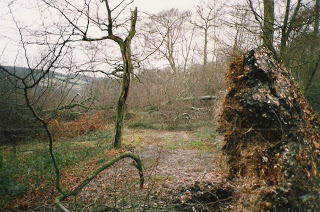 Fast forward twenty years to 2010 and the woodands are transformed. Those of us that remember the 200 year old beech know that the majority are gone and, in their place, are new trees of mixed species. It will be many years before the magnificence of the woods return but they are healing. This photo below is taken from the same spot as the one above. Some of the biggest old stumps have been left, too difficult to move – time has hardly changed their appearance apart from their ‘roof’ of mosses.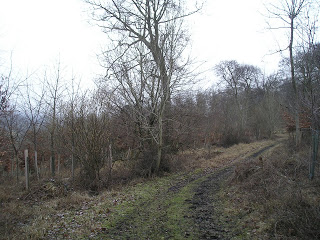
 One of the unforeseen benefits of the hurricane is the increased amount of light reaching the woodland floor, for beech trees cast a dense shade where little can grow, other than where the canopy is lightest. Apart from the view to the valley below, which was unseen before, many wild flowers are better now than ever. Roll on April when we can see the blue carpet of tens of thousands of bluebells disappearing into the distance.
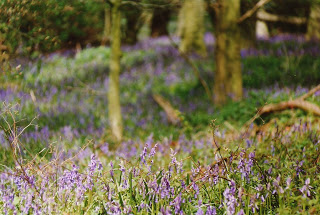 Oh! And I nearly forgot to say, the weather today is a mix of sunshine, cold winds, rain and sleet. Don’t forget to tell the next person you meet!
 Life in the English Cotswolds