
Everywhere I look at the moment there are babies – it’s that time of year. I’m not talking human babies although quite a lot of my friends seem to be having new grandchildren, yet another sign of our ageing. In the secret valley animals outnumber humans by dozens to one so it isn’t surprising that all around us there are signs of new life.
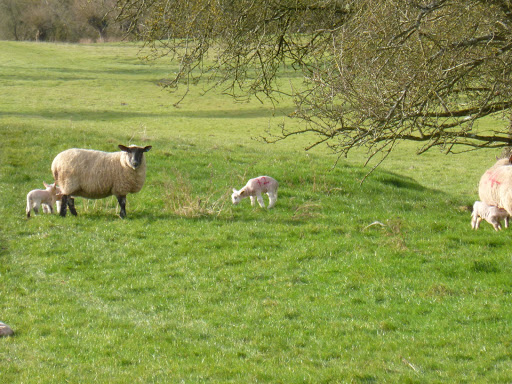
Lambing starts later here than in many places, for the spring grass is also later, so it is with impatience that we wait to see them skipping in the fields and chasing one another up and down the river banks. Of course, that was some weeks ago – now they are grown quite large and, as I write this, very noisy as they call for their mothers who have been separated for shearing. It will be a few hours before they have all found one another and normality returns again; the sound of contented and playful bleating telling us that all is well.
Calves can be born in spring or autumn. Beyond the secret valley is a beautiful herd of Red Devon cattle and they make good mothers. I first came across this gentle breed when I worked on a farm as a teenager on Exmoor and they have been a firm favourite ever since. Bred for beef, we used to hand milk a few for the farm’s own use and the milk was very rich and creamy. Large enamel basins of it would be placed on top of the Rayburn stove (fired by the peat turves I have recently written about, click here) and I would watch fascinated as the cream would rise in large clots to be skimmed off to be eaten with afternoon tea, that most traditional of West Country meals.

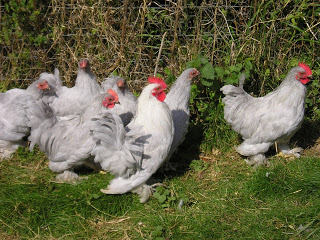
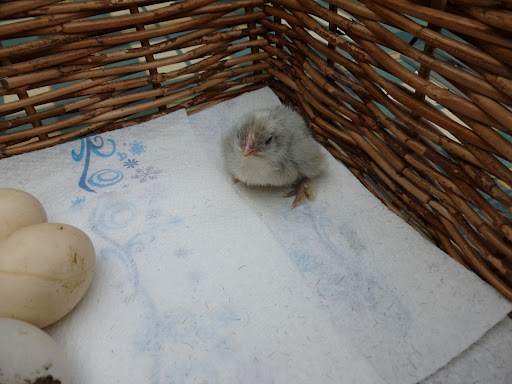
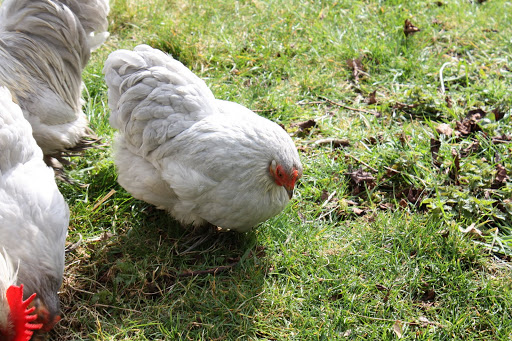
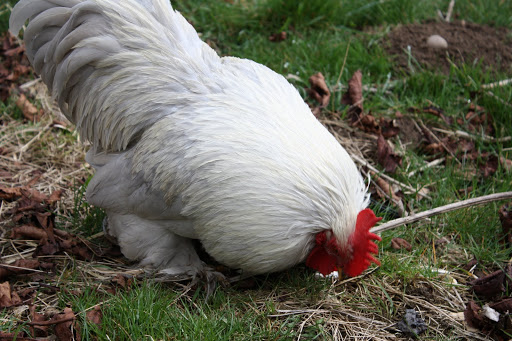
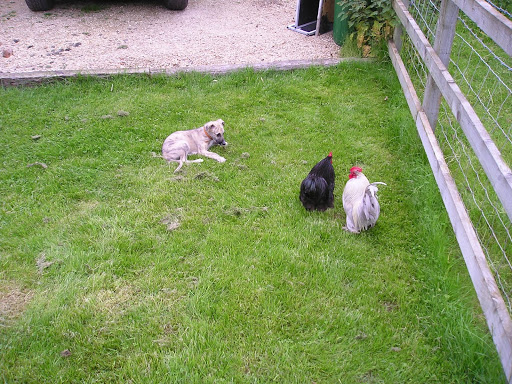
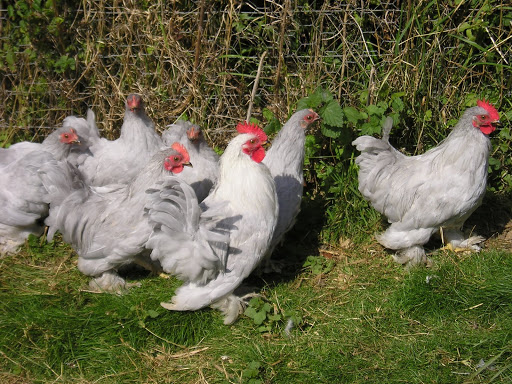
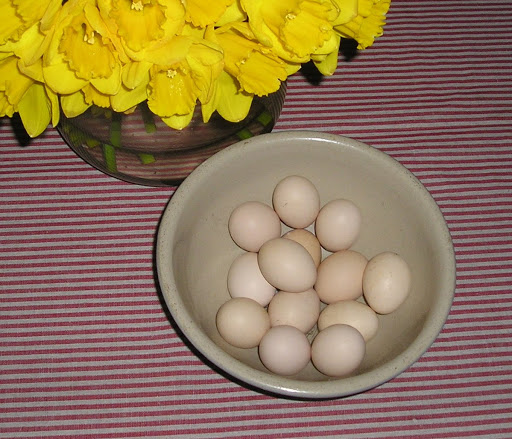
The bantams – Lavender Pekins (Cochins) – are all rapidly going broody. I find that they are only good layers in spring, the rest of the year they lay fewer eggs. We always set some of these under them so that we have a new supply of youngsters: if we get too many there is always a ready home for them but mostly they are there as ready-made meals for Mr Fox who is a far too regular visitor. I’d rather see the bantams having a short but very lovely time wandering about the place than cooped up in a pen somewhere. When left to free range it is amazing just how far they travel up and down the field which does make them rather vulnerable. As the fox usually visits in the early hours of the morning I try to always remember to shut them away safely for the night. In the cold weather earlier in the year a fox visited the garden regularly during the day – at one time actually peering through the glass garden door at us.


We don’t keep duck but that doesn’t stop us from seeing them in the garden. Usually one raises a brood of ducklings somewhere secluded: often under a large clump of oat grass or, before it rotted away completely, a few feet up on top of a rotten tree stump at the foot of a hedge. As soon as they hatch, she leads them away down the field to the river below the house.

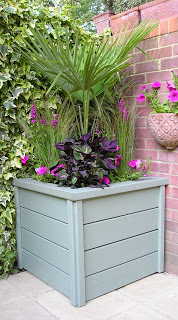
Every year, there are many pheasants that survive the shooting season. Last spring we had one nest in a planting trough beside our kitchen door. Despite the constant activity, she sat tight and none of the dogs, visiting or resident, discovered her. I have read that, when sitting on eggs, the hen pheasant can supress any scent so as to avoid predators. No sooner had the chicks hatched than every dog in the neighbourhood was investigating the planter but by then, of course, she had led them all to safety.

Partridge also visit the garden but are much more wary. When their eggs hatch the chicks are not much bigger than bumble bees and swarm about their mother. They are so tiny they appear to have no legs moving as if somehow they are fitted with wheels instead!

I almost certainly won’t find it necessary to blog about the next ‘hatching’ for an eagerly waited event is the royal birth. When Kate has her baby it will make world news – you won’t need to see a photo of it here!






 .
.







 The lavender hedge not only gave me plenty of lavenders, it also softened the curved and hard edge of the stone path that extended the whole length of the border. An unforeseen bonus was with the reflected heat from the stone – it seemed to heighten their scent, filling the air along with myriads of bees and butterflies that were attracted to it. Another good bee plant was Purple Loosetrife, Lythrum salicifolium, a native plant normally found in damp places and by pond edges. This is a garden cultivar ‘Robert’, which is shorter than the type and was quite at home in ordinary garden soil. The ground cover rose ‘Magic Carpet’ was a close match in colour, the result quite strident but tempered by the lighter centre of the rose flower. I wouldn’t describe this as me at my most subtle!
 A much quieter planting and taking cottage style to it’s extreme was this combination of Icelandic poppies and scabious. I didn’t notice the bumblebee at the time but it really ‘makes’ the photo!
  The Magic Carpet rose looks much easier on the eye planted against lavender and red sage.
 Climbing roses are a passion – no garden should be without at least one. This is a David Austin variety called Snow Goose and is one of my signature plants: it goes into many of the gardens I work with. It is easy, disease free, relatively low growing (about 9ft) so ideal for all sorts of odd corners. It sadly lacks scent which normally would rule it out for me. Certain plants such as roses, sweet peas and pinks, for example, have to have scent, for surely that is their ‘raison d’etre’. Here Snow Goose is growing through Photinia davidiana ‘Palette’ which is being trained as a wall shrub. I love the way the tiny white flowers of the Photinia mimic the rose and the white splashes on the leaves are emphasised by the flower colour.
  Rosa glauca is another rose that I use regularly. It is grown mostly for its wonderful foliage although the flowers are pretty, if somewhat fleeting. This shrub rose will grow to 6ft or more but to get the best foliage and stem colour it is best to prune it hard. Cut back severely it sends out these long, dusky wands which are perfect for cutting for use in the house. Here it is teamed with the Oriental poppy ‘Patty’s Plum’. The poppy was planted inside a trio of the roses which hides the poppy’s leaves as these tend to become rather shabby. The thorns of the rose also hook the floppy stems of the poppy flowers which means that there is no need for staking and tying in: why bother with a chore like that when nature can do it for you?
  A combination of blues against a blue sky using Love-in-a-Mist (Nigella), Salvia nemerosa ‘Rugen’ and two Iris, ‘Jane Phillips’, pale blue with a pleasant scent and ‘Deep Blue’ with its dark, almost black flowers. The tall, ferny foliage in the background is the giant scabious, Cephalaria giganteum. Its pale yellow flowers give a complete colour variation to this part of the border as the iris fade and the Cephalaria opens to glow like moonshine behind the nigella and salvia.

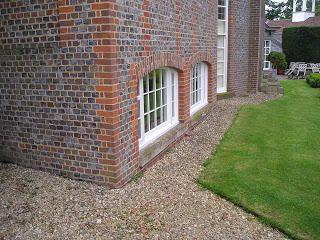

 The house won’t let go. Several weeks later I am asked to return on a regular basis as an adviser and I have been travelling there ever since – the last time to supervise the planting of lavender hedges and, when I return, I still get that warm, contented and happy feeling. Do I believe in reincarnation? I’m far too much a sceptic to say ‘yes’ but there are too many coincidences to give an emphatic ‘no’…..
 And it’s offical: it started in Spring when the BBC reported (so it must be true!) that clouds of Painted Ladies had been seen off the English coast, soon to arrive from annual migration from Africa. And sure enough, just a few days later, the hedgerows of the secret valley suddenly had dozens of them resting on the fresh new leaves and, every so often, stretching their wings to absorb what warmth there was.


 Life in the English Cotswolds