
I have noticed that even those that don’t show the slightest interest in things horticultural love exploring walled gardens, especially if they are overgrown and forgotten. Perhaps it stirs memories of the children’s novel by Frances Hodgson Burnett published in 1911 in which she shows that when something unloved is cherished and cared for it can become beautiful and healthy, be it a plant or the human spirit.

Photo Credit: AC85 B9345 911s, Houghton Library, Harvard University
I have been fortunate over the years in caring for a number of walled gardens in different stages of development yet, regardless of their state, there is something magical in placing the key in the lock and pushing open the door – as nasty, little Mary Lennox discovered in the novel. As she returned the garden to its former glory so, she too, grew into a loving and loveable child.

Perhaps even more so than the plants and trees within, the beauty of a walled garden comes from the walls themselves. The brickwork over time has mellowed and seems to release the warmth of a hundred or more summers, even on the greyest of days. Search the walls and they reveal secrets – a date scratched into a stone, old lead labels revealing the varieties of long-disappeared fruit trees or, occasionally, the name of a much-loved pet buried at its feet.

The walls in this deserted garden date back to the late 17th/early 18th centuries

Recorded for posterity: the trees may have disappeared but the record of the varieties remain
One of the most rewarding to explore yet emptiest of walled gardens has to be that of Dunmore Park. The house no longer stands but the garden walls remain crowned by that most eccentric of British garden room follies, the Pineapple. Here the walls are hollow, fires were lit at its feet and the walls warmed to promote early growth. Sliding stone blocks could be opened to release the smoke which, filling the garden at night helped to keep frosts at bay. Clever, those early gardeners.


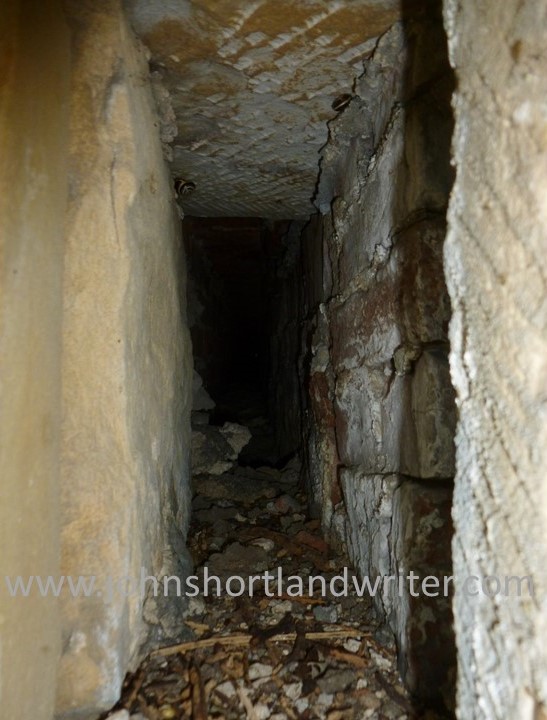
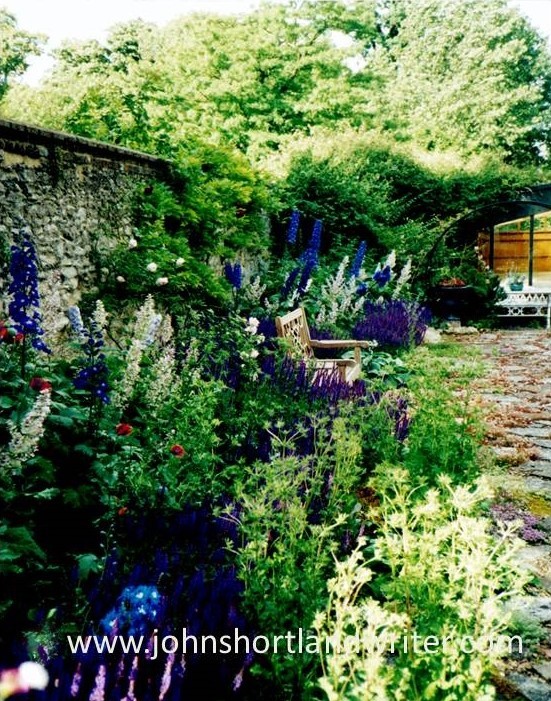
Walled gardens when not open to visitors are more often a place of silence, the only sound to accompany the gardener is that of birdsong and the hum of insects. It can be a place where your mind can be free from the everyday cares of the outside world. It can also be a place where your design ideas can run riot either in your head or, if lucky enough, in reality. The images below show before and after photos of a border I created many years ago, the idea for the colour palette coming from an Imari plate belonging to the owner of the garden. The border is living proof of an imagination run riot!




 .
.

 But it is the walls dividing fields and gardens that are perhaps the most iconic of all the Cotswold scenes. Probably nothing more than heaps of stone thrown to one side when the fields were first cleared, centuries ago, it was the obvious choice for building and permanent too – a good stone wall lasts for decades with virtually no maintenance. However, neglect took its toll.
 A dying art, the old stone walls fell into disrepair until recently when, with an upsurge of interest, building of new walls and repair of the old, has seen the work revived. New, younger blood learning the skills from the dwindling number of ‘wallers’ and with classes available to anyone, means that for the time being at least, the craft seems safeguarded for the future. Here a new walled garden – the classic feature of the English country house – is being created.
 The use of a timber frame as a guide creates the ‘batter’ – the name given to the sloping sides that gives the wall stability. The photos below shows the frame and a new wall being built. Modern techniques tend to use a bit of mortar at the base and also cementing in of the ‘header’ stones along the top. The latter is partially to make the wall more weatherproof (how the old timers would shake their heads at that!) and also to prevent theft of the stone, which is expensive and does disappear at times. Sometimes, the headers are left off altogether and a concrete cap is placed instead which soon weathers down to give an acceptable appearance.
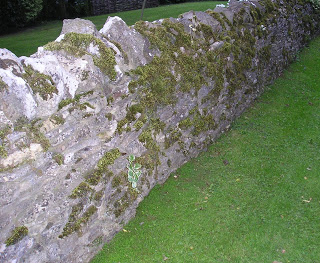
 Our garden in the secret valley has a wall that has stood for over 150 years, below. It will be many years before new walls have the depth of colour and the mosses and lichens of this one.

 The layout of this garden near the village of Oddington is beautifully illustrated from the air – I wonder if the owners were ever so fortunate to see it from above?
 The walled, organic gardens at Daylesford, too, are shown to be quite an unusual shape: the intricate design of the parterre giving way to a less formal area uses this to its advantage – a study in good design.
 Saxon ridge and furrow field systems are also shown in sharp relief. There are a lot of these around the Cotswolds and they can originate from as far back as a thousand years although many were worked up until a couple of hundred years ago. Now preserved and retained as pasture, often the drier, warmer ridges have quite different wild flowers growing compared with the damper furrows.
 We ‘touched down’ in a field not far from the small town of Stow-on-the-Wold, shown in the photo below. Stow is famed for its twice annual Gypsy Horse Fair where travellers gather from all over the UK to buy and sell ponies and catch up with news. It is also well known for its exposed climate as in the local saying “Stow-on-the-Wold where the wind blows cold”.
 The balloon’s shadow chasing us is a favourite photo as also is this one of the burners in full flame!


 Life in the English Cotswolds