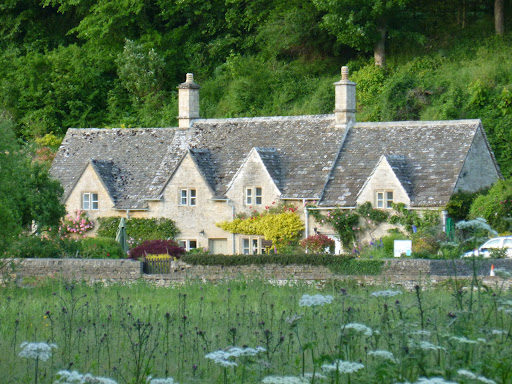
Almost hidden from view, our old stone cottage stands well above the little winding river
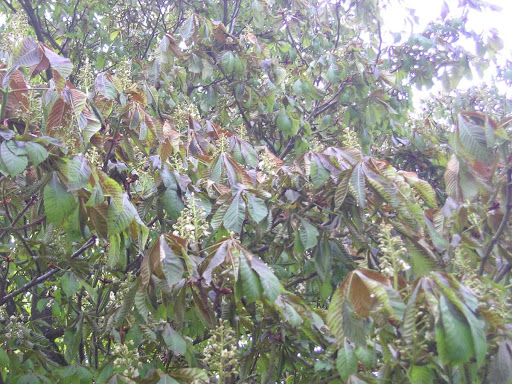
In 2011, we had a very late frost blackening both the leaves and flowers – it took months for the tree to recover
Sources:
British conkers getting smaller
World Conker Championships
Conker Tree Science Project
The making of mosaic patterns is often associated with the Romans although the earliest known examples pre-date them to 3000BC. Associated with many cultures, mosaic artists still flourish today, an unbroken tradition of five thousand years.
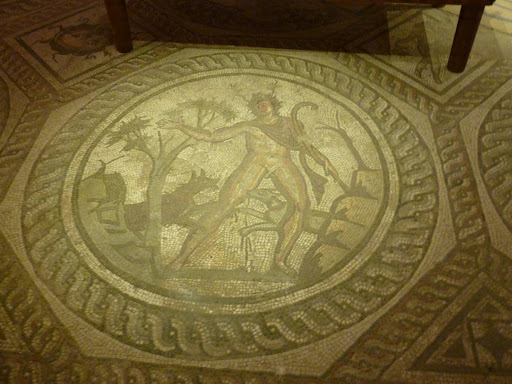
The Hunting Dogs mosaic: head of Oceanus 2nd century AD
In Britain, one of the finest collections of early mosaics can be found in the Cotswold town of Cirencester, situated 93 miles west of London. With a population of 18000, it is one of the larger hubs in the Cotswolds yet has maintained a lot of its old charm for there are still many independent shops as well as the usual High Street chain stores.
History oozes from the very fabric of Cirencester: home to the the oldest agricultural college (Royal Agricultural College) in the English speaking world, founded in 1845; it is also home to the oldest polo club in England (Cirencester Park Polo Club) which was founded in 1894. The charter for the market, still held twice weekly, was first mentioned in the Domesday Book in 1086.
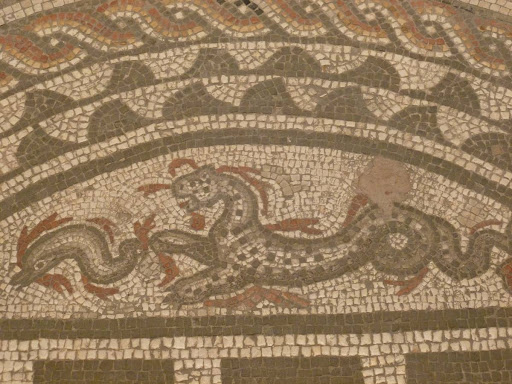
The Hunting Dogs mosaic: Sea Leopard 3rd century AD
However, when the words Cirencester and history are linked together it is the Romans that predominate for their town, Corinium – now modern day Cirencester – was the second most important city in Britain. Corinium lay at the centre of their great road network where Akeman Street, Ermine Street and the Fosse Way all meet, still busy roads today. There are still the remains of a number of their villas in the region that are possible to explore.
The great Roman ampitheatre here was also the second largest in the country with tiered wooden seating for eight thousand spectators. Today, all that remains are a series of banks and ditches, still impressive and well worth visiting.
The Seasons mosaic: 2nd century AD Actaeon being attacked by his own hunting dogs
If there is not a huge amount to see of the original splendour of the ampitheatre, you will not be disappointed by a trip to the town’s Corinium Museum which has recently been extended and refurbished making it one of the best museums in the country. The museum holds over one and a half million artefacts but the most impressive of all of their exhibits have to be the Roman mosaics.
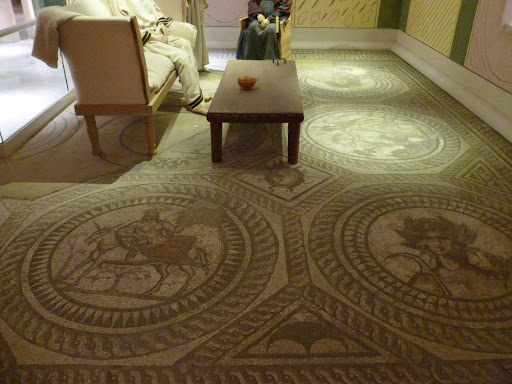
The Seasons mosaic: 2nd century AD
The Seasons is one of the most impressive mosaics in Britain, discovered in Cirencester in 1849, with pictures of goddesses depicting spring, summer and autumn. Winter is missing. In the museum the floor has been laid in an area reproducing a room in a Roman villa.
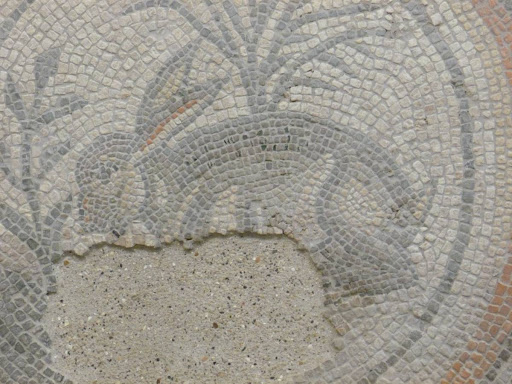
Detail from the Hare mosaic, 4th century AD
The hare is frequently used in Celtic art and fables but was rarely used by the Romans, making this central motif of the mosaic floor unique. If you click on the photo above to enlarge it, you will see that there have been shards of green glass laid into the hare’s back.
Detail from the Hare mosaic, 4th century AD
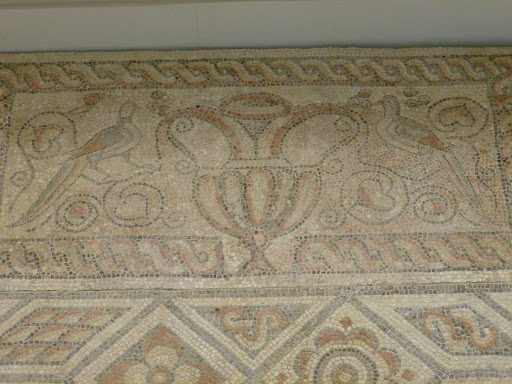
The Hare mosaic, 4th century AD
The museum does not just hold Roman aretfacts, it also covers finds from pre-history as well as more recent times such as Saxon brooches and a large hoard of coins dating back to the English civil war, subjects of a later post. The Cirencester Museum is really worth making the effort to visit – you can find out more details by visiting their website, here.
Horses play an important part of our everyday lives and with my partner having spent a lifetime involved with riding for both pleasure and competitively, it is not surprising that so many of our friends are ‘horsey’ too.
I took up riding rather late in life compared to most and although I’m a competent rider, I’ve never been tempted to do anything that remotely involves winning a rosette. I value my life too much. However, if I thought I could skip the rosettes part and go straight into winning big prize money, I might just give it a try…
Over the years I’ve had my share of falls – this is a good thing for it means that I can recount them at every available opportunity. Horse fall stories are rather like fisherman’s tales – it isn’t just the fish that get larger with every telling, so do the fences, gates and hedges where I met my comeuppance. The story, for example, where I managed to fall off twice jumping a set of rails: the first time I got back on the horse and tried to jump them again – only to land head first in the biggest pile of cow shit for 30 miles. No embellishments there but actually (and don’t tell anyone) the rails were really quite low. I probably could have jumped them even if I hadn’t been on a horse. The most irritating fall story of them all is the time I jumped a hedge to find rather a drop on the landing side. The horse stopped on landing and I sailed straight on, managing to do a double somersault before landing on my feet looking at the other riders jumping towards me. Irritating because although accurately told no-one, apart from the few that witnessed it, believe it.
One way of ensuring numerous falls and a good way to stack up a whole wad of stories for future dinner parties is to take part in team chasing. This is, for the uninitiated, where a team of usually four riders jump a cross country course at a hell-for-leather pace against the clock. The time of the third rider to complete the course is the one that counts. My partner has done this on numerous occasions but these days we are both happy to watch.
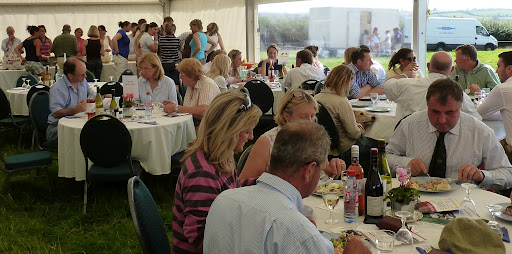
A good friend of ours who is a very successful saddler sponsored one of the classes at the Warwickshire Hunt Team Chase two Sunday’s ago and we were invited to join him and his partner for lunch. I’m afraid to admit that like most events that include food and drink, I spent more time inside the marquee than on the actual course itself.
These sorts of occasions, rather like any other horse events, are very sociable for it is where a widely scattered country population can come together and meet up with old friends and neighbours and exchange news. As I sat at the table pondering upon this and how traditional it is – for country gatherings haven’t really changed that much over the years – I also wondered if this was a worldwide phenomena or whether it was yet another example of British eccentricty. At that moment I noticed one of the guests was sitting at the table astride a pony so I decided it must be the latter. Ok, so the guest and the pony were very small but does that really matter? Of course not, we wouldn’t have cared if it had been a 17 hands stallion (well, we might just, I suppose).
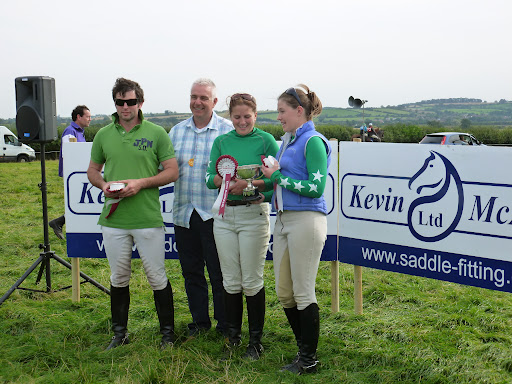
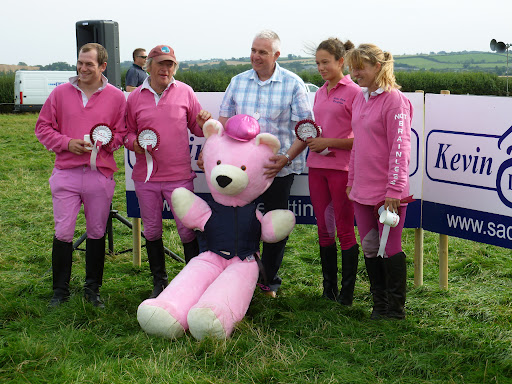
Once lunch was over it was time for the prize giving. The team in pink,, who came second, were riding to raise money for Breast Cancer Awareness.
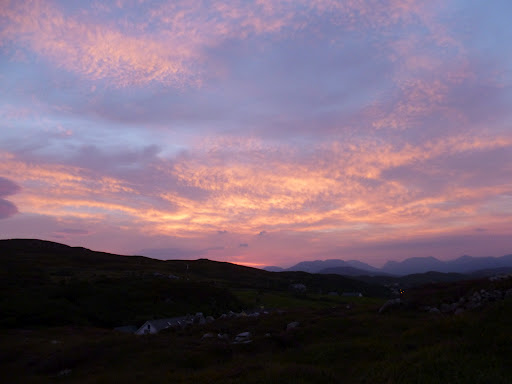
Rugged and beautiful, Connemara is situated on Ireland’s west coast. It’s a wild place: a rock strewn landscape softened by the lush green of field and bog; of purple heather interwoven with the golden flowers of gorse; of towering scarlet and purple fuchsia hedges; of blue sea and empty, sandy beaches and of vast skies. On a warm, summer’s day there can be no more benign a place yet when the gales and driving rain arrive, you are reminded that there is nothing but open Atlantic until you reach the shores of America. It is here that the Connemara pony, as enigmatic as the land that produced it – gentle but tough – developed.
The origins of the ponies are lost in time. Some believe that they date back to the Vikings, others that the local breed crossbred with shipwrecked Spanish Armada horses. What is known with certainty is that during the 19th century they were crossbred with Hackneys, Thoroughbreds and Arabians until by the early 1900’s the pony bloodlines were being lost. In 1923 the Connemara Pony Breeders Society was set up to preserve the breed, the result being that the Connemara is now thriving with societies, clubs and shows worldwide.
The most important of all of these shows – and rightly so – is the one of its birthplace, the Connemara Pony Festival at Clifden, held each year during August. It is to the Festival that I was lucky enough to be invited last week.
My interest in horses, I have to admit, is somewhat limited. I ride and (even if I say so myself) am quite good at it, despite only learning ten years ago but I do find the prospect of sitting watching horses for three days going around a ring rather daunting. But this is Ireland and the craic is as good as you would expect it to be – here you can wander in and out of the showground, the locals are happy to chat to you about anything and everything and the setting is superb: a small showground in the centre of a pretty, brightly coloured town bounded by a dark brown, peaty watered river and backed by mountains. And of course, there is Guinness! A bonus was the weather – hot and sunny, every day.
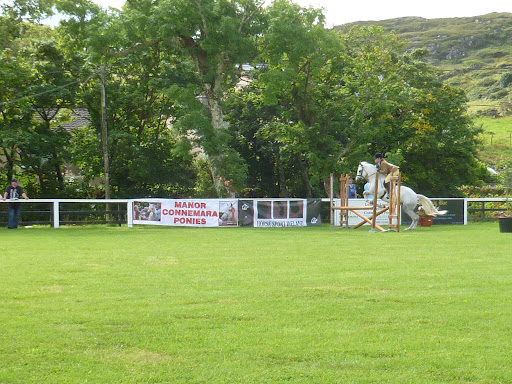
I stayed and watched some of the jumping competitions before my attention waned. The standard of the riding was very mixed but fun was had by all and it was interesting to see how the children just climbed back on board and carried on without, it seems, a second thought. Perhaps that is why so many of the top jockeys are Irish ….
However, when it comes to ‘loose’ jumping, I can stay all day. To watch the ponies move without the restraints of rider and tack, I find fascinating. Here, the atmosphere is very much more relaxed and the banter never ending.
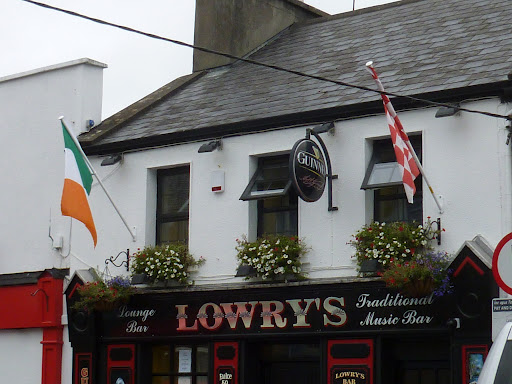
After a long day, what better way can there be than to end it with a stroll through the town, visiting a bar or two along the way? Clifden is also a stronghold of traditional Irish music and from every open doorway the sound of the fiddle eminates. Traditional music has been a lifelong interest of mine and I have had all the elements of a terrific day out – horses, Guinness, Ireland, song and warmth. I walk back to my house, twenty-five minutes outside the town, set high up on the cliffs, as the sun begins to set. The perfect end to a perfect day.
This seems an opportunity to talk of my own horse, Barney. A giant of a horse (who, by coincidence, also came over from Ireland), gentle, wicked and a lot of fun, he helped teach me to ride by ensuring, I like to think, that the saddle was safely underneath me when I landed after a jump. After months of treatment for lameness, he was ‘put down’ – a very sad day. However, I now have Bart who compared to Barney goes like a Ferrari. An ex-eventing horse, he is beautifully schooled and very disciplined, it has taken me a while to feel comfortable with his power and speed. More of all this on a later post – below is an image of him and Ernie, our other horse, as a taster!
We are sociable animals here in the secret valley and nothing pleases us more than when friends call in unexpectedly as they pass by. It doesn’t matter whether there is just one or twentyone, we can always find enough in the store cupboards to water, and feed them too if needbe. More often than not, they are on their way somewhere so a cup of tea, or something a little stronger, is all that is required.
Not the secret valley but still in the Cotswolds. If you click on the photo to enlarge it you can see that the river Windrush has as many twists and turns in it as our little river
Most of the time visitors arrive by car or on foot for the lane that brings you into the valley is as inviting and sinuous as the little winding river itself: it takes you across cornfields, through trees which create, at this time of year, a leafy tunnel before entering a fold in the hills lined with an avenue of cherry and lime trees. It is here that you get your first glimpse of the river and beyond the meanders the lane turns sharply over the bridge taking you a few more yards to the door of our home.
The villages of Lower and Upper Oddington – you can clearly see the lines of the old ‘ridge and furrow’ field plough marks that can date back a thousand years or more
The secret valley, as I have mentioned before, is a landscape in miniature. Everything is small – the road, the hills, the views, the river, even the stone built bridge you can pass over without noticing it. If it all sounds very idyllic that is because it is.
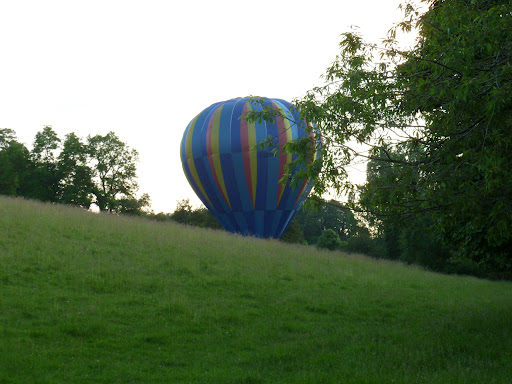
A couple of weeks ago we had some very unexpected guests although we could hear them arriving for quite a while before they finally did so. It was the unmistakeable sound of a hot air balloon losing height. Hidden by trees we could not see who was landing but went off to investigate – She-dog leading the way – and to assist if required. The multicoloured stripes told us it belonged to Charles Teall who lives some miles away and who had once taken me for a flight, although on that occasion we had not landed on our doorstep – for details of that flight click here.
Charles’ wife, Liz, incidentally, is a very talented potter and we have some very nice pieces of her work. She, like myself, is interested in traditional folk music but, unlike me, she can sing and play the whistle and tabor; she also belonged until recently to a local Morris dancers side. Have a look at her work by clicking here.
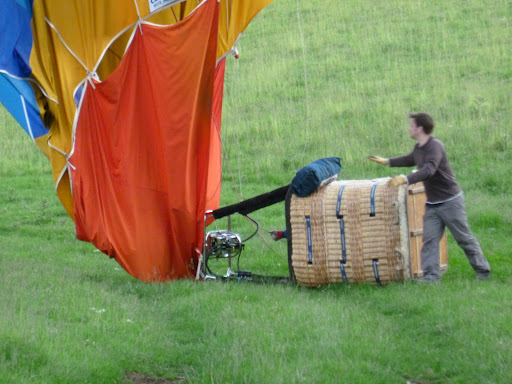
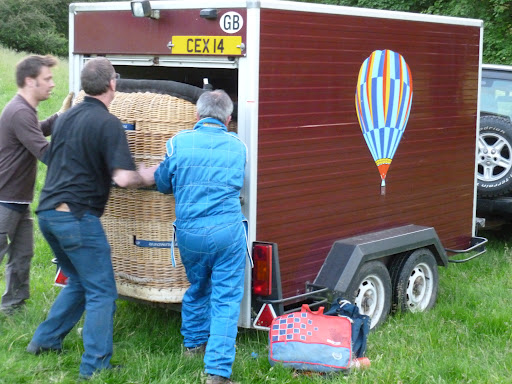
By the time we reached it, the balloon had already landed. It never fails to surprise me just how large it is and just how small the basket is.
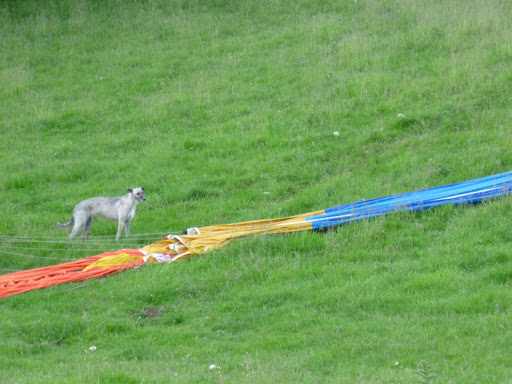
She-dog is normally fairly cautious and we thought that she would be nervous of the balloon. As always, she proved us wrong and felt it important to inspect every part of the balloon: below, the folding meets her approval. Talking of approval, those of you that follow She-dog’s exploits may have been wondering what is the latest on puppy news: there isn’t any. On the last two occasions she has refused to co-operate. She obviously felt that once was quite enough!
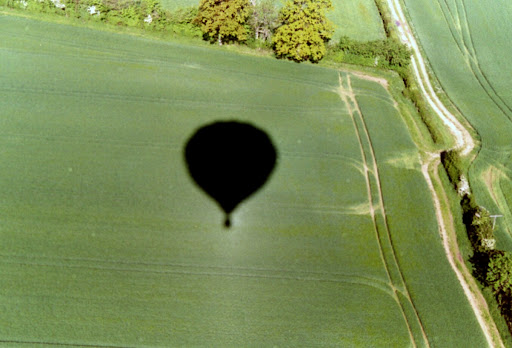
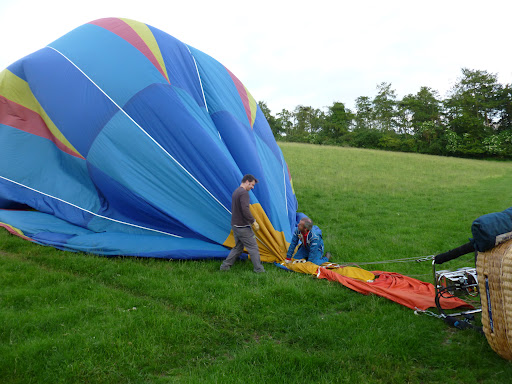
I am always surprised how neatly everything folds away and into such a small space. There is always a mobile support team to assist where necessary so our help wasn’t required. Once packed we were able to catch up with the latest news over a drink and reminisce about our trip flying over the Cotswolds. The aerial shots were all taken on that day.
The counties of Oxfordshire and Gloucestershire, which form the greater part of the region known as the Cotswolds, have some of the best surviving examples of ridge and furrow. To find out how these were created, click here.
I have kept poultry since childhood ever since returning with my parents from a farm on Exmoor with a box containing half a dozen bantams smuggled into the back of their car. When one laid an egg en route and started cackling, my mother was furious. Fortunately we were too far into our journey for them to be taken back. In time, she became equally fond of them and even allowed them to wander into the house to be given scraps of food.
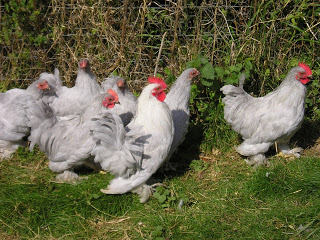
The original bantams were farmyard mongrels but since I came to live in the secret valley I have kept Lavender Pekins. These are allowed to wander the fields, even though they become supper for the fox, for there is nothing more delightful than to see happy hens striding down to the river or up the valley and (hopefully) back again.
Bantams – or Cochins, as they are called in Canada and the USA – are ideal as garden birds for they do very little damage unlike their full sized relatives. We keep those too but they are – with difficulty – kept firmly beyond the fence. I have written about the bantams in an earlier post and this can be seen by clicking here.
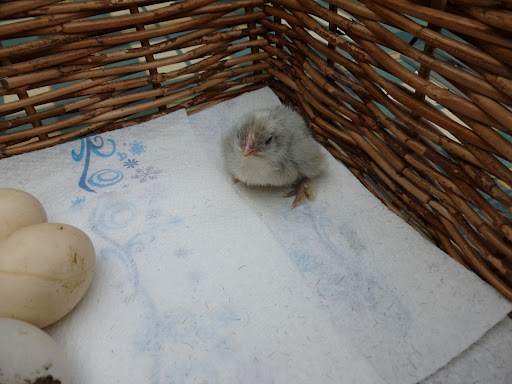
The other day I came across a couple of abandoned bantam eggs put them into a basket, kept them warm and waited to see what happened.
What a result! An hour later it was dry and fluffy ….. and making even more noise!
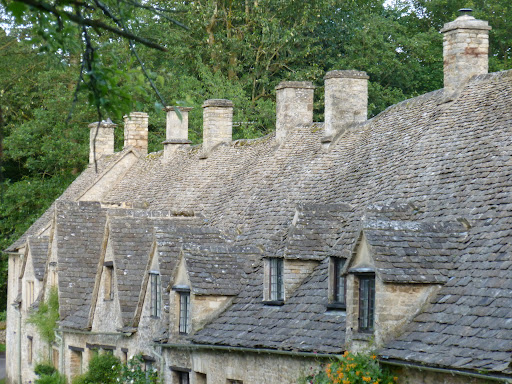
The tiny village of Bibury has long been recognised as one of the prettiest places in the Cotswolds and is much visited by tourists. It is everything you might magine an old English village to be; so much so that some visitors, according to local gossip, not realising that it isn’t a theme park creation, walk into people’s homes to have a look around.
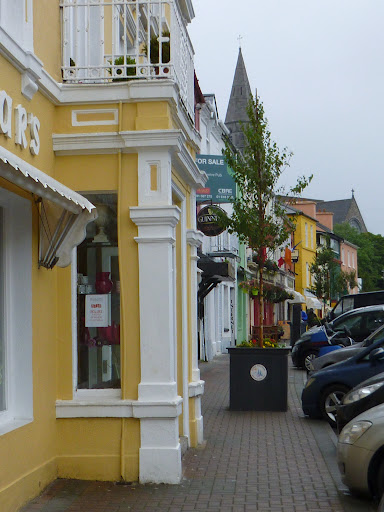
Ancient cottages in mellow Cotswold stone, a crystal clear, trout-filled river running alongside the main street, an old mill and a great pub offering food and accomodation all make Bibury “the most beautiful English village” as William Morris, the Arts and Crafts textile designer described it when he visited during the 1800’s.
The old cottages are so perfect and their setting so tranquil that they appear to have created an ethos amongst their owners: each house and garden has to be more well maintained than their neighbours. The only weeds I saw there were across the river in the marsh and, of course, not only were they growing where they belong – in a wild setting – but there were only the most attractive ones such as Yellow Flags, the bog irises and the flat, white heads of the hogweeds.
No English village is complete without its church and pub and Bibury has both. The church of St Mary’s dates back to the 12th century and is well worth seeking out for it is tucked away down one of Bibury’s few side streets.
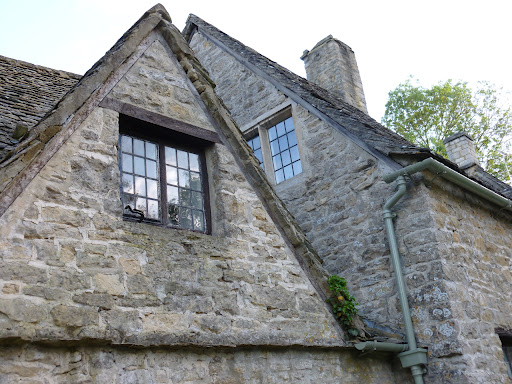
Exploring Arlington Row gives visitors an opportunity to see just how higgledy-piggledy the construction of old house are. The old stone walls and mismatched rooflines and windows are juxtaposed seemingly at random – a modern planning departments nightmare.
Despite, the large numbers of tourists (for we all like to believe that we fall out of that category and will be the only persons there), Bibury is well worth making the effort to visit. It is situated close to Cirencester, one of the most important Roman towns in the UK, with its wealth of history and it is also within easy reach of Oxford. If I had to choose only one place to take a visitor to see, I think that Bibury would be highly placed on the list.
Let me know – especially overseas readers, please – which would be the one place that epitomises old rural living in your country.
The fire boats also gave their salutes wetting already soaked participants even more ……
And Tower Bridge raised its bascules to their highest point in acknowledgement …..
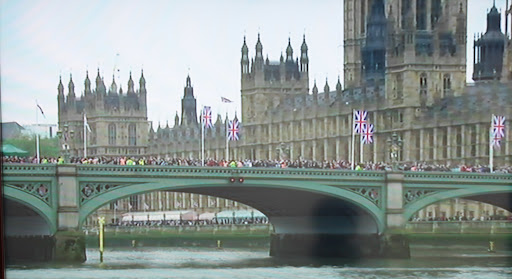
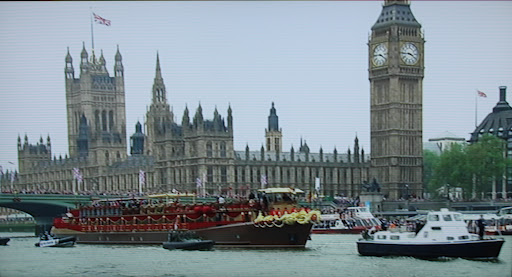
Despite the grey, dreary weather the river – it is rarely given its full title of the River Thames – was a spectacle of colour, of bells ringing, of music coming from one of several orchestral barges and the sound of the crowds cheering, clapping and singing the national anthem, “God Save the Queen”.
Once the Royal party had passed through Tower Bridge, the pageant came to an end. It concluded with the choral barge singing patriotic songs with great fervour despite the choir being drenched to the skin. Never had the words of “Rule Brittania” seemed more pertinant: “Rule Brittania, Brittania rule the waves ……”
For more details of the procession or to read about the individual boats that took part, visit the official website of the river pageant: http://www.thamesdiamondjubileepageant.org/ . Much of the information above has been taken from their very informative site.
The Gloriana (above) is the first Royal rowbarge to have been made in over 100 years. Covered in gold leaf it lived up to its name. Pphotographs can be found on an online article of the Daily Mail – and more information – by clicking here.