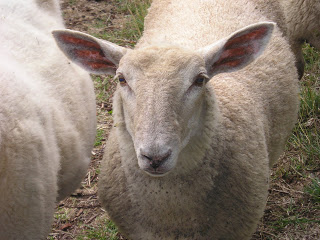
I love sheep! There is something about them. They are supposed to be stupid but I’ve known some clever ones in my time (like I’ve known lots of people who claim to be clever …..). They have exquisite faces, full of charm with a look in their eyes that just beg for a little more human understanding.
.
.
What more can I say about the joys of building a relationship with a sheep or, preferably, many sheep? They smell nice, especially when wet. They’re cuddly (when dry) once they’ve allowed you to become more intimate with them, an especial priviledge.
.
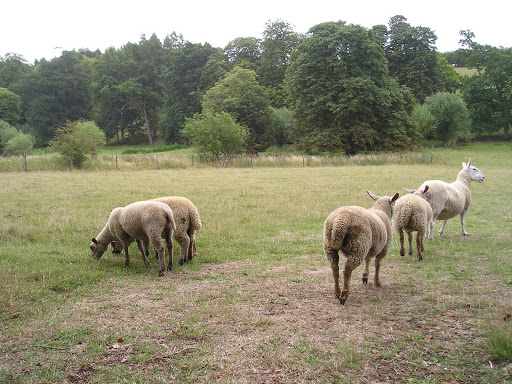
They have lovely voices – varying in tone from deep bass through alto to soprano – and there’s usually quite a few castratos among them too. Each morning, as soon as I step outside into the garden, I am greeted by uplifted heads and welcoming bleats, a sort of dawn chorus, an ovine welcome to another day. And as I enter their field to feed the bantams who are kept there, they gather around me pushing and jostling to have their noses scratched, their ears rubbed and to tell me the latest gossip and goings-on in their sheepy world.
.
.
Now there is one special reason that I haven’t mentioned yet about why I’m so fond of sheep: they taste great, well roasted with lashings of gravy and mint sauce. And that is the quandry. For the reason that these are here in the loveliest field in the secret valley is not for favouritism (as they think) – it is for the pot. And as they try to eat the poultry food I explain that they have no need for such processed feed, for they have the sweetest grass and the freshest river water, when replete they can rest in the shade of the finest trees, the secret valley can offer.
.
.
As if to make me feel even more gulity, they wander off to the empty, upturned feeders. Somehow, even the fattest ones can get inside them. For them, life behind bars is nothing more than a defiant gesture: they little know that judgement has been passed and they have been sentenced to death.
.
.
.
.
.
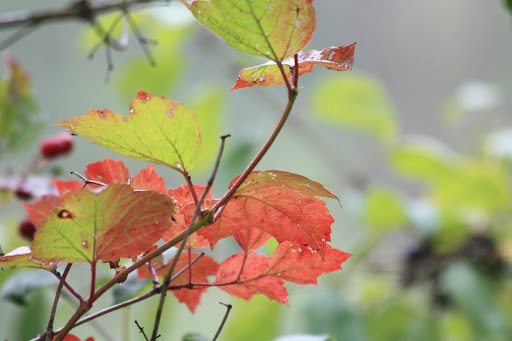
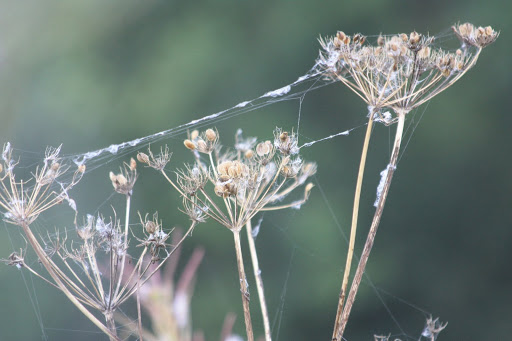
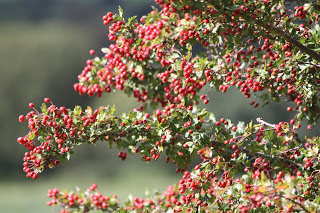
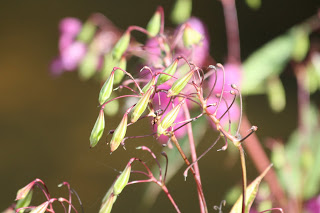
First Signs of Autumn
.
.
.
.
.
.
.
A Walk Along the River Otter: Part 2

.


.
.
Along the final stretch of our walk, the river is backed by the same red sandstone cliffs that can be seen by the coast. How many millenia did it take for this gentle stream to cut its way through to its present level? My photography skills – or perhaps my patience – did not allow me to get shots of the kingfishers that darted up and down as a flash of azure along this reach of the river. High up in the rock face, their nesting holes (or were they the breeding sites of the sand martins that had already begun their long flight south to winter in Africa?) were more easily photographed.
.
.
.
The ten mile walk to the source of the Otter will have to wait for another visit to the West Country. Oh, and I nearly forgot to mention, otters can be found – but rarely seen – along the whole length of the river.
.

.
A Walk Along the River Otter: part 1
The River Otter although not long in length – barely 20 miles from its source in the Blackdown Hills to the sea – is rich in wildlife. Mostly flowing through Devon, in Britain’s West Country, it rises just over the border in the county of Somerset. Passing through rich and fertile farmland it enters the English Channel at Budleigh Salterton where its estuary is protected from the sea by a large pebble bank. It is here that this walk begins.
.
The mudflats, reedbeds and adjoining fields are all part of a relatively small nature reserve, backed by the town on one side and high red sandstone cliffs to the other. The whole area forms part of a World Heritage site for it is part of the English coastline known as the Jurassic Coast, famous for its rock formations, clear water and abundant fossils. The underlying stone of the Otter valley holds one of the most important aquifers in England supplying drinking water to 200,000 people (source: Wikipedia, where else do we go for this sort of infortmation?!).
.
.
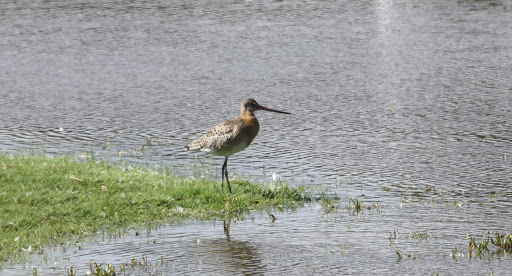
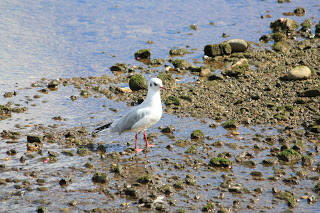
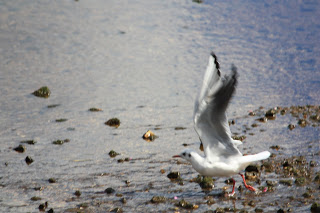
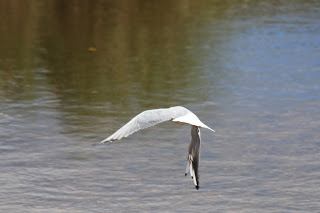
The birdlife, especially at this time of year as migration takes place, is spectacular. In my excitement in trying out my new telephoto lens, I forgot to take general views of the coastline and town. However, as tourism plays such an important part of the Devon economy, it is easy to visit and stay locally – it is well worth adding to your ‘places to visit’ list.
.
There is no public access to the mudflats which means that the birds are relatively undisturbed. However, there are good footpaths along the edges and also hides, where it is possible to view the wildlife with the aid of good binoculars or camera. The Little Egret, below, was a rare visitor to England until very recently. Now, although still not often seen, they are more frequent and breed here. We have even had them occasionally visit us in the secret valley. The Canada Goose also was once a rare escapee from wildfowl collections – now they are seen everywhere and are one of our commonest geese.
.
.
.
.
.
.
.
Richard Long’s Extraordinary Land Art
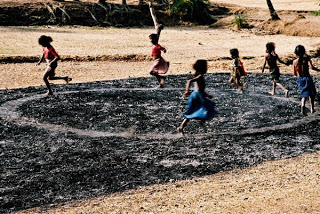
2I have found that there are no shades of grey when appreciation – or lack of it – of Richard Long’s art is discussed. It seems that either, like me, you are swept away by it or you just cannot see the point of it at all. Whilst respecting this latter point of view, I ask myself, “Does art have to have a point”? For me, of all art forms , Richard Long’s work demonstrates that beauty can be appreciated just for it’s own sake.
.
British born (in Bristol, where he still lives and works), Richard Long studied art in both Bristol and London, giving his first solo exhibition in Germany in 1968, as he completed his studies. I imagine this is quite an achievement in itself. Since then he has exhibited regularly throughout the world.
.

.
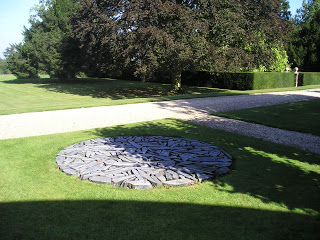
In the grounds of my ‘reincarnation’ house, I was fortunate to be involved in the placing of one of his slate circles (photo above). Sadly, I never met the great man himself, for I would have loved to have sat quietly and watched the stones being laid in place. My contribution was extremely modest: I only removed the turf and put down the base ready for the circle to be put in position. However, this did mean that the circle appeared as if by magic – and it has remained mysterious and magical ever since. And, as if by magic, the gaps between the stones have filled with leaves and debris and yellow lichens have started to colonise their surface.
.
.
.
.
.
The Large Skipper and a Comma
As far as butterflies go, the Large Skipper is not particularly uncommon but I don’t recall seeing them in quite the numbers that I have this summer. They are active butterflies, frequently on the move and fast flying but eventually come to rest to feed or bask in the warmth of the sun.
.
.
The Large Skipper lays its eggs on a variety of grasses and so can be found in many habitats, particularly the edge of woodlands and along woodland rides. The photo below, taken in the deeply wooded Chiltern Hills, may look like a woodland ride but it is an ancient Saxon field or ‘assart’. Assarting – the destruction of forest for agriculture – was considered to be one of the gravest crimes of all when carried out in any of the Royal Forests. This field still has remains of old coppiced or possibly of layed hedge – there is one Field Maple, Acer campestre that probably dates back a 1000 years to Saxon days. It now consists of a series of smallish trees around the space where the original trunk would have been.
.
.
.
Despite its name, the Large Skipper is quite a small butterfly. The females, which are slightly larger than the males, have a wingspread of less than one and a half inches. Their diminutive size has not prevented them from spreading far and wide globally: they can be found from England in the west of Europe, right across the continents, to Japan in the Far East. For some reason they are not found in Ireland or most of the Mediterranean islands. However, their range is still spreading so perhaps they will colonise these places too one day.
.
.
The golden glow of these butterflies gives them a certain charm but they can not be described as pretty, especially with their huge, bulbous eyes. This glow is also present in the underside of the wing which shows up faint spots and helps to distinguish them from the Small Skipper and the Silver Spotted Skipper, both of which are to be found in Britain but far less frequently. The latter, incidentally, is also found in parts of North America.
.
.
Another golden butterfly, but this time a very attractive one, is the Comma. It is everything the Large Skipper isn’t – delicate, attractively marked and large. This butterfly was rare when I was a child but numbers have increased rapidly in recent years and it is now no longer considered endangered.
.
.
.
.
Searching for Granny ….
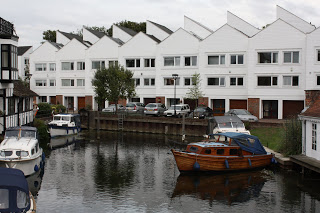
….. well, great-Granny actually. I hadn’t exactly lost her for I had ‘discovered’ her in old census records when researching our family history. I also remembered being told, as a child, that “Granny used to live there”. What I hadn’t realised was that Granny and my more distant ancestors were some of the most important mill owners on the River Thames, the premier river of England. The family owned Marlow Mills, which they converted from corn to paper production in the early 1800’s.
.
Marlow Mills survived many mishaps ranging from a very destructive fire to withstanding the riots that were a spill-over from the agricultural riots of the 1830’s. Other mills in the area had their machinery destroyed – the ancestors were obviously made of tougher stuff, for they surrounded the mill with vicious man traps. The traps could still be seen hanging in their offices in the early 1900’s – perhaps as a warning to any other miscreants! What it didn’t survive was the craze for redevelopment and in the 1960’s they were bulldozed and luxury riverside homes built in their place. Sadly, we no longer owned the mill by then: if we had I might be living in luxury for the 17 properties on the site sell now for around one million pounds each.
.
.
Yesterday, I found myself in Marlow on business but, with time to spare, decided to explore. How odd it felt walking these once familiar roads and riverside walks now knowing that two hundred years ago my family were doing the same. This street view probably hasn’t changed much although, as the family were so religious, I can’t imagine that they sat outside the local pub drinking alcohol in the warm, summer sunshine!
.
.
The view of the river, the church and the bridge must have changed even less, although they would have watched with interest the suspension bridge, designed by William Tierney Clark, being built in the 1830’s (the old wooden bridge collapsed into the river in 1828). Ten years later, he designed and built a larger version of the bridge in Budapest, with which Marlow is twinned.
.
.
This old post box must be one of the very earliest ones made for, even in Victoria’s reign, the design became more elaborate. This one looks ancient but is still in everyday use – the VR stands for Victoria Regina, she reigned from 1837 – 1901 and is our longest reigning monarch. If it is one of the earliest it could date back to 1853, the year that post boxes were first introduced. Incidentally, by tradition, all British post boxes bear the initials in Latin of the reigning monarch at time of manufacture. I wonder how many of my family had posted letters here?
.
.
.
I knew, from an old record found on the internet, that Joseph Wright – my great-great grandfather – had been instrumental in building a free church in the town. To my delight, not only did I find the church still thriving, I was able to speak with a senior member of the congregation who, by chance, happened to be there. I was shown a history of the church but there was no mention whatsoever of the Wright family connection, a name not even known to them. Had I got the right place?
.
.
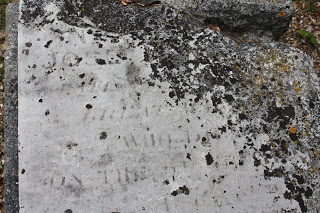
Searching through old gravestones, I first came across one with the initials J W and M A D carved in the base. The initials turned out to be for Mary Ann Downing (not for death by insanity!), a name I’d not heard of and, frustratingly, the husband’s name had been damaged and was barely legible – I could just make out the name Joseph. However, it had obviously been a smart grave once for there were the signs that it had been surrounded by iron railings. But why Downing and why J W?
.
.
.
.
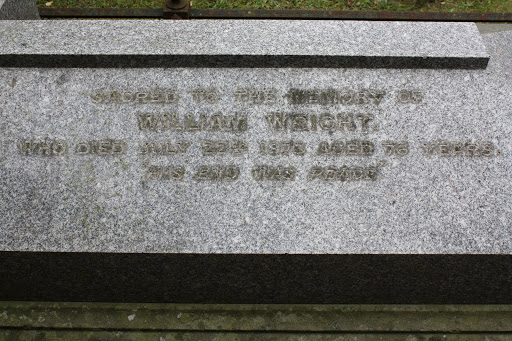
Then I came across the grave, below, that looked so recent. To my amazement it wasn’t new at all but over 130 years old. The marble and the railings of such high quality that they showed no sign of wear. Here the names were clear – they were of William, Joseph Wright’s brother and partner in the milling business, and his wife.
.
.
.Further along was another grave in good condition, although more modest. It was unusal for it was very long and narrow. Almost overlooked in my excitement, this was the grave of Ellen Wright my ‘own’ grandmother’s mother. I had found great-Granny! I knew of Ellen for she had been born in Finland, which had always been something of a mystery. I found that she had been born there because her father was, for a few years, at a paper mill there before returning to the mill at Marlow. Was he learning new techniques or was he there advising?
.
.
An Unexpected Downpour
The heatwave may have ended a good number of days ago but the dry weather hasn’t and the gardens are desparate for water. Digging down to plant some large shrubs the other day, there was no sign of moisture in the soil, nor earthworms for that matter, no matter how deep I dug. It is tedious to water with a hosepipe and, for some inexplicable reason, (perhaps it’s the chemicals in tap water), plants react so much better to a drop of rain.
.
Today the skies were grey but, as none had been forecast, it came as a surprise when I thought I could smell rain in the air. And was that a distant roll of thunder or was it just wishful thinking? With no further warning, the heavens opened, the rain bouncing off the surface of the lane and the leaves of the plants. By the time I had reached my camera, it was already beginning to ease.
.
.
.They must have had more rain than us, further up the secret valley, for water continued to rush down the lane in its haste to reach the river. Just past the bend its route took a sharp right turn to tumble down the steep banks to enter the meanders – the ones that feature on the header of this blog – just above the road bridge.
.It’s a novelty to see puddles once again!
.
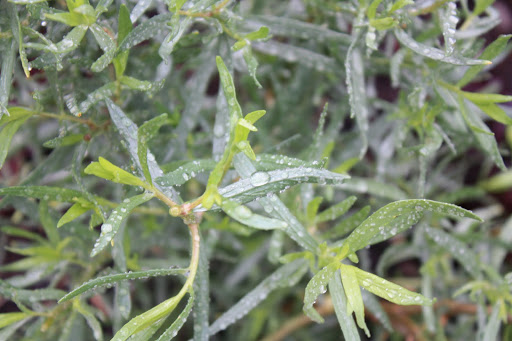
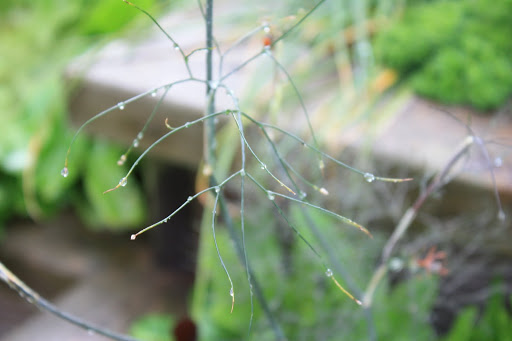
.I couldn’t resist catching these images of the herbs cloaked in moisture. The French Tarragon seems to be greedier than most and holds water all over the surface of its leaves. The bronze Fennel, however, holds its drops in a very much more refined way as befits such a graceful plant.
.
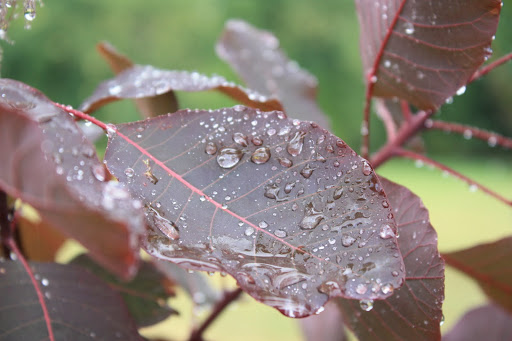
.Cotinus – this is the variety called ‘Grace’ – appeared splattered with rain, as if it had been flicked with paintbrushes. It held its drops in different sizes, some so large I wondered how they could remain in place and keep separate from the smaller sized ones alongside.
.
.The old fountain head of a cherub and dolphin sits at the top of a flight of steps leading to the garden, for many years no longer used for its original purpose. Did the rain bring a slight smile to its lips and was that a tear that rolled down its cheek to its chin as it recalled its real purpose in life?
.
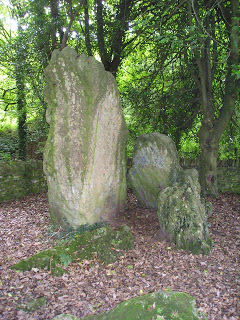
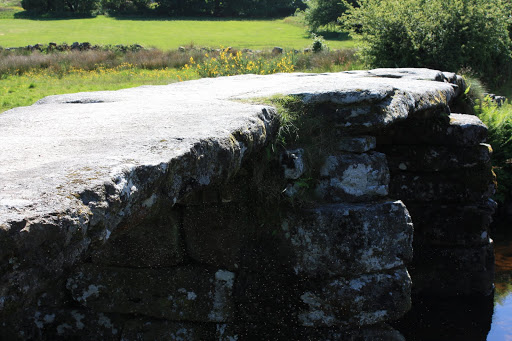
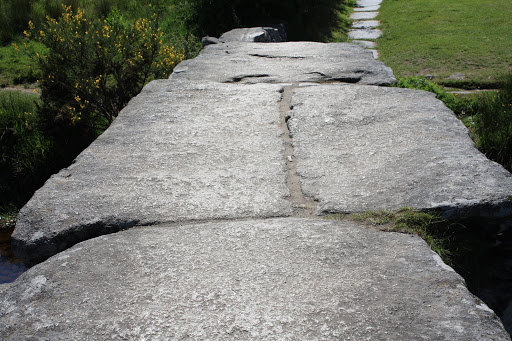
"A Massive Piece of Granite"


..
.
Anatomy of a Flower Arrangement
How often does a garden plan go awry only to find that you have something equally as good, if not better, instead? This is what happened to one of my designs, a large area taking up almost one quarter of a walled kitchen garden.
.
.
Formal beds, surrounded by box(wood) hedging and topiary, were planted to create what was to be a tisane, or herbal tea, garden. All the plants were supposed to be suitable for making infusions for either medicinal or culinary use. Something went wrong and, for reasons unknown, half the plants either died or refused to flourish. In desperation, we turned it into a cutting garden where flowers could be harvested for arrangements for the big house – actually, the mystery house I used to dream of as a child. I have written about this house before and the tale of my arriving there two hundred years after I had died….
Concentrating on those plants that survived the initial planting, I decided to see how they would cope with being used as cut flowers and the result was much better than expected. The flowers were cut in the middle of the hottest day of this year so far – not ideal conditions – and then plunged up to their necks in water for the rest of the afternoon. They looked poorly and drooping when first arranged but perked up overnight and now, ten days later, look as fresh as ever.
.
.
.Beautiful, downy, soft-as-velvet leaves and the merest hint of pink flowers, they require no staking, suffer from no pests or diseases and grow year after year, getting ever stronger. And, of course, you can always make marshmallow sweets to eat from their dried, powdered roots.