Searching for Granny ….

….. well, great-Granny actually. I hadn’t exactly lost her for I had ‘discovered’ her in old census records when researching our family history. I also remembered being told, as a child, that “Granny used to live there”. What I hadn’t realised was that Granny and my more distant ancestors were some of the most important mill owners on the River Thames, the premier river of England. The family owned Marlow Mills, which they converted from corn to paper production in the early 1800’s.
.
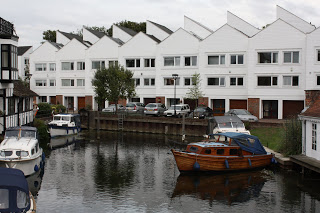
Marlow Mills survived many mishaps ranging from a very destructive fire to withstanding the riots that were a spill-over from the agricultural riots of the 1830’s. Other mills in the area had their machinery destroyed – the ancestors were obviously made of tougher stuff, for they surrounded the mill with vicious man traps. The traps could still be seen hanging in their offices in the early 1900’s – perhaps as a warning to any other miscreants! What it didn’t survive was the craze for redevelopment and in the 1960’s they were bulldozed and luxury riverside homes built in their place. Sadly, we no longer owned the mill by then: if we had I might be living in luxury for the 17 properties on the site sell now for around one million pounds each.
.
.
Yesterday, I found myself in Marlow on business but, with time to spare, decided to explore. How odd it felt walking these once familiar roads and riverside walks now knowing that two hundred years ago my family were doing the same. This street view probably hasn’t changed much although, as the family were so religious, I can’t imagine that they sat outside the local pub drinking alcohol in the warm, summer sunshine!
.

.
The view of the river, the church and the bridge must have changed even less, although they would have watched with interest the suspension bridge, designed by William Tierney Clark, being built in the 1830’s (the old wooden bridge collapsed into the river in 1828). Ten years later, he designed and built a larger version of the bridge in Budapest, with which Marlow is twinned.
. .
This old post box must be one of the very earliest ones made for, even in Victoria’s reign, the design became more elaborate. This one looks ancient but is still in everyday use – the VR stands for Victoria Regina, she reigned from 1837 – 1901 and is our longest reigning monarch. If it is one of the earliest it could date back to 1853, the year that post boxes were first introduced. Incidentally, by tradition, all British post boxes bear the initials in Latin of the reigning monarch at time of manufacture. I wonder how many of my family had posted letters here?
.
.
.
I knew, from an old record found on the internet, that Joseph Wright – my great-great grandfather – had been instrumental in building a free church in the town. To my delight, not only did I find the church still thriving, I was able to speak with a senior member of the congregation who, by chance, happened to be there. I was shown a history of the church but there was no mention whatsoever of the Wright family connection, a name not even known to them. Had I got the right place?
. .
Searching through old gravestones, I first came across one with the initials J W and M A D carved in the base. The initials turned out to be for Mary Ann Downing (not for death by insanity!), a name I’d not heard of and, frustratingly, the husband’s name had been damaged and was barely legible – I could just make out the name Joseph. However, it had obviously been a smart grave once for there were the signs that it had been surrounded by iron railings. But why Downing and why J W?
.
.
.
.
Then I came across the grave, below, that looked so recent. To my amazement it wasn’t new at all but over 130 years old. The marble and the railings of such high quality that they showed no sign of wear. Here the names were clear – they were of William, Joseph Wright’s brother and partner in the milling business, and his wife.
.

.

.
Further along was another grave in good condition, although more modest. It was unusal for it was very long and narrow. Almost overlooked in my excitement, this was the grave of Ellen Wright my ‘own’ grandmother’s mother. I had found great-Granny! I knew of Ellen for she had been born in Finland, which had always been something of a mystery. I found that she had been born there because her father was, for a few years, at a paper mill there before returning to the mill at Marlow. Was he learning new techniques or was he there advising?
.

.
The final pieces of the jigsaw came into place when, at home, I found that after Joseph’s death, Mary Ann had remarried (hence the Downing surname). Her widowed husband obviously agreed to her wishes and she was laid to rest with Joseph, her first love.
.
Feeling extraordinarily emotional (strange, really, for I did not know them in the true sense), I reported back my discoveries to the gentleman in the church who was equally delighted to discover that these unknown benefactors were still present within the church they had helped to create.
.
Now all that is left to close the circle of 200 years is for me to attend a service, something I hope to do in the very near future.
.

Add to Technorati Favorites

An Unexpected Downpour

The heatwave may have ended a good number of days ago but the dry weather hasn’t and the gardens are desparate for water. Digging down to plant some large shrubs the other day, there was no sign of moisture in the soil, nor earthworms for that matter, no matter how deep I dug. It is tedious to water with a hosepipe and, for some inexplicable reason, (perhaps it’s the chemicals in tap water), plants react so much better to a drop of rain.
.
Today the skies were grey but, as none had been forecast, it came as a surprise when I thought I could smell rain in the air. And was that a distant roll of thunder or was it just wishful thinking? With no further warning, the heavens opened, the rain bouncing off the surface of the lane and the leaves of the plants. By the time I had reached my camera, it was already beginning to ease.
.
.

.
They must have had more rain than us, further up the secret valley, for water continued to rush down the lane in its haste to reach the river. Just past the bend its route took a sharp right turn to tumble down the steep banks to enter the meanders – the ones that feature on the header of this blog – just above the road bridge.

.
.
It’s a novelty to see puddles once again!
.

.
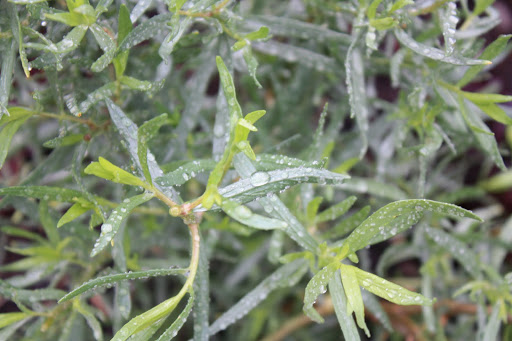
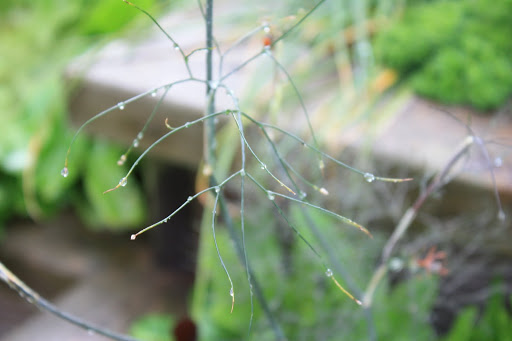
I couldn’t resist catching these images of the herbs cloaked in moisture. The French Tarragon seems to be greedier than most and holds water all over the surface of its leaves. The bronze Fennel, however, holds its drops in a very much more refined way as befits such a graceful plant.
.

.

.
Cotinus – this is the variety called ‘Grace’ – appeared splattered with rain, as if it had been flicked with paintbrushes. It held its drops in different sizes, some so large I wondered how they could remain in place and keep separate from the smaller sized ones alongside.
.

.
The old fountain head of a cherub and dolphin sits at the top of a flight of steps leading to the garden, for many years no longer used for its original purpose. Did the rain bring a slight smile to its lips and was that a tear that rolled down its cheek to its chin as it recalled its real purpose in life?
.
.
If above is the picture of innocence, what is this next one? A single raindrop on each barb transforms the fence but it can only partially disguise its wickededness. We are not that easily fooled …
.

.
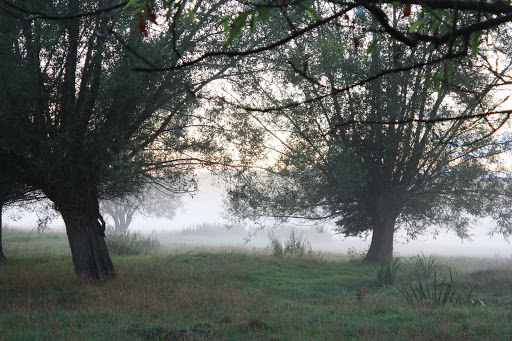
Thirty minutes after the rain stopped the secret valley was shrouded in mist as the cooled air reacted with the warm earth. A short battle for supremacy ensued but, along with a slash of blue sky came a winning dart of sunlight and the mist fell to the ground, disappearing as quickly as the rain.
.
.

"A Massive Piece of Granite"

It is a family joke that whenever a large piece of stone is seen, one person asks “What is it?” and the other answers – slowly and after much deliberation and head scratching – “well, it’s a massive piece of granite”. For, many years ago, this was the only answer we got from an old countryman at an ancient stone burial chamber that towered above us.
.
Burial chambers, stone circles and other standing stones, which mostly date back 5000 years or so are reasonably common around Britain,and a surprising number of them are quite impressive. There are several scattered around the Cotswolds and I have written about our little known and little visited Old Soldier and also the very well known and very much visited stone circle, the Rollright Stones.
.
.
The Old Soldier
.

.
The Rollright Stones
.
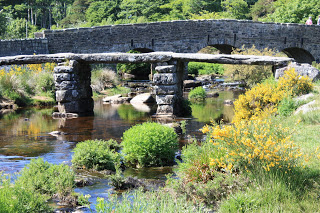
Far more scarce and, perhaps even more impressive, are the stone ‘clapper’ bridges. These are often not as old as they look although, even these, were probably built the best part of a 1000 years ago. I find these bridges, which are mostly in the West Country on Dartmoor and Exmoor, just as impressive as Stonehenge, England’s world famous ancient stone monument. The clapper bridge in the photoographs below is at Postbridge, on Dartmoor, in the county of Devon. This clapper bridge was built to aid the transport of tin from moorland mines about 1200AD.
.
.
The ‘new’ bridge in the background, which carries the road and car traffic over the East Dart river is a mere upstart, having been built about 1780. In the photo below, I love the way the arch of the new bridge is framed by the ‘arch’ of the old one.
.
.
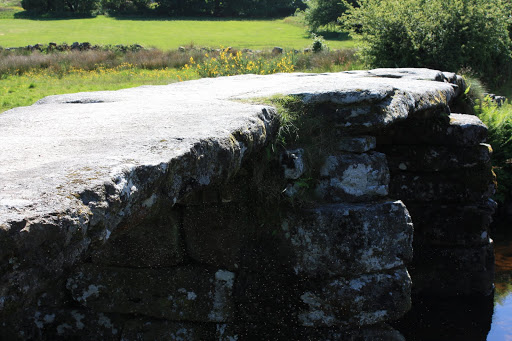
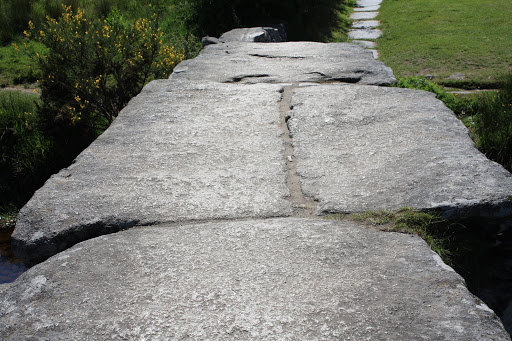
The granite slabs measure over 4 metres (13ft) long and are over 2 metres (6ft 6in) wide and weigh over 8 tons each. Despite this, over the centuries they have been swept away downstream by floods. Some have been rebuilt many times, others lost forever. However did they, without modern technology, transport them?
.

.
.
The bridge just invites you to step onto it and it can be the starting point of many walks that lead across the open moorland. It was for me, a couple of months ago. On that walk, I found deserted settlements and the most incredible stone circle – unusual in that there were two circles side by side. I shall write more of this soon.
.
.
Even now, when a special occasion needs to be commemorated it is to stone that we often turn to. To my knowledge, no modern material is in common use to mark the burial place of a loved one: we mark our graves in a very similar way as our most distant ancestors, with stone slabs.
.
We also use stone to mark more joyous occasions. This standing stone was placed on Ibstone Common, high in the Chiltern Hills, to commemorate the millenium. A small thread that unites us through 5000 years of history and far into the future – a comforting thought.
.
.

Add to Technorati Favorites

Anatomy of a Flower Arrangement

How often does a garden plan go awry only to find that you have something equally as good, if not better, instead? This is what happened to one of my designs, a large area taking up almost one quarter of a walled kitchen garden.
.

.
Formal beds, surrounded by box(wood) hedging and topiary, were planted to create what was to be a tisane, or herbal tea, garden. All the plants were supposed to be suitable for making infusions for either medicinal or culinary use. Something went wrong and, for reasons unknown, half the plants either died or refused to flourish. In desperation, we turned it into a cutting garden where flowers could be harvested for arrangements for the big house – actually, the mystery house I used to dream of as a child. I have written about this house before and the tale of my arriving there two hundred years after I had died….

. .

Concentrating on those plants that survived the initial planting, I decided to see how they would cope with being used as cut flowers and the result was much better than expected. The flowers were cut in the middle of the hottest day of this year so far – not ideal conditions – and then plunged up to their necks in water for the rest of the afternoon. They looked poorly and drooping when first arranged but perked up overnight and now, ten days later, look as fresh as ever.

.

.
Much of the structure is created with a framework of Artemisia ‘Powis Castle’. I find that to get the best results it is necessary to prune this shrub down to ground level each spring. They then produce long wands of stunning silvery foliage. A bitter herb used for all sorts of ailments, I would have to feel very ill before I would consider drinking a tea made from this!
.
At this point, I should stress, that I am no herbalist so I do not recommend that you try out any of these plants without deciding for yourself whether they will do you good or kill you instead.
.
.
Hemp Agrimony, Eupatorium cannabinum, is a British native plant, normally found growing in damp places but quite happy in the garden border. The Joe Pye of America, it is claimed that it is good for many different ailments but especially good for gout.
.
.
A big surprise, was this Spearmint. In the cutting garden it has grown exceptionally tall (and like all mints, proving rather invasive) with attractive, fine flowers. This is, of course, one that I can safely recommend for use as a culinary herbal tea, very refreshing on a hot summers day and good if you suffer with indigestion.
.
.
Lavender needs no introduction. Oddly enough, because of soil conditions, I thought they would struggle in this garden. Instead, they have thrived.
.
.
Marjoram, another common herb that grows wild in England on sunny banks, also needs no description from me. It is our best bee and butterfly plant in the garden, even outrivalling Buddleias. We grow it in huge patches throughout the garden.
.

.
Leaving the best to last and the biggest surprise of the lot! Marsh-mallow, Althaea officinalis, another UK native. This was the first time I had grown it and it is now one of my ‘signature’ plants that I try to incorporate into every design. Related to Hollyhocks but only about half their height and very much more delicate in every way, except one – they are as tough as old boots!
.
.
Beautiful, downy, soft-as-velvet leaves and the merest hint of pink flowers, they require no staking, suffer from no pests or diseases and grow year after year, getting ever stronger. And, of course, you can always make marshmallow sweets to eat from their dried, powdered roots.
.
.
This recipe comes from my old herbal, although I have never tried to make them:
2oz marsh mallow root, 14oz fine sugar mixed with gum tragacanth and enough orange flower water to bind altogether. Quite what you do after that I have no idea – perhaps just eat them?
.
Add to Technorati Favorites

Blogging One Year On….

Greetings from the secret valley! Today is a special day for it is exactly one year since my very first post.
.
.
the secret valley
.
When I began blogging, it occurred to me that, as what I was writing would be in the ‘public domain’, that someone might read it. However, deep down, I didn’t think that anyone would. It is a constant surprise that it is read and that the number of viewings is in the thousands rather than just half a dozen or so. Thank you so much.
.
Like many of you, I write for my own pleasure but, knowing that the words are read, I do make some effort to write coherently and, hopefully, interestingly – not always, I fear, with success. The secret valley is always a source of inspiration and, sitting at my computer, I look out across the fields to the trees and the little, winding river. The photo below is what I see every day and never forget just how lucky I am.
.
.
view of the secret valley from my desk
.
And so, one year on, you have followed me through the seasons:
.

.

in the cold

.

.
and as the weather warms
.
You have followed me on my travels:
.

.

Grafton Street, Dublin, Ireland

.

.

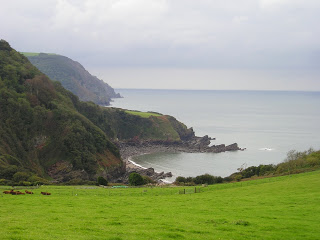
Lee Bay, Exmoor

.

You have met my family:

.

.

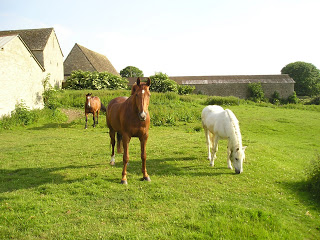
The old nags

..

and the very special She-dog

.
And you have witnessed my gardening:

.


.
my successes….
.
.
….and my failures
.
But best of all, through blogging, I have met interesting people from all over the world, from all walks of life and I am all the richer for it.
.

.

and sometimes I still can’t get the spacing right between paragraphs – is it me or is it Blogger?!

Add to Technorati Favorites

Cooking: Cherries and a Tongue Twister

It has been a good year for cherries. Despite the hard and late frosts, which continued well into May, there has been a bumper crop. And, for some reason, the birds have been kind enough to leave them for us humans to harvest. There is the appearance of something exotic, or even of decadence, in the cherry’s shining, red orbs hanging in profusion. Perhaps because we see it all to rarely.
. .
One rather plump bird has developed the taste for cherries. Henrietta, the tamest of our Lavender Pekin bantams just can’t get enough of them! Fortunately, the others show no interest and, not being the brightest of creatures, Henrietta hasn’t considered flying into the trees to eat even more.
.

.
Today was a cooking day – I love cooking but have no patience when it comes to following recipes, occasionally with unfortunate consequences. Luckily, today was one of the better days. Having picked the cherries, I had no idea what to do with them, so sat outside in the sunshine stoning them, waiting for inspiration.
.

.
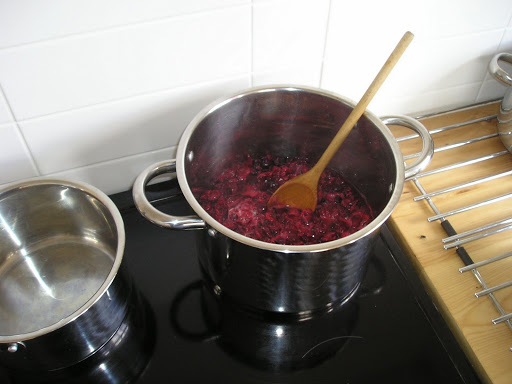
So much juice came from the fruit that it was necessary to strain it off. I thought of jam and other weird and wonderful ingredients to add to them. In the end, I just cooked them gently until their skins were tender, then added sugar and stirred in some mixed spice and some cinnamon. It made a pulp that will go down a treat with vanilla ice cream or with some natural yoghurt for breakfast tomorrow.
.

.
So what to do with the juice? First thought was to throw it away but, apart from the waste, I knew that Rhonda from down…to…earth, would not approve. Her blog is so inspirational, I highly recommend it to all that want to try and live -even just a tad – more simply. Warmed through with sugar, a few chilli flakes (I only wanted it to have a slight kick, not blow my head off) and some vanilla essence, it has become the basis for several potential options. Below it was poured over crushed ice and topped up with chilled tonic water to make a beautifully, refreshing drink for a hot, summers day. The colours were an unexpected and added bonus.
.
.
Next, the tongue twister: Geviklte Kichlach. I have had the great fortune of having a Jewish grandmother – if you have never had one, I suggest you find one that you can adopt. For apart from spoiling their grandchildren rotten, they are the most superb cooks. Geviklte Kichlach, which translates approximately, to ‘twisted little cakes’, Grandma would make for my every visit.
.
The recipe is more a pastry one than a cake recipe and it is very simple. I use spelt flour and baking powder as my partner has a wheat intolerance – spelt, despite being a type of wheat, is often ok for people with digestive problems.
.
.
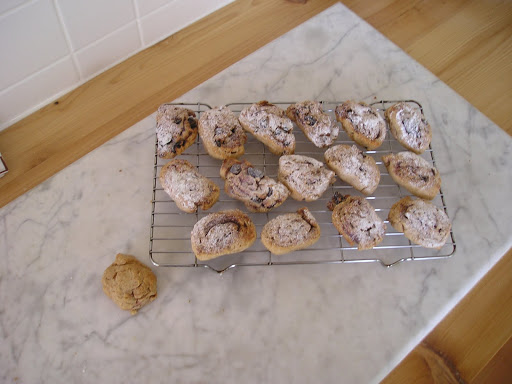
Mix 4 oz butter with 4 oz curd cheese and 6 oz flour (if not using self raising, add two teaspoons of baking powder). Roll out thinly to an oblong and spread with jam. Then sprinkle currants over the top and some ground cinnamon and roll into a sausage shape.
.
.
You can elongate the sausage, if need be, by rolling it with your hands like plastacene. Cut into thinnish slices. Place on an ungreased baking sheet and bake at 190 until golden – about 10 minutes. Once cool, dust with icing sugar (it does need this additional sweetness, so don’t be tempted to leave it out). The undusted, currant free version, sitting on the marble slab is a special treat for She-dog!
.
.
You don’t like it? Well, as Grandma would have said, “You will like mine – now eat!”.
.
.
Please remember, overseas visitors, that the measurements are in British ounces and the oven temperature is in Centigrade.

Add to Technorati Favorites

A Sting in the Tail

This year is proving to be one of extremes. Weather wise, first it was snow, then late frosts, then rain, more recently drought and scorching temperatures. And it also seemed to be a similar situation with wildlife. The tree blossom and wild flowers have been amazing with every month some new blooms outrivalling those of the previous month’s.
.

.
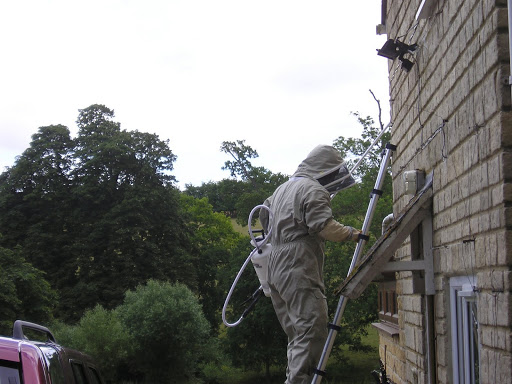
Now it seems July is to be the month of wasps. There are hundreds in the garden, indeed probably thousands, and they are everywhere. And if that isn’t bad enough, the very hot weather we’ve been having seems to have made them far more aggressive. Normally they do not prove to be troublesome until the fruit ripens in late summer, this year it’s different. And I’ve already been stung once this week which is very bad news for me – I suffer from a severe reaction, although never yet been hospitalised, fortunately. I keep my drugs and sprays with me – and a mobile phone, in case help is needed – and also keep my fingers tightly crossed. This, like the recent advice from a doctor to stay indoors, is not too much help for someone who earns their living by gardening.
.
.
Fifteen wasp nests in four days has surely got to be a record and so I have been keeping the pest control man busy. It’s a pity to destroy them but better I get them first than the other way round! I remind myself that during the spring they live on aphids and the like and are, therefore, valuable pest controllers themselves. Then I remind myself of the pain, discomfort and swelling, and sometimes injections I get, and they have to go.
.
.
I commended myself on my bravery, taking these photos, as the wasps went into the attack as the chemical jet entered their nest. But such is my devotion to get a new post out – I’m becoing a true blogger news hound!

. . .

My heightend awareness of wasps this week made me also notice these holes in a deserted timber garage. They were the homes of a small colony of wood wasps. Unlike the common wasp which live communally in their hundreds (the largest of our nests turned out to be the size of a football), wood wasps are more solitary, each one occupying their own chamber.

. .

They are quite placid compared to their aggressive cousins and, I believe, unable to sting a human being. The largest ones look terrifying but this species was small, about half the size of the common wasp. There are about 500 species of solitary wasp in Britain and I can’t identify any of them. I felt totally at ease photographing them inches away and they completely ignored me. Perhaps word had got round what I did to them further down the secret valley!
.

. ..

I’m now looking forward to the first frosts and a wasp free winter!

Add to Technorati Favorites

Scabious: Wild and Tame

Regular readers of this blog will know that I am very fond of garden plants that have not been messed around with too much. By that, I mean I generally prefer the simpler flowers. So-called ‘improvement’ is so often just another word for vulgar, blousy and big – although there are occasions when I have a need for both the blousy and vulgar!
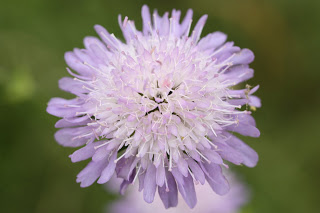
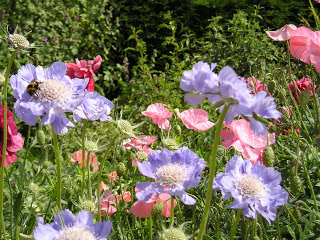
Scabious are a delight regardless, whether they are growing in the hedgerow or the border.
.
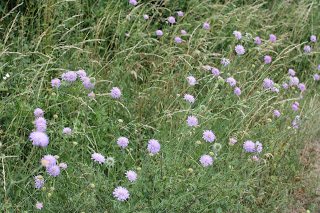
The secret valley is awash with scabious, as well as other wild flowers, at the moment. The dry weather seems to suit them for they are looking just perfect. They seem to be everywhere – they especially like roadside verges but also grow in odd pockets of wasteland on very poor soil. But it is not just the secret valley where they are found, for the whole of the Cotswolds seems to be a haze of powder blue. In fact, they grow pretty well throughout the British Isles although they are much more scarce in Scotland.
.
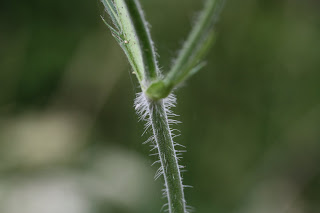
I have found photography and blogging has improved my powers of observation for it is only recently that I noticed that the scabious has quite hairy stems. These feel quite soft to the touch, so it was with some surprise that I learnt that they are closely related to teasels, whose hairs have been modified into sharp, protective spines.
.
However, it was only when looking at these pictures that I noticed how the flowers open from the outer edge and then work there way inwards. Obviously, my powers of observation have still some way to go!
.
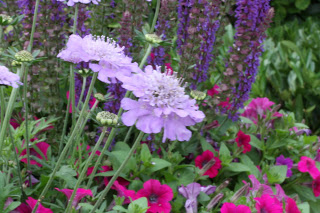
As garden plants, in my opinion, they are superb. Always tidy, never need staking and, with regular dead heading, flower continuously from mid June onwards. In the photos below, scabious is being grown in a cottage garden border (this is Scabiosa caucasica but still pretty!) amongst pale pink Icelandic poppies. The scabious is perennial and will grow again every year, the poppies are annuals. I just threw some poppy seed down amongst them and, as the poppies were mixed colours, removed any that turned out not to be pink. Simple!
.
As an ingredient for containers they are unrivalled, too. Here, in huge one metre square pots, they form an underplanting with Salvia nemerosa and small flowered petunias beneath the (very) light shade of Cornus controversa ‘Variegata’. This scabious is an improved form of our wild flower – it is dwarfer than the type.
.
.
The Five Spot Burnet moth flies in daylight and is everywhere at the moment. They especially seem to like feeding on the scabious, choosing these above the profusion of other wild flowers. They are very pretty and when the light catches them at the right angle, the black ground of their wings become irradescent, similar to the ‘black’ feathers of the magpie and farmyard cockeral.
.
.
Going…..
.
Going…….
.

Gone!
.
Like many plants, occasionally a ‘sport’ arises. Driving home today, I noticed just two white flowered scabious growing by the side of a country lane. Beautiful!


Add to Technorati Favorites

No Time For Growing? A Recipe For Guaranteed Success

We all lead busy lives these days and often don’t have time to sow seeds, despite our best intentions. I garden for my living and, in the tradition of cobbler’s children, my own garden is, more often than not, far from text book perfect. I simply do not have the time for all that seed sowing and pricking out even though I spend all day encouraging others to do it!

Raised beds are often described as labour and space saving and, indeed, they are. They are hugely productive and can look lovely, as the many posts and photographs by fellow Bloggers prove. But what if you don’t have the time even for that?

Here is my recipe for growing summer suppers…..

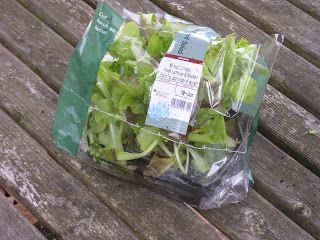
1. Purchase a box of lettuce. No, not joking! Supermarkets sell a wide range of salad ingredients including growing pots of near full grown lettuce. Recently they have started to sell mixed leaves as seedlings, the idea being to keep them fresh for a few extra days.


2. Carefully remove all wrappers and tip out of their packaging. There is quite a good root system already started.


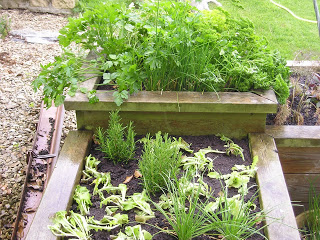
3. Divide carefully and, just by using your fingers, plant direct into your soil or compost. Water well. In the photo below, for even more speed, I just pinched a few plants out of the growing medium and planted together in one hole. I ended up with about twenty groups – planted separately I would probably have had nearer a hundred. Note the herbs behind the lettuce, all grown the same way.


4. The lettuce in the photo above may have looked a little sad but within a day, the seedlings perked up. Ten days later here are some of them again below. Enjoy!

Recently I have been taking the idea of raised beds a stage further and creating much higher raised beds that avoid the hardship of bending. I use them as ‘walls’ to separate different levels of a garden, I use them on the flat and I use them where the client is elderly or has a disability.

Made from chunky timber so they won’t rot for years, I also make them bottomless as that is always the first place to go. They require less watering that way too. Lining them with black plastic prevents water seeping through and disfiguring the boards which is important if they have been painted or stained. And the boxes just seem to be getting ever bigger!

This box separates the lower dining terrace from the house level and creates a sense of enclosure when seated below. As it is situated close to the kitchen door, the box is planted with a mix of herbs as well as garden flowers. The twisted stemmed bay gives a degree of formality as well as height.

Exotic planting works well in this square box. A hardy palm is underplanted with coleus, the magenta splashes of the leaves are emphasised by the identical colour of the petunias and of this favourite plant of mine, Lythrum. Lythrum is native to the British Isles and grows besides streams and in boggy places. This variety, ‘Robert’, is identical in every way except for its shorter height and is a great garden plant. I’ve found that it grows in quite ordinary soil in the border and it certainly thrived here in these conditions.


PS I’ve just remembered! Spring Onions (Scallions) bought as bunches from the supermarket: when planted out early in the year, grow to become reasonable sized onions. They don’t store well but help to bridge the gap that occurs before those grown from sets are ready for harvest. Try some in your boxes!

Watercress works as well: eat most of the stems you buy and plant just the last 2 – 3 inches in ordinary compost. Keep moist and it will provide food up until the first frosts.

Add to Technorati Favorites

Archbishop Desmond Tutu in Oxford

Last May, Archbishop Desmond Tutu gave the Bynum Tudor Lecture at Kellogg College, University of Oxford in the historic Sheldonian Theatre.

The lecture, “Lessons from the truth & reconciliation process for 21st century challenges”, was thought provoking and fascinating. Although I have written of the lecture at the time – the post and photographs of the Sheldonian Theatre can be seen here – it is only now that the video of the lecture has become available.

For those of you that would like to view it, click on this link to Kellogg College, here.

Add to Technorati Favorites