Cheltenham: a Regency Treasure

From the moment you enter the town of Cheltenham you are struck by the number of Georgian and Regency houses and municipal buildings – there are hundreds of them dating back to the late 1700’s. In fact, the town has one of the largest concentrations of listed buildings in the country. The style of building is as pleasing to the eye today as it was 250 years ago: clean, fresh lines, mostly built of local, cream coloured stone.

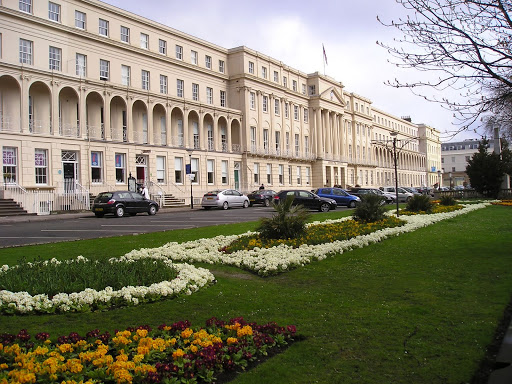
The most prestigious street in the town is Promenade, situated in its heart, in the area known as Montpelier, a mix of designer shops, offices, bistros, sculpture, flower bedding and fountains. The photographs below demonstrate the grandeur of the area – the large building is the Borough Council offices.

Montpelier came into existence in 1808 when a new well was discovered there. A hundred years before, salt springs were discovered and, after George III visited in 1788 to ‘take the waters’, the town became even more popular. Montpelier’s well ensured the success of the area and Promenade was laid out as a wide, tree lined walk in 1818.
.
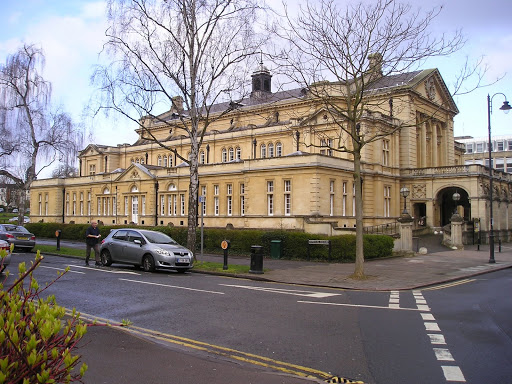
Today, Cheltenham still thrives, busy and loved by both local residents and tourists alike. The Town Hall, below, is the centre for many exhibitons and concerts and each year the town plays host to both literary and music festivals attracting a world wide audience.

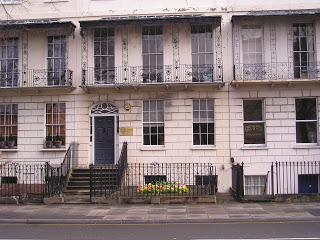
It is not just the grand buildings and streets that contain architectural gems. The photographs below demonstrate the houses and apartments that can be found down many of the side streets. These photographs are of original buildings; many new buildings are also built in the style and blend in so well that, in many cases, they have to be sought out. Not many new buildings can afford the elaborate iron work railings as in these genuine, Regency flats. Ironwork is another major architectural feature of the town.

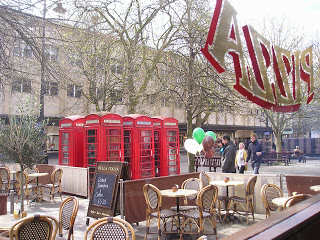
Cheltenham is a place that really has to be explored on foot to discover all of its secrets and eccentricities. Sitting in a street cafe on Promenade I realised I was looking out onto a cluster of red telephone boxes – a very traditional, English sight, rather akin to red double decker buses. These boxes are almost a thing of the past now, having been replaced by modern kiosks that look the same whichever city in the world you might be in.
.
The Wishing Fish Clock is totally eccentric! The tallest mechanical clock in existence, on the hour the fish blows bubbles while the clock plays the tune ‘I’m Forever Blowing Bubbles’!
.
The Cotswold Hills rise steeply from the edge of Cheltenham and driving back to the secret valley through unknown country lanes, I came across another eccentricty. This stream that runs through the tiny village of Compton Abdale has had a witty crocodile waterspout added to it. There was no sign to explain the reasoning behind it: another case of British humour, I imagine!
Add to Technorati Favorites

At Last! Signs of Spring!

The secret valley is at last bursting into life, albeit rather late. Or perhaps, this is how the season should be as we have had such mild winters the past few years. Whichever, the last few days have been warm and sunny, although the wind has been on the keen side at times. The result is greenery beginning to appear in the hedgerows and on the trees and what a welcome sight it is. Today I decided to walk along the ‘old’ road, a drover’s route that was the original way to enter the secret valley before the present road was created, probably in the late 18th century. This route is now a wide grassy path – a subject of a post to come shortly.
.

The photo above shows how advanced the Spindle bushes are compared to some of the other hedgerow shrubs. The hawthorn beyond it is still quite dormant yet, some years, they can start to leaf up during February. Hawthorn seems especially prone to variation as some of them elsewhere in the secret valley are quite green with new leaves.
.
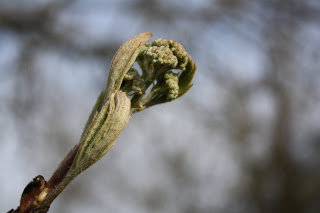
The Wayfaring Tree, Viburnum lantana, below (which never reaches tree like proportions) also looks lifeless from a distance. However, that is because its leaves and flower buds are greyish when first opening, being covered in felt like hairs , botanically referred to as tomentosum. The photograph beneath the Wayfarer is not of the same plant but the opening buds of the Whitebeam, Sorbus aria. They are not related: Viburnums belong to the honeysuckle family and Sorbus to roses. The Whitebeam makes a fine tree and although it is native, it is often planted in gardens.

It will be sometime before the Ash trees open their leaves but their black nobbly buds, that look so hard and devoid of life, quite suddenly have burst into little pom-pom flowers. All they need now is a group of cheerleaders to use them in their routine: it would certainly aid pollination!
.
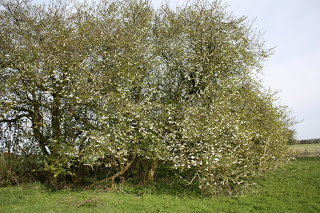
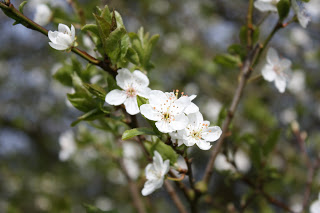
Why should this group of Cherry Plum be in full flower when other trees are not in leaf? I have no idea but am just grateful to be able to enjoy some of the first blossoms of the year. I’ve had to wait a long time to see this, this year.

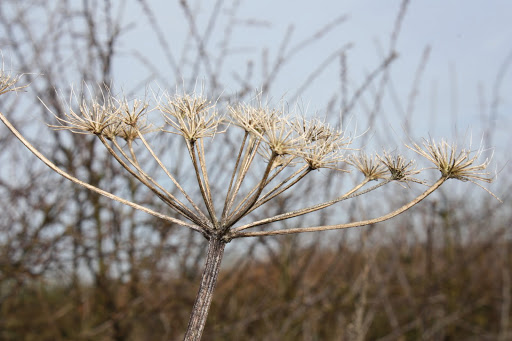
The wild flowers also show both signs of the winter and also spring life. Cow Parsley or ‘Keck’, as it is known locally around here, is sending up its young leaves which clearly show the reason for the ‘parsley’ in its name. Where ‘Keck’ originates from, I have no idea, for I have not come across that name when I lived in the Chiltern Hills just 50 miles away. Local plant names can be very confusing and make an interesting study in itself. Despite its lushness, Cow Parsley is poisonous. Later, in the summer, it will send up tall spikes of flat, white flowerheads made up of dozens of tiny stars. These dessicate to remain standing through the winter and, surprisingly, there are still a few that have survived the snow. They have a special beauty when the sun catches their metallic, bronzed skeletons.

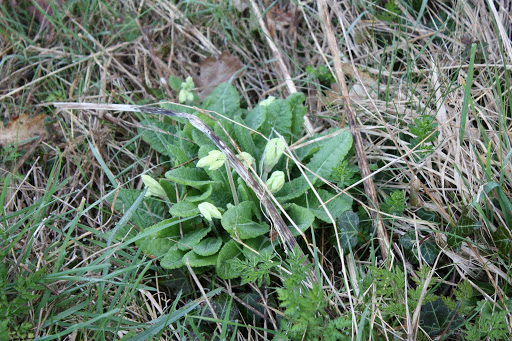
Cowslips, Bluebells and the Hedge Mustard (which in the Chilterns, we called Jack-by-the-hedge) are all showing signs of things to come. The cowslips show their flower buds and, normally, bluebells would be doing so too. In the bottom photograph, the Jack-by-the-hedge has leaves reminiscent of the garden plant, Honesty. These leaves have quite a mild garlic smell when crushed and make a good addition to spring salads when they are young and tender. The little spikes of six to eight small leaves in whorls are the dreaded Goosegrass (or Cleavers, depending where you live). Before long, these will have scrambled five or more feet over every plant in the hedgerow and the garden, their leaves and bobbly, pinhead seeds sticking to every bit of clothing – the gardener’s curse.


Add to Technorati Favorites

Images at Easter

So the Easter holidays are with us once again: a time of our gardens and countryside bursting with new vigour, the smell of fresh, green growth, gentle, warming breezes and longer daylight hours to enjoy it all.

Primroses and violets are the traditional wild flowers of Easter and our lawn is dotted with dozens of them. We avoid mowing them when in flower, after that we don’t worry yet the numbers increase with every passing year.


The pretty, native Wood Anemone, Anemone nemerosa, blooms in profusion in favoured places – usually in sheltered woodland. Sometimes they are found on banks, perhaps showing where ancient woodland once stood, for Anemone nemerosa is one of the ‘indicator’ plants. Ancient woodland is classified in England as woodland growing prior to 1600 and although a number still stand many were cleared centuries ago.

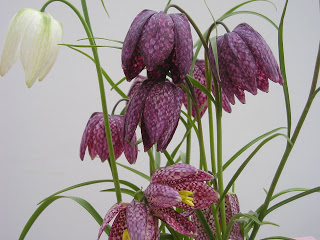
The Snake’s Head Fritillary, Fritillaria meleagris, is an extremely rare plant in the wild although there are water meadows around Oxford and the Cotswolds where they carpet the ground – a spectacular sight. Fortunately, they grow quite easily in our gardens and the corms are readily available from reputable bulb merchants, who only source them from grown stock. Sadly, there are still occasions when bulbs and corms are marketed from illegally collected wild stock.
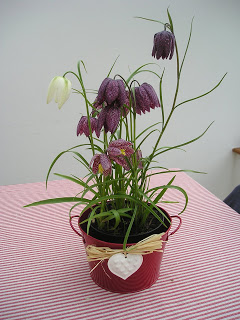
They make fine, if somewhat short-lived house plants. We like to have them indoors at Easter and they can afterwards be planted in the garden to bloom again another year. When seen close-up, it is obvious from their markings why one old name that country folk give to them is Chequers.
It is not only flowers at Easter that should be thriving. The wild birds are singing and building their nests and sheltered beneath a large clump of Oat Grass, the wild Mallard duck, lay their eggs each year in our garden. As soon as they hatch, their mother leads them to the safety of the river below the house.

This is the joy of Easter – or it usually is. Not in 2010. The primroses and violets may be blooming but the weather is more of winter than spring with the season up to six weeks behind this year. There is hardly a leaf showing on the trees and bushes of the secret valley and the river has burst its banks with the continuous rain we have had the past few weeks. Any duckling that ventured onto the water would soon be swept away in the torrent our gentle stream has become.

However, She-dog is thoroughly enjoying running through the flood waters – especially where it is shallow enough to admire her reflection!


Add to Technorati Favorites

Finally, We Have Daffodils!

Despite a return to cold, blustery weather and barely a decent spring day so far this year, the daffodils (narcissus) have at last started to bloom.

I suppose it is because of the long winter weeks of relative stillness in the garden that we eagerly await the first signs of new life: the first grey green tip of the daffodil’s leaves pushing through the soil, the lengthening of the flower stalk, the swelling of the bud and the first hint of colour and, then, the pleasure of seeing the open trumpet in all its glory. And how apt that daffodils are one of the few flowers that have trumpets, for the sight of them, whether just a few or en masse, herald the start of the floral year with a fanfare of pleasure as great as any orchestral masterpiece.

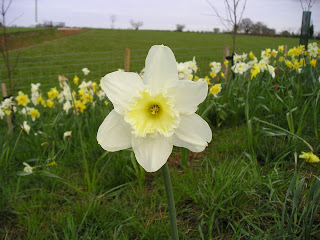
Narcissus ‘Carlton’
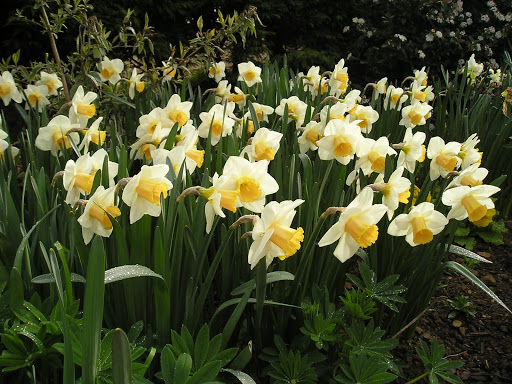
Last autumn saw the planting of 8000 daffodils along the edge of a field that led to one of our client’s houses. The hard labour was well worthwhile both in physical effort and the time we have had to wait to see the result. When I plant like this, I mix the varieties to extend the flowering period – generally Carlton, St Keverne, Counsellor and, if I want a few white included, Ice Follies.

Combination of varieties to extend the flowering period

Narcissus ‘Ice Follies’

I can be incredibly opinionated, as many of you will know, where plants are concerned. I tend to prefer simple, unimproved varieties – fancy colours and doubles, or those described as having the largest flowers ever seen, can be left for others to grow. I can see no reason why, for example, a bloom “as big as your face” (as I saw one begonia described) is considered desirable. I am not keen on double daffodils as they nearly always seem to be top heavy. The slightest puff of wind or shower of snow and the heads sit face down on the ground where they remain to be eaten by slugs. Ice King is a variety I plant – although hardly to be described as a favourite – as it stands fairly well. In the photo one bloom has collapsed which rather proves a point.

Narcissus ‘Ice King’

Salome, is a bi coloured variety, the trumpet changing from a rich yellow to a peachy shade as it fades. I can never decide if I really like it or not. Here, in the photo below, it gives a warm glow to the border. However, what can be more charming the pure simplicity of Segovia? Its delicate yellow cup and pure white, evenly spaced petals (or perianth, if we want to be horticulturally correct) give it the look of a plant that has quiet superiority.

Narcissus ‘Salome’

Narcissus ‘Segovia’


Whatever your personal preference, daffodils are a joy and amazing value for money. With individual bulbs just costing pence each and increasing year by year if left to naturalise, it is always remarkable that after a few short weeks, we cannot wait to see them gone, being tired of their gently decaying leaves which interfere with our border work or mowing regimes.
.
When grown in grass, we mow the top growth off six weeks after flowering for, by then, nourishment has returned to the bulb and next years flowering is assured. Just to be doubly certain, we feed the grass grown bulbs with Autumn lawn food (minus the weedkiller, of course) immediately after flowering. And being the fickle species man is, six months later we will be back eagerly scouring the ground for the first signs of the daffodils and the forthcoming warmer weather once more.

Narcissus ‘Burma’

Add to Technorati Favorites

Coronation Chicken, Anyone?

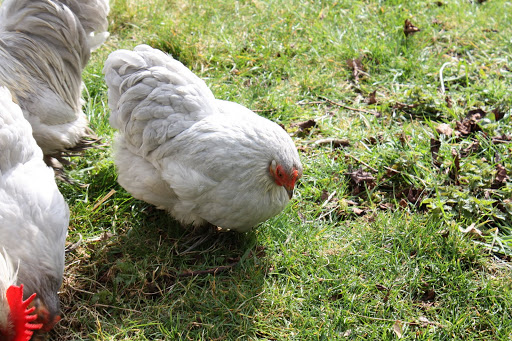
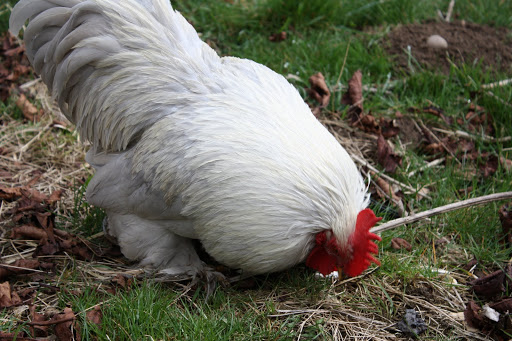
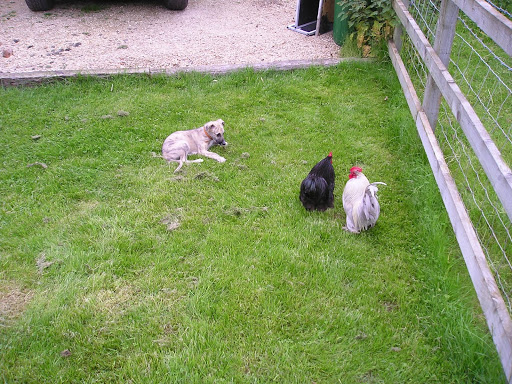
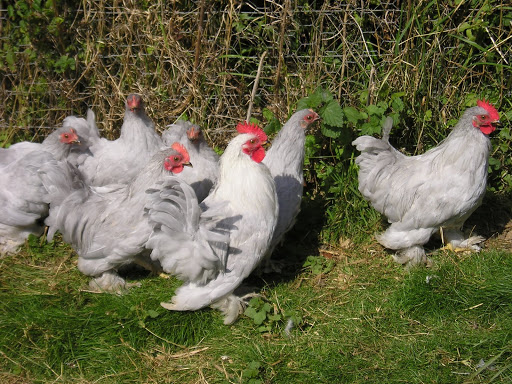
According to one tradition, the first Pekins were smuggled out of China and presented to Queen Victoria in 1837, the year of her coronation. Whether this is true or not is immaterial – it just makes for a nice story. The first Pekins (I have read that in the States and Canada the breed is known as Cochins) presented to me were a gift from a friend several years ago and we have been breeding them ever since, concentrating on the more unusual lavender coloured variety.

Pekins are a breed that is only found as bantams – which is fairly unusual in itself – the majority of bantam breeds have a ‘full size’ chicken version as well. Recognised most easily by their feathered feet they are friendly, almost cuddly, as the hens especially are rounded and dumpy, another recognisable feature.

The cockerels, too, are reasonably lacking aggression (some bantam breeds I have kept in the past would attack at every opportunity). They do, however, have their moments, especially at this time of year. I have found that the way to deal with this is to arm yourself with thick gloves and ‘teach’ the cockerel that you are not intimidated. As he attacks, I catch and pin him to the ground, holding him there for a few seconds: he soon learns that he is second in the pecking order to me and the only thing to be hurt is the cockerel’s pride. We have a number of cockerels (too many) and, surprisingly, they show no aggression to each other.

Penned away safely at night, during the daytime we release them when they have the freedom to roam the fields of the secret valley. It is extraordinary the distance they travel in the course of the day as they cross back and forth. With the odd handful of corn to entice them back, I try to keep them reasonably close to the house for safety but, even then, the fox takes them from time to time.

Ramblers dogs are also a threat – it is amazing the number of people that seem to think it is acceptable for their animals to chase livestock when they are in the country. She-dog, our lurcher, a type of dog specifically bred for hunting, had to be taught that chasing certain animals was unacceptable if she wished to remain living on a farm. From the earliest age she was made to sit amongst sheep and also the bantams, which made useful training aids, with the consequence that now she totally ignores them. It didn’t stop her stalking them when a puppy if she thought we wouldn’t notice!

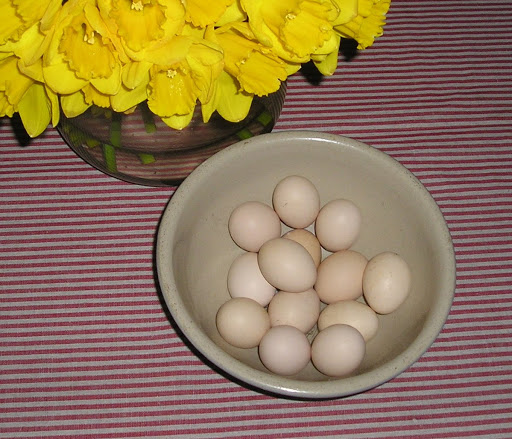
Would I recommend Pekins? Only with reservations. If it’s egg production you want, they are fairly useless although they lay enough for our requirements and the eggs are full of flavour with rich yolks. If it’s meat, then there isn’t much food on a bantam! If it’s just the lovely sight of a group wandering about the open fields, scratching in the hedgerows and dust bathing in the sunshine then yes, they win hands – or even feathered feet – down every time.

Coronation chicken? We don’t eat our bantams but I bet they would taste good and coronation chicken has to be one of my favourite dishes. If you want the recipe you will have to ask……

Add to Technorati Favorites

Frog March

As night falls we have started hearing the sound of tapping at our garden door. It happens every year as the weather begins to warm up and the days draw out. At first we were uncertain as to what it was for there was no-one there when we looked outside. Yet, as soon as the door was closed, the gentle knocking sound would start again.

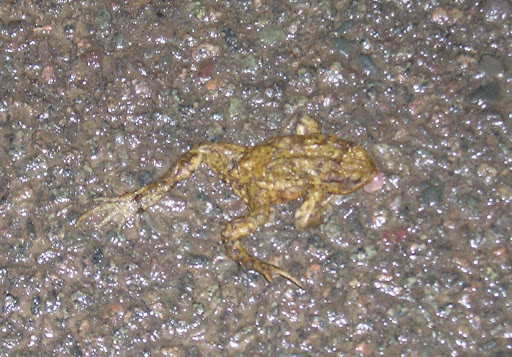
No, this is not the start of a scary story for on one occasion, leaving the door open a little longer than usual, into the house jumped a large frog, followed by several more. Now when we hear the sound we know that the frogs (and some toads) are on their march to their spawning grounds. Unfortunately this involves them crossing the little country lane just below our house and, although traffic is few and far between in the secret valley, each morning there are the squashed bodies of those that didn’t make it to the other side. The photo below may look as if it’s squashed but this one survived!

Quite why the frogs cross here is a bit of a mystery. The river is below and to one side of us as it meanders through the valley and around the house. The frogs are coming from the field up on the hillside and this isn’t a nice, moist and lush grass field that might be a bit of froggy heaven. The field they come from is plough – stony, brashy and rough. Or have they been hibernating in the old hedgerow and, if so why, when there are plenty of, what would appear to be, more attractive and comfortable places to sleep? Whatever the reason, they are off back to the river and pond and our house is in their way. If the doors are open, a constant flow of ‘hoppers’ pass through the sitting room and kitchen – or around it as we tend to keep them out. When our little cottage was built 150 years ago, was it built on an ancient pathway created by thousands of generations of frogs?

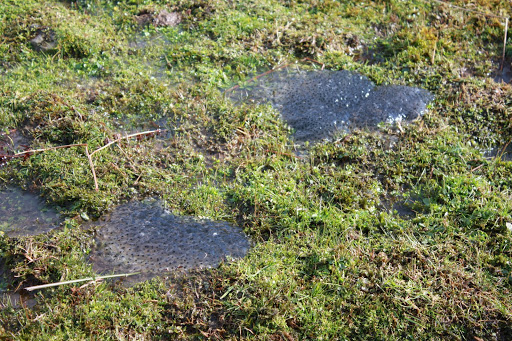
Oddly enough, on Exmoor, despite its harsh climate, the frogs spawn earlier than here in the secret valley. On a walk recently, we found this perfectly formed circular pond (perhaps an old sheep wash) on the moor and the frogs had already filled it with spawn. And in every boggy patch of the moor we found even more spawn. It rose above the water level in great mounds: perhaps it is the higher rainfall that prevents the spawn from drying out. However many frogs must there be and how many tadpoles will survive to return to breed in the future? The answer is mind boggling!

An update 27th March:

The frog march has ended as they have reached their destination. When I walk past the large pond that has been formed by a breach of the river banks, the noise of croaking is amazing. Everywhere you look there are frogs and toads amongst the submerged vegetation. In the last 36 hours spawning has commenced – we have snow showers forecast over the next few days but, hopefully, it won’t affect the spawn too much.
Add to Technorati Favorites

No More Cheese Rolling…..

Another great Cotswold tradition has come to an end thanks to Health & Safety issues. Cheese Rolling, which has taken place at Cooper’s Hill for centuries, has been banned.

As a protest and in support of the cheese makers, I went out today and bought some of the same local type they use. Not a 7lb wheel, more a slither but it was the gesture that was important. And it tastes very good too. My photo below does not do justice to the texture, the smell and oh, the taste: ecstasy on a biscuit!

So what is cheese rolling? A 7lb Double Gloucester cheese is set in motion from the top of the steep hill – and it can reach speeds up to 70 miles per hour – and us ‘locals’ then chase it. The first person to reach the bottom and cross the line is the winner. Yes, you are right -it is another barmy English tradition.

Cheese rolling is not for the faint hearted as competitors are catapulted through the air such is the force and momentum generated by the hill’s steepness. Injuries are common but not as serious as you might think – a few broken bones but that is of little consequence to those that want to take part. What is more odd, is that the Health and Safety concerns are not about the competitors but the spectators, for the event has become so popular that over 15000 people attended the last one, which is usually held in May. With our little country lanes totally jammed and the hill only able to cope with 5000 people, the numbers are quite obviously a problem.

But there is some good news: a revised version of cheese rolling may take place next year. If it involves eating the cheese rather than risking life and limb running after it, I may just enter the competition…….

[Acknowledgement to the Daily Mail for some of this information]

Exmoor: Stoke Pero Church

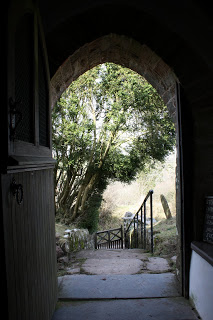
“Culbone, Oare and Stoke Pero, three churches where no priest will go”, goes the local Exmoor rhyme. Three parishes so remote that, before the days of motor transport, it took for ever to reach them, over some of the roughest and open terrain England has to offer. And of all the remote parishes, Stoke Pero has to win hands down, for even by car it is a difficult place to find. The narrow lanes cross wide expanses of moorland, close to Dunkery Beacon, the highest place on Exmoor. When you arrive at Stoke Pero, there is no cosy village green scene to greet you, for the church serves a widely scattered community. The wind cuts across the open land with an icy blast and even the church seems to be hunkered down against it, squatting in a dip in the land. As you enter the porch an old sign reminds you why.


Once inside the church, the simplicity of its decoration is the first thing that strikes you. Whitewashed walls with little in the way of decoration are the backdrop for ancient, worn pews and the most beautiful barrel vaulted roof. The red of the altar cloth at the far end almost seems an intrusion of colour, a scarlet splash of paint on a plain canvas.

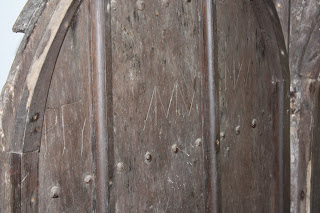
The doorway to the belltower is tiny – so narrow that only the slimmest can enter. Despite its size it has a degree of solidity about it. The main door to the church is the opposite – a massive piece of oak with letters and symbols scratched into its surface. To date, the meaning of these remain unknown. Any ideas, anyone?

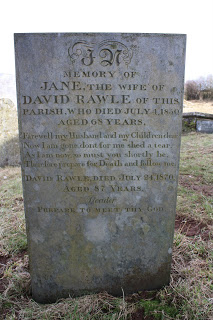
Leaving the church, the sun is shining again and the wind has eased. Many of the Exmoor tombstones from the 19th century have verses on them. Was this the fashion of the time or a peculiarity of Exmoor custom? This particular one seemed to me to be slightly malicious – saying “I might be dead but you’ll be next” – not a great comfort to the bereaved!

Add to Technorati Favorites

An Ancient Breed – The Exmoor Pony

Exmoor beckons at this time of year despite the harsh moorland climate. The landscape may be drab – the bracken and heather has lost most of its colour and the predominant colours are greys and fawns with just the occasional rusts and greens. However we were lucky – the sun shone for much of the time giving us additional blues from the sky and also from the sea, for the rolling moorland tumbles steeply into the sea on its northern edge.

The tiny clifftop hamlet of Countisbury – the far distant horizon is the south coast of Wales

The origins of the Exmoor pony date back into pre-history, for they are the oldest surviving breed in Britain and have remained virtually unchanged from the earliest days. They are perfectly adapted to surviving on the moor all year and, as can be seen from the photographs, look fit and well having come through the snow and bitter weather of the coldest winter for very many years. The ponies that live in the Valley of the Rocks (photo below) are used to seeing people for it is a much visited area with easy access despite its rugged terrain. The ponies of the high moor are far more wary.

On a walk across Brendon Common there would appear to be no ponies or wildlife of any kind at all. However, ponies and red deer are common and buzzards and ravens soar and call overhead. Despite appearing to be a rolling plateau, the moor is divided by deep valleys, locally known as coombes. The little stream at its foot is Farley Water, a remote and a beautiful place. If you look carefully at the lower photo you will see the ponies – totally camouflaged. Their coats are the colours of the winter bracken, their mealy coloured muzzles (which is one of the breeds identifying features) the colour of the bleached winter grasses.

There are fewer than 500 Exmoors left and the breed is recognised as being endangered. Many of these are kept as pets and riding ponies in other parts of the country and there are probably no more than 150 of these free roaming ones left on the moor. It took quite a while to approach this group but patience was rewarded by finding the herd at rest with two lying flat out in the first sunshine of the year.


Getting too close for their comfort, they were soon up on their feet and ambling away. In a matter of moments their camouflage made the moorland look empty once again.


Add to Technorati Favorites

The Real Vicar of Dibley

When a new comedy television series called The Vicar of Dibley hit British television screens in 1994, Dawn French, the actress who played the part of the vicar, was already a familiar and much loved face. Less well known, was the situation of the village of Dibley. Was it even a real place for surely nowhere could be that idyllic and unspoilt? Well, yes, it is real.

Turville, is a tiny village, hidden deep in a valley in the Chiltern Hills and is close to where I was born and spent the greatest part of my life (I only came to the secret valley nine years ago). The Chilterns is a place of steep hills, thick with beechwoods that seem to hang onto their very sides – many use the word in their names: Old Hanging Wood near Hughenden, for example. The villages, as a consequence, seem tucked away and forgotten, yet they lie only some 30 miles west of London.
Chalk and flint are the geological features that make the Chiltern Hills what they are and you are never far from them for the topsoil is thin, as all Chiltern children soon learn. Childhood games need chalk for drawing hopscotch and the flint cuts deep into knees when falling over. Flint also is, or was, the favoured building material for houses and Turville has plenty of fine examples, even the church is made from it.


No English village is complete without its pub and Turville is no exception. The Bull and Butcher stands almost in the road. Less common are windmills and Turville lays claim to Cobstone Mill (which really ‘belongs’ to the neighbouring village of Ibstone), standing high above on a steep hilltop. The windmill, like the village has been used in many films such as Chitty, Chitty, Bang Bang and the 101 Dalmatians. In the latter, when the road outside became covered in machine made ‘snow’ I drove past confused – for there were still traces of the snow and it was midsummer. We also had no water for several hours as the filming had used up the village supply in the making of it.

Turville is popular both with the film crews and visitors because it is so ancient and unspoilt. To get photos like these you have to visit on a grey, winter’s weekday as weekends, especially fine, summer ones, find the narrow lanes choked with cars. The village is so unchanged that even the warning roadsigns, like this old schoolchildren one are decades out-of-date!

Add to Technorati Favorites