Eighteen months ago I was contacted by a gallery in Cheltenham about their researching an artist for they had acquired four watercolours of London street scenes painted during a ten-year period from 1885. They were by Edward Angell Roberts who had lived with Mary Ann Shortland, an ancestral cousin of mine. Although they described themselves as husband and wife in official documents, Edward was already married to the exotically named Josephine Bartolozzi Vestry Anderson.
NewStreet, Spring Gardens Edward Angell Roberts, 1885
Edward was born in Kennington in the English county of Surrey in1836. His father was a tea merchant and aspiring gentleman which presumably he became for by the age of fifteen, Edward was being educated at Christ Church Hospital, a school for sons of clergy and gentlemen. It was a good springboard for Edward for in 1855 he was promoted to Deputy-assistant to the Commissary of the Inland Revenue before proceeding to becoming Clerk to the War Office. In his spare time, he painted.
Old Wooden Houses, The Strand Edward Angell Roberts, 1887
The four watercolours show great artistic detail of places within a stone’s throw of the War Office, in London’s Pall Mall. They are New Street, Spring Gardens (1885), Old Wooden Houses, The Strand (1887), Garden House, Clements Inn (1895) and Pump Court, Temple (1895). They have since been sold at auction to a buyer in the United States.
Garden House, Clements Inn Edward Angell Roberts, 1897
Edward had married Josephine in 1858 and the census, three years later shows them living apart. Whether that was a temporary separation is not known for shortly after they had two children, a girl in 1864 who died in infancy and a boy in 1866. However, by 1871 he was living with Mary Ann and Josephine and the son disappear from record. It is thought that they may have moved to Ireland for the son reappears in the English 1901 census return and claimed to have spent time there. As for Edward and Mary Ann, they never married (or had children) for in his will, Edward leaves his estate to Mary Ann Shortland, spinster.
Pump Court, Temple Edward Angell Roberts, 1897
I began to wonder if we had other artists in the family for several of my cousins, my sister and my father were all artistic, I always felt that the skill had passed me by until some kind person exclaimed that through my career as a garden designer, I paint with flowers, a description I rather hold onto. It is true that there are some similarities for a new garden is a blank canvas waiting to be given a backwash of green and then daubed with the colour shapes and textures of flowers. Below is a rather poor quality photo of one of my early designs inspired by a Japanese Imari plate which was, I suppose, quite any arty approach to take!!
Garden design inspired by Japanese Imari Plate John Shortland, 1999
Another ancestral cousin painted and illustrated books on the town of Rye. Marian Eleanor Granville Bradley was the granddaughter of the Dean of Westminster Abbey, George Granville Bradley. Mostly remembered for her line drawings, occasionally they or paintings of hers are available for sale at auction. An only child, born in the United States, she returned to England sometime during the 1880s. She never married and died in 1951. Her pencil sketches of Rye appear very simple at first sight and, like Edward Angell Roberts, belie the attention to detail that is executed. Interestingly, a couple of her close relatives are described as ‘oil and colour merchants’ so it seems that art provided a living for my family in more ways than one…
Ship and Anchor, Rye Marion Eleanor Granville Bradley,1920
And finally, there is Uncle Les – not my uncle at all but (yet another) cousin of my father and, in the convention of the time, known to me as Uncle. I only met Les the once for he died quite suddenly when I was young. However, I did get to know his widow well, so it came as rather a surprise when I was sent this little pen and ink drawing of (I think) a house in Kingston-upon-Thames many years after her death.
Edwardian House Arthur Leslie Shortland, 1935
A few lines on Josephine. With a name like hers, curiosity got the better of me and so enquiries were made and she turned out, as hoped, to be ‘interesting’. She was a close relative of Madame Vestris, a famous, if not infamous actress, contralto opera singer and theatre manager. Madame Vestris probably deserves a full article of her own!
Madame Vestris, c1831 [Wikipedia]
Family history research is always uncovering something fascinating, puzzling or new – I wonder what it will turn up next?
With thanks to Andy Shield of Brave Fine Art , Cheltenham www.bravefineart.com }for sending me copies of the four paintings
“Culbone, Oare and Stoke Pero – places where no priest will go-o” says the old Exmoor rhyme about three of the moor’s remotest churches. That’s not totally surprising for they must be some of the most isolated in England and all involve considerable effort to reach even with today’s modern transport. Or, perhaps, it was because of their association with witches, bandits and lepers that made them reluctant to go. In his book, Exmoor Memories, A(rthur) G(ranville) Bradley writing of his time spent on Exmoor in the 1860s, tells of how the parson of Simonsbath church wouldn’t stay on the moor during the winter, leaving his parishioners to spiritually fend for themselves. With no roads at that time crossing the moor, one can hardly blame him.
even today, Exmoor is a wild and rugged place
I recently visited Culbone church which can still only be reached on foot. Whichever of the two routes you take, a very steep climb is involved but the effort is well worthwhile when you finally get there. The deep wooded combe opens up just enough to allow room for the church and two houses. It is a very tranquil spot and, resting there in an attempt to recover breath, it did feel very spiritual too – perhaps because records show that it has been a place of worship and meditation for over sixteen hundred years. The present church was mentioned in the Domesday Book so is just a mere one thousand years old!
Culbone has been a place of worship & silent contemplation for over sixteen hundred yearsthe private box pews where only the gentry would sit
Claiming to be the smallest parish church in England – it is only 35 foot x 11 foot in size – it can seat about thirty on its hard, wooden pews. It also has a small box pew where the family of Ashley Combe House once sat. Like many of the buildings that must have once populated the area, Ashley Combe House has long since disappeared. Entering the church through its thirteenth-century porch two things are immediately noticeable: first that it is still lit by gas and secondly, the ancient, stone font, now also well over a thousand years old.
the church is still let by gaslampthe one thousand year old font – how many baptisms has it seen?
Despite the hardship in reaching the church and its very few houses, it is still very much a living church with services held there fortnightly. However, the priest, perhaps mindful of the old rhyme or the lepers that once roamed the woods lives elsewhere. To visit Culbone it is possible to park the car by the sea at Porlock Weir and climb 400 feet to reach it or, as we did, park at the top and walk down. If that sounds the easy option, remember there is still the steep climb back! Either way you’ll be rewarded with breathtaking sea views and the chance to glimpse a way of life (and worship) now almost totally past.
the church is hidden in a deep, wooded combePorlock Weir
Oare church, these days is by far the easiest of the three churches to reach for it is just a short drive down a narrow lane from the A38 Porlock-Lynmouth coastal road. Famed for its association with Lorna Doone, the novel by R D Blackmore, Lorna was shot at the altar on her wedding day by the wicked outlaw Carver Doone. A pretty, riverside walk through the stronghold of the Doones, the Doone Valley, is possible from nearby Malmsmead where there is camping as well as an art gallery and coffee shop named the Buttery. Overlooking the picturesque bridge and ford, it also serves great food and is well worth a visit.
Oare church is easily approached by a narrow lanethe bridge and ford at Malmsmead
Compared with the church at Culbone, Oare is a relative newcomer having been built in the 1400s and then partially rebuilt four hundred years later. Inside, it is light and airy with memorials to Blackmore and also to the Snow family who feature in the novel. Blackmore tended to use local family names and traditions in his writing and mixing fact with fiction. Ridd is another local name; its variation Red is recorded on many of the gravestones at Culbone. For those not too familiar with the tale of Lorna Doone, or to see photos of the Doone Valley take a look at my earlier blogs, The Story of Lorna Doone – just a myth? and A Walk in the Doone Valley.
the interior of Oare church is very light and airythe window through which Carver Doone shot Lorna on her wedding dayas she stood at the altar
There are wonderful, albeit rather long, walks to Stoke Pero church from Horner Woods (car park at Webber’s Post or in the village of Horner), taking in the ‘four corners of Horner’ and distant views of Dunkery Beacon, the highest point of Exmoor. It is well worth the effort for apart from the views there is a good chance, providing you walk quietly, of spotting red deer, the largest of our wild deer and for which Exmoor is now one of its few remaining strongholds. There is plentiful wildlife to be seen along the river too – Dippers and Kingfishers and with Buzzards soaring overhead. You may even be lucky enough to see Red Kites or even White-tailed Sea Eagles which are becoming ever-more frequent visitors to the area.
Dunkery Beacon from Webber’s Postwild red deer hind with its calf half-hidden in the deep woodland
It is possible to drive to Stoke Pero although the lanes are long, winding and narrow. The road even passes through a working farmyard which confuses many, especially visitors from overseas who find our narrow lanes scary enough at the best of times! If you choose to reach the church this way you will fully understand why a priest might not want to be bothered to travel there. Below is an Ordnance Survey map showing the three churches; I would strongly advise to carry a paper, rather than digital, version of the map for phone signals can be a bit erratic in such remote countryside.
the three churches – a good map and equally good boots are essential if travelling by foot
We’ve had lepers and bandits with our previous two churches which only leaves witches as a possible reason (other than the journey) why Stoke Pero might have been clergy-less. Look closely at the old oak door and scratched into its surface are a series of lines: witches marks. ‘Apotropaic’ marks to give them their correct name are symbols carved into buildings to ward off witches and protect people from evil spirits. They are usually found wherever there is a point of entry such as doors, windows or chimneys and usually date back many centuries when belief of the supernatural was commonplace. It is not known when the marks at Stoke Pero were made or what they mean but they may well have literally put the fear of God into any visiting priest.
witches marks – apotropaic marks – on the church door at Stoke Pero
The church at Stoke Pero lays claim to being the highest on Exmoor for it stands, isolated at over 1000 feet above sea level. Although much of the building is only a couple of hundred years old, the church tower dates from the 1200s, as does a list of the rectors which rather belies the story of lack of clergy. Like Culbone, an earlier church here is mentioned in the Domesday Book and, also like Culbone, services are held here lit by candles or gas lamps.
old sign staking its claim as highest church!Stoke Pero church sits high on a bank
I blogged about Stoke Pero over fifteen years ago (link here) and mentioned how simple its interior is with its whitewashed walls, the only colour being the splash of red from the altar cloth. Revisiting recently, unsurprisingly the place hasn’t changed, and the barrel roof is as spectacular as ever. However, this time I noticed other things too such as the delicate ferns growing inside the window of the ancient bell tower and the contrast between the rough-hewn stone windows and the smooth white plasterwork.
the magnificent barrel roof of Stoke Pero churchferns grow in the cool shade found inside the ancient bell tower
If you have the opportunity to visit Exmoor, now protected by its National Park status, there is much to see – but only if your pleasure comes from the joy of being in wild, open places for it remains remarkably uncommercialised. It has much to offer apart from the moorland (spectacular at this time of years smothered in purple heather) for it has the sea, rugged cliffs, fast-running boulder-strewn rivers and the unspoilt little towns of Porlock, Lynton and Lynmouth. It is a walker and nature lovers paradise.
the heather moorland tumbles away to the seaLynmouth
Regular readers of my blog will know of my love of Exmoor which I discovered now nearly sixty years ago. They may even recall how through a chance meeting it changed the direction of my life, giving me an outdoor career as well as many Exmoor friends. More remarkably, I have found numerous family references to the moor, unknown at the time, for A G Bradley was my grandmother’s cousin and other family members lived and are buried at Luccombe, a village not too far from Stoke Pero. An uncle was involved with the rebuilding of Lynmouth after the devastating floods and loss of life in 1952 and a few years prior to that my parents honeymooned on the moor. A small world indeed and one in a small way I have been privileged to be part of.
my first night spent on Exmoor – many, many years ago!old postcard of the cottage in Luccombe where my ancestors lived in the early 1900s
Just occasionally nothing prepares you for a visual and emotional onslaught however much you might have read or seen images of it. I had been planning my first visit to Warwick for a few years. Perhaps it is because it is so close to home – about an hour’s drive north from my part of the Cotswolds – that it had taken me so long to actually go there for, when a place is on your doorstep, you feel you can go at any time and so put it off for another day. As it happened, I finally arrived in the town on the first warm, sunny day of spring when the ancient black and white timbered buildings really stood out against the blue sky.
Warwick is even older than those medieval buildings for it has been inhabited since the 5th century. However, it came to prominence when William the Conqueror built Warwick Castle in AD1068. Today, it is possible to visit the castle and even stay there but this was not the purpose of my visit. I had come to see a later building – the Collegiate Chapel of St Mary, most of which is only a mere three hundred years old. A great fire had swept through the town in 1694 destroying much of it as well as the greater part of the original church. Miraculously, the fire was extinguished saving the chancel and the Beauchamp Chapel built during the 14th and 15th centuries. The crypt is all that is left of an even earlier church built over 900 years ago.
The Collegiate Church of St Mary, WarwickThe 900 year-old crypt – all that is left from the earlier church
I had only been standing in the church a few moments when the organ began to play; the timing could not have been better for it set the mood for the whole visit. Lovely as it was, I moved on quite quickly to the chancel dominated by the tomb and effigies of Thomas Beauchamp and Katherine Mortimer. Both died within a few months of one another in 1369 and their effigies are unusual for they lie there holding hands, signifying not just their undying love but also their equal status for Katherine had brought land and wealth to the marriage. The chancel is also unique for its light and graceful ‘skeleton rib’ vaulted roof simply adorned with the Beauchamp coat of arms clasped by angels.
The tomb of Thomas Beauchamp & Katherine Mortimer who died in 1369 – my ancestral grandparentsThe ‘skeleton rib’ vaulting & Beauchamp crest held by an angel
From the chancel it is possible to glimpse into the Beauchamp Chapel where Thomas’ grandson Richard’s tomb stands. I purposely avoided doing so for I wanted to enter the chapel and to see it for the first time in its full glory. As I mentioned in this blog post’s opening sentence, I was completely unprepared for the visual feast that stood before me. The colour, the light, the opulence, the sun-kissed, bronzed effigy of Richard lying there centre stage was pure theatre – just the effect Richard had planned when he left detailed instructions for the building of the chapel all those centuries earlier. With the organ still playing behind me, I stood in the entrance transfixed, feeling slightly silly for being so moved before descending the steps to explore further. I had finally come to see the burial place of my ancestral grandfather.
Richard’s dramatic tomb lying in the Beauchamp Chapel
A short (but necessary!) history of Richard’s life: Richard Beauchamp was born in England in early 1382, the son of the 12th Earl of Warwick. His godfather was King Richard II although within a very few years Richard’s father, also a Thomas, had fallen out of favour and imprisoned in the Tower of London for treason. Fortunately for him at least, the King was deposed and replaced on the throne by Henry IV; Thomas was released and his titles and land restored. During the King’s coronation in 1399, Richard was knighted and later succeeded to the title of 13th Earl of Warwick at his father’s death in 1401. When Henry V succeeded to the throne in 1413 Richard became one of the new King’s most trusted advisers and given responsibility for the education of his young son, later to become Henry VI. Richard then spent much of his time in France, part of which had been annexed during the Hundred Years War and he died there in Rouen on 30th April 1439.
Richard’s armour is captured in fine detailThe bear and the griffin are Beauchamp heraldic emblems
Richard’s body was brought back to England and buried in a temporary grave in the church, for in his Will of 1437 he leaves detailed instructions for the construction of the new chapel to house his tomb. No expense was to be spared for he wanted it to become one of the finest in England, in which he more than succeeded. The creation of the chapel as one complete and new entity, using only the finest materials and highest quality craftsmanship makes it unique – all the more so, for its surviving almost unscathed by the later Reformation, attempted destruction during the Civil War, as well as the great fire. He was finally laid to rest there in 1475.
The Great Fire of 1694 stopped behind the chapel wall destroying the lower part of the wall paintings
The tomb is, of course, the central feature of the chapel as well as its purpose. Richard lies on an intricately carved and highly coloured marble chest set with fourteen gilded ‘weepers’, namely his children and their spouses. There had been a dispute after Richard’s death within the family over inheritance for Richard had been married twice with children from each. It was Ann that finally inherited the title and estates, a daughter from the second marriage (my ancestor was Eleanor, the second daughter from the first marriage) and so it was she that oversaw the completion of the chapel. Richard’s effigy is of a younger man, his eyes open, his hands outreaching, and dressed in full armour, showing the world that he is ready to enter the Kingdom of Heaven. He gazes upon the stained glass that confirms this story.
Richard’s daughters, some of the fourteen ‘weepers’ that surround the tombAnn, who became the 16th Countess of Warwick in thoughtful pose
The stained glass is another miracle of survival for it is mostly complete. During the English Civil War (mid-1600s) many of the country’s churches and religious icons were damaged or destroyed with the Protestant dogma that followed. The Beauchamp Chapel’s glass was spared much of this with only its lower parts damaged. Although it cannot be seen in my photograph, it was hastily repaired – perhaps a little too hastily for Richard’s head and hands were replaced with those of a woman. The imagery depicts saints and angels in glowing colours, produced at huge expense. Musicians are shown with their instruments and a banner of sheet music runs across the entire window. The notations can be clearly seen and, as instructed by Richard, this is sung in the chapel each September with prayers said for his soul, a practice of huge significance in medieval times. There is a short YouTube video of the choir singing this original music in the chapel, as well as a brief history of the windows which can be found here.
Richard, reborn, raises his arms towards HeavenSection of the East Window surrounded by statues of saints
Within the chapel are many other delights although none overshadow Richard. Tombs of his descendants, the Dudleys (through his eldest daughter Margaret), were placed there. They are resplendent in their own right but do not form a part of this blog. Even the prayer stalls, quite modest compared to other features of the chapel deserve close attention with their heraldic emblems carved into their timbers; they are fine in quality as well as detail. They can more briefly be shown by photos but deserve inclusion.
The tomb of Robert Dudley and Lettice KnollysBeautifully carved prayer stalls, now almost 600 years old
My family connection to the Beauchamps. When you travel back through so many centuries from the present day you are bound to uncover many ancestral grandparents. The problem is the discovering of them for in most families, as in the rest of mine, they lived very ordinary lives that were not well recorded if at all. Just occasionally, it is possible to find one that has risen to fame and this is the case with my paternal grandmother’s family. Granny Shortland’s relatives had been well-known up to the early-1900s for they held high positions within the Church of England and Government. A friend of Tennyson, the Reverend George Bradley had risen to become the Dean of Westminster Abbey. His brothers and sisters had also risen to fame in their spheres of work. These connections, known as ‘gateway ancestors’ enabled the research to progress relatively easily through time to Thomas Bradley – my 8th great-grandfather – who had been Chaplain to King Charles I and later, after the restoration of the monarchy, Charles II. From there the connections to the Beauchamps and even further back are well-researched by historians. It had always been whispered that Granny Shortland had married ‘beneath herself’ – now I know the reasons why!
Granny Nellie Shortland c 1945
Visiting: The Collegiate Church of St Mary and The Beauchamp Chapel is open to visitors free of charge. Guided tours (which are well worth doing) are available at a modest cost, as is a climb to the top of the tower to view the town and beyond. Details can be found on their website here.
Warwick Castle is impressive and a popular attraction. It was the home of the Beauchamps but was built in the 11th century by command of William the Conqueror. It is possible to stay in the castle for short breaks. More details can be found here
There is a useful website (click here) if you are planning a visit to Warwick, which is situated a few miles south of the city of Birmingham and north-west of London.
Nearly all of us have family stories passed down to us through the generations but gradually some element of the story, if not all of it, becomes lost. Over the past twenty years or so our family have written down not only these tales but also a detailed account of our own lives to pass onto future generations. Whether, of course, they will be that interested who can tell but it is quite likely that someone one day will be.
When the family first began to write their life history it felt self-indulgent and embarrassing, and these emotions must be overcome if it is to be successful. Then, of course, there are decisions to be made as to what to include and what to leave out, after all, we all have moments in our lives that we’d rather forget. So, a decision needs to be made whether to go for the ‘warts and all’ approach or to be a little more restrictive in what you have to say. I think it’s important to be cautious, for no-one wants to intentionally hurt others through careless writing or cause a family rift – unless, of course, you seek revenge! If it is selective memories you decide to write about it is equally important to include the lows as well as the highs, otherwise the writing will not sound genuine. None of us, sadly, just sail through life, after all.
My first big low – the death of my girlfriend, Carolyn, aged 14
Your life hasn’t just been one of relationships with people. It has included the places where you have lived, where you studied, where you worked, where you holidayed. I was 37 when I first wrote my story, now aged 70 it’s time for an update. In that thirty-three-year gap I have moved westwards from the Chiltern Hills, where I had lived all my life, to the Cotswolds. I changed careers from the indoor world of retail fashion to my present one of designing and managing gardens. It also includes a two-year stint studying as a full-time student at horticultural college, a couple of years of being involved with the Chelsea Flower Show and working on one of the first garden makeover programmes, Garden Doctors, for Channel 4 television. You and I have lived through a Covid epidemic, witnessed the recent death and funeral of Queen Elizabeth, and part of Europe is at war – all proof that we don’t need to be in our dotage to write down our history. There is no shortage of things to write about!
College days – which one is me?!!
It was my sister who first persuaded my mother and then me to write our life stories. Strangely, she was surprisingly reticent when it came to writing her own and took some persuading to take part! However, what we have now is a potted history not only of our lives, but also social conditions and changes that span well over one hundred years. An aunt and an older cousin have both added some of their memories too and now that some years have passed since their deaths, as well as my mother’s, these documents become more interesting and more precious with each passing year.
Extract from my mother’s memoir detailing the moment in 1945 when she regained consciousness from a coma– for the full story of the pioneering treatment she received, click here
One of the stories that had been passed down from my paternal grandmother was the tale of the family’s friendship with a famous poet. The bulk of the story was lost, and we had always assumed that the connection must be with Shelley as the poet’s mother had lived in Marlow, where my grandparents also lived. It was only relatively recently, when researching the family history, that the connection became clear. My grandmother’s cousins had been a close friend of Alfred, Lord Tennyson, the Victorian Poet Laureate. I discovered through this research that our generations weren’t the only ones with lives documented for their friendship with Tennyson, as well as several letters between them, survived in the National Archives. Even better, a memoir had been written by the cousin, later published, which gave delightful insights into their lives: “…there was a constant coming and going between the children of each house, all being equally at home in the other…”
The start of a friendship – to read more about our family connection with Tennyson click here
Regular readers of my blog will know that I spent a lot of my time as a very young man (and now as an old one!) on Exmoor staying and working on a remote hill farm. Although so very different to my own home background and upbringing, I loved the traditional, farming life despite it being such hard work, sometimes in very bleak weather. Now, much of that lifestyle has gone which makes a written record of it all the more valuable – and it is all included as part of my life story. I hadn’t anticipated discovering yet another ancestral cousin had written about his teenage life on Exmoor a hundred years earlier. I also discovered that his sister married and emigrated to New Mexico and published a memoir of her life there in 1898. It seems that writing life histories is a long-established tradition in our family after all! I hadn’t known of the New Mexico connection when I visited there in 1994 – visiting a cousin from another branch of the family who had also emigrated there – even more to go into my updated memoir.
A memoir from an earlier generation
So now that you’re going to write your own historical record what is the best way to preserve it for posterity? A blog, such as this one is a possibility, and it is an easy way to record events along with appropriate photographs. It may not survive long-term as it depends upon the blog hosting company continuing indefinitely to exist. The same applies to any form of digital storage: in my lifetime we’ve gone from reel-to-reel tape recording to cassette tape recording. Then we became computerised, and storage moved from floppy disk to cd-rom to memory stick. Now only the latter is in common use (how many younger people even know what a floppy disk is?) and that is almost certainly to change. I shall continue to type my memoir with photos attached although hand-written would be even better for it gives a deeper insight into someone’s character as well as looking nicer on the page. Part of the pleasure of reading my mother’s story is that it is in her own handwriting, and it is easier on the eye. We have digitally copied it which means that it can be shared easily amongst the family. Publishing it in book form, as my ancestral cousins did (for it was their only option) is a good way to preserve it. These days it is much harder to find a publisher that is interested although self-publishing could be an option. Lastly, a copy lodged with your local museum or County archive should ensure its survival and many are very interested in receiving a record of everyday life and lives. Go ahead and do it!
Include photos, newspaper cuttings, invitations – anything that helps to tell the story
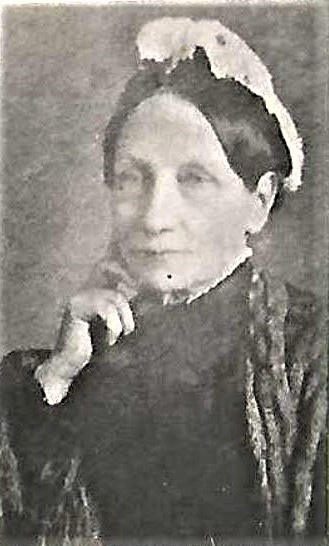
A photograph came winging through the ether to me via email recently of a rather severe looking lady, taken in her later years. As is often the case when meeting an older person for the first time it is all too easy to forget that they had a past; that they were young once and, perhaps, hold a huge store of memories and tales. Sometimes, the stories they tell surprise you and seem more in keeping with today rather than decades before. It was (as it turned out) the same with this lady – Sophia Bradby.
Sophia Langston nee Bradby
I had never seen a photograph of Sophia before although I knew of her existence for she was my great-great grandmother. The only tale I knew was that she came ‘from a good family’, the friend of a great poet and the giver of a ‘middle’ name for succeeding generations. Numerous boys, although for some reason, neither my father or myself (for which I’ve always felt rather cheated), sported the name Bradby immediately before the surname. Now that this unexpected image had landed in my inbox I began to dig a bit deeper.
Sophia was born on Christmas Day 1828 in Theale, Berkshire, the third daughter of William Bradby and Mary Shepherd. William had been born in Derbyshire, his parents of Yorkshire origin. Why or when he came south is unknown but in 1814 he married Mary in Reading. We also know that by then he had changed his surname from Bradley to Bradby. The reason behind the name change is unclear for he remained on friendly terms with other members of the Bradley family. In their day, the Bradleys were well-known nationally and, later, internationally. Perhaps the name change was to give his own, immediate family a degree of anonymity. Whether the family were upset and/or disappointed by his decision is unrecorded but perhaps this is the first sign of a rebellious streak that would continue to run through the family to this day.
The date on this old image is wrong for he was baptised on 3rd September 1823
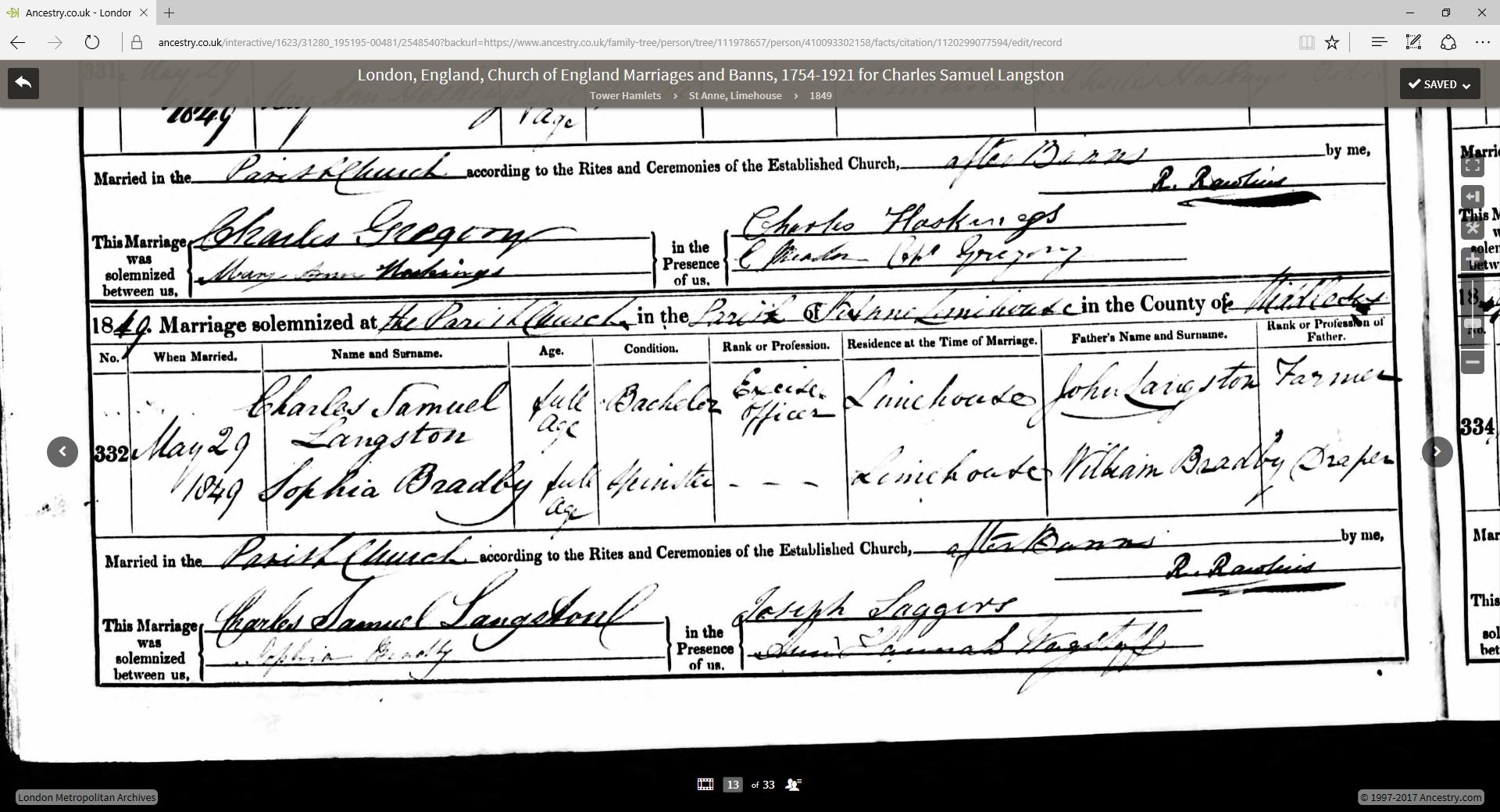
In 1849 it was Sophia’s turn to rebel. On the 29th May she eloped to London to marry Charles Samuel Langston, a union disapproved of by her family. These days, the journey would take no longer than an hour but in the mid-1800s it would have been quite an undertaking. Her travel may have been by coach and horses although the new Great Western Railway line had opened in the early 1840s so she might have travelled by train. Whichever mode of travel she chose she would have been all too aware that her path crossed both an area that had been notorious for highwaymen and footpads and, in more recent times, the scene of a landslide that had derailed a train, killing ten passengers. Whether Sophia ever met her parents again is unknown.
The marriage of Charles Samuel Langston to Sophia Bradby 1849, St Anne’s, Limehouse, London
St Anne’s, Limehouse, London (photo Wikipedia/Amanda Slater)
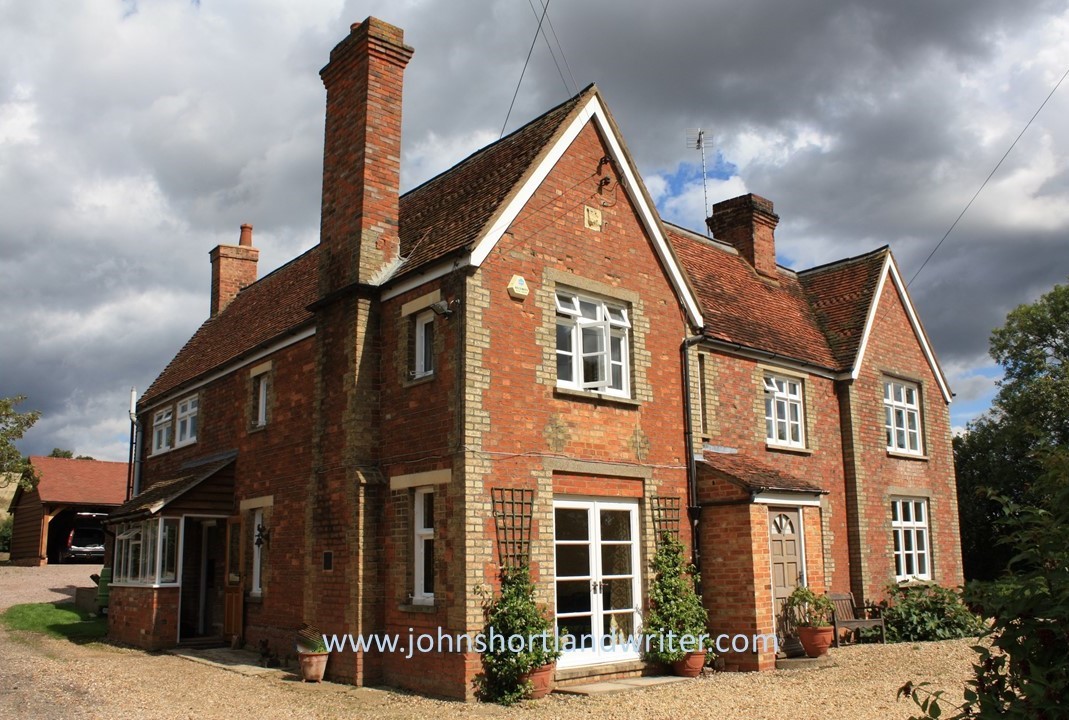
It turned out that Charles, too, had rebelled, leaving his parents’ home in Cranfield, Bedfordshire because of religious differences. Quite what these might have been is unrecorded. We know from old records that Charles had been baptised into the Church of England and he also married Sophia within the Church of England so there seems to be no conflict there. Whatever the reason, in 1843 he became an Excise Officer and his application papers are held by the National Archive in Kew, London. At a later date, this side of the family must have been reconciled for Charles’ father died when visiting Sophia in 1865.
The childhood home of Charles Samuel Langston
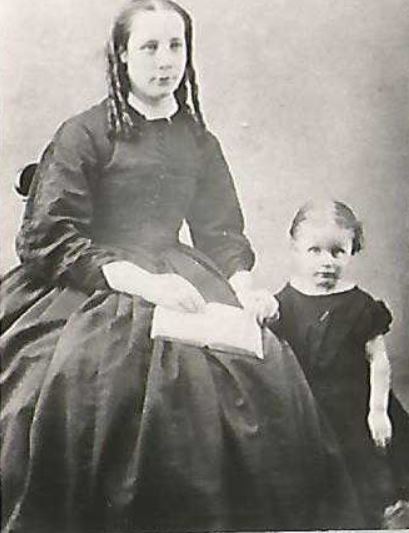
Sadly, Charles and Sophia’s marriage turned out to be fairly short-lived for Charles died aged 40 from cancer of the throat. Their 14 years of marriage produced eight known children, my great-grandfather William Bradby Langston was just twelve months old at the time of his father’s death and poor Sophia was some months pregnant with another daughter, Agnes. The photo below shows Sophia – wearing a crinoline – with one of her children, probably Christiana and taken in 1865. By 1871 she had established a drapery business with her eldest son, Ernest in Reading. By 1891 she had been successful enough to retire to the south coast where she died in 1916; the business that she had founded also prospered and became the largest department store in Reading before it finally closed its doors 120 years later.
Sophia with (probably) Christiana, 1865
Many thanks to Jo Liddement who, like me, is a great-great grandchild of Sophia. Not only did she send me the two photographs of Sophia which set me on the journey to find out more about the life of our remarkable ancestor, she also became a newly-discovered cousin.




 Life in the English Cotswolds