Unknown's avatar

About johnshortlandwriter

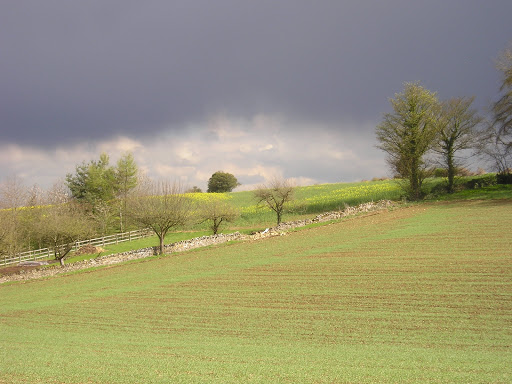
John the Writer: It is as natural for me to write as it is for me to eat or drink (sometimes I forget to do both when the ink is flowing). For years I would write – then shuffle the words until satisfied - then shred it. The act of writing was enough. One day I thought that seemed just a tiny bit silly so saved them on the computer and Life in the English Cotswolds was born. That was in 2009 and to my surprise people like you came along and liked what you saw. Since then, over 180,000 of you have visited, commented and become ‘friends’. Thank you! 2012 saw the very first Chipping Norton Literary Festival take place with which I was closely involved for several years. It was there that I was approached to write my book, Why Can’t my Garden Look Like That?, published a year later by How To Books, an imprint of Constable & Robinson and now part of Little, Brown. Over the years, my blog has expanded to cover many topics ranging from travel to family history and much else. This has brought a new audience with it for which I am both delighted and grateful. John the Gardener: The earliest image of me gardening is one of me as a child of about four using – well that’s too strong a word for it – a rake. Gardening is in my blood for every member of my family have been keen amateur gardeners (I am the only one doing it for a living). Whether it was aunts, grandparents or my father, everywhere I went they were in the garden tending flowers and vegetables or in the greenhouse potting up seedlings. Indoors, around the table, the talk was all about plants. Despite that, I started off my working life (apart from a short stint on a remote Exmoor farm) in the rag trade – selling men’s and women’s fashions. All the time, the great outdoors beckoned so it was off to horticultural college as a mature student before becoming Head Gardener to several large, country estates. That was twenty years ago now and every day I realise that not only did I make a great career move but just how lucky I am. Another sideways step brought me to where I am now – designing gardens, showing others how to garden and looking after gardens. And, of course, writing about it. John the Countryman: I have lived in the country all my life. As a child I spent my time exploring the lanes, woodlands and orchards of the Chilterns, that range of glorious, chalk hills cloaked with beech trees. Each spring they become carpeted with tens of thousands of bluebells. It was here, as a small boy, that I learnt about the wild plants and animals that share our world, a magical place. In more recent times I moved to the Cotswolds – only 50 miles away yet a completely different range of hills both geologically and in character. Here, there are wide open views and skyscapes, dry stone walls and rushing streams and some of the prettiest towns and villages in Britain. I now live in a tiny stone cottage beside the winding river in the photo above, all tucked way in a secret valley. Bliss. Horses and dogs play an important part in my life too. More bliss. John the Explorer: The description is a tad exaggerated but I have had my moments. I guess that spending a night in a hostel for down and outs in the Rocky Mountains (how did I mistake it for a hotel and why didn’t I leave, I often ask myself), being stuck in a blizzard in an Indian reservation at 3 am in the morning in the far north of Canada or getting caught up in an attempted coup in Sudan probably allows me some claim to the title. Recent years have seen my exploring closer to home, in considerably more comfort and a lot less scary. Well, in principle, it is. I spend a lot of time on Exmoor, my spiritual home of over 45 years, and Ireland is another place that I visit frequently. Strangely, things still don’t always seem to go quite to plan …

All the Colours of the Rainbow

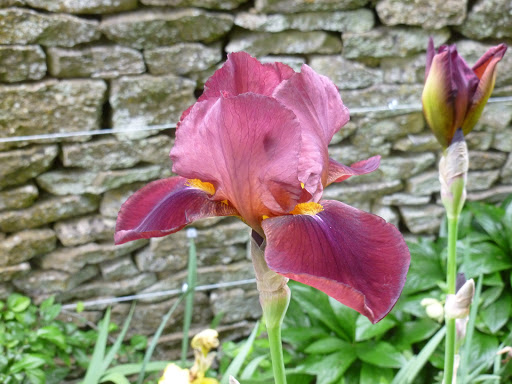
There are certain flowers that I have been aware of all my life.  I’m not sure if that proves that I was an extremely sensitive child or whether it is just because my parents and other relatives only ever talked about gardening.  I can still see pansies growing in the circular bed beneath the apple tree and shrub roses either side of the archway that led to the vegetable garden.  The strawberries grew along the right hand fence and the rhubarb in front of the chicken run and yet we moved from that house when I was just nine years old.  But there is one thing that bothers me: I can recall the Iris, dark blue, growing tall and strong but I can’t remember if they were in the front or back garden. It doesn’t really matter, of course, but it seems odd that I can’t picture them when I can clearly remember my father telling me enthusiastically that “they come in all the colours of the rainbow.”  Despite his passion for them he only ever grew the one colour (which is perhaps odder still) and it was only when I had a garden of my own that more and more colours started to creep in.

An idea that I had wanted to try out for some time, spurred on by this memory, was to plant a border devoted to iris of all colours – a rainbow border.  This requires space, not because the plants take up much room but because they have quite a short flowering time, perhaps just two or three weeks.  This makes such a border rather a luxury, especially in a small garden.
 

I garden for my living – a hobby turned into a career – and I have quite a number of clients with gardens, some of very many acres.  It is in one of these that the rainbow border has been planted.  Confidentiality prevents me from showing the completed border in its entirety so you will have to imagine wave after wave of varying shades of blues, whites, burnt ochres, burgundies, golds and purples.  The effect is breath-taking as is one other thing I’d forgotten from childhood: scent although not all colours are fragrant and those that are vary in strength and quality.  Spectacular they may be when in bloom but blink and they are gone for another twelve months.  Fortunately, herbaceous borders bursting into flower draw attention away from what has now become a dull part of the garden.
In my own garden, I’ve had to be more restrained, poking them into odd spaces where they can get enough sun, yet they still offer surprises.  This yellow variety, Butterscotch Kiss, is a good colour for it is not harsh; best of all its fragrance is overpowering, scenting the whole garden and wafting into rooms through open windows.

Although the Bearded Irises, Iris germanica, arefavourites, there is always room for smaller varieties. The tiniest are the early flowering Iris reticulata which tend to get lost in my borders so are grown in pots.  They flower in February and March.  The Dutch Irises are useful grown in the vegetable garden for cutting but also grow well in the flower garden, flowering about now.  Both types are grown from corms (similar in appearance to bulbs), planted in the autumn.  Iris unguicularis is a perennial, winter flowering iris, ideal for picking and often with a delicate perfume.  In the photo below, it is growing in a pot indoors and flowering on Christmas Day.  In the garden it wants to be placed at the foot of a wall and grown in poor, stony soil.
The bog Iris, Iris sibirica, grows well in wet soil but also adapts quite happily to the garden border providing it is kept well watered until established.  Its leaves are grass-like and the flowers much daintier than their Bearded cousins.
Compared to the standard Iris sibirica above, Flight of Butterflies is more compact and has flowers with emphasised blue and white veining
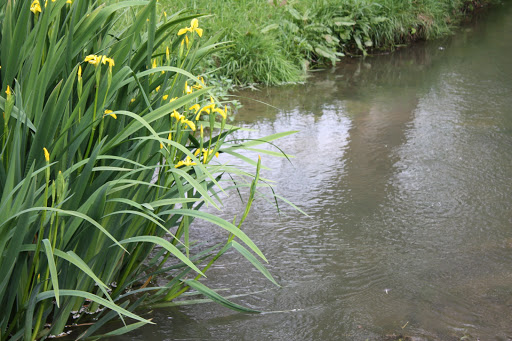
There are numerous types, too, for the pond and these grow standing in several inches of water. Our native Yellow Flag, Iris pseudoacorus, is robust and can be too dominant in smaller areas of water. It is a lovely sight when seen in the wild – we have plenty here in the secret valley growing along the edge of the river, their broad rush like leaves making the perfect resting place for dragonflies .

Add to Technorati Favorites

Babies Everywhere

Everywhere I  look at the moment there are babies – it’s that time of year.  I’m not talking human babies although quite a lot of my friends seem to be having new grandchildren, yet another sign of our ageing.  In the secret valley animals outnumber humans by dozens to one so it isn’t surprising that all around us there are signs of new life.

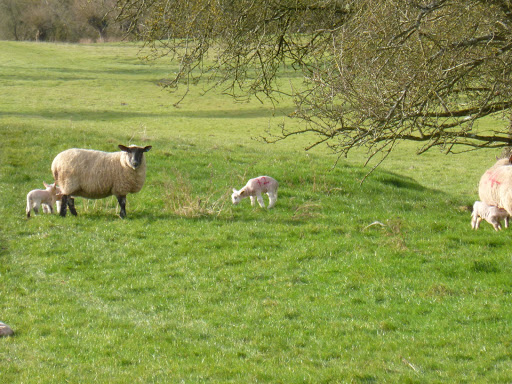
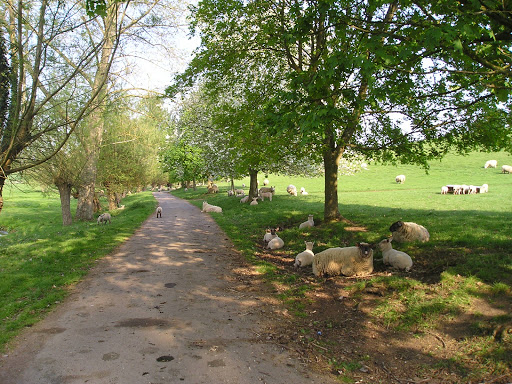
Lambing starts later here than in many places, for the spring grass is also later, so it is with impatience that we wait to see them skipping in the fields and chasing one another up and down the  river banks.  Of course, that was some weeks ago – now they are grown quite large and, as I write this, very noisy as they call for their mothers who have been separated for shearing. It will be a few hours before they have all found one another and normality returns again; the sound of contented and playful bleating telling us that all is well.

Calves can be born in spring or autumn.  Beyond the secret valley is a beautiful herd of Red Devon cattle and they make good mothers.  I first came across this gentle breed when I worked on a farm as a teenager on Exmoor and they have been a firm favourite ever since.  Bred for beef, we used to hand milk a few for the farm’s own use and the milk was very rich and creamy.   Large enamel basins of it would be placed on top of the Rayburn stove (fired by the peat turves I have recently written about, click here)  and I would watch fascinated as the cream would rise in large clots to be skimmed off  to be eaten with afternoon tea, that most traditional of West Country meals.

The bantams – Lavender Pekins (Cochins) – are all rapidly going broody.  I find that they are only good layers in spring, the rest of the year they lay fewer eggs.  We always set some of these under them so that we have a new supply of youngsters: if we get too many there is always a ready home for them but mostly they are there as ready-made meals for Mr Fox who is a far too regular visitor.  I’d rather see the bantams having a short but very lovely time wandering about the place than cooped up in a pen somewhere.  When left to free range it is amazing just how far they travel up and down the field which does make them rather vulnerable.  As the fox usually visits in the early hours of the morning I try to always remember to shut them away safely for the night.  In the cold weather earlier in the year a fox visited the garden regularly during the day – at one time actually peering through the glass garden door at us.

 
We don’t keep duck but that doesn’t stop us from seeing them in the garden.  Usually one raises a brood of ducklings somewhere secluded: often under a large clump of oat grass or, before it rotted away completely, a few feet up on top of a rotten tree stump at the foot of a hedge. As soon as they hatch, she leads them away down the field to the river below the house.

Every year, there are many pheasants that survive the shooting season.  Last spring we had one nest in a planting trough beside our kitchen door.  Despite the constant activity, she sat tight and none of the dogs, visiting or resident, discovered her.  I have read that, when sitting on eggs, the hen pheasant can supress any scent so as to avoid predators.  No sooner had the chicks hatched than every dog in the neighbourhood was investigating the planter but by then, of course, she had led them all to safety.

Partridge also visit the garden but are much more wary.  When their eggs hatch the chicks are not much bigger than bumble bees and swarm about their mother.  They are so tiny they appear to have no legs moving as if somehow they are fitted with wheels instead!

I almost certainly won’t find it necessary to blog about the next ‘hatching’ for an eagerly waited event is the royal birth.  When Kate has her baby it will make world news – you won’t need to see a photo of it here!

Add to Technorati Favorites

Turf Cutting on Exmoor

A few weeks ago I blogged about cutting peat – or ‘turf’ as it is known on Exmoor – for burning.  It is an ancient tradition, now past.  You can read that post by clicking on the link here.

When I first visited Exmoor forty-five years ago one of the first tasks I was given was to ‘turn’ the turf, literally just turning it over and over so that the wind dried it.  In many ways it was a boring and monotonous job but it had to be done for it was the provider of heat for the farm, both water and cooking.  Being alone, high up on the moors, was never lonely for the isolation, even for a lad, was awe-inspiring.  I loved it.

Recently, I was flicking through the pages of a book that has been in our possession for as long as I can remember and came across a photograph of an Exmoor turf cutter.  I’d never noticed it before.  The book is called ‘People of all Nations’ and was written about 1920.  The photographs are wonderful and show a way of life long gone.  

click on the photo to enlarge

With the benefit of hindsight, it is a pity that I took so few photos of my early days on Exmoor.  At the time, it seemed that the unchanged life of the moors would go on for ever.  Little did I realise that I was witnessing its passing and  I feel very privileged to have been a (very tiny) part of it.  What has endured has been its influence: my arrival quite by chance on Exmoor and being taken into its heart has been a subject of discussion recently with Phil Gayle on BBC Oxford.

The caption below the photograph reads:

Cutting Turf on the Rolling Heights of Exmoor. With his primitive cutter this Devon labourer is procuring long strips of turf at the opening of the shearing season.  The turf is stacked into barns in which the sheep are herded on the eve of shearing.  They rub against it and lie on it, thus ridding their wool of much dirt and grease which would detract from the value of their fleece were it present when shearing began.

Add to Technorati Favorites

Hedgerow Project – Revisited

Back in March of last year I decided to run an informal monthly survey of the hedgerow that follows the line of the little country lane that runs past our cottage in the secret valley.  Parts of the lane are an ancient ‘green’ road and so would have once been busy with drovers herding their sheep and cattle to market.  There are only two houses in our part of the valley and the other is reputed to be an old drovers’ inn.  Our place was built a lot more recently in the 1850’s so may just have witnessed the passing of the tradition as livestock began to travel along the more direct and newly created turnpikes.  It was also necessary for the secret valley to have a more direct route to the turnpike and a new road was built that went past the little winding river in the header photo above.  Where it joined the turnpike it was marked by a white gate and even though it was removed a hundred years or more ago we still talk of turning left or right ‘by the white gate’.  This is rather confusing to those unaware of the history behind the expression – it took me two years before I found out why I could never see it!  In the decades that followed the ‘old road’, as it is now known, became disused and is now part of the footpath and bridleway networks used by walkers and horse riders.

Drove roads can be very ancient indeed and they were often marked by hedgerows to provide shelter and food and to prevent stock from straying.  These were often linear strips of the original wildwood left after the remainder of the trees had been clear felled – in our case, the Wychwood Forest.  As a result, the wild flowers associated with these ancient woodlands have survived nestling in the hedgerow bottom giving a good indication of their history.  So sensitive are these plants to change that it is possible to follow the line of the original road by the flora growing alongside it.  Although the newer parts of our lane – now probably two hundred years old – are also lined with hedges of equal stature, the plants have yet to colonise.  To record these changes was the initial idea behind my hedgerow project.

Like all plans, it didn’t quite work out.  In my first and only blog post about the project, I described March as being warm and dry; in fact it was hotter than normal and then turned out to be the hottest month of the year.  In April, the weather turned cooler and, on the day that drought was officially declared, it began to rain until the year was declared the wettest ever recorded.  This coupled with other commitments and the commissioning of my book on gardening meant the idea was abandoned to be resurrected this year.  That hasn’t gone quite to plan either!

So rather than set myself the unrealistic target of recording on a specific day of each month, I shall satisfy myself with just taking photographs when I either have the time or feel in the mood.  Not scientific, I know – and certainly not disciplined – but the pleasure I get from walking along the lane every day is not just because of the plants I see.  For me, it is knowing that I’m following an ancient track that has been trodden by countless generations of hard working countrymen.  Some of the trees I pass are the same as when they walked by; the secret valley still echoes to the sounds of sheep and cattle and the little winding river waters them and refreshes sore, tired feet on a hot, summer’s day.  It is twelve years since I came to the secret valley and it is still releasing its secrets.  How many times have I walked along a sunken track above the house to a rough patch of uncultivated land? Now recently learnt, I know it is the site of a Bronze Age settlement and the thought that this special place has been home to us lucky few for three thousand years or more is a humbling and joyous experience.

To view the original post from March 2012, click here.

Add to Technorati Favorites

BBC Oxford Interview with Phil Gayle

I’m being interviewed on BBC Oxford  on Tuesday 21st May. 

Talking to Phil Gayle about career changes and the people that influence them – in my case the change from fashions to flowers.

“What or who changed your life? Phil Gayle hears from someone who got lost on a bike ride and it changed the direction of their life” – this refers to my eventual arrival on a remote hill farm on Exmoor at the age of 16.

To listen to the interview click here

Add to Technorati Favorites

Turf Burning

For gardeners, peat is a well-known, although less used than before, mainstay of seed and potting composts.  It’s ability to absorb large quantities of moisture and to retain nutrients plus being very light when dry, thereby reducing transportation costs, made it the perfect growing medium.  In recent times, the environmental impact of industrial scale peat extraction has given rise to concern leading to the development of alternative composts becoming available.

Exmoor’s rolling moorland: a wild, windswept and boggy place

In the areas where peat is found – mostly in the temperate regions of the northern hemisphere – it was also a common fuel source and is still used for this purpose today.  On a non-commercial scale peat for burning is also in decline as the hand digging of the bogs, the drying out process and the carting all takes time for very little financial gain.  The days of the ‘turf cutter’ being paid sixpence a load have long passed.

Turf cutting creates deep trenches across the bogs

On Exmoor, in England’s West Country, peat is always referred to as ‘turf’, a dialect word, that means something very different from the velvety, green sward of gardeners.  Turf was still being cut there into the 1970’s and was one of the very first tasks I was given when arriving as a lad to work on a remote hill farm.  It was back breaking labour turning the individually cut pieces over and over to allow the wind to dry them before stacking them in heaps which later would be carried back to the farm to supply the fires that were needed all year for both heating and cooking.

 Cut turf in Ireland’s Connemara

Despite the backache, it was an enjoyable time being up on the moors all day with just the sound of the wind and the curlews mournful cry for company.  The native Exmoor ponies and the wild Red Deer all would appear from time to time for you became part of the moorland scenery too. Returning to the farm tired after a hard day’s work to be greeted by the sweetly fragrant smoke from the turf fires within was reassurance enough that it was all worthwhile.


Curlew and Red Deer on Exmoor


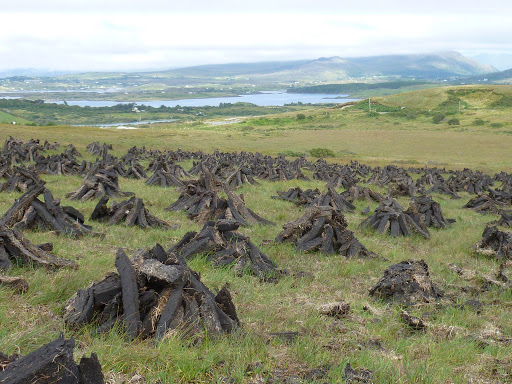
Last summer a visit to Connemara, on the west coast of Ireland, brought back all these memories for there turf burning is still commonplace.  There were the rows of turf lying on the ground waiting to be wind-dried, there were the stacks of turf waiting to be carted.  And, best of all, there was the heady smell of dozens of peat fires wafting over the landscape. 

Connemara turf stacked ready for carting – cut to a very different shape to Exmoor

Recently, on Exmoor, it has been realised that turf cutting kept the bogs ‘open’ providing a valuable wildlife resource and although not reinstating the practice the National Park has instigated the Exmoor Mire Restoration Project. This has involved blocking old drainage systems and re-wetting over 300 hectares; the project is on-going.  Visit there website by clicking here to find out more.

The trenches fill with water creating a very special and rare wildlife habitat


Exmoor is still as beautiful as ever and my love for it never diminishes but, without the scent of the turf fires, there is that little ‘something’ missing.  However hope may be around the corner: the entrepreneurial Irish are selling peat incense blocks by mail order so that you can have the scent anywhere.  I may even take a few blocks and light them on Exmoor for old times’ sake.

Add to Technorati Favorites

Being Interviewed on BBC Radio Oxford

I was a guest of Kat Orman on BBC Radio Oxford today, being interviewed about my forthcoming book, Why Can’t My Garden look Like That?, and also the career change from fashions to flowers.

One of the questions Kat asked was had I ever had a ‘Lady Chatterley’ moment.  You will have to listen to the interview to find out my response!

To listen to the programme  click here.  I am on air at 2:07:00.  The programme is only available for a few days so you’ll need to be quick…

Add to Technorati Favorites

Behind the Scenes at ChipLitFest

It hardly seems possible that a week has passed since the Chipping Norton Literary Festival (or ChipLitFest as it is affectionately called) took place.  For four days the small, market town situated on the edge of the Cotswolds hosted eighty of the best authors to be found anywhere – a remarkable feat for a festival still in its infancy.

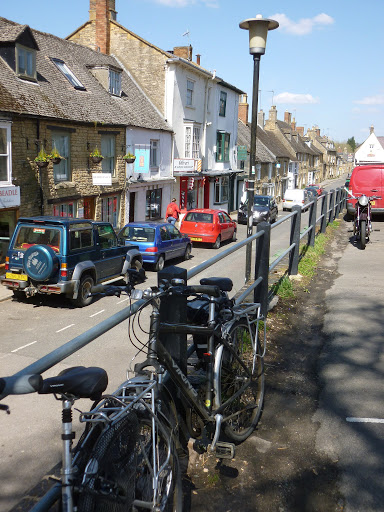
A quiet back street in the centre of Chipping Norton

For the eleven of us on the committee the past year has been an endless round of meetings, venues to be visited, volunteers to be found and co-ordinated, emails to be sent, publishers and agents to be contacted and authors to be booked.  Fortunately, our meetings have always been enjoyable and any stress negated by copious amounts of food, wine  and strong coffee.  These are an absolute necessity for none of the committee receive any payment whatsoever so meetings have to be fitted around busy work schedules in the evenings.  Perhaps if we had ever worked out how much the meetings cost the individuals hosting them there would have been a mass resignation.

The information point in the market place

The first two days of the festival are focused on children with authors visiting all of the local schools, speaking and reading and encouraging them to become better readers and writers.  The story writing competition was well supported; the winning entries can be read by clicking here.

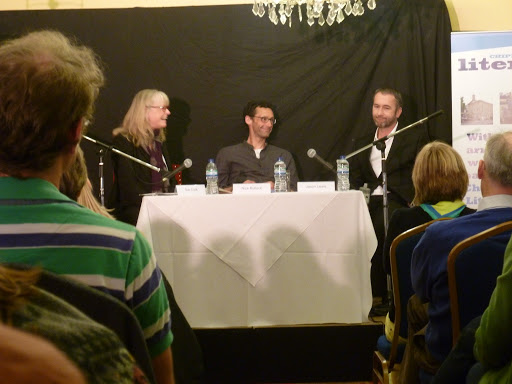
Mountaineer Nick Bullock and explorer Jason Lewis discuss their exploits with Sue Cook

The authors and patrons were guests of honour at a reception held in the town centre on Friday evening and gave them the chance to network and to meet the committee and sponsors in a relaxed and informal way.  My role in the festival has been  Author Liaison so I was especially keen to speak with as many of them as possible – it was good  to be finally able to meet face to face after many weeks of messages and telephone conversations.  The following evening myself and Merilyn Davies, the children’s programme co-ordinator, hosted a dinner for the authors and, as many events had taken place by then, we were all realising just how successful the festival was becoming.

At the reception our designated charity Storybook Dads gave a short explanation of their amazing work inside some of the UK’s toughest jails.  Their film was uplifting and heart-breaking all at the same time and it was wonderful that the festival was able to present a cheque to them for five hundred pounds.  They are now out in Afghanistan too, helping servicemen keep in touch with their children.  A short video montage of their work can be seen here.

Sharon Berry, founder of Storybook Dads, talks to author Clive Aslet about their work

It wasn’t just the committee that welcomed our guests for the whole town has taken the festival to its heart: the local window cleaners had put up yards of bunting, shops and cafes were offering special promotions and the farmer’s market was held over two days instead of the usual one day. Festival goers were appreciative of this and with warm, spring sunshine finally making an appearance the atmosphere was electric.

One of the drawbacks of being involved in putting on an event – and I wouldn’t have changed places for a second – is that there is little time for us to actually see any of the talks or workshops.  However, I did manage to sneak into a few places to take a quick photograph or two.

Julian Fellowes meeting festival goers and signing books after his Downton Abbey talk


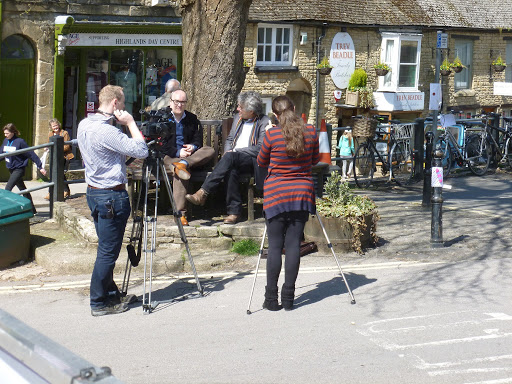
Both the local and the national press came to town too.  David Freeman, past presenter of Sky television’s The Book Show, was busy interviewing and filming authors.  I, too, was interviewed by him about my forthcoming book Why Can’t My Garden Look Like That? published next month.

David Freeman being filmed during an author interview

The festival ended on Sunday evening and we all returned home utterly exhausted.  This state of affairs didn’t last long for within twenty-four hours emails from the committee were pouring into the inbox discussing how well it went and how we could make 2014’s even better.  Even more gratifying were the huge number from the authors, volunteers and public saying how much they had enjoyed it and asking for the dates of the next one.  So here it is:

Chipping Norton Literary Festival 2014 – April 24-27

If you want to take part or visit follow the information on the links to the websites: ChipLitFest, Facebook or Twitter

The actress, Lalla Ward, caught having a quiet moment at the Chipping Norton Literary Festival

Add to Technorati Favorites

Chipping Norton – One Week To Go!


Chipping Norton, one of the gateway towns of the Cotswolds often gets overlooked on the tourist trail.  It is not surprising in some ways for many of the region’s towns and villages look as if they have come straight off the lid of a chocolate box – all golden, mellow stone crouched under a heavy hat of deep thatch, devoid of much of twenty-first century life.  Chipping Norton – or Chippy as it is affectionately known by the locals – is different: a bustling, working town full of people going about their everyday lives , whether shopping or working.

Look beyond the modern shop fronts and traffic and you find a gem of a town; raise your eyes for every building has a different façade and, yes, they too are built from Cotswold stone.  Explore the side streets and you find almshouses and a magnificent church and both the 16th century Guildhall and the Town Hall are as glorious a building as you will see anywhere.  Bliss Mill,  a former tweed mill now converted to flats, is surrounded by common land that reaches into the heart of the town.

Chippy is a busy place socially too and for a small town with a population of only 6000 there is always something taking place.  Perhaps one of the most ambitious of recent events is the Chipping Norton Literary Festival (ChipLitFest), the first of which was held last year to great acclaim.  This year it is bigger than ever and starts in just seven days time on the 18th April and continuing throughout the weekend.


Because the town is so small, the festival is held in numerous venues.  It is fortunate to have an award winning theatre to stage larger events and an award winning bookshop, Jaffe & Neale, that holds workshops – and sells the most delicious coffee and cakes.  It seems everyone is involved in one way or another: the Chequers pub, the Blue Boar Inn, the Crown & Cushion Hotel, the Vintage Sports Car Club, the local churches, the library; even the shoe shop is hosting a children’s event.  Incidentally, there are free things going on for youngsters all weekend and the festivals designated charity this year is Storybook Dads, which connects prisoners with their families through books and reading.

So who is coming to the festival? There is an amazing choice of eighty authors so there is bound to be someone to interest everybody.  Sir Julian Fellowes of Downton Abbey fame will be there; Fern Britton will be talking about her latest book – and perhaps her experience in Strictly Come Dancing.  For detective novel buffs, Mark Billingham will be discussing murder with Val McDermid, Stuart MacBride and Martyn Waites.  Did you see the film We Need to Talk About Kevin?  Author Lionel Shriver will be discussing her new book, Big Brother, which tackles the subject of obesity.  For foodies, Xanthe Clay, Henrietta Green and William Sitwell ask “are we a nation of food fashionistas?”

Prue Leith – one of our Festival patrons
Two events that especially appeal to me are Ursula Buchan’s talk ‘How England’s Gardeners Fought the Second World War’ and the Extreme Travel team of Nick Bullock and Jason Lewis discuss their adventures with Sue Cook.  Jason, incidentally, has just been recognised by the Guinness Book of Records as the first person to circumnavigate the world using only human power and described by the Daily Mail as “the most remarkable adventurer in the world today.”

Sue Cook, another of our Patrons

One of the especial pleasures of coming to the festival is that because both the town and the venues are small, you are able to be close to the authors, to chat with them and to get them to sign your books.  You can also meet me (!) for, as Facebook followers of this blog know, I am part of the organising committee.  ChipLitFest also has a Facebook page or follow them on Twitter.

Tickets for all of these events are selling fast and for more information about them and the other authors and host of workshops visit the festival’s website by clicking here.

I look forward to seeing you at the Chipping Norton Literary Festival, 18th-21st April – do come and say ‘hello’.

all photos, apart from Bliss Mill, from the ChipLitFest website

Add to Technorati Favorites

Frogs: Sex, Mayhem & Confusion

So it is now officially spring, yet the weather is still cold – much colder than is usual.  We even had a blizzard a couple of days ago turning the secret valley white once again for several hours. The snow turned to rain and was washed away.  At least we have longer hours of daylight to look forward to.  On the rare occasions when the weather brightens, the strengthening warmth of the sun on the skin lifts the spirits after months of grey, cold dampness.
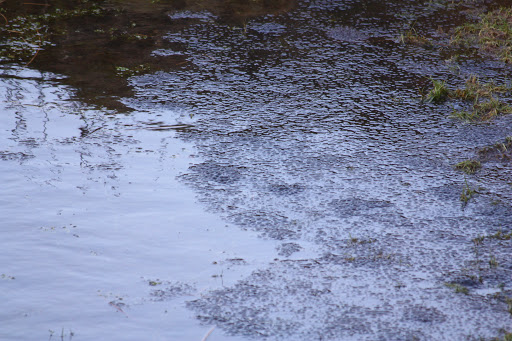
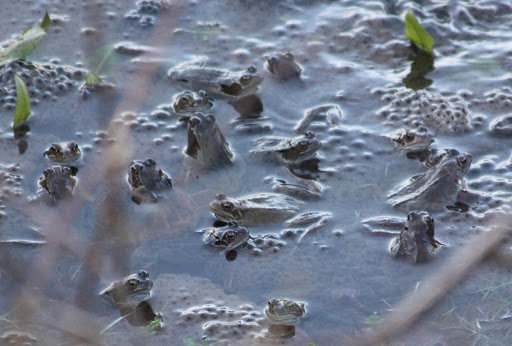
Some years, the surface of the pond is covered in spawn

It is that time of year when the local frog populations’ spirits are also lifted as they emerge from hibernation and crawl out from under the leaf litter and fallen twigs of the old hedgerow above the little stone cottage.  Under cover of darkness they cross the lane, all making their way towards the pond two fields away.  For some reason they don’t take a direct route but detour to our garden door (and if open), march through the sitting room, into the kitchen and out through the back door.  If the door is shut the sound of tapping on the glass panels as they attempt to jump through is continuous.

In other years there can be very little

But not this year.  There have been no signs of the frogs on the road and no-one has come a-knockin’. The weather seems to have got the better of them: they are as confused and, perhaps as depressed, as we humans after twelve months of cold and wet.

Trying to look innocent…

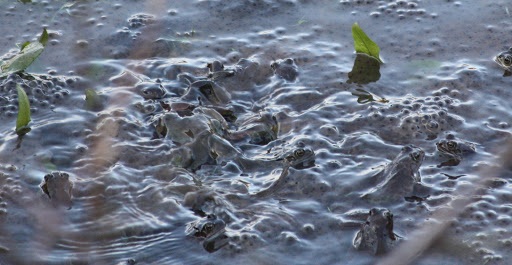
In normal springs the culmination of their journey is celebrated in a frenzied orgy in the calm water of the pond.  If you creep up on them, their presence betrayed by a carcophany of croaking, they become still and gaze up at you with a degree of embarrassment.  Trying to look innocent they sit willing you to believe that they wouldn’t do anything so vulgar (or exciting, depending on your outlook) as sex in public.  As soon as they think the coast is clear they return to their shenanigans making the pond look like a whirlpool bathtub.

Caught in the act!

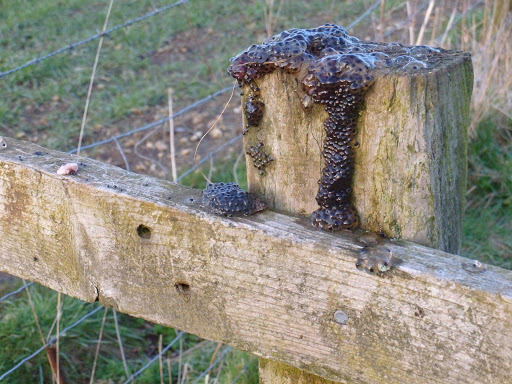
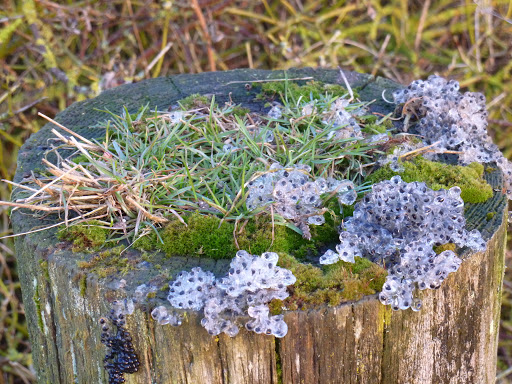
This year the frogs have returned silently.  There is no sign of them in the water or of their frogspawn floating like oil slicks on the surface.  In the confusion of the weather, where every surface is as wet as any other, the frogs have spawned on top of the fence posts that protects the pond.  The larger posts wear a crown of spawn, the smaller ones cannot hold it and it slides off, dripping to the ground.  It is a strange and  unsettling sight: something that we have never seen before.

Frogspawn falling and decaying from every fence post

What does this mean for the frogs?  The eggs cannot survive and if they do not lay more in the water the population must surely crash.  We already miss seeing their heads turn toward us as we walk past; we miss their visits to the cottage even more.  It will be sad if that becomes a thing of the past as has the song of the cuckoo and the churr of the nightjar, both summer visitors to the secret valley not so many years ago.

Sadly, there is no chance of this spawn hatching successfully

Add to Technorati Favorites