
With the long, dark nights now upon us (and the gloomy daily news) we could all do with a little cheer to take us forward. It isn’t too late to take a small step towards obtaining it for there is nothing quite like flowers in the house to lift the mood. Now is a good time to plant bulbs for indoor flowering. The choice is surprisingly large and some can have quite exacting growth requirements but the simplest of these – that anyone can succeed with even if they don’t have green fingers – is the sweetly scented, white-flowering Narcissus Paperwhite.

Unlike the majority of Narcissus (Daffodils) they do not require a period of complete darkness to encourage them into growth. In fact, they do not even need to be planted for they will happily flower just anchored in a bowl or pot of gravel that is kept moist. However, I think they are better planted in potting compost and look far more aesthetically pleasing. I never bother with special bulb fibre that is sold for the purpose mostly because I tend to have half-open bags of compost kicking around the place that need to be used up. If you plant the Paperwhites now and bring them straightaway into the house they can be in flower in six to eight weeks. Those in the photos below were placed in our conservatory and, with the unanticipated warmth from a week of late autumn sunshine which accelerated their growth, have come into flower in just three weeks from planting. So much for having them in bloom over Christmas!
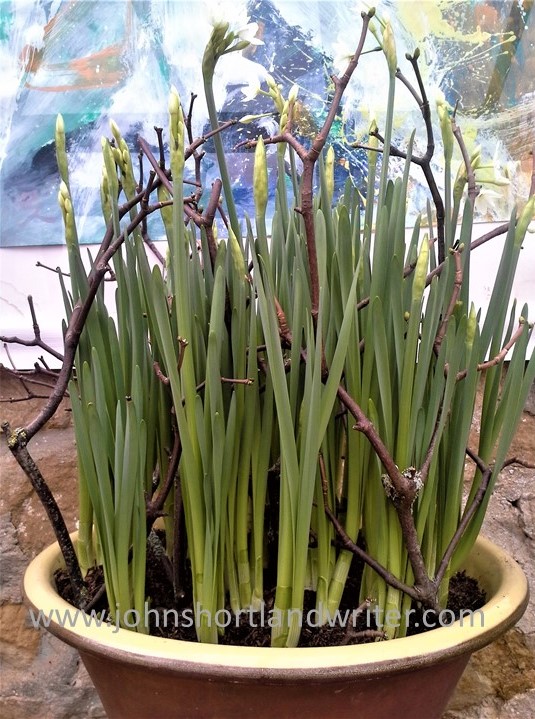
The secret to the planting is to cram as many bulbs as you can into the pot, either in a single or double layer. If choosing the latter don’t plant directly over one another but stagger them a little so they all have freedom to grow without struggling to push past. The bulbs in the glazed earthenware pot here were planted in a single layer all touching one another – that way I was able to squeeze in twenty-eight bulbs into a container measuring just twelve inches in diameter.
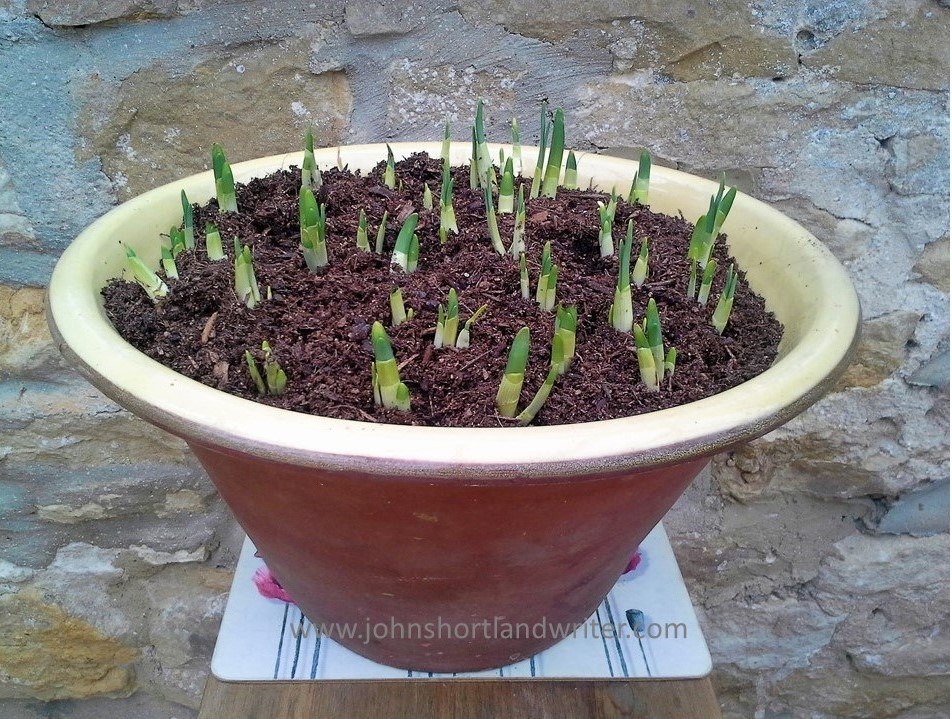
Paperwhites have a tendency to flop just when they look their best and the quickest way to prevent this is to push twigs into the compost. If you do this at the time of planting or very soon after the plants grow strongly through them and look far more natural than when you try to rectify it once they have collapsed. It is also far less fiddly than using canes and string and looks more natural too.

I have always found hyacinths far more difficult to grow well although I know plenty of people who never seem to have any trouble whatsoever. They need to be kept in darkness until the flower bud just shows. I have found them to be rather erratic with their growth and, in the days when I had to provide huge displays for the big country houses I worked for, I grew them in individual, small pots. By growing more than I really required I could select those of matching height, remove them from their pots and then replant them into the display pots. They never failed to impress and I never let on how I managed to get such a uniform display! Far easier are the little grape hyacinths, Muscari, growing here in a glass bowl – an idea I copied after I was given them one year as a gift.

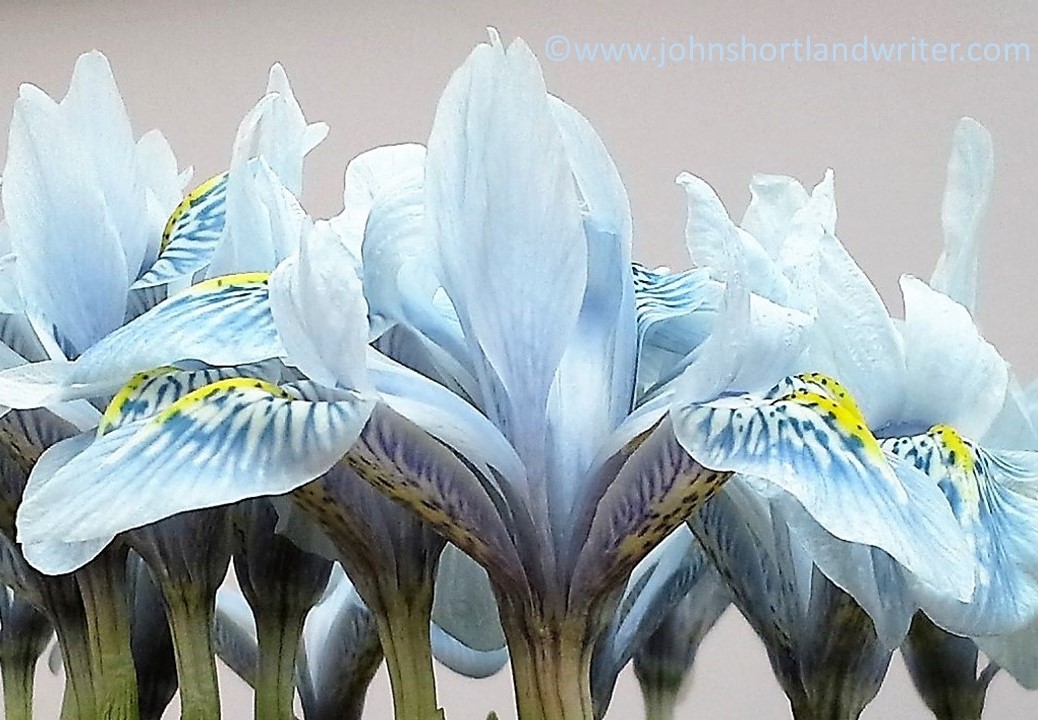
Perhaps one of the loveliest bulbs I have planted in recent years is the miniature iris, Iris ‘Sheila Ann Germaney’ (I have spelt that right!). Once, again, very easy to grow – just keep them in the dark until they start to grow and then bring them indoors. After they have finished flowering they can be planted in the garden where they will flower each spring for many more years.

Amaryllis or Hippeastrum are spectacular giants that aren’t to everyone’s taste. I’m not too keen on them as an individual plant grown on a kitchen window sill although they will bloom there quite happily. I prefer to use them as cut flowers and for this I tend to grow them in a greenhouse, although a light windowsill would work just as well if you have the space. They are very straightforward, do not need to be kept in the dark and are often sold complete with pot and compost in gift boxes. When used as I suggest, several stems placed together in a tall vase look superb.

I have found tulips to be less successful as indoor bulbs although the shorter types should work; I’m just not very keen on those so have never bothered to try. However, if you have an unheated greenhouse that lies idle through the winter plant the exotic double types there. Protected from the worst of the cold and rain they flower weeks earlier than normal and can be harvested as exceptionally beautiful cut flowers.

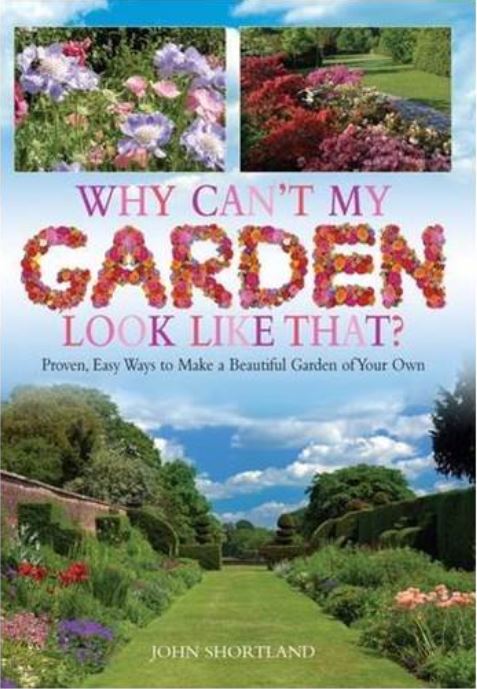
The secret to indoor bulb growing, as with all forms of gardening, is to experiment and find what works best for you. Over the years, I have tried all sorts, some surprisingly successful and some, if not quite disasters, they certainly weren’t worth bothering with a second time. With success, you will have an endless supply of colour and scent for your home and, of course, they make great Christmas and birthday gifts. This last sentence also gives me the excuse to remind you all that my book Why Can’t My Garden Look Like That? is still available from Amazon or through booksellers and also makes a great gift! In it you will find all sorts of hints and shortcuts that I used during my years as a Head Gardener when it was essential that the displays both in the house and the garden were as good as they could be. Happy bulb planting!


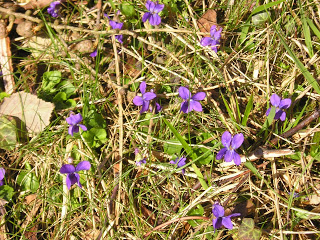
 The pretty, native Wood Anemone, Anemone nemerosa, blooms in profusion in favoured places – usually in sheltered woodland. Sometimes they are found on banks, perhaps showing where ancient woodland once stood, for Anemone nemerosa is one of the ‘indicator’ plants. Ancient woodland is classified in England as woodland growing prior to 1600 and although a number still stand many were cleared centuries ago.
 The Snake’s Head Fritillary, Fritillaria meleagris, is an extremely rare plant in the wild although there are water meadows around Oxford and the Cotswolds where they carpet the ground – a spectacular sight. Fortunately, they grow quite easily in our gardens and the corms are readily available from reputable bulb merchants, who only source them from grown stock. Sadly, there are still occasions when bulbs and corms are marketed from illegally collected wild stock.
 It is not only flowers at Easter that should be thriving. The wild birds are singing and building their nests and sheltered beneath a large clump of Oat Grass, the wild Mallard duck, lay their eggs each year in our garden. As soon as they hatch, their mother leads them to the safety of the river below the house.



 Daffodils, or Narcissus if we want to be technical, are one of the first of the bulbs to be planted for they start to send out their roots early in the season as we discover when we dig them up by mistake when weeding. Like all bulbs, they need to be planted in generous quantities to look their best. The photo above shows several hundred lining the old lime avenue of the house I described in an earlier blog ( 21st August 2009:
  I am not keen on double varieties – they tend to be top heavy and spend most of their time prostrate. However, I find the Orchid flowering types don’t do this and are quite fascinating to look at. The one above is Dolly Mollinger, the one below Chanterelle.
  Bicolours can also be tricky to my biased eye. I don’t like Scarlet O’Hara (below top), so vulgar in the border! But Jetfire, which is a similar colour combination works well in this wilder setting and is beautifully enhanced by the white bark of the Jacqmontii birch tree (below bottom).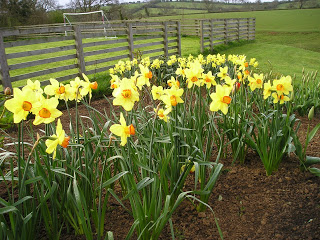
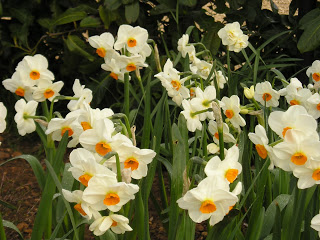
 Scent is all important in any flower and in narcissus it is especially welcome after the bleak winter months. Few scented winter flowers have the freshness of the smell of a vase full of Cheerfulness – a stonger coloured version is Laurens Koster.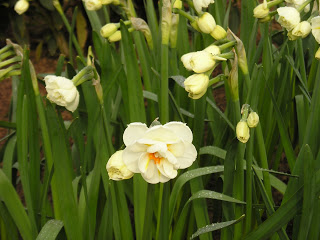
 But perhaps the best daffodils of all are the ‘bog standard’ yellow ones. That’s what spring is all about. (Although to be honest, I don’t totally agree with that statement – my favourites are the miniatures but I don’t have any photographs! I will have to take some next March and persuade you all then……)
 Life in the English Cotswolds