
When I wrote my initial post on the ancient hedgerow that leads uphill out of the secret valley I intended to update it on a monthly basis (click here). What a failed idea that has proved to be! For March 10th was as hot a day as any summer’s and that, coupled with a very dry winter, created the worst drought for many years. The day that I had intended to walk the hedge (and also the day that a hose pipe ban was announced) the heavens opened and we have had torrential rain ever since. I have been soaked to the skin most days because of work – I had no intention of a second soaking whilst carrying out hedge surveying upon my return home.
A break in the clouds, however, allowed me to sprint up the lane snapping away with the camera moments before the next deluge. No time to marvel at the way nature responds to climate or to look carefully to see what species of plants might be new to my eyes. The only wildlife I saw was a solitary snail, pale lemon in colour and rather pretty – if you can describe a snail as such – which dropped off it’s grass blade perch the moment I got the camera in focus. I’m sure I heard it giggling in the undergrowth.
Here is what I did see.

Cowslips
Cowslips (Primula veris) are a great favourite of mine bringing back memories of early school for ours had a play area that was carpeted with them. Years ago no-one worried about picking great bunches of them or digging some up for the garden which we all did yet the numbers there didn’t seem to diminish. However, overpicking (or perhaps spraying roadside verges) meant that the cowslip became a scarce plant. Happily, they are now seen sporadically along the Cotswold lanes although not on my old school playground which became a high density housing estate in the ’80’s. Along our hedge, cowslips appear in small numbers which, hopefully, will increase over the years. Further up the valley a field grazed only by sheep and never sprayed is a yellow carpet at this time of year and on warm, still days, the faint smell of honey wafts around transporting me back more years than I care to admit to.

Cowslip meadow in the secret valley

Primroses
The last few primroses are still in bloom, quite late for this time of year and no doubt, like some of the daffodils, lasting longer because of the cool, damp weather. Primula vulgaris, their botanical name, sounds like a misnomer for their is nothing vulgar about them, for every part of a primrose is pretty, whether it is the palest lemon of their petals, the deeper yellow throat or the fresh green of their leaves. Even the ribbing and lines of their veins create attractive patternss and textures. Vulgaris does, of course, mean common – there is nothing common about them in appearance either!

The hot March had an odd effect on plants. Some revelled in it, throwing caution to the wind and paraded their summer finery early, whereas others seemed to remember the old saying about not casting a clout ’til May is out. Proven right, when cold returned in April, they now seem reluctant to even expose a leaf and, as a result, the hedgerow is bright green in places, yet bare and wintry looking in others.

Field Maple
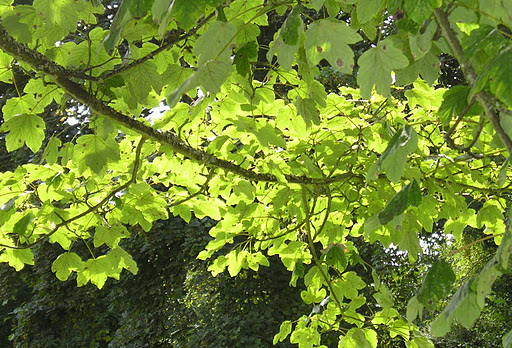
Field Maple is a classic old hedgerow plant. Left to grow untouched it makes a medium sized tree of, to my mind, simple but great beauty. However, it is usually trimmed to make a reasonably dense, twiggy barrier. Like all maples the flowers and leaves emerge together but I had never noticed before the rich mahogany colour of the leaf buds. Acer campestre.

Ground Ivy
A plant so common and so small as to be overlooked, Ground Ivy (not related to ivy but to mint)has to be viewed on hands and knees to see its quiet beauty: tiny, mauve, hooded trumpets darkening at the throat. According to my old herbals it was used for all sorts of ailments from the uterus to inflamed eyes and everything in between. Glechoma hederacea, in a greyish variegated form is often used in hanging baskets where it is seen trailing in ugly, thick ribbons. Leave it where it belongs – trailing over the ground at the foot of a hedgerow. Perhaps it should be used in the garden in this way?

Jack-by-the-Hedge
Jack-by-the-Hedge or Garlic Mustard is a common plant and quite a useful addition to early spring salads for its shredded leaves have a mild garlic taste. In the photo above it grows along with stinging nettles and the fine leaves of Cleavers or Goose-grass. It is the food plant of the Orange Tip Butterfly which is quite regularly seen throughout the secret valley, although scarce so far this spring due to weather conditions. Occasionally they fly into the house and require rescuing – not always as easy as in this photo!

Orange Tip Butterfly – only the male is coloured orange

Bluebells with White Dead-Nettle
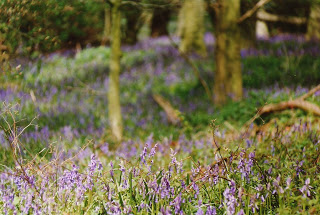
Bluebells, Hyacinthoides non-scriptus, are another of the ancient woodland indicators (click here for more details of this term) and they flower the whole length of the hedgerow. In the Chiltern Hills, the area where I spent most of my life, the beechwoods are renowned for their Bluebell carpets (photo below). Here, they grow more sparsely, with the occasional white flowered sport growing amongst them. In the photo above, it is the white flowered dead-nettle they mingle with. The dead-nettle, Lamium album, is not related to the true nettle and has no sting, just an unpleasant smell when the leaves are crushed. In the garden it is a nuisance with a white, running root, quite thick and brittle unlike the stinging nettle’s yellow, fibrous root system – a useful way to tell them apart if uncertain, apart from the sting, of course.

A bluebell wood in the Chiltern Hills in Spring

Burdock leaves
The large leaves of Burdock, Arctium minus, are already forming rosettes. It will be a while before they send up their spikes of lilac flowers, reminiscent of those of the thistle and even longer before the troublesome round seedheads, the burs, stick to clothing and She-dog.




 .
. .
. .
. .
. .
. .
.
 .
.
 Turville, is a tiny village, hidden deep in a valley in the Chiltern Hills and is close to where I was born and spent the greatest part of my life (I only came to the secret valley nine years ago). The Chilterns is a place of steep hills, thick with beechwoods that seem to hang onto their very sides – many use the word in their names: Old Hanging Wood near Hughenden, for example. The villages, as a consequence, seem tucked away and forgotten, yet they lie only some 30 miles west of London.
 Chalk and flint are the geological features that make the Chiltern Hills what they are and you are never far from them for the topsoil is thin, as all Chiltern children soon learn. Childhood games need chalk for drawing hopscotch and the flint cuts deep into knees when falling over. Flint also is, or was, the favoured building material for houses and Turville has plenty of fine examples, even the church is made from it.
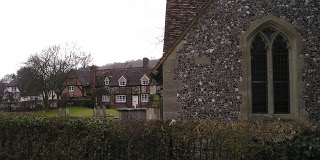
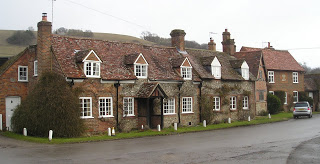 No English village is complete without its pub and Turville is no exception. The Bull and Butcher stands almost in the road. Less common are windmills and Turville lays claim to Cobstone Mill (which really ‘belongs’ to the neighbouring village of Ibstone), standing high above on a steep hilltop. The windmill, like the village has been used in many films such as Chitty, Chitty, Bang Bang and the 101 Dalmatians. In the latter, when the road outside became covered in machine made ‘snow’ I drove past confused – for there were still traces of the snow and it was midsummer. We also had no water for several hours as the filming had used up the village supply in the making of it.
 Turville is popular both with the film crews and visitors because it is so ancient and unspoilt. To get photos like these you have to visit on a grey, winter’s weekday as weekends, especially fine, summer ones, find the narrow lanes choked with cars. The village is so unchanged that even the warning roadsigns, like this old schoolchildren one are decades out-of-date!

 I think the reason we may behave like this is because English weather is nearly always gentle. The landscape that makes up England is beautiful and can be dramatic but not in the way of so many other countries. Take the USA, for example. Where’s our Grand Canyon, our towering redwoods, our Rocky Mountains, our Great Plains and our Niagara Falls? We have them in miniature and, perhaps, that is just as well as we are such a small country. And likewise, our weather: we have heatwaves, we have floods, we have blizzards. But they are rarely anything truly spectacular (except to those poor people affected by them, of course). And so when we were told by the weather men in 1987 that reports of a hurricane were completely exaggerated, we believed them totally. And despite the fact that much of the country was hit hard by it when it arrived, my part of the Chiltern Hills where I lived at the time was not much affected, even though it is one of the most wooded parts of the country.
 The night in January 1990 was different. This time we had winds, whilst not as severe as three years earlier, which created total havoc with the already weakened root systems of the trees. Great swathes of the magnificent beech woods that are the very heart and soul of the Chilterns were flattened in a couple of hours. (I am reminded by my partner, that as the rest of the world cowered in their beds as the trees came crashing down all around, I woke up to say “a bit windy out there” before falling asleep again). As dawn broke the true damage could be seen.
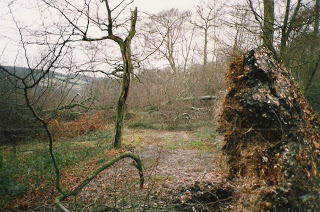 Fast forward twenty years to 2010 and the woodands are transformed. Those of us that remember the 200 year old beech know that the majority are gone and, in their place, are new trees of mixed species. It will be many years before the magnificence of the woods return but they are healing. This photo below is taken from the same spot as the one above. Some of the biggest old stumps have been left, too difficult to move – time has hardly changed their appearance apart from their ‘roof’ of mosses.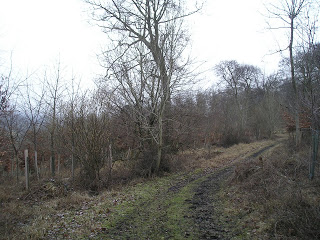
 One of the unforeseen benefits of the hurricane is the increased amount of light reaching the woodland floor, for beech trees cast a dense shade where little can grow, other than where the canopy is lightest. Apart from the view to the valley below, which was unseen before, many wild flowers are better now than ever. Roll on April when we can see the blue carpet of tens of thousands of bluebells disappearing into the distance.
 Oh! And I nearly forgot to say, the weather today is a mix of sunshine, cold winds, rain and sleet. Don’t forget to tell the next person you meet!
 winter sunshine on silver birch
 Fallow Deer – one of the larger species of deer to be found in England and quite common throughout the country. But like all deer, despite their size, they are remarkably difficult to see and watch. When I lived in the Chiltern Hills, 50 miles to the east of the secret valley, they grazed the field close to my windows, making watching easy. Here, we see them occasionally from the cottage – yesterday was one of those days. In winter, their coats lose their lovely dappled spots and become quite dark – the two pictures below show this, the lower one being taken last summer.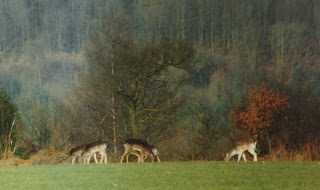
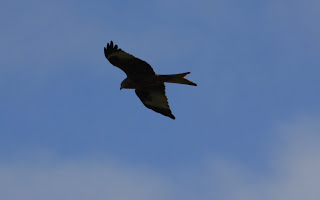
 The Red Kite is one of the great conservation success stories of recent times. Once so common they scavenged in the streets of London (and had a reputation for stealing hats off people’s heads to decorate their nests with. These days they often use plastic instead – the Kites, not the people, I mean, of course). By the 1970’s numbers were down to just a few pairs living in the remotest parts of Wales. A breeding and reintroduction programme started in the 1980’s centered on the village in the Chilterns where I lived. Soon they were a relatively common sight in that area but they have been slow to extend their range. Now we are seeing them much more frequently in the secret valley and they never fail to thrill. The full story of the Red Kite can be found on the Chilterns website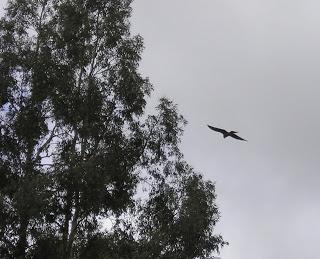
 This photo is most definitely poor quality – I only have a small ‘aim and fire’ camera and took this from an upstairs window. I am hoping to buy a more sophisticated camera with telephoto lenses very soon: another unexpected side effect of blogging has been a rekindled interest in photography. Who knows what will show up on this blog then?
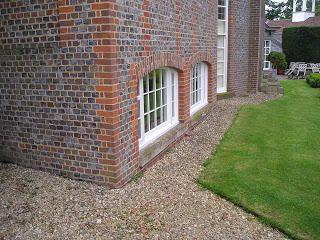

 The house won’t let go. Several weeks later I am asked to return on a regular basis as an adviser and I have been travelling there ever since – the last time to supervise the planting of lavender hedges and, when I return, I still get that warm, contented and happy feeling. Do I believe in reincarnation? I’m far too much a sceptic to say ‘yes’ but there are too many coincidences to give an emphatic ‘no’…..
 All the rain we have had this July – the wettest since the late 1800’s – has held up the start of the harvest and the machines have sat idle while the farmers have watched their golden corn, (in England we call wheat ‘corn’), turn black with moulds and the price fall, along with the quality. With modern drying techniques and machinery the crop can be salvaged but how terrifying it must have been, just a few centuries ago, knowing that hunger and possibly starvation was the only certain outcome.
 Now the rape is safe in the barns, the wheat is on its way and the barley, still to cut, hopefully before it is lost completely to the weather.

 The practice of stubble burning is also lost but this is due its being made illegal, except under special circumstances. Used mostly to get rid of pests and diseases and excess straw, it was an exciting if somewhat frightening sight. Occasionally these fires would get out of control but our changeable climate meant that there was no risk of the ‘wild’ fires of elsewhere in the world, with the
  Fingers crossed for a few more dry days and the harvest safely in – then we can all celebrate with the Harvest Home.
 Life in the English Cotswolds